Traffic Ecosystem

Activities and Technology Development to Adapt to an Ever-Changing Traffic Environment
The traffic ecosystem is a dynamic concept where people and mobility interact to create a seamless flow of traffic. Traffic conditions are ever-changing due to various factors such as weather, congestion, and traffic jams. Honda believes that preventing collisions in these conditions requires smooth interactions, considering the movements and circumstances of each road user. These efforts not only safeguard everyone sharing the road but also enhance the overall quality of society. Honda envisions a society where everyone can enjoy freedom of mobility, driven by both safety and a sense of warmth and humanity that inspires movement. To create such a society, rather than relying on technology without human interaction, Honda aims to foster safety driven by people’s own will. By enhancing the inherent mutual respect among everyone sharing the road and encouraging their cooperation through technology, Honda aspires to create a safer society.
The traffic ecosystem Honda envisions includes all traffic participants—motorcycles, automobiles, bicycles, urban mobility, and people of all ages—working together to make traffic smoother and safer.
History
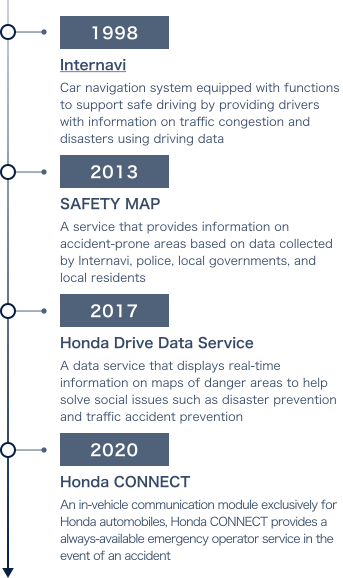
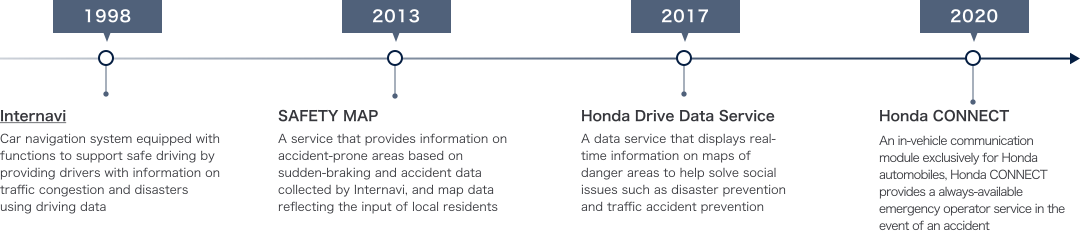
In 1998, Honda began offering Internavi, a car navigation system equipped with a communication function that supported safe driving by utilizing driving data collected from vehicles. Later, Honda analyzed the emergency braking data collected from the Internavi system and published the SAFETY MAP service on the Honda website to provide information on areas of high accident frequency in advance. Furthermore, developed the Honda Drive Data Service, which displayed danger areas on a map in real time helping to solve social issues such as disaster prevention and traffic accident prevention. In 2020, Honda began applying Honda CONNECT, an exclusive in-vehicle communication module, to its new cars, providing services that made the driving experience more secure and comfortable. These efforts are also being deployed outside of Japan in accordance with regional circumstances.

Main Technologies and Activities
In the future, ensuring the safety of everyone sharing the road, including vulnerable road users, will become increasingly important. For this reason, Honda is strengthening its collaboration with international organizations such as the United Nations toward the year 2030. Honda will support safety policies such as institutional reform, awareness activities, and infrastructure development by providing the knowledge and know-how accumulated through Honda’s longstanding safety activities to countries around the world, with a focus on emerging countries, through such organizations.
In addition, transportation infrastructure will continue to advance as smartphones and other communication terminals, IoT-enabled equipment, and mobility become more widespread and evolve. As this infrastructure advances, Honda will continue to pursue technology development and activities optimized for traffic safety.
Honda CONNECT - New Generation Connected Technology

Honda analyzes a variety of data received by Honda from around the world and utilizes it to evolve services for customers and improve product quality, thereby providing high value to customers in terms of both software and hardware.
We are also developing "Honda CONNECT Insurance," which uses points of constant communication with vehicles to improve safety awareness through driving scores and advice.
Honda Drive Data Service - Making Automobile Data More Useful for Everyone

Honda Drive Data Service utilizes big data to understand the movement of vehicles. As of February 2020, the number of service members in Japan has reached 4.4 million vehicles, with daily data collection exceeding 50 million km, covering the whole of Japan. Data acquired from vehicles equipped with Internavi helps reduce the risk of accidents by identifying danger areas that could lead to accidents.
Honda Partners with United Nations Road Safety Fund (UNRSF) to Work Toward Reduction of Fatalities from Traffic Collisions

In November 2024, Honda became the first automobile manufacturer to partner with the United Nations Road Safety Fund (UNRSF) to contribute to global initiatives to reduce fatalities from traffic collisions.
By combining the knowledge and know-how Honda has amassed through its long history of developing safety technologies and promoting safe driving/riding with the global network of the UNRSF, Honda and UNRSF will support traffic collision analysis and the road safety policies of various countries.
Honda and UNRSF have made emerging nations, particularly in Asia, as a focus area.
Toward the Future
Safe and Secure Network
Toward 2050, Honda will further enhance its connected technologies developed over the years and focus on Safe and Sound Network Technology. This technology aggregates data collected from roadside equipment, in-vehicle cameras, smartphones, and other sources in the cloud to recreate the traffic environment in a virtual space. Based on the conditions and characteristics of road users, it predicts dangerous behavior and derives optimal information to help prevent collisions. This information is conveyed through interfaces such as voice-based conversational AI, and by prompting drivers and pedestrians to take evasive action before an accident occurs, it helps prevent collisions before they happen.
Safe and Sound Network Technology (conceptual image)

<three core elements>The Safe and Sound Network Technology consists of three core elements: “Understanding Human Characteristics,” “Prediction and Anticipation,” and “Synlogue-based Communication.” Currently, research and development are progressing in each of these areas.
Understanding Human Characteristics
By using technologies such as vital sensing to monitor the driver’s condition in real-time, the impact on driving behavior is statistically analyzed, and specific risk factors are systematically identified.
Prediction and Anticipation
Utilizing Digital Twin technology and comprehensive risk assessment algorithms, predictions and forecasts of traffic accidents are made.
Synlogue-based Communication
This technology promotes the understanding of latent risks so that everyone sharing the road can prepare before collisions occur.
<Demonstration experiment>Participation in Demonstration Experiments through Industry-GovernmentAcademia Collaboration for Smooth Social Implementation Various verifications are being conducted to ensure the smooth implementation of the Safe and Secure Network Technology into our society.
<Project with Cabinet Office>In 2025, Honda participated in the Cabinet Office’s Cross-ministerial Strategic Innovation Promotion Program (SIP) Phase 3 and conducted demonstration tests in Tsukuba City, Ibaraki Prefecture, to prevent traffic collisions. As part of efforts toward the real-world deployment of Safe and Sound Network Technology, which enables road users to share risk information with one another, these tests verified a system in which road users, including not only drivers and riders but also pedestrians and bicyclists, use smartphones to share information that helps prevent collisions.
The results showed that advance alerts function effectively even on public roads in situations that are likely to lead to collisions, such as pedestrians suddenly entering intersections with poor visibility and overlooking motorcycles during right turns.
In SIP Phase 3, discussions have also begun on the organizations responsible for developing and operating platforms that will be essential for promoting the real-world deployment of various technologies, including Safe and Sound Network Technology.
Honda is promoting industry- and public-private sector-led efforts in collaboration with various stakeholders, including measures that address these issues and other initiatives that take institutional design and standardization into account.


