Climate Change-related Disclosures
(Response to the TCFD Recommendations)
Honda has declared its support to the Task Force on Climate related Financial Disclosures (TCFD), established by the Financial Stability Board (FSB), and discloses information in line with the TCFD-recommended disclosure framework.
Risk Management
Honda has established the Risk Management Committee to identify, check and discuss the status of company-wide priority risks which are deemed important for the entire corporate entity. Climate-related risks such as risks related to environmental regulations and natural disasters caused by climate change are also managed and monitored by the Committee, which leads to promoting more effective risk management activities while considering the characteristics of respective Operations. The Corporate Strategy Operations evaluates and identifies climate-related risks by conducting scenario analysis in line with TCFD recommendations, reflecting external and internal risk information which includes companywide priority risks. The results of the scenario analysis of climate change-related risks are shared with the Risk Management Committee. Climate-related risks are mainly addressed by the Corporate Strategy Operations, Business Operations and Regional Operations as well as by each respective Operation, Unit, subsidiary and cross-departmental task force. Important matters related to risk management including the responses to the climate change-related risks are discussed by the Committee, and details of their activities are reported to the Executive Council as appropriate. For more explanation of the risk assessment and management process, please refer to Risk Management.
Honda ESG Report 2026|P182 refer to Risk Managementt
Strategy
Identification of Climate-Related Risks and Opportunities
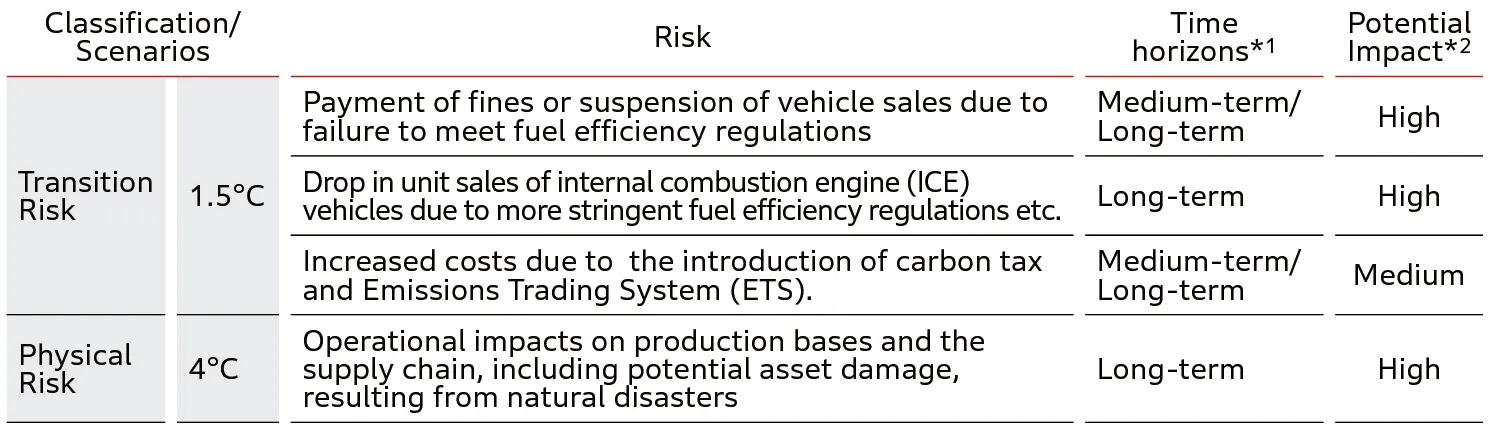
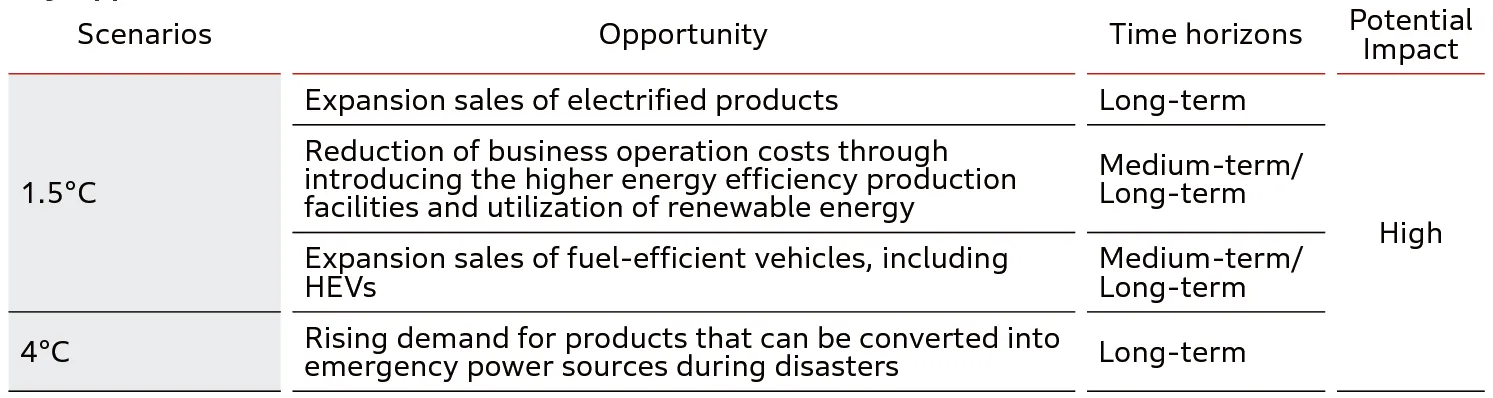
Honda has identified climate-related risks and opportunities that can reasonably be expected to affect our business activities and outlook by reference to a 1.5°C scenario, which assumes a rapid transition to a low-carbon society, and a 4°C scenario, which assumes insufficient progress in climate change mitigation measures, as set out below.
Key risks
Key Opportunities
-
The time horizons are defined in alignment with the planning periods used in Honda’s strategic decisionmaking processes. Honda defines the time horizons based on when the impacts of risks and opportunities are reasonably expected to occur, as follows:
Short-term: Within one year from the end of the reporting period (aligned with the annual action plan period)
Medium-term: The period after the end of short-term through the fiscal year ending March 31, 2031 (aligned with Honda’s medium-term management plan period)
Long-term: The period after the end of medium-term through 2050 (2050 being the benchmark year for Honda’s carbon neutrality goals). - In assessing the magnitude of impacts of risks and opportunities, Honda applies quantitative monetary thresholds where financial impacts can be quantified and qualitative thresholds in other cases. Based on these criteria, the impacts are classified as follows:
High: JPY 100 billion or more, or impacts at the company-wide level
Medium: JPY 10 billion or more but less than JPY 100 billion, or impacts spanning multiple regions
Low: JPY 2.5 billion or more but less than JPY 10 billion, or impacts limited to a specific region
Impacts on the Business Model and Value Chain
■Areas where climate‑related risks and opportunities are concentrated
The majority of our greenhouse gas emissions are attributable to CO₂ emissions generated during the use phase of our products. As a result, among climate-related transition risks, we recognize that, with respect to the risk of penalty payments or sales suspension due to failure to meet fuel economy regulations, climate-related risks and opportunities are concentrated in our automobile business, and that the risk of a decrease in new internal combustion engine (ICE) vehicle sales due to the tightening of fuel economy and other regulations is concentrated in both our motorcycle and automobile businesses. Accordingly, we consider that climate-related risks and related opportunities are concentrated in these businesses.
The remainder of our greenhouse gas emissions arise from direct emissions from our corporate activities, indirect emissions from energy use, as well as emissions related to activities such as resource extraction and waste disposal. These areas are where climate-related risks and opportunities are concentrated, particularly the risk of increased costs resulting from the introduction of carbon pricing mechanisms, such as carbon taxes and emissions trading schemes (ETS).
In addition, because our business model involves the use of water in our manufacturing processes, we recognize water-related risks associated with natural disasters as key climaterelated physical risks. Among the regions where our vehicle assembly plants are located, we recognize India, Thailand, Vietnam, and Mexico as regions where physical risks are concentrated, given their elevated exposure to flood risk.
■Current and future impacts of climate-related risks and opportunities
Honda is working toward achieving carbon neutrality by 2050 and has set up milestones to prioritize the reduction of CO₂ emissions from the use of sold products, which account for a significant portion of our total emissions, as well as the reduction of CO₂ emissions from our own corporate activities, which falls within our operational responsibility.
The operating environment surrounding the automotive industry is changing rapidly, and uncertainty in our business environment is increasing due to factors such as changes in environmental regulations and developments in trade policy. Over the medium to long-term, if fuel‑efficiency regulations or regulations promoting zero‑emission vehicles (ZEVs) are strengthened, there is a possibility that Honda could face risks such as a decline in sales volumes of new ICE vehicles and the payment of penalties or the suspension of sales if regulatory requirements are not met. While carefully assessing market conditions and demand trends in each region, Honda will accelerate a multifaceted approach to carbon neutrality by combining EVs, hybrid vehicles, carbon-neutral fuels, and carbon offset technologies.
With respect to CO₂ emissions arising from our own corporate activities, we recognize a risk of financial impacts—such as increased tax burdens—associated with the expected introduction or expansion of carbon taxes and ETS. We intend to reduce CO₂ emissions from corporate activities within our area of responsibility via three main categories of technologies, experience and expertise: 1) improving production efficiency and implementing energy-saving measures, 2) electrification of production equipment, and 3) utilization of renewable energy.
Beyond our own corporate activities, we are advancing CO₂ reduction initiatives across the entire product life cycle—from the procurement of materials and components through design, development, production, logistics, sales, use, and end-of-life processing—in collaboration with a broad range of global partners.
Impacts on Strategy and Decision-Making
■Addressing climate-related transition risks and opportunities
Honda positions electrification, including EVs, as a long-term climate-related opportunity in achieving carbon neutrality by 2050. At the same time, in light of current demand trends, we are reviewing our powertrain portfolio and have made decisions to reallocate development and production resources, with a near-term focus on hybrid vehicles, which are experiencing strong demand, in order to enhance environmental performance. In making these decisions, we have taken into account the trade-offs between accelerating CO₂ reductions through electrification and responding to the market environment.
Taking into account region-specific market environments and demand trends, we will accelerate a multi-faceted approach to achieving carbon neutrality by combining EVs, hybrid vehicles, carbon-neutral fuels, and carbon offset technologies. With respect to EVs, we plan to continue to introduce more competitive EV hardware platforms and advance research and development of next-generation batteries, including all-solid-state batteries in the long-term. In the short to medium-term, as we plan to continue sales of products equipped with internal combustion engines, we will also continue to improve the environmental performance of our motorcycle, automobile, and power products.
While electrification contributes to reducing CO₂ emissions during the use phase of our products, CO₂ emissions may still remain depending on the level of renewable energy adoption and application across countries and regions. In addition, we recognize the need to address the adoption and expansion of carbon-neutral fuels for ICE vehicles, including the vehicles owned.
Accordingly, Honda is committed not only to reducing CO₂ emissions during the product-use phase but also to promoting the broader decarbonization of energy, through both increased use of renewable energy in our own operations and engagement in external policy and stakeholder initiatives.
Furthermore, Honda will consider opportunities to contribute more directly to the supply of clean energy to customers. Through these efforts, we aim to support the expansion of clean energy across society as a whole.
Honda designates production sites that have effectively achieved zero CO₂ emissions from our corporate activities as “carbon‑neutral factories,” and we are promoting initiatives to reduce CO₂ emissions across our corporate activities. At the Saitama Factory Automobile Plant, one of our automobile production bases, in the fourth quarter of the fiscal year ending March 31, 2026, Honda achieved its first carbon‑neutral factory, which is currently in operation, through theapplication of three key elements: (1) improvements in production efficiency and the implementation of energy‑saving measures, (2) electrification of production equipment, and (3) utilization of renewable energy.
We will continue working toward realizing carbon‑neutral factories at all of our automobile production sites worldwide.
For the transition plan toward achieving carbon neutrality by 2050, please refer to Key Initiatives and Milestones for Achieving Materiality.
Initiatives and Milestones for Achieving Materiality.
■Key initiatives and progress by business segment
In the motorcycle business, Honda unveiled its first electric motorcycle, the Honda WN7, at EICMA (held at the Fiera di Milano) in November 2025 and began supplying it to the European market. In January 2026, the Honda UC3 equipped with a fixed battery was launched in Thailand and Vietnam. In both countries, Honda will expand charging infrastructure by installing CHAdeMO charging stations for fixed-battery electric motorcycles, while also advancing the deployment of battery-swapping stations.
In the automobile business, to achieve carbon neutrality by 2050, Honda is promoting the steady adoption of EVs and reliable CO₂ reduction through HEVs, while responding flexibly to changes in the market environment.
In the EV sector, we will steadily expand our lineup, beginning with the launch of the N-ONE e: in September 2025, followed by the rollout of the Super-ONE in Japan, the United Kingdom, and other Asian countries starting in 2026. Furthermore, the global strategic model Honda 0 α will be launched primarily in Japan and India, further strengthening the lineup in 2027. At the same time, to maximize environmental contributions during the transition to EVs, Honda is strengthening the use of highly efficient hybrid technologies. In addition to the PRELUDE launched in September 2025, the Company will apply next-generation hybrid system technologies developed in-house, expanding their use particularly in mid-size and large vehicle segments, where demand is high in the North American market.
■Physical Climate‑Related Risks and Adaptation Measures
We assess flood and other water-related operational risks by using external water‑risk assessment tools such as WRI’s “AQUEDUCT” and WWF’s “Water Risk Filter,” supplemented by adjustments based on inundation analyses (including CaMa‑Flood*3) and hazard maps. The assessment results are used to inform site‑specific countermeasures and improvement plans.
At production sites located in regions with high physical risk, we implement measures to reduce potential impacts on our business operations, including securing elevation during site construction, installing backflow‑prevention mechanisms for sewer lines during high‑water events, and enhancing drainage capacity to prevent inland flooding. In addition, for regions exposed to water‑scarcity or depletion risks, we implement water‑saving measures and introduce recycling systems in areas where water‑intake or discharge regulations are stringent. Through these initiatives, we work to reduce operation‑related risks at each site.
- CaMa-Flood: A global-scale flood analysis model used to estimate river discharge and flooding.
Climate Resilience
We conduct climate‑related scenario analysis annually as part of our climate‑related risk assessment process for the relevant reporting period. The disclosures presented in this report are based on the results of the analysis conducted during the latest reporting period.
■Scenario Analysis Overview
To assess and consider the potential impacts of climate change on our business, w e have selected the following climate‑related scenarios for our scenario analysis: (1) a 1.5°C scenario that reflects significant policy transitions aligned with the Paris Agreement goal of limiting global temperature rise to below 1.5°C; and (2) a 4°C scenario in which environmental regulations do not strengthen and physical risks become more pronounced.
Our scenario analysis covers our motorcycle, automobile, and power products operations, as well as the operational sites associated with these businesses. We assess climate‑related transition risks, physical risks, and opportunities, and we quantify—where reasonably possible—the potential medium‑ to long‑term financial impacts under each scenario. In quantifying the potential impacts, we apply a medium‑term and long-term time horizon for transition risks and a long‑term time horizon for physical risks.
The key assumptions under each scenario are as follows.
(1.5°C Scenario)
Under the 1.5°C scenario, Honda refers to the International Energy Agency’s “Net Zero Emissions by 2050 Scenario (NZE)” and the Intergovernmental Panel on Climate Change (IPCC) AR6 “SSP1‑1.9” pathway. This scenario assumes that, over the long-term, global measures toward achieving carbon neutrality by 2050 will advance, leading to the wider development and use of new technologies, broader adoption of carbon‑free products, and increased utilization of renewable energy.
Although uncertainty in the business environment is increasing due to factors such as changes in environmental regulations that affect the pace of EV market expansion across regions and developments in trade policy trends, this scenario assumes that, over the long-term, fuel‑efficiency regulations and zero‑emission vehicle regulations will be further strengthened. As a result, demand for EVs and fuel cell electric vehicles (FCEVs) is expected to increase, particularly in developed markets.
(4°C Scenario)
Under the 4°C scenario, we referred to the IPCC AR6 “SSP3‑7.0” pathway. In this scenario, continued high levels of greenhouse‑gas emissions lead to further temperature increases. As a result, the scenario assumes an increased frequency and severity of extreme weather events—such as typhoons and flooding—along with changes in rainfall patterns and rising sea levels, which collectively contribute to the heightened manifestation of physical climate‑related risks.
Metrics and Targets
For GHG emissions, which are used as key metrics, please refer to GHG emissions, and for climate-related targets and their performance, please refer to Reduction of CO₂ Emissions from Product Use and Reduction of CO₂ Emissions from Corporate Activities.
Honda’s Approach: Environmental Data/GHG emissions
Honda’s Approach: Environmental Data/Product Use
Honda’s Approach: Environmental Data/Corporate Activities
Target Setting, Review, and Monitoring Methods
Honda has identified ”Priority Issues” that it must focus on in order to achieve its ambitious goals for 2050 and realize its long‑term vision. Based on these priority issues, we establish goals that look ten years ahead and are updated every five years, while also setting annual goals and formulating, executing, and evaluating strategies each fiscal year as part of our management processes.To monitor progress toward these targets, we set management indicators, including KGIs overseen by the Board of Directors and KPIs for which the Executive Council holds execution responsibility. Both bodies regularly monitor progress, thereby strengthening our governance and oversight of target achievement. In addition, the Board of Directors and the Executive Council exercise their monitoring functions to assess, as necessary, whether adjustments to the targets are warranted in light of changes in the business environment.We have not obtained third‑party assurance for these targets or for the methodologies used to establish them.