Initiatives for Reduction of CO₂ Emissions in the Logistics Domain
Honda positions logistics within its supply chain as one of the core areas for CO₂ emissions reduction and is addressing this as a management priority in order to realize a carbon-neutral society.
Procurement logistics and product logistics for motorcycles, automobiles, and repair parts are areas where CO₂ emissions are significantly affected by transport distances, transport frequency, and the choice of transport modes. Recognizing that fundamental reductions are difficult to achieve through incremental, locally optimized measures alone, Honda is advancing company-wide, cross-departmental initiatives to address this challenge.
Specifically, Honda is advancing decarbonization in the logistics domain through two key pillars: logistics efficiency improvements and the carbon-free transition of logistics methods (vehicles and fuels), promoting these efforts strategically from both short-term and medium- to long-term perspectives.
In terms of logistics efficiency improvements, Honda is reducing inefficiencies across the entire logistics network by optimizing transportation routes and improving load factors, thereby curbing overall transport volumes and reducing energy consumption.
At the same time, recognizing that efficiency improvements alone have limits, Honda is also advancing the carbon-free transition of logistics methods. In addition to shifting to electric vehicles and rail transport, the Company is progressively introducing alternative fuels—such as hydrogen, ammonia, LNG, and ethanol—while taking into account regional characteristics and levels of technological maturity.
The following section introduces specific examples of initiatives based on this approach.
Case Study: Modal Shift in Procurement Logistics for Electric Components (IPU) (Japan)
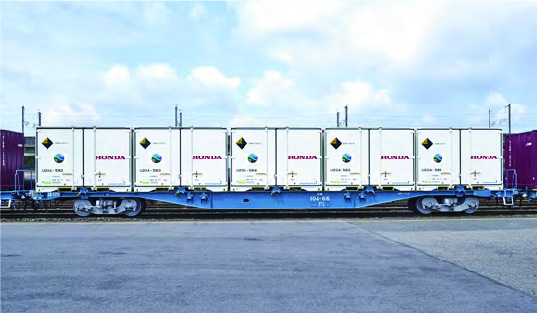
With the arrival of the full-scale EV era in mind, Honda is advancing initiatives in the logistics of EV-related components that balance decarbonization with business feasibility, while taking into account product characteristics and supply stability.
In particular, for components and products that require long-distance transportation, the choice of transport mode has a significant impact on CO₂ emissions. Recognizing this, Honda positions the shift to rail transport—which has a lower environmental impact—as one of the key options and is actively promoting modal shift initiatives.
For large and heavy electric components (IPU: intelligent Power Unit), which are core EV components whose domestic production began in 2024, Honda collaborated with logistics companies, railway operators, and component suppliers to shift the transportation method from conventional truck transport to rail transport, while addressing constraints such as ensuring stable supply and maintaining product quality.
Through this initiative, Honda achieved an annual reduction of approximately 700 tons of CO₂ emissions, equivalent to about 75%, while establishing an effective low-carbon logistics model for the early phase of EV production.
Case Study: Demonstration Tests of Fuel Cell Trucks and Technical Verification Toward Commercialization (Japan/China)
As part of its medium- to long-term efforts to transition logistics methods to carbon-free solutions, Honda recognizes that establishing next-generation logistics capable of supporting long-distance and heavy-load transportation is essential. Based on this understanding, the Company is advancing technological development and verification aimed at the practical application of fuel cell trucks.
Fuel-cell vehicles, which emit no CO₂ during operation, are considered a promising technology for future long-distance transportation due to their advantages in driving range and payload capacity. However, challenges such as infrastructure development and pricing remain significant, making verification in real-world logistics operations essential.
Taking these challenges into account, Honda is conducting driving demonstration tests under real-world logistics conditions in Japan through joint development with Isuzu Motors Limited.
In addition, in China, Honda is collaborating with Dongfeng Motor Group to conduct operational demonstration tests on actual logistics delivery routes.
Through these initiatives, Honda is verifying the technical effectiveness and practical feasibility of fuel cell trucks, expanding future options for reducing CO₂ emissions in the logistics domain, and accumulating knowledge to support the social implementation of next-generation logistics solutions.
-
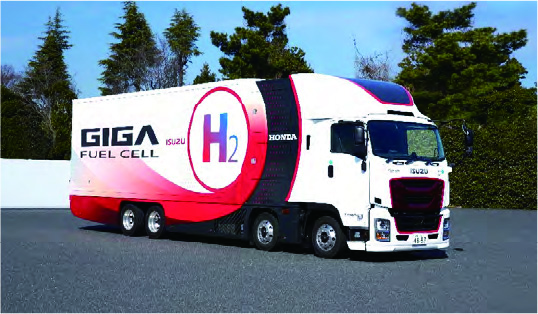
Fuel cell truck demonstration vehicle (Japan)
-
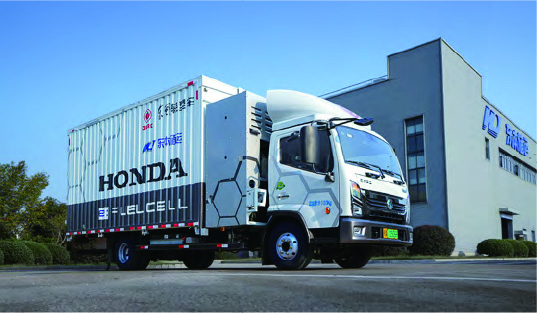
Fuel cell truck demonstration vehicle (China)