Strategy

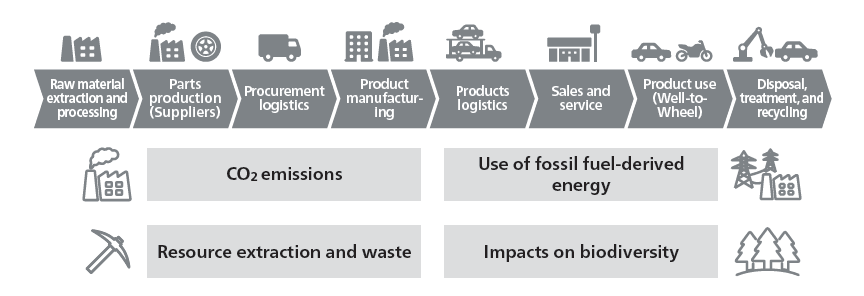
Environmental Impacts Recognized by Honda
Honda recognizes that all business activities have environmental impacts.
To address these challenges, it is important to consider the environmental impacts of each stage of the product lifecycle.
Honda identifies the main environmental impacts as: greenhouse gas (GHG) emissions, use of fossil fuel-derived energy,
extensive resource extraction and waste, and impacts on biodiversity.
Main Environmental Impacts in the Product Lifecycle
Honda, aiming for sustainable business practices, has set achieving a “Zero Environmental Impact Society”
as one of its company-wide priority issues. To comprehensively reduce interlinked environmental impacts,
Honda has established four materialities*1 to guide its efforts.
- We select “Priority Issues” by comprehensively analyzing social issues from the perspective of sustainability, aligning them with Honda’s strategic direction, and defining the particularly focused issues for each priority issue as “materialities”.
Priority issue
Achieving a Zero Environmental Impact Society
Materialities

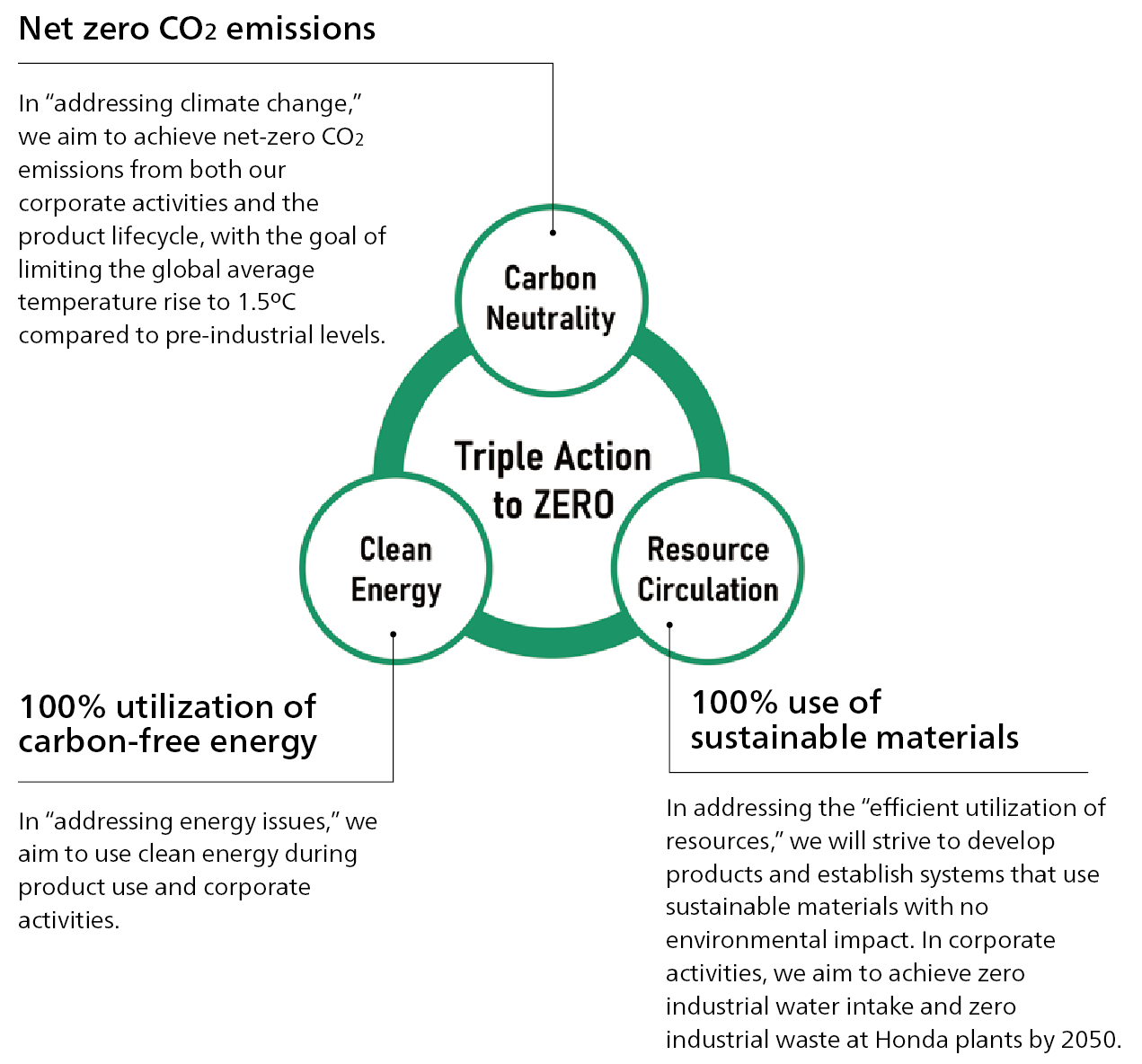
Triple Action to ZERO
In our efforts to achieve a Zero Environmental Impact Society, we are working towards
our vision of achieving CO₂ emissions neutrality, 100% utilization of carbon-free energy, and 100% use of sustainable materials in 2050. This vision is encapsulated in the concept of Triple Action to ZERO, a concept that consolidates three key initiatives: Carbon Neutrality, Clean Energy, and Resource Circulation. We position Triple Action to ZERO as the core concept guiding our efforts.
The three initiatives of Triple Action to ZERO are closely related
and we aim to maximize synergistic benefits by considering their linkages.
The Triple Action to ZERO initiatives are also linked to the international demand for preserving biodiversity
and fostering harmony with nature. In advancing these initiatives, we will consider Nature-based Solutions*2 as well.
- Nature-based Solutions (NbS) nvolve advancing societal challenges while conserving and restoring natural ecosystems.
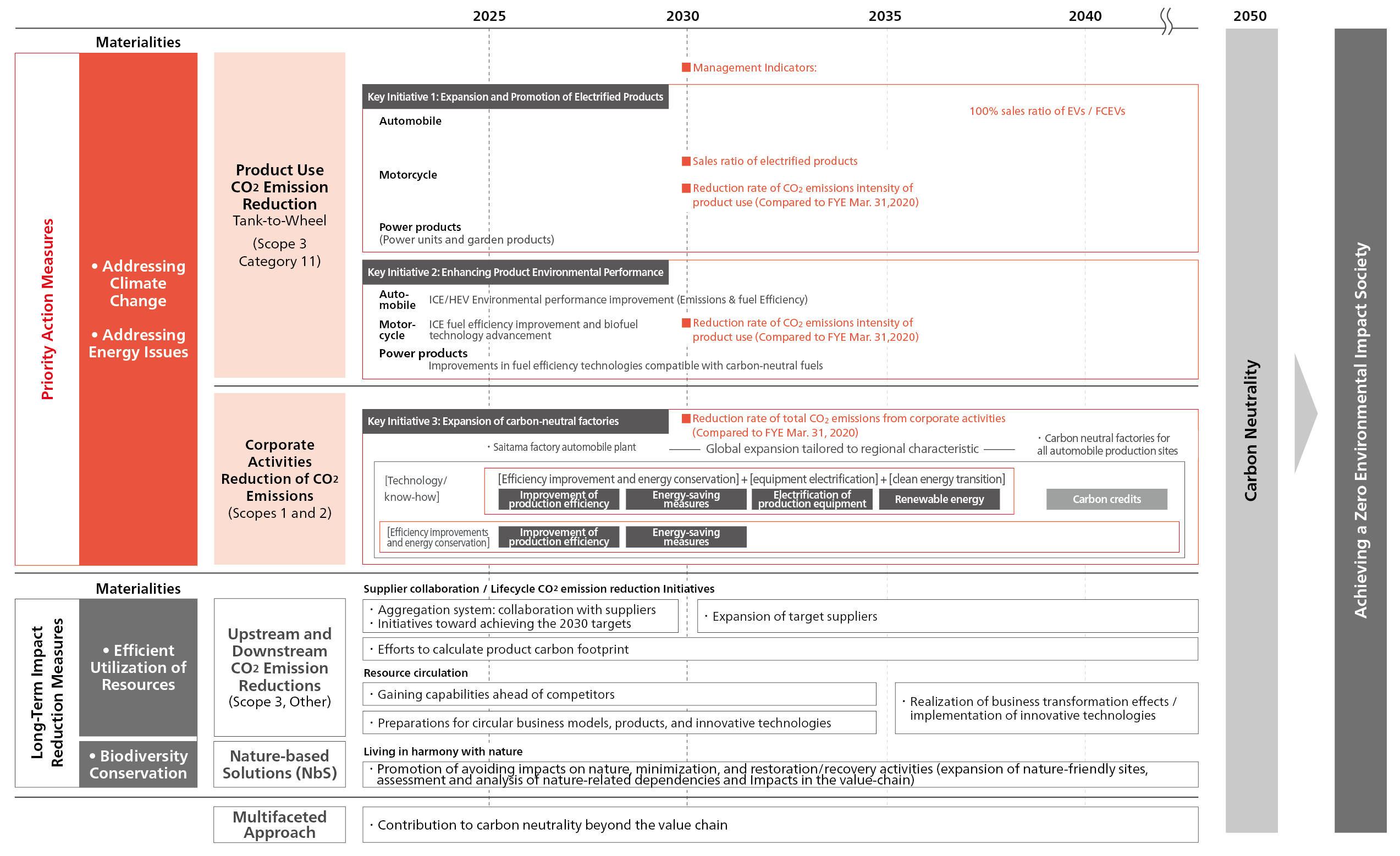
Key Initiatives and Milestones for Achieving Materiality
Honda supports the Paris Agreement*3 and, with the goal of realizing a Zero Environmental Impact Society,
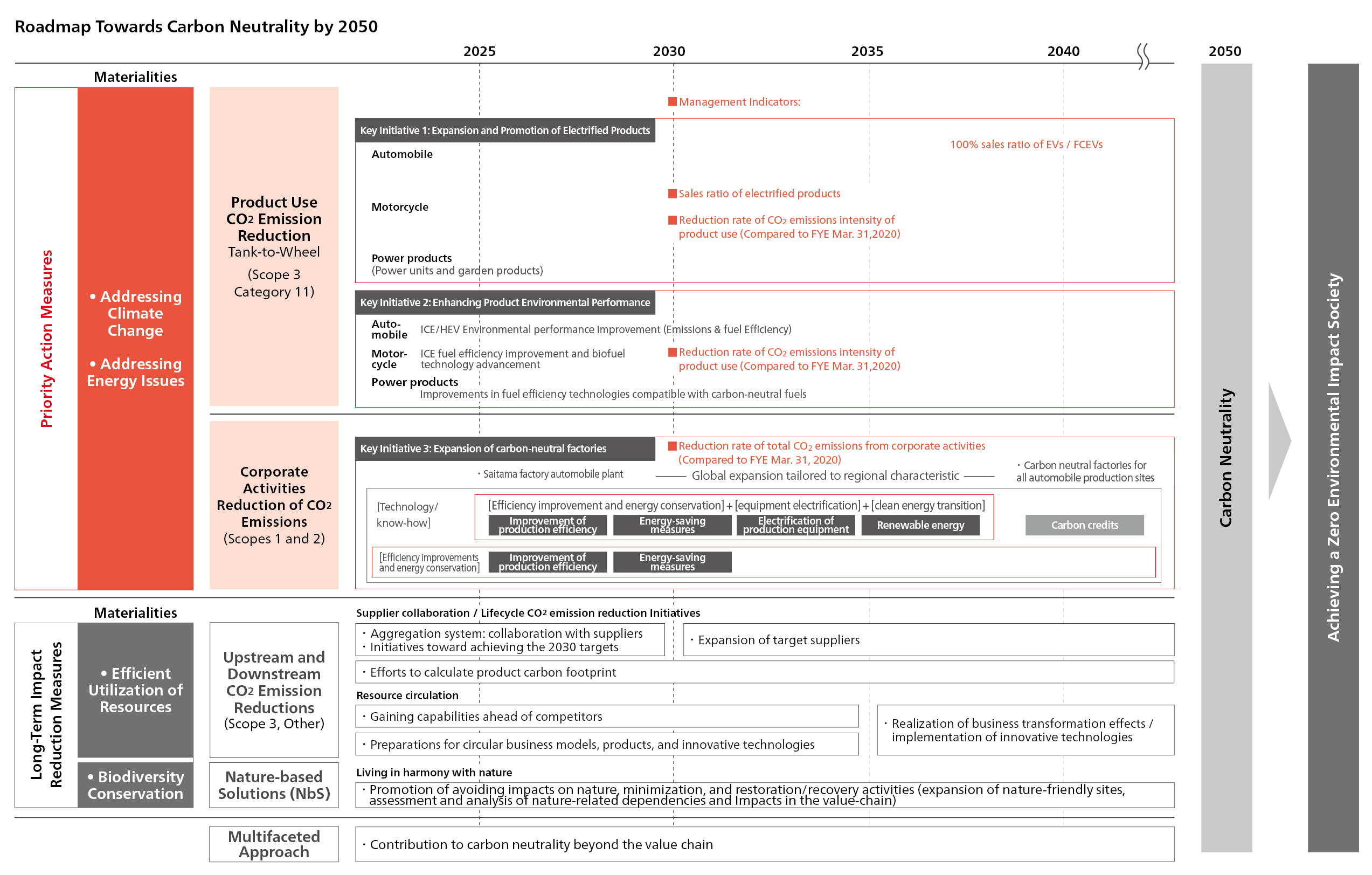
aims to achieve carbon neutrality across all products and corporate activities involving Honda by 2050.
Of the four materialities in the environmental domain, we are prioritizing efforts toward
“addressing climate change issues” and “addressing energy issues” for achieving carbon neutrality.
As priority actions, the Company is working on reducing CO₂ emissions from product use and corporate activities,
breaking these efforts down into more specific initiatives that the Company plans to implement as concrete actions.
Specifically, CO₂ emissions are tracked for various product groups within each business segment,
as well as for individual production plants and manufacturing equipment.
This approach helps in quantifying CO₂ reduction amounts for each product and factory.
Honda will accelerate a multifaceted approach that combines EVs, hybrid vehicles (HEVs),carbon-neutral fuels,
and carbon offset technologies, while carefully assessing market conditions and demand trends in each region.
For long-term impact reduction measures related to the materiality of “efficient utilization of resources,”
there are initiatives that may require business transformation beyond existing frameworks.
Honda is currently in the preparatory phase for reducing future CO₂ emissions across the entire product lifecycle
from resource extraction (upstream) to disposal (downstream).
We also recognize the importance of advancing these initiatives while considering our impact on nature,
such as the materiality of “biodiversity conservation.” Honda is aiming not only to achieve “carbon neutrality by 2050”
but also to pursue a long-term perspective toward realizing a “Zero Environmental Impact Society.”
- The Paris Agreement sets as a global long-term goal to keep the rise in average global temperatures well below 2°C above pre-industrial levels and to pursue efforts to limit the temperature increase to 1.5°C.
Roadmap Towards Carbon Neutrality by 2050
Approach to Just Transition
To realize a Zero Environmental Impact Society,
Honda aims to achieve carbon neutrality across all products and corporate activities involving Honda by 2050.
We recognize that this process affects a wide range of stakeholders, including our associates, suppliers, and local communities.
We will promote initiatives aimed at realizing a Zero Environmental Impact Society under the concept of a “just transition,” carefully balancing the implementation of measures that contribute to carbon neutrality—such as the electrification of products—with consideration for any potential negative impacts on stakeholders.
In addition, Honda has established a working group comprising related divisions,
including Human Resources, Procurement, Environment, and IR.
Through cross departmental collaboration, the Company will advance multifaceted discussions related to a “just transition.”