
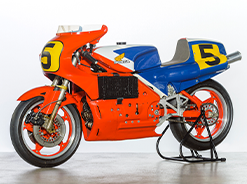
Monocoque Frame, Coaxial Pivot, Inverted Fork
The Challenges of the Cam Gear Train
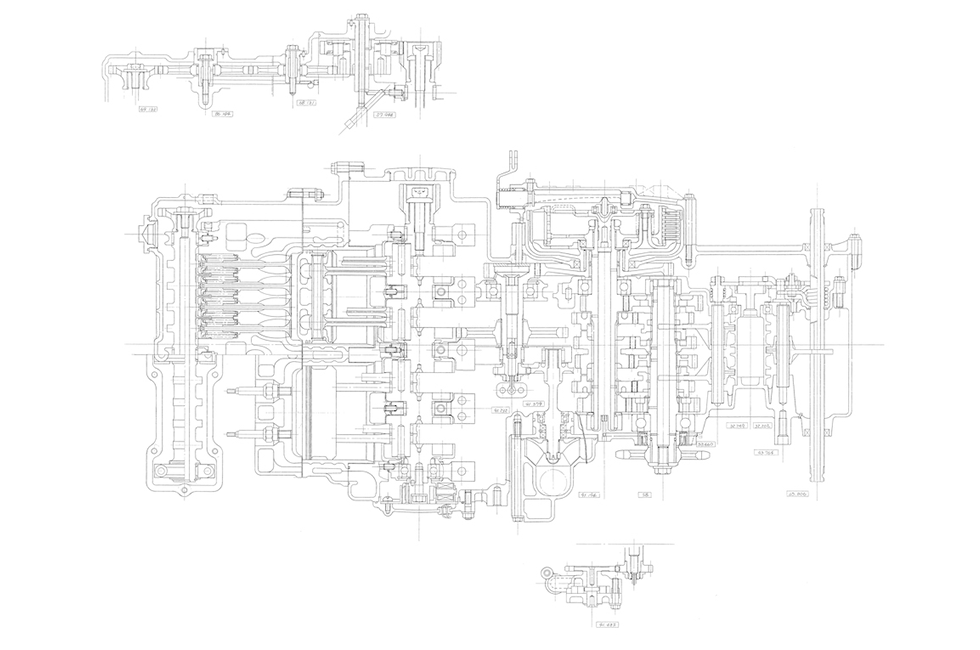
This is a longitudinal cross-section of the 0X engine installed in the 1979 NR500 (NR1) model. The crankshaft has 5 journals. In this orientation, the uppermost journal is also responsible for extracting the driving force for the cam gear train.
There was no other way to drive the camshaft to reliably open and close the intake and exhaust valves at 20,000 rpm than with a gear train. The 0X engine adopted a design that placed this gear train at the far right.
To support the elongated oval piston, two connecting rods were required for each cylinder. Therefore, four crankpins were needed to hold the connecting rods, and five or six crank journals were required on the engine body side to hold the crankshaft.
The fact that the number of crank journals was limited to five was a major reason why the cam gear train was placed at the far right of the 0X engine. If it were placed in the center, the driving force extraction gear for the gear train would have to be installed by dividing the journal located between the cylinders on the left and right sides of the engine's center. This would have resulted in six crank journals, increasing engine weight. This was avoided.
However, when bench testing of the 0X began, it became clear that its cam gear train had a major problem. As the engine speed increased, the cam gears would resonate and break.
Redesigning the gear train would have required a complete overhaul of the 0X, but the schedule did not allow this. The only solution was to install a damper, which absorbs vibration in the cam gear train, converting it to heat and preventing harmful oscillations and resonance. The damper could be fitted only in the second gear (reduction gear), which first engages the cam gear train's drive gear on the crankshaft. Since the gear dimensions could not be changed, a shear-type damper of several rubber blocks was used.
However, in reality, this shear-type cam damper was insufficient. The volume of rubber that could be incorporated was critically insufficient. In other words, this was a problem that could not be solved with the 0X design, and a design based on this reflection was implemented in the 1X, introduced in the following 1980 season.
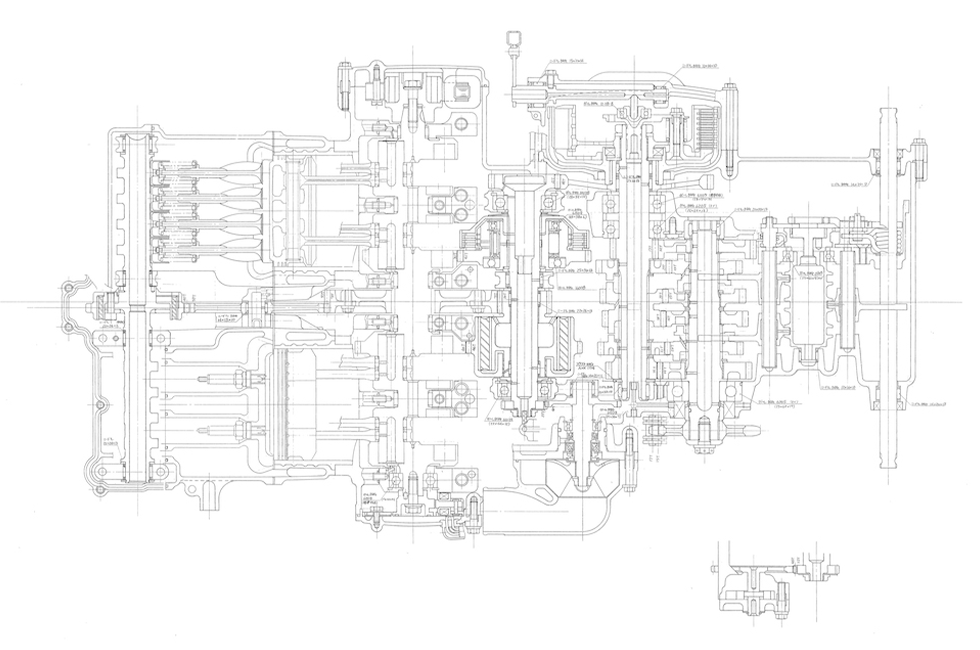
A longitudinal cross-section of the 1X engine installed in the 1980 NR500 (NR2) model. The biggest change from the previous 0X model is the gear train's position at the center of the engine. The crank journal, which was in the center, was split, resulting in a 6-journal crankshaft, which increased weight, but reliability was prioritized. Cam dampers were also installed on all camshafts, which are the source of vibration.


