
1979 NR500 Chassis Technology
text=KIYOKAZU IMAI translation:SHINTARO URASHIMA
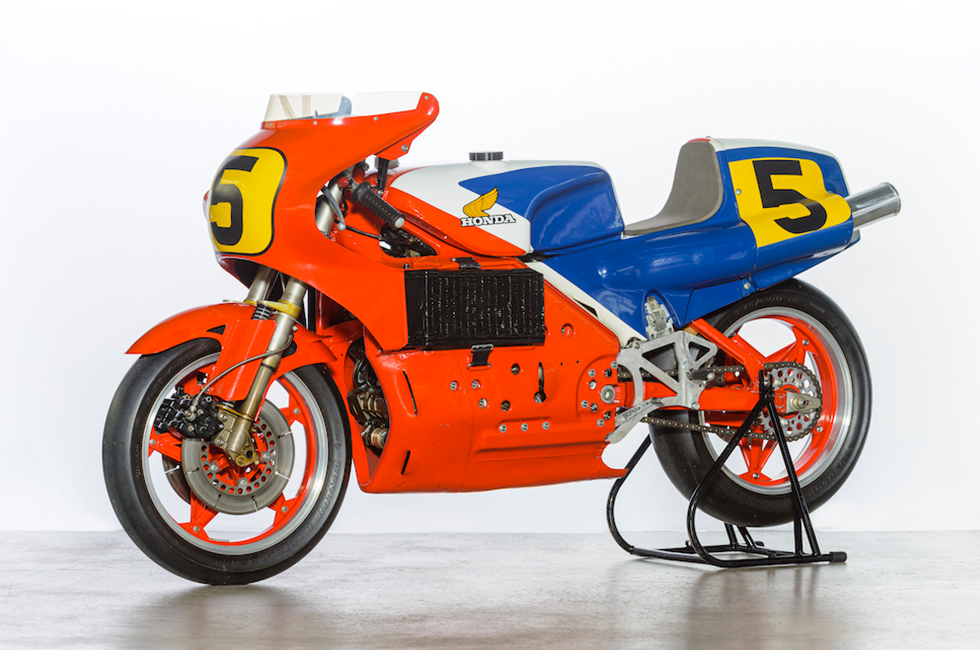
1979 Honda NR500 [NR1](Photo/Shinobu Matsukawa)
A Parade of New Features, Even More So Than the Engine
Monocoque Frame, Coaxial Pivot, Inverted Fork
A 4-stroke engine, with its many parts, is inevitably heavier than a 2-stroke engine. In other words, even if the same displacement and power can be produced, the chassis must be lighter than the rivals in order to achieve a power-to-weight ratio that is equal to or better than the competition. Furthermore, Honda hoped that the new GP500 racer they would create would offer a new concept for the next generation of motorcycles, even in its chassis.
Shoichiro Irimajiri, the head of the NR Project, was thinking about the chassis of the first-generation NR500 (NR1) with this in mind. However, his original specialty was engines. So he asked a researcher who was knowledgeable about chassis, "Do you have any interesting ideas?" That researcher was Tadashi Kamiya. While serving as a test rider for Honda, he explored various aspects of motorcycles and also founded Blue Helmet, Honda's in-house motorcycle racing team.
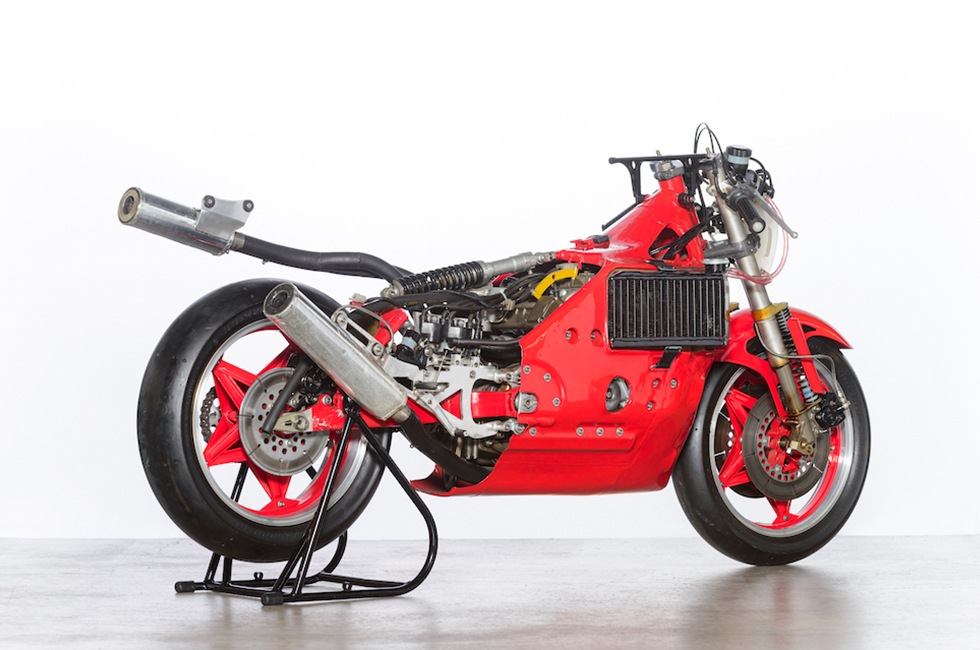
The fact that it still looks like it's wearing fairings even after the fairings have been removed is a unique feature of the first-generation NR500 (NR1), a monocoque frame vehicle. The wheelbase was 1380 mm, 25 mm shorter than the 1979 Suzuki RGB500 and the same as the Yamaha YZR500. (Photo/Shinobu Matsukawa)
Kamiya shared an idea he had been nurturing with Irimajiri: building the chassis as a monocoque. While common in four-wheeled vehicles, this technology had very few practical examples in two-wheeled vehicles.
Irimajiri found the idea interesting, but Kamiya replied, "I wouldn't want to do that in racing." Kamiya predicted that if the technology failed to deliver strong race results, it would soon be dismissed. Despite these reservations, Irimajiri believed that since the engine side was starting from scratch, the chassis side should also take bold steps. He decided the only option was a monocoque. Consequently, he brought Kamiya into the NR Project, appointed him as supervisor for the NR1 chassis, and tasked him with developing the monocoque frame.
Kamiya's monocoque frame idea was intended for street bikes. To incorporate that technology into the NR500, its shape, the engine position, the steering head pipe, the swingarm pivot and so on needed to be considered and developed from scratch. Incidentally, there were no alternative plans to use the NR1's chassis in any other form; the developers stuck to the monocoque design.
For the outer shell of the monocoque frame, thin aluminum sheets were chosen, initially 1.6 mm thick, and ultimately 1.2 mm thick. While the double-cradle and later twin-spar designs, prevalent in road-racer frames at the time, didn't directly bear the load on the frame, the monocoque design used the engine as a structural component. To ensure a rigid connection, 18 φ6 mm bolts were used to fasten the engine from both sides of the monocoque.
As a result, the NR1's frame rigidity in its completed state was significantly higher than that of the GP500 racers of the time, which typically used double-cradle frames made of chromium-molybdenum steel pipes. Despite this, the all-aluminum monocoque frame weighed only 5.5 kg, achieving the goal of "a lighter frame than its rivals."


