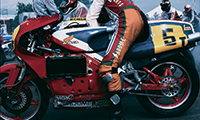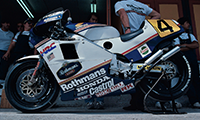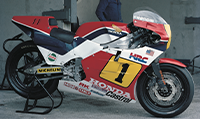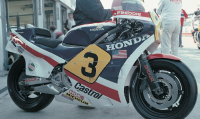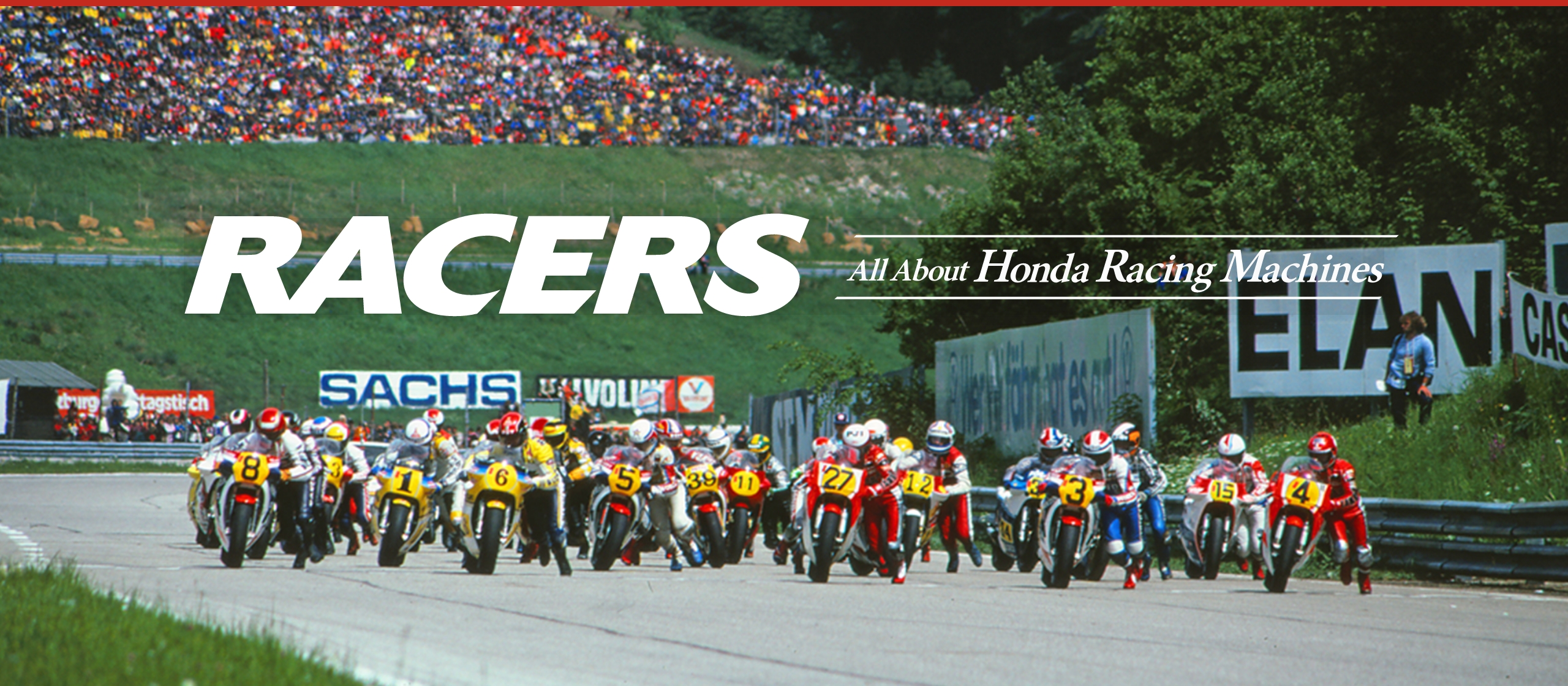
Since its establishment in 1982,
HRC has focused on motorcycle racing
right through to 2021.
During that time, the company (HRC)
has produced countless racing bikes.
Among them, we will focus on machines
that are remembered as epoch-making in particular,
and showcase the passion of Honda men who were
devoted to their development and racing activities.

vol04

1979 Honda NR500 [NR1]

GP500 Works Road Racer

Many are familiar with this machine, calling it a true Honda-esque challenge. Honda chose a four-stroke engine instead of the then-standard two-stroke for GP500 racing. To surpass the two-stroke's power at the same displacement, each cylinder had eight intake and exhaust valves, an oval-shaped combustion chamber, and a piston and cylinder. The chassis also introduced innovations, especially the monocoque frame. This was the 1979 NR500 (code "NR1"), the NR series' debut, known for its oval pistons.

text=KIYOKAZU IMAI 
translation:SHINTARO URASHIMA

"It's Not Interesting to Be the Same as Everyone Else"

The Background Behind the Planning of the First-Generation NR500:

"Creation of Innovative Technology and Human Resource Development"

1979 NR500 Engine Technology

World's First 8-Valve, Oval Piston Engine

To Beat a 2-Stroke Engine of the Same Displacement With a 4-Stroke Engine

1979 NR500 Chassis Technology

A Parade of New Features, Even More So Than the Engine

Monocoque Frame, Coaxial Pivot, Inverted Fork

1979 NR500 Race

Without the Right to Finish

The Two NR500 Retire in the Debut Race; Both Fail to Qualify in the Second Race

[ Back number ]

Past episodes can be viewed here.

vol03

Honda NSR500 [NV0B]

1985 GP500 Works Road Racer

The first-generation NSR500 [NV0A] was a unique racer featuring an upside-down body layout, such as a fuel tank under the engine. Although it was one of the fastest machines in the 1984 FIM Road Racing World Championship, it seemed immature in some areas. HRC then needed more capacity to improve the challenging upside-down layout. Therefore, they designed the second NSR500 [NV0B] model straightforwardly, giving Freddie Spencer the overwhelming strength to win the championship in 1985.

text=KIYOKAZU IMAI translation:SHINTARO URASHIMA

vol02

1984 Honda NSR500
[NV0A]

GP500 Works Road Racer

After winning the premier class riders' title of the FIM Road Racing World Championship for the first time in 1983, Honda remodeled their racers for the following year. It was a completely different machine with a newly developed 2-stroke V-type 4-cylinder engine. Moreover, the 1984 version featured a unique layout with a fuel tank below the engine. That was the birth of the first generation NSR500 development code [NV0A].

text=KIYOKAZU IMAI 
translation:SHINTARO URASHIMA

vol01

Honda NS500

1982-83 GP500 Works Road Racer Honda NS500

The NS500, equipped with a unique V3 engine, was developed in a short period of time by integrating the knowledge gained from the NR500, a 4-stroke racer with oval pistons which had suffered a series of setbacks, and the 2-stroke technology cultivated in motocross. The NS500 brought Honda the first Grand Prix road racing premier class riders’ championship.

text=KIYOKAZU IMAI 
translation:SHINTARO URASHIMA

About RACERS

Established in 2009, with the editorial policy of rediscovering old racing machines, “RACERS” focuses on the technology that went into them and the people who raced them. This content, “RACERS -All About Honda Motorcycle Racing Machines-” is a digest from past issues of RACERS, including revised content based on information gained from subsequent interviews during the years after the publication.