
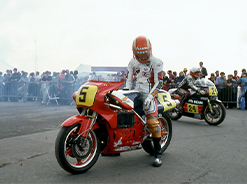
The Two NR500 Retire in the Debut Race; Both Fail to Qualify in the Second Race
Coaxial Swingarm Pivot and Upside-Down Front Fork
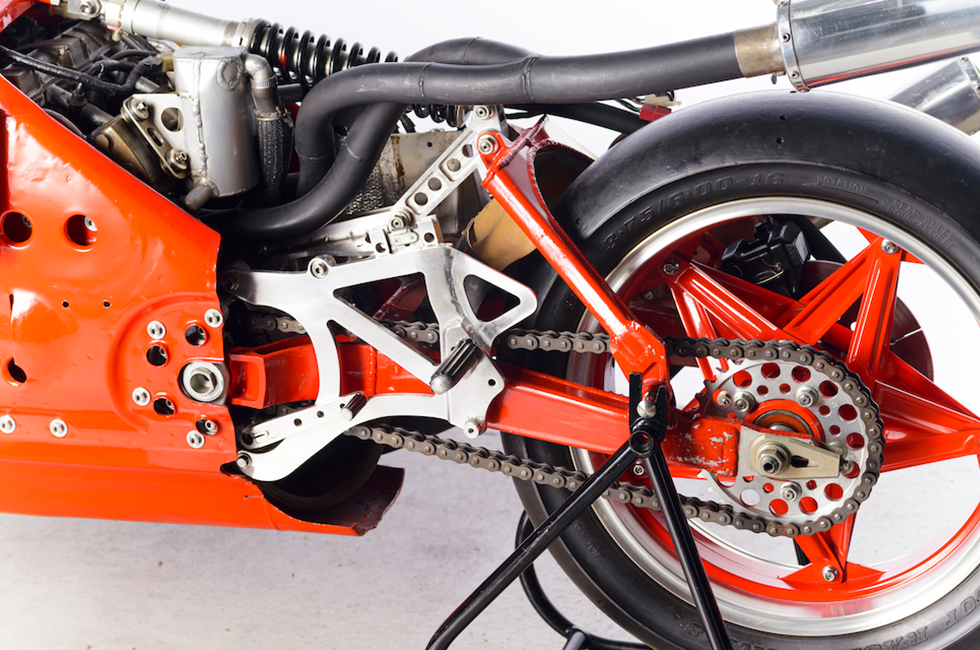
In the NR1, the swingarm pivot is mounted by sandwiching a rear-opening "pivot box", serving as the swingarm's base mounting point, between the rear of the engine's crankcase and the monocoque frame. The base of the swingarm inserts into this box. The rear suspension uses a link-type setup with a bell crank positioned between the top end of a gate-shaped arm (extending diagonally upward from near the swingarm's rear) and the damper unit's lower end. (Photo/Shinobu Matsukawa)
In chain-driven motorcycles, the countershaft (Honda's term for the shaft that takes engine power and to which the drive sprocket is attached) and the swingarm pivot are typically offset from each other. However, this offset causes changes in drive-chain tension due to the swingarm's vertical movement.
"This might be affecting the rear suspension's movement and negatively impacting handling....!?" This was the concern of Tadashi Kamiya, the inventor of the monocoque frame. Therefore, in the NR1, which he supervised, the chassis design adopted placed the countershaft and swingarm pivot coaxially. However, the effect of this was not confirmed.
Even during actual testing, the NR1 had numerous engine-related problems, and its structure made engine removal and installation extremely time-consuming, preventing sufficient analysis and chassis setup. Furthermore, the policy regarding the NR500 chassis changed significantly before the second season, 1980, and the monocoque frame plan was discontinued. The coaxial swingarm pivot was lost along with it.
Satoru Horiike, who was involved in the chassis design of the NR1 and later served as Vice President of HRC, commented as follows:
"The idea behind the coaxial pivot was that by adopting it, we would no longer need to worry about alignment changes due to skort (rear suspension compression), and we would be able to focus solely on the suspension settings. However, we were unable to fully refine it. I don't think we have found the answer regarding the coaxial pivot."
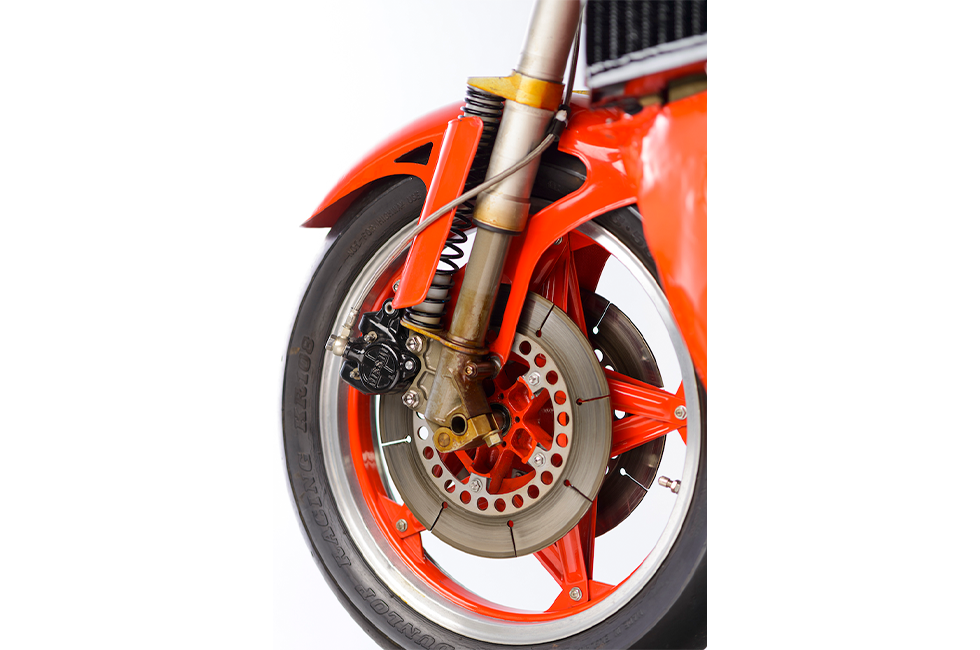
The NR1's front forks have unique appearance, being inverted and with the springs exposed and clearly visible. The trailing axle design, where the axle shaft is positioned behind the fork's centerline, is also interesting, but, again, its effectiveness was not confirmed. (Photo/Shinobu Matsukawa)
The NR1's front suspension was also unique. Mechanically, it was a telescopic front fork, but at a time when only upright forks with an outer tube at the bottom and an inner tube at the top were seen, it was equipped with an inverted fork with the top and bottom reversed.
Based on the idea that higher rigidity is better on the side held by the top bridge, the thicker outer tube was placed on top. To cancel the bending moment acting on the sliding part with the inner tube, the spring, which is usually housed inside the outer tube, was moved outside and positioned in front of the inner tube on the lower side.
The inner tube was machined from solid aluminum, with a hard anodized finish and polished surface. It was manufactured by Honda. The damping mechanism was handled by Showa Seisakusho (now Astemo). The inner tube diameter was φ35 mm, and the effective stroke length was 140 mm.
However, this inverted front fork was also caught up in the discontinuation of the monocoque frame line, and it ended up being an item whose performance could not be fully verified.


