
1979 NR500 Race
text=KIYOKAZU IMAI translation:SHINTARO URASHIMA
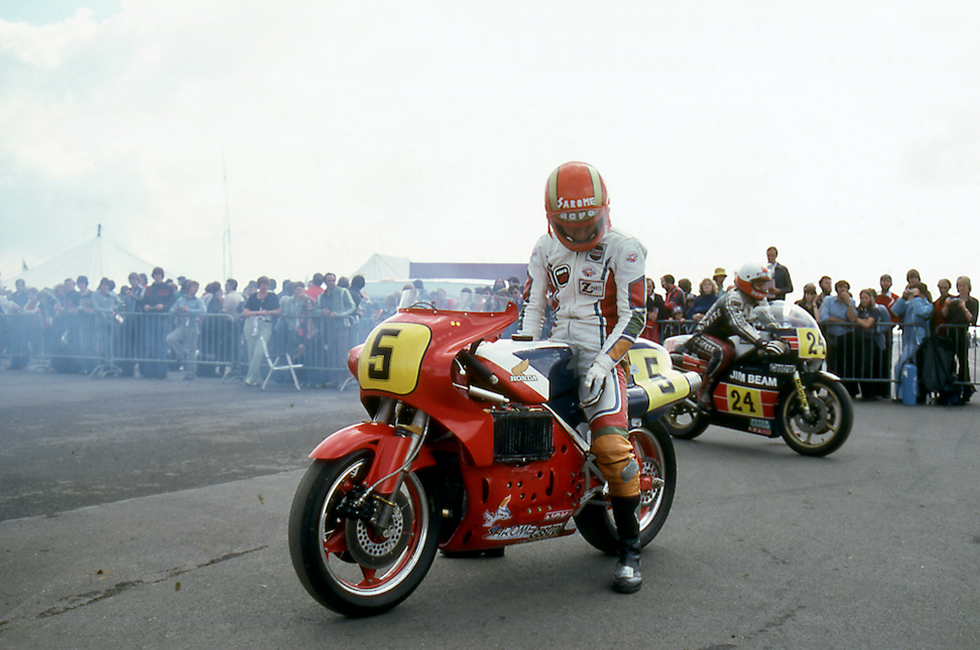
The NR500, on its debut race, and Takazumi Katayama, straddling it, were concentrating intently. A photo taken before practice at the 1979 British GP. (Photo/Honda)
Without the Right to Finish
The Two NR500 Retire in the Debut Race; Both Fail to Qualify in the Second Race
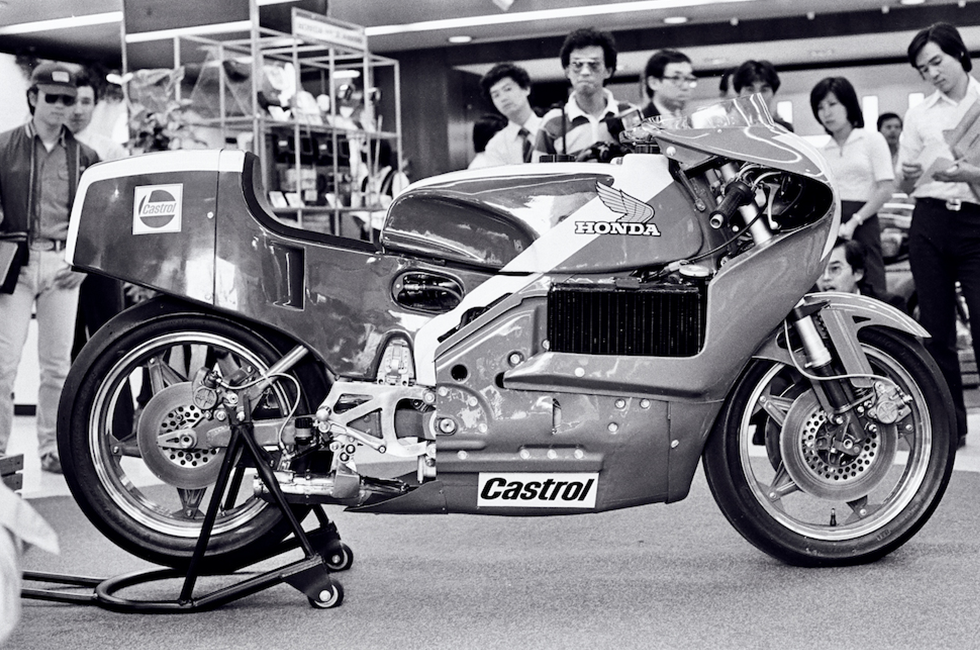
The first-generation NR500 (NR1) was displayed at a press conference held by Honda on June 7, 1979. At this stage, it had only run on test tracks, and it was fitted with a different cowl shape than the one brought to the British GP, its debut race on August 12. (Photo/Honda)
Honda planned return to the World Grand Prix in 1979, but when the season began in March, the first-generation NR500 (NR1) did not yet exist. Nevertheless, the NR Project team was relentlessly working on this difficult task. Once the four-cylinder "0X" engine took shape in April, they continued bench testing all day long for weeks, working in two shifts, day and night. Eventually, the monocoque frame was finished to match the engine's shape, and the inverted front forks and new 16-inch "Comstar" wheels, which had been under development, were assembled to complete the vehicle.
On April 27th, the first NR1 made its maiden run at the Japan Automobile Research Institute's test course. A month later, on May 28th, Takazumi Katayama, 1977 World Grand Prix 350cc champion and recent Honda signee, conducted the first ride at the new test track, Honda Tochigi Proving Ground. On June 7th, a press conference was held at Honda's temporary headquarters in Harajuku, Tokyo. The following week, on June 13th, testing continued at Suzuka Circuit with Katayama and Mick Grant, the other NR1 rider.
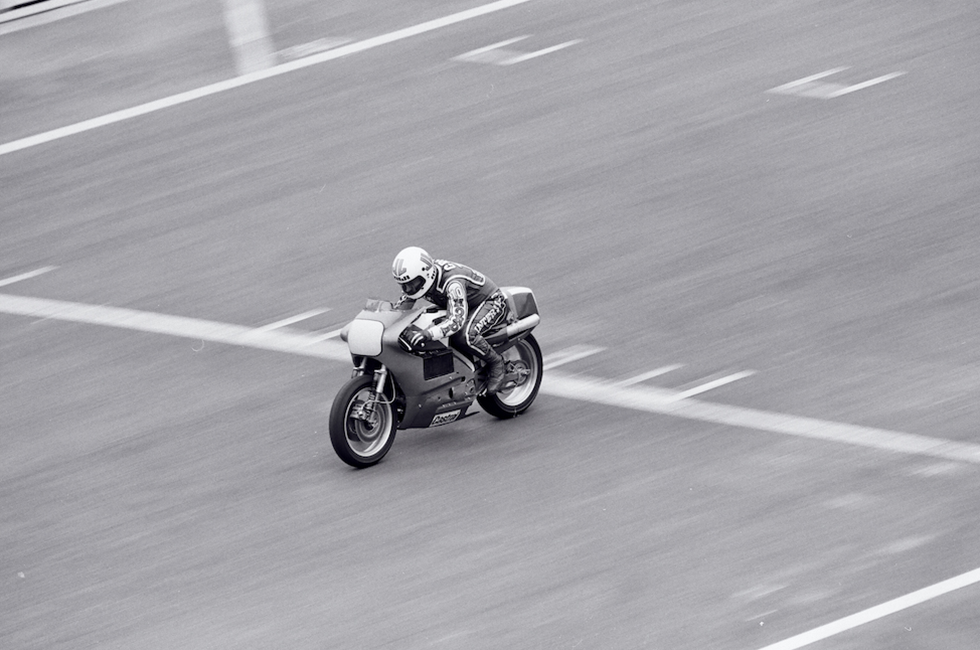
The NR1 ran during the Suzuka test, its sound evocative of a V8 racing engine in a four-wheeled vehicle. The rider pictured is Grant, celebrated for his British domestic race successes and, at the time, under contract to Honda Britain. Gerald Davison, manager of HIRCO, Honda's European Grand Prix base in the UK, led the team. Davison's recommendation secured Grant's debut on the NR500. (Photo/Honda)
"It runs about as well as the TZ350 (Yamaha's 350cc production racer) I used to ride," Katayama commented on May 28th, his first ride on the NR1. This was a reasonable assessment. At that point, the four-cylinder "0X" engine was producing far less than 100 PS.
The Suzuka test on June 13th was the NR1's first run on a racing circuit. Here, the strong engine braking became a problem. Many of the NR Project's engineers lacked racing experience and had assumed that the strong engine braking of a four-stroke was an advantage over a two-stroke, but they soon realized this wasn't the case.
The NR engine engineers couldn't immediately understand Katayama and Grant's complaint that "the engine speed isn't stable even at partial throttle." Their thinking at the time was that racing engines should be as responsive as possible, and the NR1's 0X engine had an extremely light flywheel.
As a result, even when the rider wanted to corner with a constant, partial throttle, the NR1 reacted sensitively to even subtle changes in throttle opening.
The insufficient cooling of the side radiators remained a serious problem. In the NR1, the engine served as a structural element of the chassis, but several mechanical issues appeared, including crankcase cracks that caused oil leaks. The most serious was the premature failure of the cam gear train. As detailed in Chapter 2, this could not be fundamentally solved with the 0X design, so they had to run it knowing its durability was insufficient to finish a Grand Prix race.
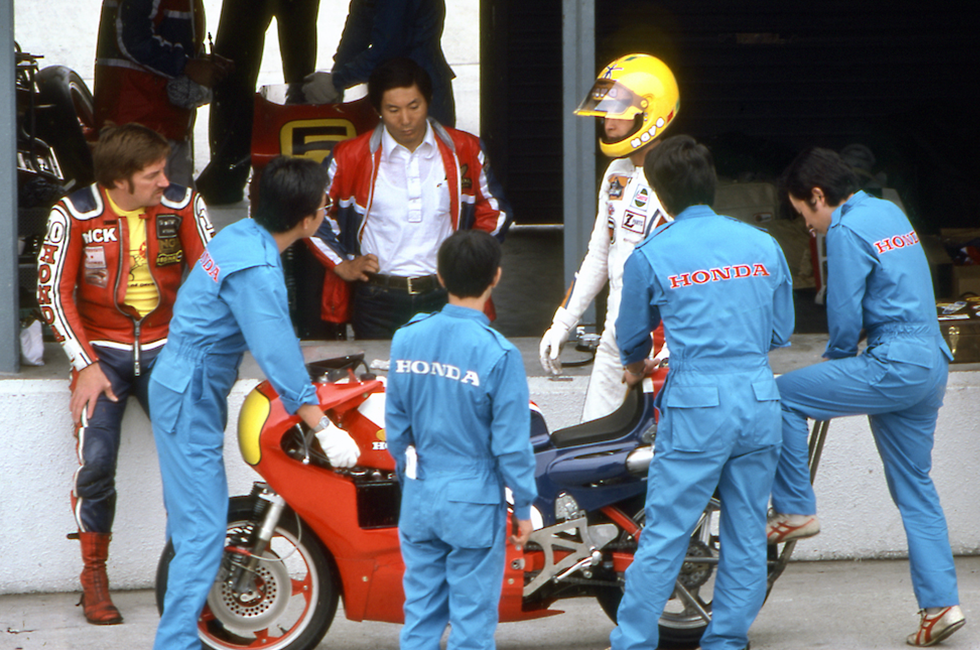
The photo shows everyone listening to Takazumi Katayama in the pit during the Suzuka test. The person in the center of the photo with his hands on his hips is Shoichiro Irimajiri. He was the supreme commander of the NR Project and also the head of Honda's motorcycle development at the time, as they were heading towards "the HY War". (Photo/Honda)
At the end of April, Honda announced that the Dutch TT (Dutch Grand Prix), scheduled for June 23rd, would be their return to the World Grand Prix. However, due to insufficient preparation time, the participation to the Dutch race was canceled, and the NR500's debut race was rescheduled to the British Grand Prix on August 12th.
Even so, there wasn't enough time; the World Grand Prix Road Race season at that time was short, and if they skipped the British Grand Prix, the only option left was the final race, the French Grand Prix, on September 2nd. Therefore, although it was clear that the NR1 was not yet fully developed, they had no choice but to go for it.


