
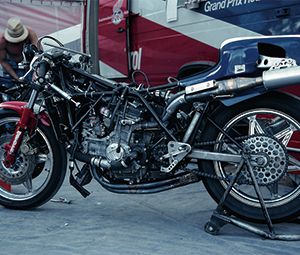

Honda pursued an extraordinary goal with the NR500: to create a four-stroke machine capable of defeating two-stroke rivals of the same displacement. Four distinct versions of the bike competed actively. While their engines consistently employed the signature oval-shaped combustion chambers, pistons, and cylinders, the chassis's technical specifications evolved rapidly. Consequently, the machine's appearance varied significantly depending on the model. Vol. 05 examines the details of the second-generation NR500 (development code "NR2"); the "NR3," which secured a victory in the 1981 All Japan Championship; and the "NR4," which, despite being the final NR500 race bike, never actually competed in a final race.
Both of the Improved NR500 Fail to Qualify in the Second Race
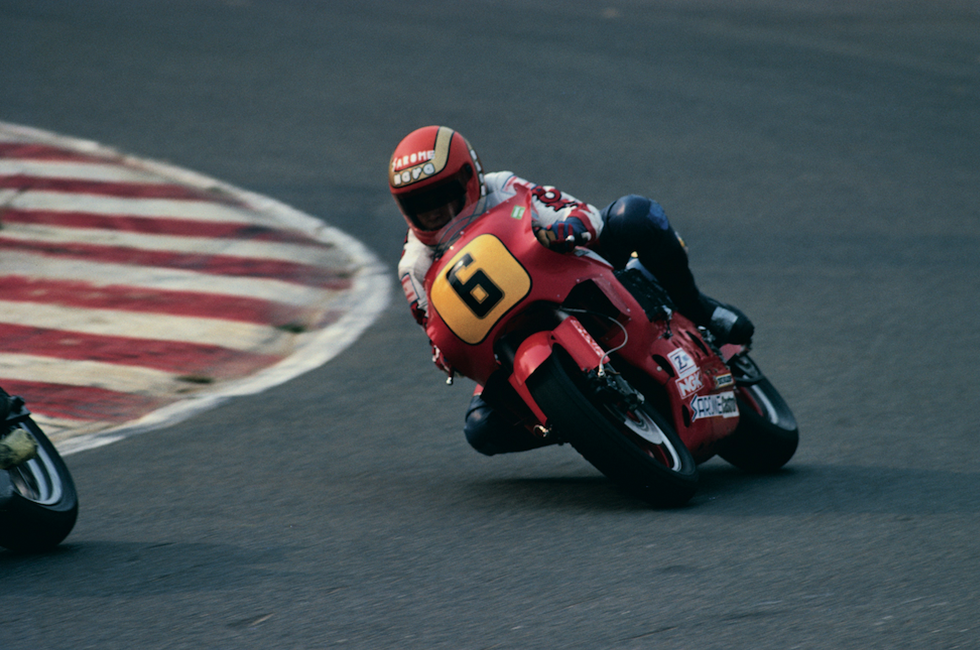
The NR500's second race was the 1979 French Grand Prix, the final race of the World Grand Prix season. However, neither Katayama nor Grant was able to perform a proper time attack. (Photo/Shigeo Kibiki)
After the British Grand Prix on August 12th, the four NR1s were sent back to Japan. They had to implement a 10-horsepower increase and a 10 kg weight reduction, and return the vehicles to Europe in time for the French Grand Prix, which began qualifying on August 31st.
The engine underwent several modifications in sequence. First, changes were made to valve timing. Next, the carburetor bore diameter was increased from φ22 mm to φ26 mm. Then, the pistons were manually machined to reduce weight. As a result of these modifications, the maximum output rose from 95 PS at the British GP to 108 PS for the French GP specification. To further reduce chassis weight, vehicle development leader Fukui and chassis supervisor Kamiya Tadashi used rotary tools themselves, shaving off about 11 kg from areas they identified as low stress.
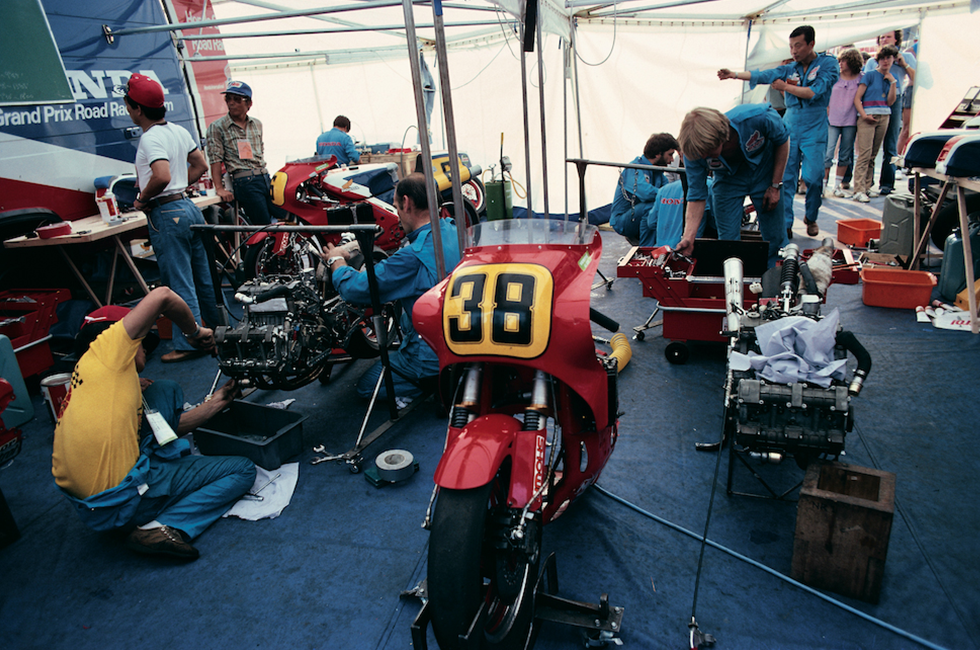
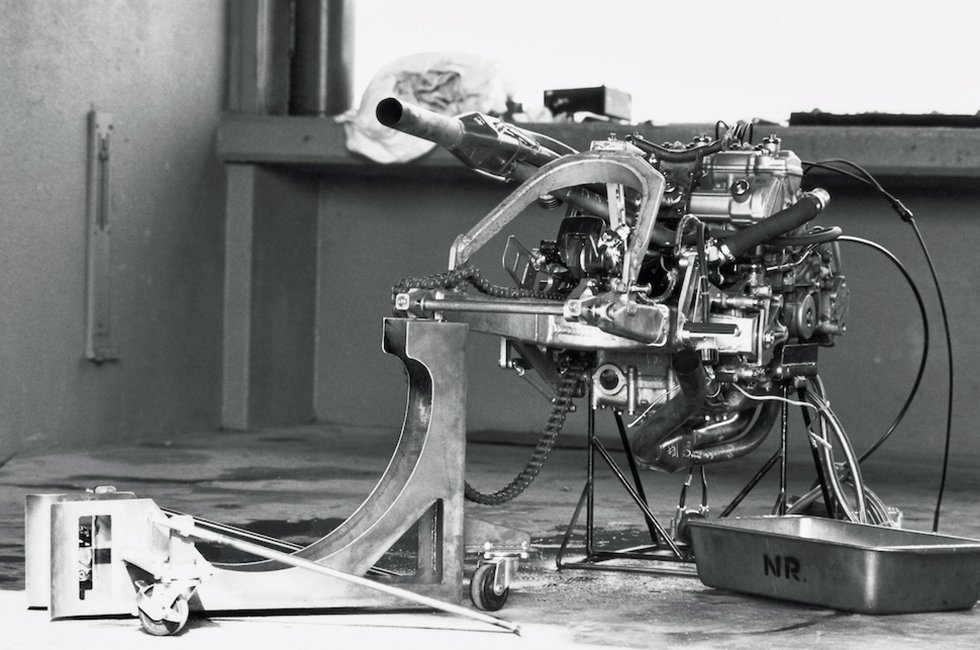
At the first race, the British GP, Honda completely closed off their service tents and pits to focus on their work, but at the second race, the French GP, they allowed the press to view and photograph the process. This revealed the incredibly difficult maintenance of the NR1, including the removal and installation of the engine, a chassis component. (Photo/Shigeo Kibiki)
And so, the four NR1s headed back to Europe. Since there was no room to use a cargo flight, the monocoque and engine were packed in as carry-on luggage, like suitcases, and flew on the same passenger flight as the staff going to the French GP. Fukui, who had stayed behind for the British GP, was also present this time.
Because the durability of the cam gear train remained unreliable, the NR1 at the French GP resorted to the drastic measure of having a new engine installed after each running session. As a result, the Honda service tent set up in the Le Mans paddock was filled with separated monocoques, engines, and swingarms, and a large number of staff members were silently working on them.
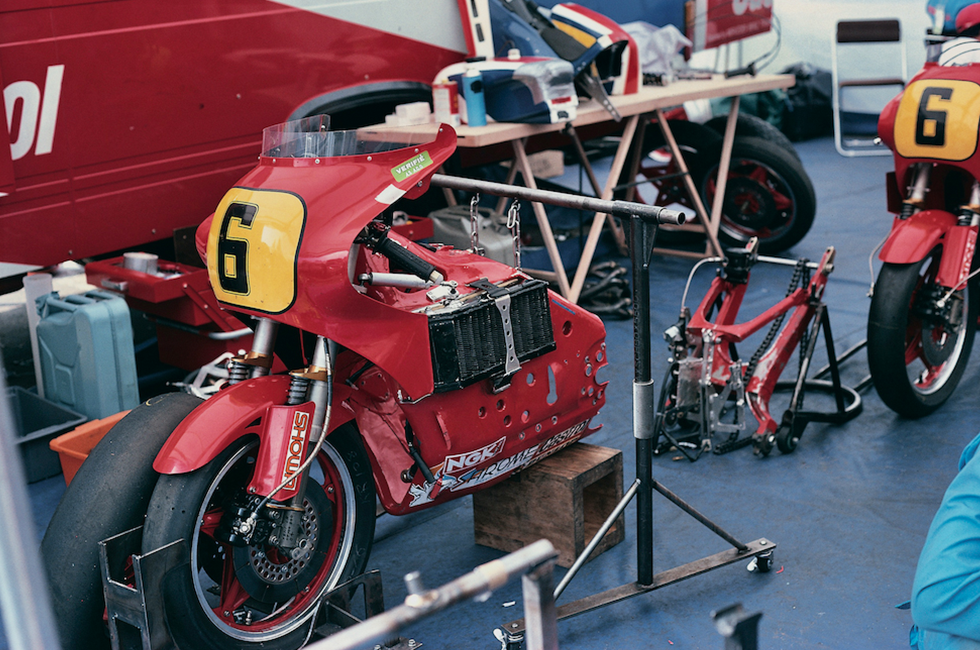
The NR1's structure meant that the rear arm could not be held in place without the engine. Several additional holes drilled for weight reduction were visible in the NR1's monocoque frame at the French GP. (Photo/Shigeo Kibiki)
Despite the tremendous effort put into the French GP, the performance and results of the NR teams were even more disastrous than at the British GP. They tried to finalize the settings and postpone the time attack, but things didn't go well. Time ran out, and both Katayama and Grant failed to qualify.
However, there was still a possibility they could participate in the final race if other riders withdrew due to injury. But Gerald Davison, the HIRCO team manager, argued, "It's pointless to race when there's no chance of winning. We should quit." This led to a fierce clash with Fukui and others, who felt that "there's no point in coming here if we go back without racing or collecting data."
Ultimately, Fukui and his team's opinion prevailed, and Katayama and Grant lined up at the back of the starting grid for the final race. However, two riders who were expected to withdraw ended up racing, and the two NR1s were forcibly removed from the grid by the officials.
It was nothing short of humiliating. Moreover, the French GP was the last Grand Prix of the year, and the NR1s never had another chance to redeem their reputation on the public stage.
Development of the NR1 continued even after its racing debut in 1979. The photo was taken during a field test of the 0X engine, which had its intake and exhaust valve angles narrowed to 55°. Reducing the valve angle allows for a more compact combustion chamber, improving combustion efficiency and extracting more power. The original 0X engine had a valve angle of 65°, and the 10° reduction was achieved by using valve springs made from re-produced maraging steel wire. (Photo/Honda)
The result of two bikes failing to qualify did not accurately reflect the NR1's capabilities, which achieved a maximum output of 108 PS, a weight of 122 kg, and a power-to-weight ratio of 1.13, even given the rushed work. Strongly dissatisfied with this, development leader Fukui and the other members of the NR Project traveled to England immediately after the French GP and conducted an unplanned test of the NR1 at Donington Park.
Grant and Ron Haslam rode the NR1 at this test. In particular, Haslam, despite it being his first ride on the NR1, ran only about 3 seconds slower than the then-GP500 course record at Donington. This greatly encouraged the NR team staff.
Development of the NR1 continued enthusiastically, with repeated field tests by Katayama and others. However, sometime in 1980, the team leader, Irimajiri, made a major decision. He decided to discontinue development of the monocoque frame and instead prepare a new NR500 with a standard chassis.
Irimajiri confided his difficult feelings to the NR Project staff, urging them to move forward. "The monocoque frame may have potential, but we can't continue with the same unsatisfactory results. The time for doing what we want is over; now is the time to do only what needs to be done."
Thus, the 1980 NR500 (development code "NR2") would debut with a completely different appearance from the NR1.


