
A Debut Race Enveloped in Flames
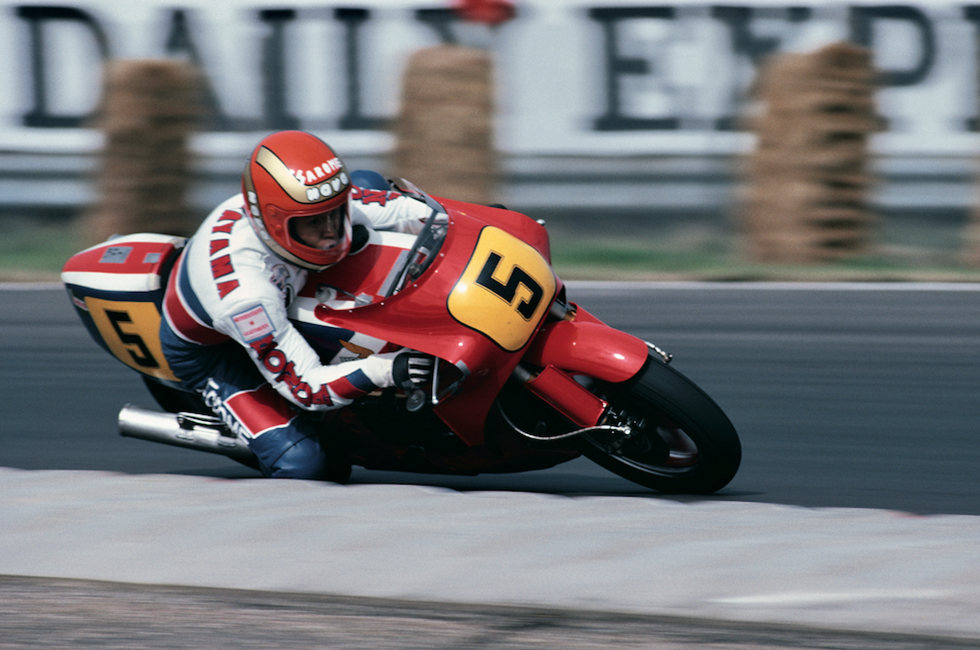
Takazumi Katayama riding the NR1 at the 1979 British Grand Prix. Years later, he said, "The NR's engine wasn't difficult to control the throttle, and it was very easy to ride from the very first one. That's another matter, though, regarding the torque." (Photo/Shigeo Kibiki)
On July 27th, work continued through the night at the NR Block of the Asaka R&D Center, and four NR1s and a large quantity of spare parts were shipped to the UK as international air cargo. At this point, the NR1 had a maximum output of 95 PS and a weight of 133 kg. The target power-to-weight ratio was 1.08, but the actual figure was significantly lower at 1.4.
Before the British GP, its debut race, the NR team conducted tests at Donington Park and Snetterton. At Donington, Takazumi Katayama suffered the NR500's first crash. He had pointed out the stiffness of the shift and the difficulty in engaging gears, but at one point the gear shifted into neutral, and he couldn't brake in time.
The crashed vehicle was sent to the HIRCO (Honda International Racing Company Ltd.) base established by the NR Project in the UK for frame repair. However, the NR1's monocoque frame was highly elastic, and even using jacks and presses, it was impossible to return the steering head pipe to its original position. Therefore, they resorted to the drastic measure of cutting and re-welding the monocoque to make it in time for the British Grand Prix.
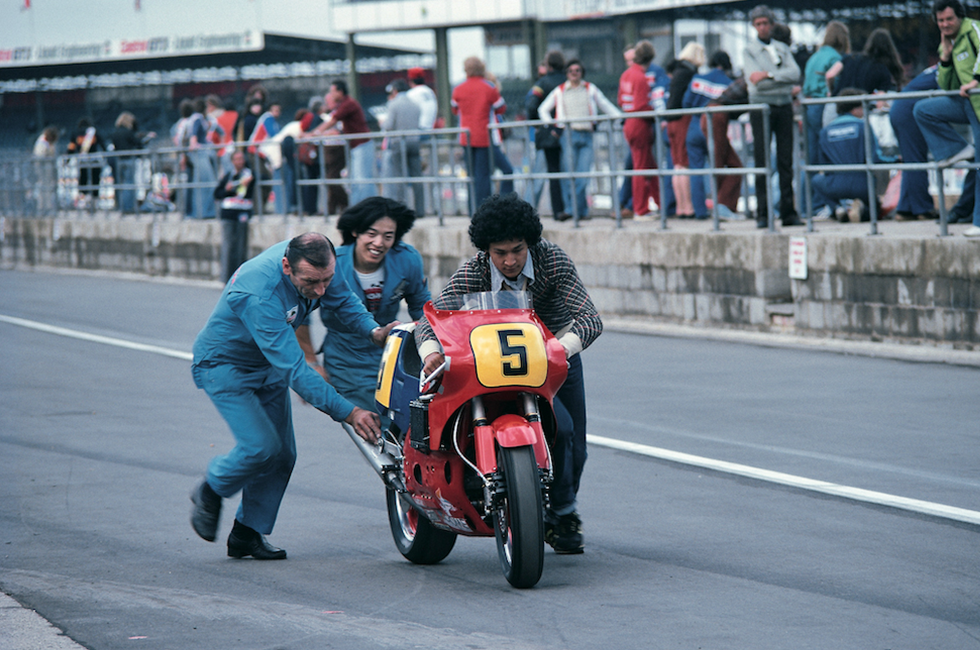
At the debut race, the British Grand Prix, before practice, as they were warming up the engine, Katayama volunteered to start it, pushing the NR1 down the pit lane in his civilian clothes. Pushing from behind were Shinichi Sugihara, who had been Katayama's chief mechanic since 1977, and Carlo Murelli, a veteran mechanic who had been active in motorcycle racing since the 1950s. (Photo/Shigeo Kibiki)
At the British Grand Prix, an incredible amount of attention was focused on the NR500. Rumors were spreading that the engine had oval pistons. Honda closed off their service tent and pit to concentrate on their work.
Katayama repeatedly practiced push-starts. At the time, the World Grand Prix road races started with riders push-starting their engines, but the NR1's 0X engine had poor starting performance, making a slow start inevitable. Furthermore, even during practice and qualifying sessions, the NR1 spent an unusually long time in the pits due to its extremely poor maintainability.
Then came qualifying. Kenny Roberts, riding a Yamaha YZR500, secured pole position with a time of 1 minute 29.81 seconds. In contrast, Katayama's time was 1 minute 36.74 seconds, placing him 38th, and Grant's was 1 minute 38.04 seconds, placing him 41st. Both times were slower than those in the 250cc class.
Following these disastrous qualifying results, Shoichiro Irimajiri made an international call to Takeo Fukui, the vehicle development leader who was in charge in Japan, and told him that the power had to be increased by 10 horsepower and the weight reduced by 10 kg before the next race, the French GP, which was just a two-week interval away. "Otherwise, it's not worth it," he said.
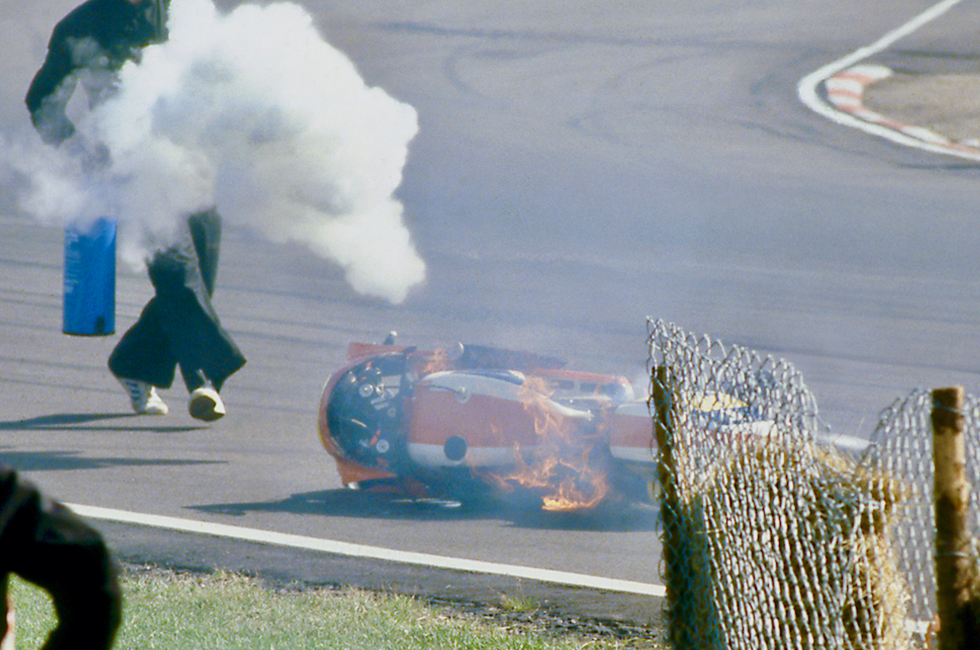
Grant's NR1 crashed shortly after the start of its debut race. Gasoline leaked from the fuel tank, igniting and engulfing the bike in flames, creating a scene that symbolized the turbulent career of the NR500. (Photo/Honda)
On August 12th, the day of the British Grand Prix final, the weather was fine. In the 500cc class race, Roberts won a historic close battle against Barry Sheene by a mere 0.03 seconds, but the NR500's debut race had already ended long before that result was announced.
First, both NR1s had a spectacularly slow start from the push-start. Katayama's engine started first, but he waited a little before the first corner for his teammate to catch up. However, Grant was having trouble starting his engine, so Katayama decided to go ahead. Eventually, Grant's bike started, too. With great momentum, Grant revved the throttle hard, and his NR1 lifted its front wheel high into the air, resulting in a wheelie.
At that moment, engine oil sprayed from the breather and onto the rear tire. The rider didn't notice, put the front wheel down, and continued riding; he then leaned the bike into the first corner and crashed easily.
After sliding on its side for a while, gasoline from the NR1's fuel tank leaked, igniting and causing a fire. Thus, one of the NR1s couldn't even clear the first corner on the first lap, ending its debut race prematurely. Another bike, ridden by Katayama, also failed to last more than three laps; this one suffered ignition trouble.


