
Valve Springs as a Hindrance
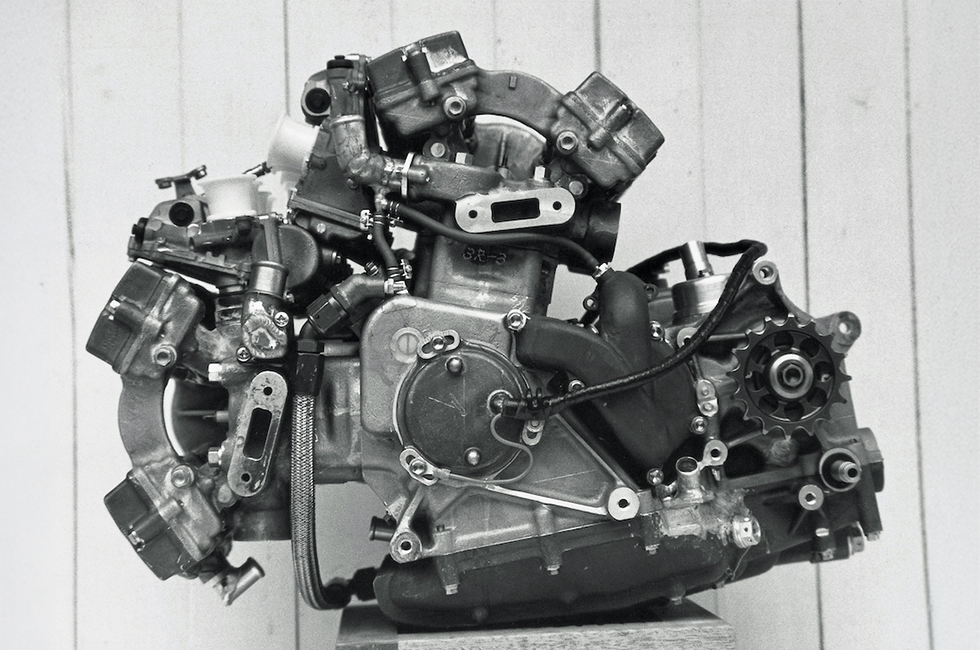
Even though both are four-cylinder engines, four-stroke engines naturally have more parts than two-stroke engines, making them heavier. The NR engine also had several factors that further increased its weight, such as having two connecting rods per cylinder. To achieve the lightest possible weight, magnesium alloy, with its low specific gravity, was generously used for parts that did not bear significant load. (Photo/Honda)
The NR500's four-cylinder engine featured a V-shaped layout with two cylinder banks, each holding two cylinders. The oval cylinders are horizontally elongated, and a parallel four-cylinder configuration would result in an extremely wide engine. Therefore, the V-shaped layout was a necessity.
The carburetors for the four cylinders were positioned in the V-shaped valley formed by the two cylinder banks. The V-angle was set to 100°. While 90° would theoretically eliminate the primary vibration of the crankshaft, the size of the NR carburetors at that time was too large to fit within a 90° V-angle.
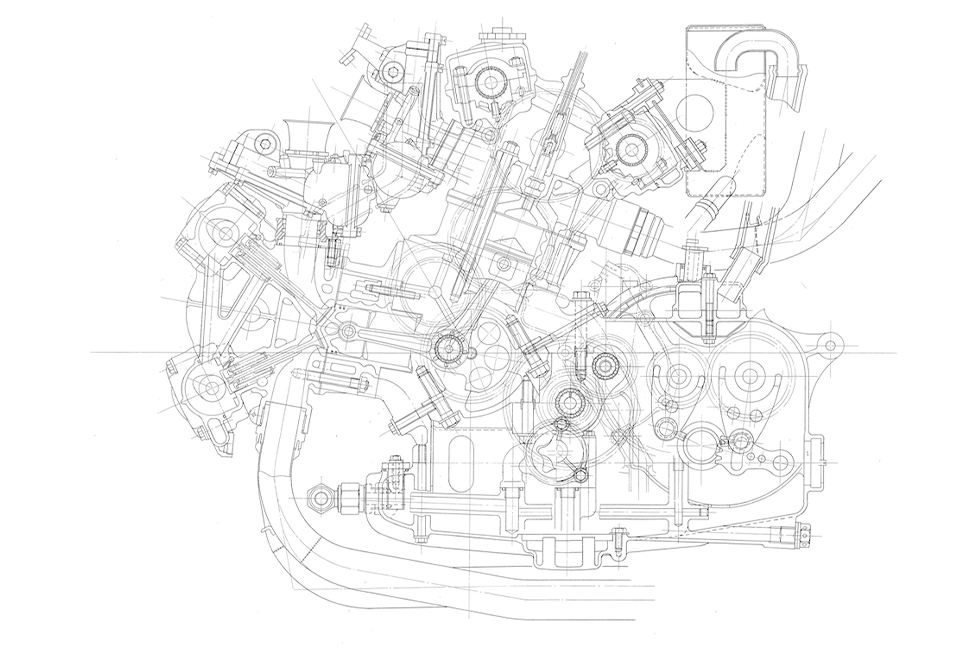
Cross-sectional view of the 0X engine installed in the 1979 NR500 (NR1) model. The engine uses a four-shaft configuration, transmitting power through the crankshaft, primary shaft, main shaft, and countershaft, with the crankshaft rotating in the opposite direction to the tire's rotation.
In the 1960s, Honda reached 20,000 rpm with its 50cc two-cylinder racers, the RC115 and its successor, the RC116. On the other hand, the first NR500 engine, the 0X, was designed in the late 1970s. Despite this, valve springs were breaking frequently at engine speeds far below 20,000 rpm during the initial stages of bench testing.
The cause lay in the materials. While the valve springs in the RC115 and RC116 were made from maraging steel wire, a highly durable and tough, ultra-hard steel, the 0X used a more common material: silicon-chromium steel oil-tempered wire. Maraging steel was a rare and specialized material subject to national export restrictions, making it unavailable at the time the NR Project began.
The valve springs in the 0X were special, made from silicon-chromium steel oil-tempered wire and designed using stress calculations based on 20,000 rpm. However, when approaching 20,000 rpm, they would surge (abnormal vibration caused by the valve's inability to keep up with the rate of change in cam angle), failing to withstand the load.
Honda negotiated with material manufacturers and secured their agreement to reproduce maraging steel wire. However, this was not ready in time for the first NR500 (NR1) races. Therefore, they had no choice but to use valve springs made of silicon-chromium steel oil-tempered wire.
However, there were other weaker parts than the valve springs, and these were the first to fail, so the NR1 never suffered valve spring breakage during races.


