
1979 NR500 Engine Technology
text=KIYOKAZU IMAI translation:SHINTARO URASHIMA
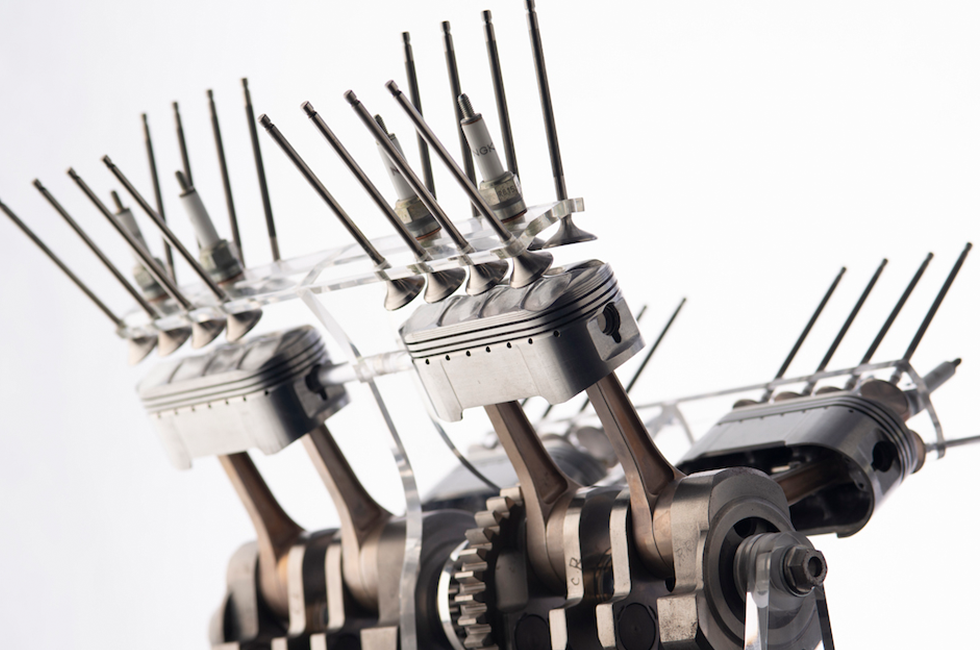
(Photo/Shinobu Matsukawa)
World's First 8-Valve, Oval Piston Engine
To Beat a 2-Stroke Engine of the Same Displacement With a 4-Stroke Engine
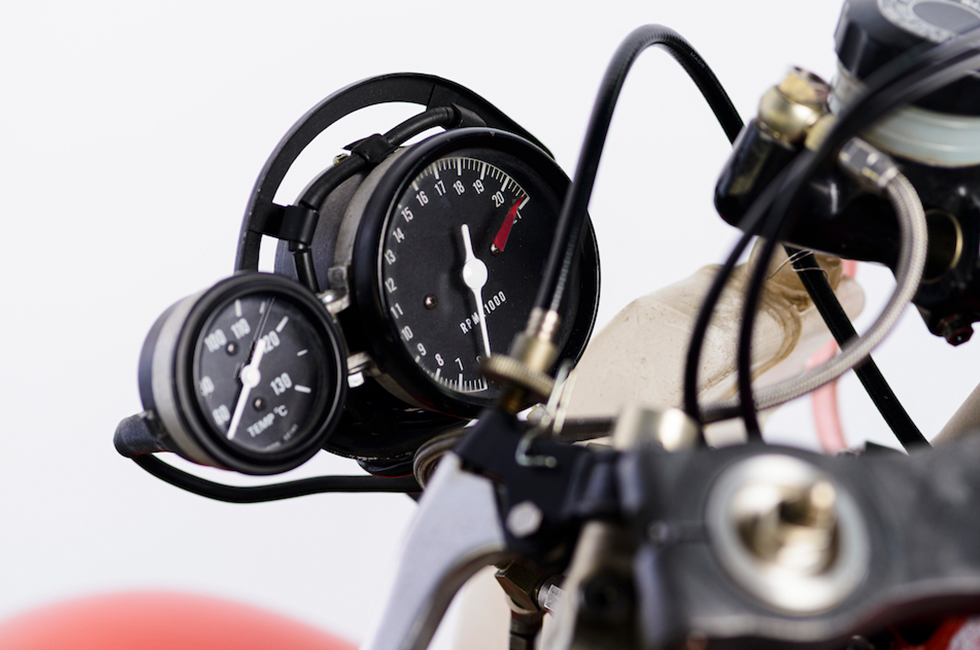
The tachometer of the 1979 NR500 (NR1) model. The scale is marked up to 21,000 rpm, with a rev limit mark at 20,000 rpm. (Photo/Shinobu Matsukawa)
By the end of 1977, it was decided that the NR500 engine, which Honda would use for its return to the World Grand Prix Road Race after an 11-year absence, would be a 4-stroke. So, how could they make it a machine that could beat 2-stroke bikes?
At the time, Yamaha and Suzuki were vying for supremacy in the 500cc class. Both companies' 2-stroke factory bikes delivered 120 PS and weighed 130 kg, giving a power-to-weight ratio of 1.08, according to Honda. In contrast, the 4-stroke NR500 engine would weigh about 10 kg more, putting it at a disadvantage. To match or exceed the 2-stroke models' power-to-weight ratio and stand a chance of winning, the NR500 would need to produce 130 PS. Achieving this with a naturally aspirated 500cc 4-stroke engine required it to rev to 20,000 rpm, making it especially challenging compared to its lighter 2-stroke rivals.
The number of cylinders was set to the maximum allowed by regulation, 4. Then, assuming a standard number of intake valves per cylinder (2), the diameter of each valve was calculated to be φ28 mm. The intake and exhaust valves of a 4-stroke engine move up and down once every two engine revolutions. Therefore, at 20,000 rpm, the valves move 10,000 times per minute. A φ28 mm size was beyond the capabilities of valve spring technology at the time.
The only feasible size would be φ20 mm, in which case the number of intake valves would be 4. For efficiency reasons, the number of exhaust valves would also be the same. In other words, to achieve 130 PS at 20,000 rpm with the technology of the time for a naturally aspirated 500cc four-stroke engine, the total number of intake and exhaust valves per cylinder would need to be eight.
This much is easily calculated. The problem was how to arrange the eight valves.
Arranging eight valves in a perfect circle is fairly easy. But the system needed to operate these eight valves, set around the combustion chamber, would be very complicated, bulky, and heavy. Also, making all the intake and exhaust ports the same length and shape is very hard, and spark plugs must be included. So, an eight-valve design in a perfectly round cylinder was judged impossible.
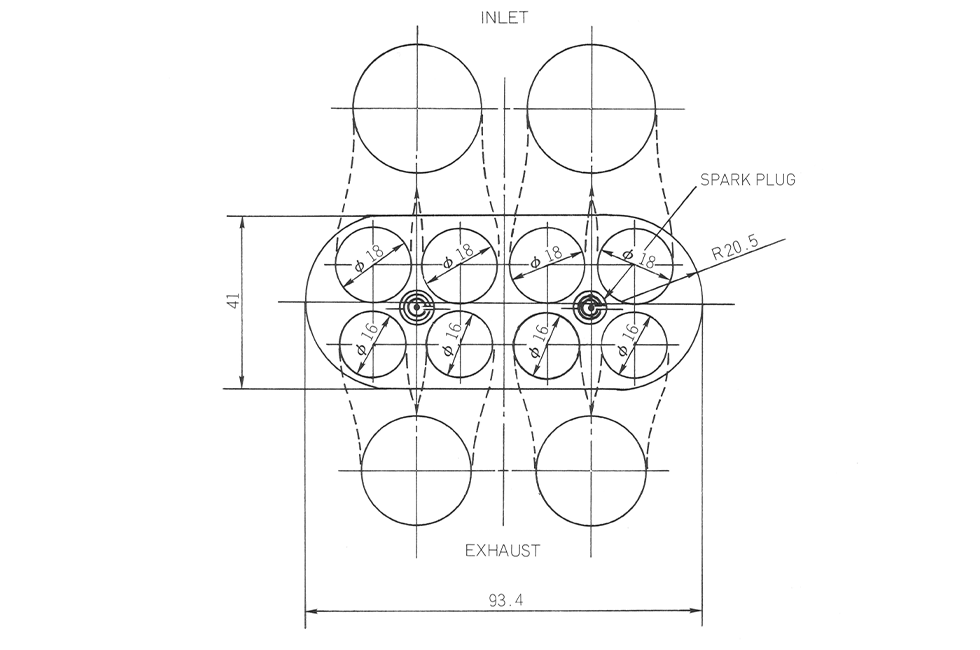
Cylinder head layout diagram. Picture two four-valve engines joined together. In the end, all later NR500 engines had intake valves measuring 18 mm and exhaust valves measuring 16 mm.
To efficiently arrange and drive eight intake and exhaust valves, the combustion chamber was made into an "oval" shape. This oval design enabled four intake valves to be placed in a row on one side and four exhaust valves on the other, allowing the use of only two camshafts per cylinder head, as in a standard DOHC engine. As a result, the intake and exhaust ports could also be uniformly shaped to the ideal form. Although flame propagation was not circular, this was counteracted by using two spark plugs per cylinder.
This idea came from a flash of inspiration by Irimajiri, the project's leader, who designed engines for Grand Prix RC motorcycles and Formula One cars in the 1960s. When he caught sight of a traffic light outside the Asaka R&D Center, he envisioned eight valves neatly arranged in a horizontally elongated circle and quickly sketched his idea. The combustion chamber, piston, and cylinder were all oval. Because two curved sections are connected by two straight sections, the transition of curvature is discontinuous. Although the NR500 engine is often described as having an "elliptical piston", it was initially designed with an "oval piston".
However, it was the world's first engine with a non-round piston in actual use. No machining company had ever manufactured such a thing, not even Honda itself. The cylinder, in particular, proved difficult to manufacture, and the "non-round piston engine" project quickly hit a snag.
The company that saved the day was a supplier with whom Honda had a long-standing relationship dating back to the 1950s, and it possessed ultra-precision machining technology. This company agreed to manufacture the oval cylinder, allowing the project to move forward. Prototypes of the oval piston, piston rings, and cylinder were then produced, and testing indicated that it was feasible. This was in July 1978, 13 months before the NR500's debut in competition.


