
The Struggle With the Oval Piston Ring
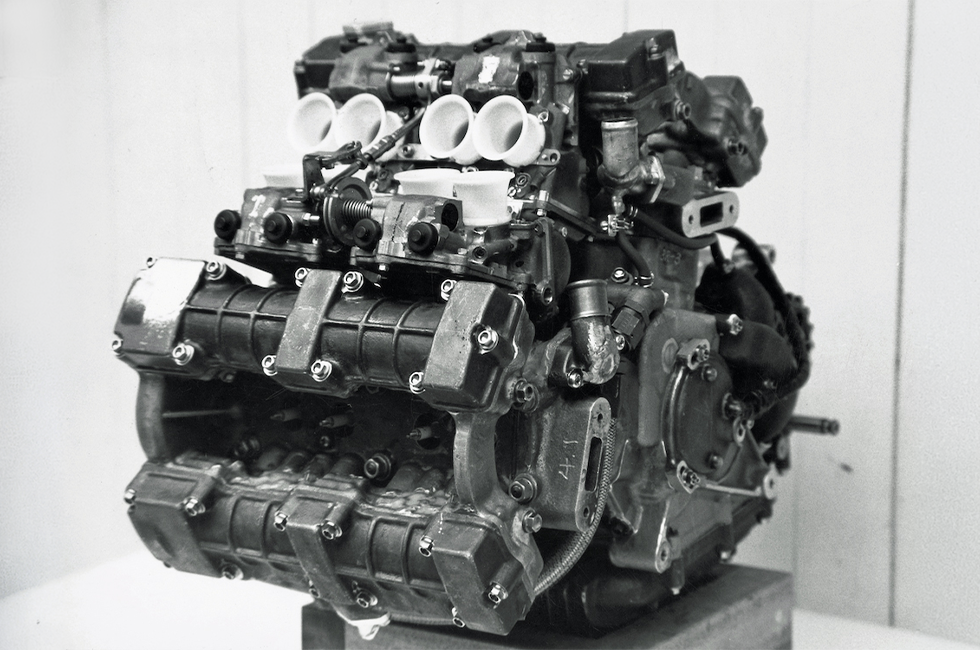
A view of the engine installed in the 1979 NR500 (NR1) from the front left. With eight carburetor air funnels visible and four spark plugs on the front cylinder bank alone, one might mistakenly believe it's an eight-cylinder engine. In reality, conceptually, it was a "four-cylinder version of a V8 engine." (Photo/Honda)
Design of the single-cylinder test engine "K0" began in July 1978. In November of the same year, design began for the four-cylinder engine "0X," which would be installed in the first-generation NR500 (development code "NR1"), the 1979 model.
Both engines had a single combustion chamber volume of 125 cc (strictly speaking, 124.9 cc), and the bore x stroke was also the same.
In the case of an oval shape, its dimensions are expressed by two values: the longer side (major axis) and the shorter side (minor axis). The cylinder bore of the K0 and 0X was set at 93.4 mm (major axis) / 41.0 mm (minor axis). This value remained unchanged until the 3X engine was installed in the 1982 model (NR4), the final version of the NR500.
The bore x stroke was determined by first selecting the stroke, which is the distance the piston travels in the cylinder. That value was set to 36.0 mm. Higher piston speed, in other words, the average speed during engine operation, increases frictional resistance. This resistance limits the engine's maximum rotational speed. To keep friction low enough for the NR500 to reach over 20,000 rpm, engineers set a piston speed limit of 24 m/sec or less. With a stroke of 36.0 mm and a single-chamber volume of 125 cc, the bore (cylinder diameter) would be 66.4 mm if perfectly circular. Converting this bore to an oval shape, the major axis becomes 93.4 mm and the minor axis 41.0 mm.
The valve diameters were changed from φ19 mm intake / φ17 mm exhaust in the K0 to φ18 mm intake / φ16 mm exhaust in the 0X. Valve lift was also reduced from 7.0 mm intake / 6.5 mm exhaust in the K0 to 6.5 mm intake / 5.7 mm exhaust in the 0X. On the other hand, the valve angle (the angle between the intake and exhaust valves) remained the same as in K0 at 65° (30° intake / 35° exhaust) and was adopted for the 0X as well.
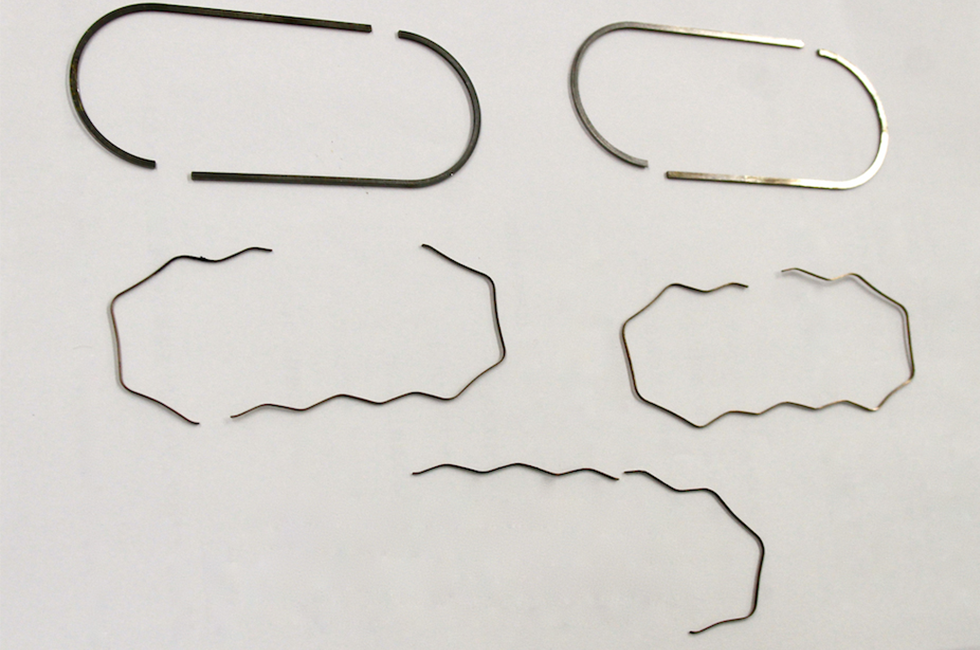
The image shows some of the piston rings tested during the K0 single-cylinder test engine stage. Based on numerous considerations such as "self-tension type or expander type" and "what happens when the ring is divided," various rings were created, and bench tests were conducted for each to collect data. Note that not all the rings shown in this photo were adopted. (Photo/Kiyokazu Imai)
One of the things that greatly troubled the developers was how to ensure the sealing performance of the oval-shaped piston rings. Because of its shape, which consists of two semicircles connected by two straight lines, twisting occurs at the point where the semicircular section transitions to the straight section.
In a typical circular piston, self-tensioning piston rings are standard. However, in the development team for the oval piston, there was initially a strong inclination towards an expander type with a corrugated spring embedded on the back of the ring (the piston-side surface).
The preceding single-cylinder test engine, the K0, was designed with two piston rings (a compression ring and an oil ring) to achieve low friction, both of which were of the expander type. However, it was found that when this type was used as the compression ring, the fuel-air mixture would leak into the space between the back of the ring and the spring, and this would be expelled without ignition, resulting in a loss.
Therefore, the four-cylinder 0X was designed with three piston rings. The two upper compression rings are self-tensioning type, and the bottom oil ring is an expander type. This specification would continue to be used until the final 3X model of the NR500 engine.
For the self-tension type, Honda created and tested various designs: a two-part U-shaped type cut in the middle of a straight section, a two-part J-shaped type cut near the semicircular section, a four-part type cut at two straight and two semicircular sections, and a four-part type cut at the midpoints of both straight and semicircular sections. Since all proved insufficient, the engine design team ultimately chose the one-piece self-tension type as best for compression rings. Furthermore, the dedication of Honda's business partners enabled the development of these oval piston rings.


