Confirming Passenger Seating Comfort
How can you keep your girlfriend happy on a long ride on the rear passenger seat? One common answer is: "Obviously, the quickest way is to improve your own riding skills!"
But is that really all you can do? With that question firmly in mind, moto-journalist Tsutomu Matsui, who always does his own riding, set out to experience the passenger's view of motorcycle riding.
The Rear Seat or Pillion = Inspected for Comfort
One day, while looking on a shelf in my room for a pair of goggles to use on a job, I stumbled upon a bag that contained a bunch of old photographs and film. I'd completely forgotten that I'd put that bag on the back of the shelf when I moved to my current home. The sight of those photos brought back a rush of memories! There I was, still in my early twenties. Vivid reminders of so many things.
Back in the day, I used to ride tandem quite a lot. And mostly those who sat on the rear seat were either friends or loves. I remember trying to improve my riding technique, trying to make my operation of the throttle, brake and gear shifts as smooth and comfortable as I possibly could, so nobody would tell me, "I'm never riding with you again!" While immersed in these old travel memories, a simple question ran through my mind: "Is passenger comfort on a motorcycle solely determined by the skill of the rider?" Or was this merely a preconceived notion I'd long held, based on my perspective as a rider?
Over the years, I've only had limited experience riding pillion perched on the rear seat. Despite that, from my own experience, I've often given advice to people that riding two-up in a way that makes girlfriends happy is a sure way to improve one's overall motorcycle riding skills.
I started wondering if rear seat comfort might instead depend more on a motorcycle's fundamental design and performance, and I made a note to myself that I should really reexamine the rear seat's seating comfort. Forgetting all about the goggles I was first looking for, I began thinking about how I could go about confirming this.
In order to test and confirm rear seat riding comfort, another rider would be necessary, as I'd often be the one riding pillion. So who would be the best choice? Several riders quickly came to mind and were soon dropped. Expert riders are certainly good at what they do, however I thought this test would require more of an expectant or anxious state-of-mind, similar to what I experienced when first riding pillion behind a friend during my high school days. This level of uncertainty would be more appropriate for accurately testing the rear seat and its seating comfort in ways that would be easier to understand. I also wanted the subjective opinions of another person without having to rely only on my own preconceived notions. So this other rider really had to be a woman! I thought that a woman's viewpoint, sharpened by the feelings of tension and unease brought on by trying to maneuver a motorcycle with a big man like me on the back, would make it possible to uncover the true sensations and level of comfort (or lack thereof) of pillion riding.
As a result, I asked Miss Risa Nishimura to take part in the test. Risa is not only a well-known model, but also a motorcycle rider who regularly rides her own liter bike. Risa told me that while she'd been photographed in many locations riding or sitting on back of a motorcycle, this would be her first experience actually riding with a large man like me sitting behind her. She said, "Honestly, I'm not sure I can do as well you may expect" and didn't hide her concern. That meant that she was the perfect fit for the job I had in mind.
The most important test points were as follows:
- Comfort of the front, back and sides of the seat
- Positioning of the steps relative to seat
- Positioning of the grab bar, or hand holds, etc. and how comfortable the grip feels
- How comfortable does the rider feel when someone climbs on back?
Based on these key points, I set out to experience the comfort of a range of rear seats. And one fine Monday morning, we conducted our tests
PCX
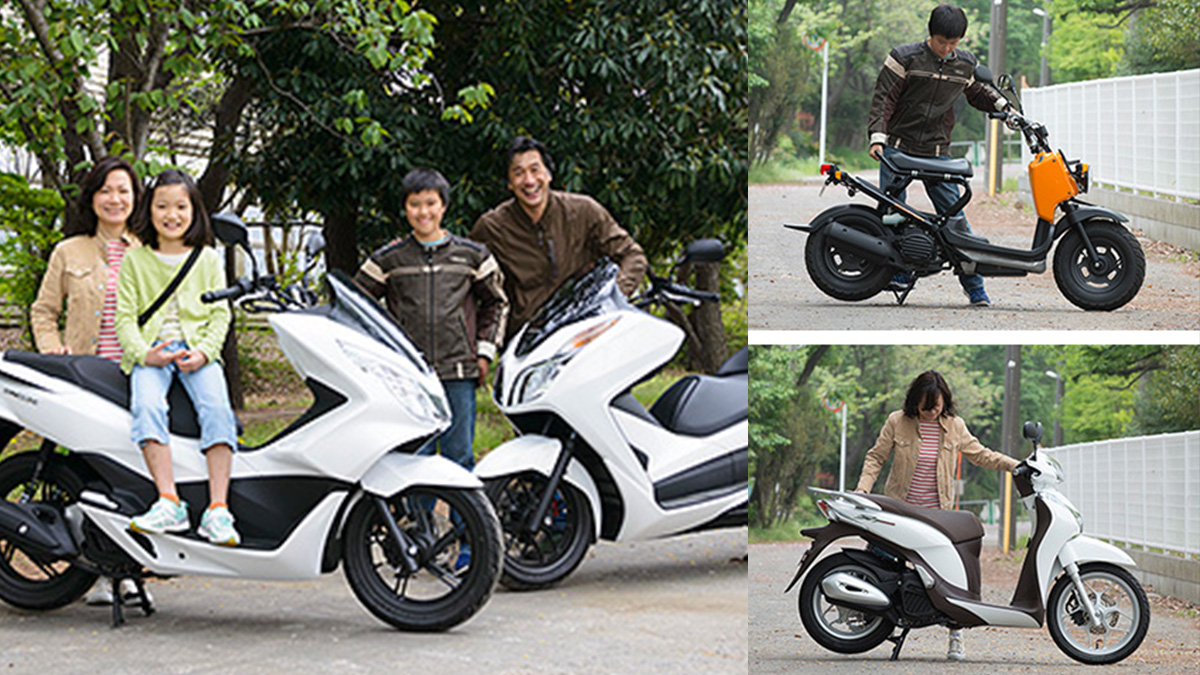
First, I climbed on the PCX's rear seat. This was my first experience getting on behind a woman rider who was already astride a bike or, in this case, scooter. The PCX's low seat and easy reach to the ground left Risa, who stands 168cm tall, with nothing lacking in the way of confidence sitting on and holding up the . However, when I, at 180cm tall and weighing 85kg, swung my leg over the rear seat, which sits a bit higher than the rider's seat, I first worried that my extra weight might topple over the scooter. However, Risa said that she wasn't particularly bothered when I got on. My immediate impression was that the PCX not only offers an easy reach to the ground, but also excellent balance in that situation, indicating that the engineers designed it for a solid foot plant, which would be an important factor for commuters, as well as added peace-of-mind when a rider sits on the seat and places his or her feet on the ground. If the bike were to lurch here, then the rider might get overly nervous, even on the move.

We started our ride on a busy street. Soon after turning at the first intersection, we stopped at a red light. I asked Risa if she was okay, and she replied, "This is easier than I thought it would be, with fewer distractions."
That sounded good, so I concentrated on evaluating the ride on the rear seat.
The instant I sat down, I discovered the seat's surface area and fit to be good. The fold-out passenger steps are shaped to integrate nicely with the scooter's stylish good looks, and flip out easily for passenger use. The steps are positioned for a comfortable seating position, and contribute greatly to the PCX's overall sense of stability. However, while waiting for the light to change, I found I had to take care not to let the toes of my boots bump into the rider's (Risa's) lower leg. When on the move, there was no contact at all.
Under acceleration, I felt that the seat offered an appropriate mix of firmness and shock absorption to securely support my weight. Further, the space at the front and rear seemed well separated to keep me from interfering with Risa's riding. There was also ample seating area forward and back to allow me to move my bottom around and not get locked into one, eventually uncomfortable position.
The stylish, boomerang-shaped tail section surrounding the back of the seat also doubles as the grab rail, and its attractive form lends a sporty touch to the PCX's overall body design. Also impressive is the detailed consideration given to the design of often overlooked parts, including the ergonomic shaping of this tail section to give it a comfortable hand hold that's easy to wrap one's fingers around at virtually any position without any limitations. That played a big part in reducing fatigue by allowing me to sit in a relaxed posture, particularly when combined with the spacious rear seating area, which offered ample room front and rear to shift my weight during acceleration and braking.

When we came to a bumpy stone-paved road, I found the PCX offered a much more comfortable ride than I first expected, including both its suspension and engine response. Being able to comfortably ride tandem through town is an important feature in a commuter. The ride was remarkably smooth, without feeling any unpleasant engine vibration or rough bumps in the road through my bottom. In fact, it was so smooth that I felt I could relax and ride forever in these conditions. The view from the rear seat wasn't bad, either. I was again reminded that the rear seat's comfort depends on a combination of good positioning, sufficient seating space, etc., which all come together to determine a bike's overall strengths.
Risa noted, "I was surprised to find that the PCX was quite a bit easier to ride than I first thought it would be." As you know, she was riding a mid-sized scooter with a big 85kg man sitting behind her. She continued, "My riding position while carrying a passenger was remarkably relaxed. Since the PCX is only a 150cc-class scooter, I prepared myself to feel cramped with a passenger behind me, but its surprising spaciousness made it easy to maneuver. I also expected that riding double on this class of scooter would be slow and difficult, but the engine had enough power available that I felt that even two-up touring on it might be possible. Creating a positive mood is one of the most important factors of bike performance.
I've ridden pillion on other makes of scooter in the same class before. One time, it was a two-up ride with two sizeable men on the bike, and when I climbed onto the rear seat, the front of the scooter became noticeably lighter and appeared to be somewhat unstable. Because of this, I still remember straining my hands to hold onto the skinny grab bar, and gripped it so hard that it hurt my fingers.
And although the size of the seat itself was not especially small, it seemed to transmit engine vibration and rear suspension movement more directly to the rear saddle than to the rider's seat. If issues like this are not made clear, it makes me feel uneasy. Honestly, I didn't feel like riding double again after that experience.
Even 125cc-class models have such large differences between people wanting to ride them and not wanting them at all. Is this only due to differences in cost? No, differences in manufacturer's consideration play a big part, a factor which became instantly clear this day.
CB250F
Next Up: the CB250
This bike is the naked version of the CBR250R, and its wedge-like shape reveals impressive sports bike-like styling. Its rear seat is also slightly taller than the rider's seat.
Seeing Risa straddling this bike from the side presented a very stylish picture. Initially, I worried that it might be a bit hard for her legs to hold up the CB when a bigger and heavier man like me climbed onto its rear seat. However, Lisa was hardly even phased by me throwing a leg over and settling down on the seat.
The shape of the rider's portion of the seat enables an easy and secure reach to the ground, which certainly plays an important role in stability at stop. Its form tapers outward within comfortable range of most riders' legs, and no body parts bulge out to get in the way of their direct extension to the ground. The handlebars are also ideally sized and positioned to offer excellent support when stopped, further enhancing the CB's sense of stability.

Riders ranging from beginners to those with more expert skills, regardless of sex or physique, choose to ride motorcycles, so it's important that all the fundamental components be well made.
The suspension sank as I climbed aboard the rear seat, but Risa noted that she only needed to exert a bit of strength in one of her legs, and hardly noticed that somebody had gotten on the bike.
In fact, when I settled down on the rear seat, I found it to be a comfortable fit, and easy to stay balanced. The relative layout of the seat and steps felt good, as well.
Risa was able to start out on the CB smoothly and expertly. Although the rear seat pad is not particularly big, it never gave the impression that it was uncomfortably small either. Designed to provide good support for most bottoms, the positioning of the rear pegs made it easy to use my feet to coordinate my movements with those of the bike and rider, enhancing my sense of security.
The size and shape of the grab bar also offered a comfortable grip, and it seemed relatively free from the annoying vibration normally associated with single-cylinder engines at speed. The CB's chassis is robustly constructed, and seems impervious to bumps in the road surface, leaving me with the impression that I could tolerate a long day's outing seated right where I was.

My body shifted back and forth as the gears were changed or brakes were applied, but it was easy to keep my balance by merely holding on lightly to the two integrated side grab rails and allowing the upper part of my body to sway back and forth. It felt fine to simply wrap my hands around the grab rails and enjoy the ride behind Risa. This grip helped prevent any exaggerated body movement that might interfere with Risa's otherwise smooth and careful control. It brought to light another important design criteria in that the passenger's environment needs to be to adjusted to allow the rider to concentrate on riding operations without being distracted by the passenger. Tandem riding is much safer and more enjoyable when both rider and passenger are comfortable.
I also found I was able to move around on the seat freely. Employing the latest in tail-up styling, the CB250F's designers seem to have taken great care in the design of the rear seat. Risa observed, "This CB250F is really easy to control, even riding double. At first I thought that its small 250cc engine might not have enough power for riding double, but that wasn't the case at all. The CB makes quite a good city commuter. Also, when we switched riding duties and it was my turn to sit on the rear seat, my first impression was that it was quite high, since the rear seat is positioned higher than the rider's seat. However, once we started out, I soon found I could easily support my body, so it wasn't scary in the least. Instead, I was able to enjoy the sensation of riding together almost as one with the rider."
Although our height and weight differ greatly, what Risa felt was nearly the same as my own experience. It was great to be able to hop on the rear seat and feel such a sense of security at the start of the ride that we could instantly share the pleasures of riding together.
FORZA Si
Next, we tested Honda's big Forza Si scooter. I decided to leave the driving to Risa and enjoy the ride from the passenger seat. Both of her feet seemed to be firmly planted on the pavement when I climbed on back, and she said she had no trouble at all supporting the bike while I took up my position on the rear seat.

My first impression was that the Forza's rear seat offered a good, comfortable riding position and well-located foot steps. In fact, the positioning of the rear steps was particularly good. The size and shape of the rear seat was also good in all directions, and seemed to hold me firmly and securely in place. This positioning made it easy for me to keep my feet facing forward. And, of course, I never felt uneasy while cornering. From a rider's point of view, the impression was that of holding the bike with my lower body. Even the integrated grab rails provided a comfortable, easy grip that enhanced riding enjoyment by allowing me to just put my hands down next to the seat and wrap my fingers around their curved edges. It was clear that careful and deliberate consideration had also been given to the shape and positioning of the rear grab rails, as I felt was the case on the PCX.
Reevaluation performed this way enables me to more clearly understand things that I have taken for granted until now. First and foremost, I'm able to develop my own sense of security, which leads to a more relaxed feeling while travelling and enables me to better enjoy the scenery in comfort.
"My impression is that a big scooter's rear seat is more spacious and comfortable. However, what makes this comfort possible is the employment of technology directed at optimizing the riding positions of both the rider and passenger." While riding on the comfortable passenger seat and thinking up comments like this for my story, I completely forgot to change riding positions with Risa.
From her seat at the controls, Risa chimed in, "Of course, this scooter is more stable than I thought it would be. However, more so than that, it hardly feels as if anyone is riding behind me." This ability to ride naturally is also an important two-up performance feature. There must be a lot of demand for sophisticated, high-quality bikes that not only feature excellent designs, but also have ideally positioned seats and grab rails, and the Forza Si brilliantly satisfies these demanding requirements.
On this test day, we crossed a section of expressway that was exposed to a strong crosswind, yet both rider and passenger remained relaxed and comfortable. This was really remarkable. It meant that the Forza Si is not only good at short-distance hops, but also long-distance tours.

I've had similar experiences a number of times riding on the rear seats of big scooters other than Honda's. And while their spacious passenger seats appeared at first to be comfortable, when seated, I soon noticed that the positioning of the steps relative to the seat left a lot to be desired, and resulted in my body weight being carried entirely on my bottom, which soon made the ride uncomfortable. And while the seating area was pretty spacious, it made me feel as if I were sitting precariously on a tall stool, and I simply couldn't relax.
What's more, the bodywork that had been expanded to make room for a larger-capacity underseat carrying space rubbed against my lower legs when my feet were resting on the steps. Also, while riding, vibration and road surface bumps were transmitted directly to my legs, causing quite a bit of discomfort. If I rested my feet on the steps with toes splayed outward to avoid contact with the scooter's body panels, then I wasn't able to rest my feet firmly on the steps.
Whenever that scooter would start from a green light, showing off its excellent acceleration, I'd have to tighten up my abdominal muscles just to sit upright. And when the brakes were applied, I'd have to brace myself against the sudden deceleration. These were not especially great memories of riding that scooter. At the time, I knew that there were big differences in both experience and impressions between rider and passenger. Calling up those experiences again from memory enabled me to reassess how hard Honda has worked to improve rear seat riding conditions.
GL1800 Gold Wing
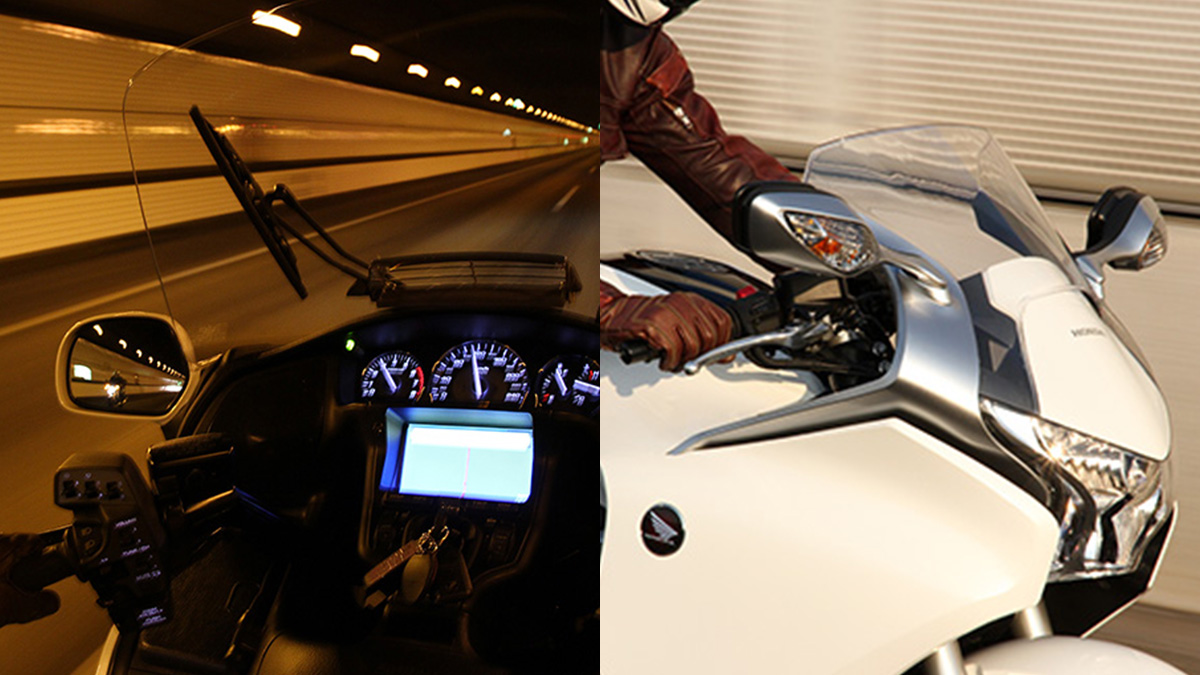
Last, we tested the Gold Wing, Honda's premier luxury touring bike. I've always thought that this bike's rear seat is the best in the business. This time, I was at last able to test out the rear seat that looks like a comfortable sofa.

Confronting the Gold Wing for the first time, Risa seemed a bit overwhelmed by its gargantuan size, and began her ride saying, "I'd like to take this out for a little bit by myself first." Despite this, she came to understand this motorcycle's inherent riding ease in her first five minutes on it, and soon smiled, "OK, no problem, let's go." I, who had initially ridden the bike to the photo location with Risa on back, felt as if the Wing's magic charms had been revealed. Yes, the Gold Wind is astoundingly easy to ride.
Risa started out riding with me sitting on the passenger seat. She remarked with a smile, "I was surprised to be able to ride so naturally that I hardly even noticed your presence when you were behind me. When I stopped and touched my feet to the ground to hold up the bike, I felt a little uneasy at first. But owing to its excellent balance, I didn't experience any unusual strain in my legs and feet."
The Wing's rear seat was more comfortable than I ever imagined. It felt as comfortable as when stopped, and it seemed to be a device that raises the mood once you start riding. Anyway you look at it, this seat's riding comfort is excellent. It also enabled me to experience the enjoyment of ridings together, in addition to a feeling of being held in the seat's embrace. One reason for this is the seat's ample room in all directions, and the superb riding position made possible by the optimal positioning of its steps. Moreover, since the steps are floorboards instead of pegs, the positioning of one's lower legs can be shifted around a bit more than usual.
With the bike leaned over through a corner, I was able to enhance my feeling of "oneness" with the machine by leaning myself back against the trunk-integrated back rest to feel the bike's movement through my back. This was also the first time I'd ever experienced this.
I'd heard from one of the Gold Wing's development engineers that he'd played a central role in developing the world's No. 1 rear seat. Perhaps, this was what I was experiencing.
The seat covering offered excellent "holding" characteristics, enhancing its overall feeling of quality and allowing me to relax more than possible in an ordinary passenger car by letting me rest my elbow on its arm rests. This experience made me feel as if the entire purpose of the Gold Wing was concentrated here. And as such, anybody could enjoy the Gold Wing, even without actually riding it!
Many Honda bikes share this feeling. A good positional relationship between the seat and steps, ample seating area that doesn't force one to sit in a single place, and leaves a bit of forward, back, left and right positioning freedom that not only enhances one's riding enjoyment, but also reduces the burden.
Thus passengers, too, can relax, which surely must directly affect the rider's feelings of security and confidence. The Wing's well-balanced aspects also become important, and are certainly one reason why Risa was able to ride this over 500kg bike with the total weight of two persons and not experience any anxiety about it.
What I was also simultaneously able to feel was reassuring riding comfort, barely noticing any engine vibration, although I could clearly hear the sound of the engine, which gives the strong impression of moving together with rider. Quite a few tourers feature both luxurious equipment and luxurious price tags, but there aren't many models that can make one comfortable while extending to passengers a special feeling of peace and riding ease. Free of unnecessary vibration, with a quiet exhaust note, and no exposure to any of the heat generated by the engine and its exhaust system.

The high degree of finish and refinement employed in this bike to satisfy both rider and passenger often surprises me. Incidentally, Risa tried out the Gold Wing's passenger seat and found it very much to her liking, saying "It's so spacious it makes me feel like I'm sitting on a sofa at home, giving me a strong sense of security even if I don't hold onto the grab rails. I had a great time riding it."
On this day, I took notes of my impressions riding tandem on the following Honda bikes: the PCX, the CB250F and Forza Si. Reading them again, I noticed that I wrote very much the same things for all models. The seat seems to hold one well, the step positions seem optimal, allowing me to more easily support my body, and the grab rails are designed, situated and shaped to facilitate the passenger's grip. Moreover, the positional relationship between the seat and steps is excellent, helping to prevent the upper part of the body from being shaken back and forth during acceleration and braking, even when not holding onto the grab rail with all one's might.
Since even I, standing 183cm tall, felt comfortable on these rear seats, it follows that those who are shorter than I am would have a greater range of comfort available to them on these seats. Optimal foot positioning is another important factor required of the rider's seat, but to passengers who can leave the solution of such problems to the rider, a wider range of available comfort is a top priority. Technologies that Honda has designed into its motorcycles to help make both riders and passengers comfortable do not appear in the spec sheets. However, hidden though they may be, they remain important.
And if all these conditions are satisfied, this makes the view and conversations from the rear seat, as well as the bike trips themselves, more enjoyable. In other words, the effort and technologies Honda has invested in the improvement of comfort can be experienced by merely climbing on the seat. Therefore, if you're interested in a particular motorcycle, be sure to check out its passenger seat as well as its riding position.
Of course, just as I asked Miss Risa Nishimura to help me out, I suggest that you have another person to sit on the bike with you. There you'll find an evolution that cannot be seen if only one person straddles the machine. Make sure to conduct road tests riding two-up as well. Check which maker best covers the fine details, such as seat dimensions, seat cover materials and seat cushioning. Since these details are never listed in the spec sheet, be sure to make on-the-spot inspections. By doing this, I'm sure you find yourself satisfied with Honda's hidden technologies even before taking a ride on the motorcycle.
User Reviews
-
Sh mode
Male, 18 years old
I wanted to take my girlfriend on a date, so I picked up this scooter. The fact is, I feel really happy when we go somewhere together riding two-up. Besides the sensation of closeness we both feel, she noted that the Sh mode's rear seat was noticeably more comfortable than on other scooters she's ridden. I'm looking forward to going on another ride together soon.
-
CB1100
Female, 34 years old
Although this CB is a pretty big, its comfortable seat height offers an easy reach to the ground, giving me lots of peace-of-mind even when carrying a passenger. Everybody who’s ever had the experience of riding pillion soon falls in love with motorcycles. When friends tell me that they don’t know how to ride, I first show them where to hold on, and tell them that there’s nothing to be afraid of if they ride this way. Then I put the bike into gear and off we go. They all say that it was a comfortable and enjoyable ride, and wish we could go even farther. I'm especially impressed by how stylish and easy to ride this bike is.
-
PCX150
Female, 23 years old
This PCX150 is my boyfriend's scooter, and I've become the rear seat specialist. I've found its size and firmness to be just right, and I haven't experienced any pain in my bottom or general fatigue. To tell the truth, I used to ride frequently on the rear seat of another make of scooter. At first it looked spacious, and felt really soft and comfortable the instant I sat on it. However it wasn't long before my bottom started hurting. Generally speaking, I think that just being "soft" is not really the best for comfort, even for sofas and beds.
-
VFR1200XD Crosstourer
Male, 39 years old
My wife and I had talked a lot about going on a big adventure, like riding to the end of a continent, so we got this bike. Since then, both of us have been completely satisfied with the Crosstourer. Before buying it, we carefully compared and checked various motorcycles and their features, including seating comfort and firmness and ease of holding onto the grab handles. I must confess that I like this Honda better than anything I've ever ridden before. So far, we've gone on several long tours and, as expected, the rear seat seems to provide excellent comfort, as well as a better view than we first imagined.
-
FORZA Si
Male, 51 years old
I first bought this scooter for my own personal use, but after riding several times with members of my family, my Forza has now completely changed into a tandem touring bike. Since tandem riding provides a unique closeness between two people, I find I now enjoy the time spent with my family in a more meaningful way. After a ride, they often tell me, "That was fun! Let's do it again, soon!"
-
VFR1200F
Male, 49 years old
Before choosing our sports tourer, we visited dealerships and comparison shopped with test rides on different models. Ride quality and comfort, including operating ease and range of optional equipment such as top boxes and sidebags to pack things in, became important factors in our decision. According to my wife, her bottom doesn't hurt even on our longest rides together.
-
INTEGRA
Couple: Husband (59) & Wife (56)
He: Recently, we changed up from a 250cc scooter to the Integra. I often go touring on the Integra with my wife, and hardly ever feel fatigued by the riding, either physically or mentally, which I believe can be attributed to both its Dual-Clutch Transmission and its seat. I've also had no problems with either the height of the seat or its texture and feel.
She: Since we travel a lot, we've mounted both side panniers and a top box onto the Integra. I was surprised to find that they don't cramp the seating in back at all, and even provide a feeling of being "held," which certainly makes me feel more secure when riding.
-
Gold Wing
Couple: Husband (35) & Wife (32)
He: I really enjoy riding together with my wife. The fact is that this bike doesn't tire me out at all. Partly that's because of the Gold Wing's big engine displacement, but also because of its excellent seats. Before this we had another manufacturer's big V-twin tourer, which I'd long dreamed of riding, but we soon found its level of comfort to be a big disappointment, and my wife didn't want to ride it very much.
She: I always ride on the rear seat. Since we first started riding together, I quickly came to love travelling by motorcycle. And I've been enjoying it a lot more since we got the Gold Wing five years ago. I call the rear seat my "Queen's Throne," and proof of how relaxed I feel riding it is that I often doze off sitting in back.
-
NX700X
Male, 22 years old
I've ridden sports bike regularly for quite some time, but recently switched to the NX700X because of growing opportunities to ride double. My girlfriend, who was a bit afraid of motorcycle riding at first, is now a great "tandem fan." When we ride together, she holds onto the grab bar with her right hand and puts her left hand around my waist. Riding double is so enjoyable that even frequently travelled roads seem new and different.
Tsutomu 'Ben' Matsui (b. 1963, Tokyo)motorcycle journalist
Since 1986, motorcycle journalist Tsutomu Matsui has contributed interviews, riding impressions and first-hand race reports to a host of magazines and specialty motorcycle publications. He has also ridden in the Paris-Dakar and Baja 1000 rallies.