6.AHM Unity and Action: AHM Became a True Local Company
by Overcoming a Crisis in Unity
In January 1991, the Gulf War erupted between Iraq and the multinational forces led by the U.S. Some HAM associates were deployed to the battlefield. AHM prayed for the safe return of its associates and their family members while providing various support, including offering salaries and welfare programs for associates who were deployed, and supporting associates’ family members who were deployed and who were left behind.
Years later, on September 11, 2001, the U.S. experienced the devastating terrorist attacks, which had a profound impact on the people in the U.S. not only because of the immense loss of life and damage but also because it was an attack that the U.S. experienced on its homeland which had never experienced an invasion by foreign forces before. People in the U.S. were on high alert for further acts of terrorism, and Honda had to halt all production lines.
After the situation settled, AHM was committed to resuming North American business as soon as possible. It was done through the dedicated efforts of Honda production associates and coordinated support from Japan and other regions. Such recovery efforts extended beyond Honda activities. AHM and other associates of the Honda Group and Honda dealer groups came together to support various programs for the recovery and support of 9.11 victims.
For example, Honda and its dealers donated all-terrain vehicles, water pumps, and generators to support emergency responders involved in the recovery and cleanup of the World Trade Center site. In addition, Honda and its dealers made donations through the United Way September 11th Fund established by the United Way of New York City*5 and also through the American Red Cross. Moreover, nearly $450,000 was raised from Honda associates, partner companies and Honda retirees in North America. AHM added a matching gift amount to the donation.
In the days following the attacks, there was a mood of self-restraint toward holding large gatherings due to the fear of becoming a target for terrorist attacks, which led to concerns of economic stagnation. Recognizing the need to move forward in times like these without succumbing to the threat of terrorism, AHM made a decision to hold its nationwide automobile and motorcycle dealer meetings in Las Vegas as originally planned. While traditional entertainment for the dealers was canceled, AHM arranged for a symphony to perform patriotic and inspirational music for a joint concert for Honda motorcycle and automobile dealers, receiving high praise from the participants.
- A nonprofit organization based in New York.
The Multi-polarization of the World Economy
In January 2023, Honda reached its 30 million-unit milestone in cumulative automobile production in the U.S. This achievement was anything but a smooth journey.
Honda's annual automobile sales in the U.S. exceeded one million units for the first time in 1998, reaching 1,009,600 units, and continued to grow thereafter. In 2006, Honda announced the construction of a new auto plant in Indiana, in addition to existing plants in Alabama, Ohio, Canada and Mexico. The new Indiana plant became operational in 2008, and Honda’s automobile production capacity in North America has increased from 1.4 million units in 2006 to 1.86 million units as of 2022.
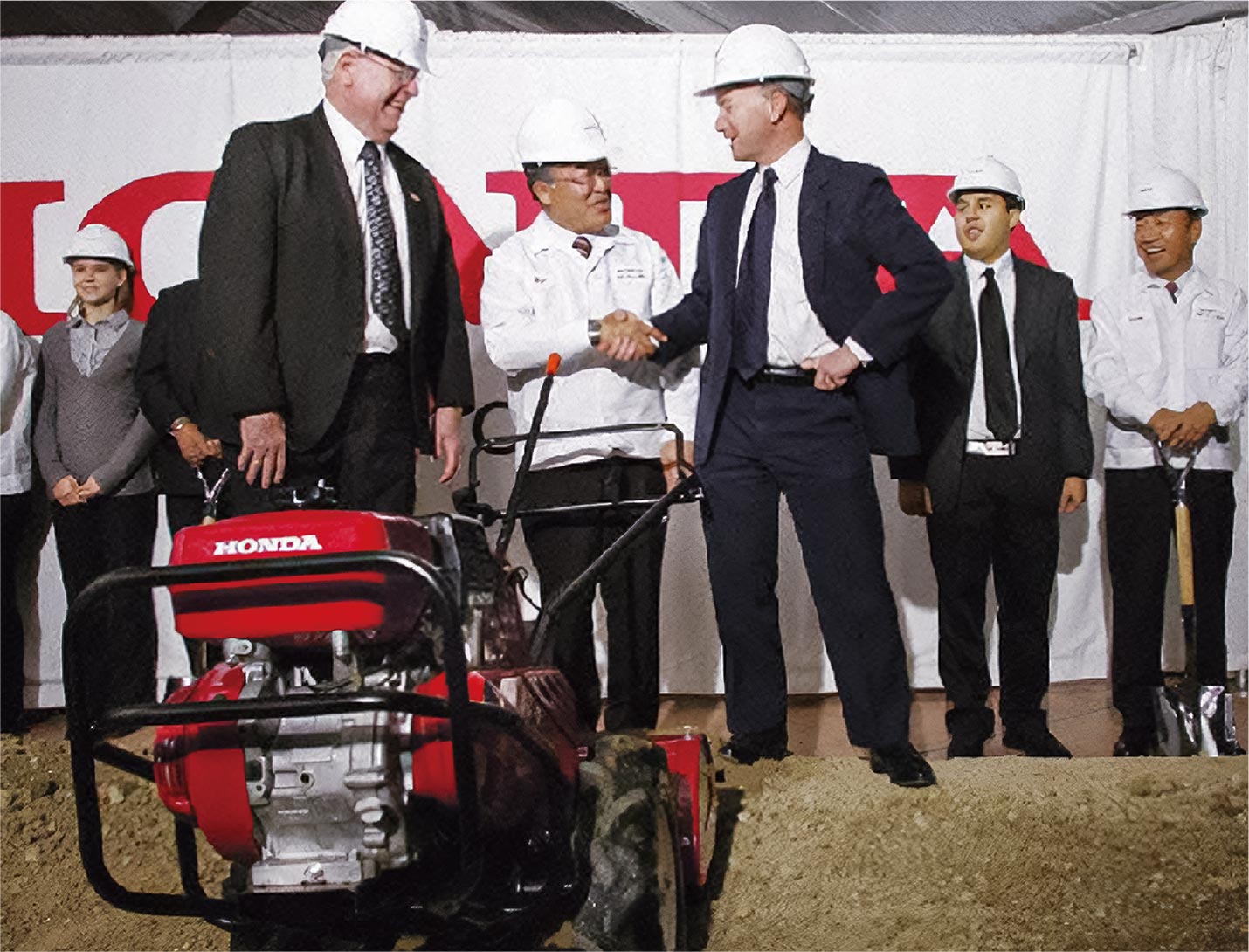
Construction begins on a new plant in Indiana, U.S.A.
While Honda was making such steady growth, the U.S. subprime mortgage crisis started in 2007, leading to the collapse of a major investment bank, Lehman Brothers Holdings Inc., in 2008, that contributed to a global financial crisis.
In his New Year's message in 2009, then Global CEO Takeo Fukui told Honda associates, “Looking back at the past year, the soaring prices of crude oil and raw materials and the rapid deterioration of the economy stemming from the financial crisis started in the U.S., have had an unprecedented impact on our business environment all around the world. In automobile markets, waves of stagnation swept over not only advanced countries such as Japan, the U.S. and Europe but also emerging countries. All automakers, without exception, have been facing sluggish sales, declining production volume and deteriorating earnings. The uncertainty in the economy is only increasing, and we must be prepared for tough times ahead in the next one to two years.”
While most of automakers fell into the red due to the global financial crisis, Honda barely managed to stay in the black. There were two key reasons for that. The strong demand for motorcycles in emerging markets helped Honda, and early establishment of a local automobile production system and capability based on its approach to “building products close to the customer” enabled Honda to avoid running a deficit despite the difficult situation with a downturn in demand for new automobiles. Above all, the fundamental reason behind Honda’s ability to stay in the black was the LOL (Lifetime Owner Loyalty) initiative Honda had been working in North America since 2003. The high ratio of brand loyal customers and high profit margin, that resulted from the LOL initiatives, helped Honda maintain a profit during this economic crisis.
In 2011, the Honda Executive Office conveyed a message summarizing its view of changes in society: “The world's economic structure has changed completely after undergoing the economic crisis triggered by the global financial crisis. The era in which the U.S. served as a major consumption base and Japan as a major production base, driving the world economy through the strong ties between the two countries has come to an end. The world is shifting toward a global multipolar structure.”
In order for Honda to adapt to such changes of the times and accomplish the transformation, Honda needed to address pressing and important issues, namely accelerating its speed of transformation to be at the forefront of other automakers and advancing its global operations.
7.Global Operations and Expansion in North America
Embracing a New Era, Going Back to the Starting Point:
Realization of “The Three Joys”
After the 2007- 2008 financial crisis, the world transitioned into the multipolarity.
In the automobile market, customers were accelerating a shift in their preference toward smaller electrified models with affordable prices, putting automakers into competition based more on the business structure and comprehensive strengths.
Emerging countries have significantly increased their standing as hubs for production and consumption, backed by their rapidly growing large markets. How Honda can enhance its presence in these markets would become a key factor for its survival.
Markets around the world were transitioning into an era where customers carefully consider and purchase from brands they truly desire. However, no matter how convenient people’s daily lives become, human desire for the “freedom of mobility” remains unchanged. How well Honda responds to and satisfies such a desire depends on what Honda pursues through its corporate activities.
As a result of the company-wide commitment to consistently deliver products with “a new level of outstanding quality” around the world, the number of quality-related customer complaints has been declining since the 2010 model year, and Honda was making progress toward the goal of the quality initiative to reduce the amount of quality-related expenses by half. The Initial Quality Study (IQS) conducted by J.D. Power rated Honda as having top-class quality in both Japan and North America for two consecutive years in 2011 and 2012.
However, before 2020, due to the simultaneous pursuit of product development which would maximize the joy of customers and expanding business volume, Honda faced challenges in keeping up with not only changes in the business environment, but also with the speed of the business expansion it strived for. This resulted in an imbalance of workloads, particularly in divisions involved in the product development and production.
As a result, Honda had to conduct multiple market recalls for new automobile models, causing inconvenience to customers and society and resulting in a decline in Honda's ranking in the Initial Quality Study (IQS) in North America.
In response to these circumstances and to continue to be a company society wants to exist, then Global CEO Takahiro Hachigo renewed his commitment to the realization of The Three Joys, Honda’s Fundamental Beliefs.
In order to maximize customers’ “joy of buying,” which means bringing joy to customers when purchasing, using, and continuously using Honda products, each and every Honda associate needs to constantly seek ways to realize the "joy of selling" and the "joy of creating" in their daily work. To this end, Hachigo demanded all associates to continue pursuing quality in their daily work in all areas including development, production, purchasing, sales and service, quality assurance, management and all supporting functions.
Moreover, in order to not only solve immediate issues but also to respond quickly to changes in the times, Honda had to have a vision for the future and take actions. Therefore, in 2017, as a new challenge Honda would take on toward the next era, Honda formulated the “2030 Vision,” which outlined what kind of company Honda wants to be in 2030, and began working toward it.
As the automotive industry undergoes a period of major transformation, with the anticipation of the acceleration of electrification, Honda embarked on a reform of its automobile production system and capability based on the policy to “optimize production allocation and production capacity on a global basis.”
Honda took steps to optimize its production operations in various regions, including Thailand, Japan and Brazil.
Also, Honda has been working to establish a production system that enables Honda to accommodate the acceleration of electrification, especially in high-demand markets such as China, the U.S. and Japan.
Unifying Automobile Manufacturing and R&D Functions
into One New Company in the U.S.
Amid the urgency to prepare for the electrified era and future automotive technologies such as CASE*6 and MaaS *7, declining profit margins for its automobile business had become a significant challenge for Honda. Since after the Gulf War in 1991, the sales ratio of light trucks, consisting of SUVs, minivans and pickup trucks, has been continuously growing in the U.S. market. Since the ratio surpassed 50% light trucks in 2001, this market trend has further accelerated.
To accommodate the rapid increase in demand for SUVs, Honda gradually ramped up CR-V production, resulting in inefficient operations with the same model being produced in five different factories in North America: Marysville, East Liberty, Indiana, Canada, and Mexico. To address these issues, Honda began working on the improvement of production efficiency by consolidating some production based on basic rules set for production allocation: a maximum of three models per production line and two factories per model.
In July 2020, functions served by Honda North America (HNA) responsible for support functions such as legal, public relations, human resources and IT functions, and Honda Patents & Technologies (HPT) responsible for managing intellectual properties for all Honda operations in North America, were consolidated into AHM. Subsequently, in April 2021, Honda consolidated all of its operations related to automobile manufacturing in the U.S., such as HAM in Ohio, automobile plants in Indiana and Alabama and engine and transmission plants, as well as HRA’s automobile R&D functions in Ohio, and established a new company, Honda Development & Manufacturing of America (HDMA).
This swift organizational reform enabled a transition to a simple structure of North American Regional Operations, where AHM took charge of business and product strategies and administration and support functions for the region while HDMA assumed responsibilities for the E&D (engineering & development) functions for the region.
The previous approach Honda took was to build region-specific operational structures with delegated authority, but as further globalization progressed, efficiency became a critical factor for both individual operations and Honda as a whole. The North American market was no longer growing as steadily and, thus, existing operations had reached their limits. While keeping the customer-first philosophy unchanged, adapting business strategies flexibly in accordance with the times had always been the core of Honda’s strengths. Embracing the concept of “One Team, One Honda,” Honda pushed forward with the reform of its business structure in North America.
- Connected, Automated, Shared (& Service), Electrified
- Mobility as a Service is the integration of various forms of transport services including public transportation, excluding privately owned vehicles, into a single, seamlessly connected mobility service.
Significance of Regional Models
As a result of Honda’s global strategy to strengthen development capabilities in various countries and regions, there has been an increase in the number of regional models developed locally to meet the needs of specific markets around the world. This approach not only enabled Honda to create better products by developing them close to the customer but also served as a means to increase the number of models without burdening the automobile R&D center in Tochigi (HGT), Japan.
However, there were some cases where certain regions were hastily demanded to handle tasks beyond their capabilities, resulting in the need to send engineers from HGT on long-term assignments to support the development of regional models.
To address this issue, Honda reevaluated its approach and further strengthened development capabilities in each region so that development of regional models such as Pilot, MDX, Ridgeline and RDX would be completed within their respective regions. This enabled the development capability in Japan to be dedicated to the development of global models such as Civic, CR-V, and Accord, which also required incorporating region-specific requirements for other regions. The idea behind this change was that regional operations have their roles to play in their respective regions, and global operations has roles that can be played only by the global operation.
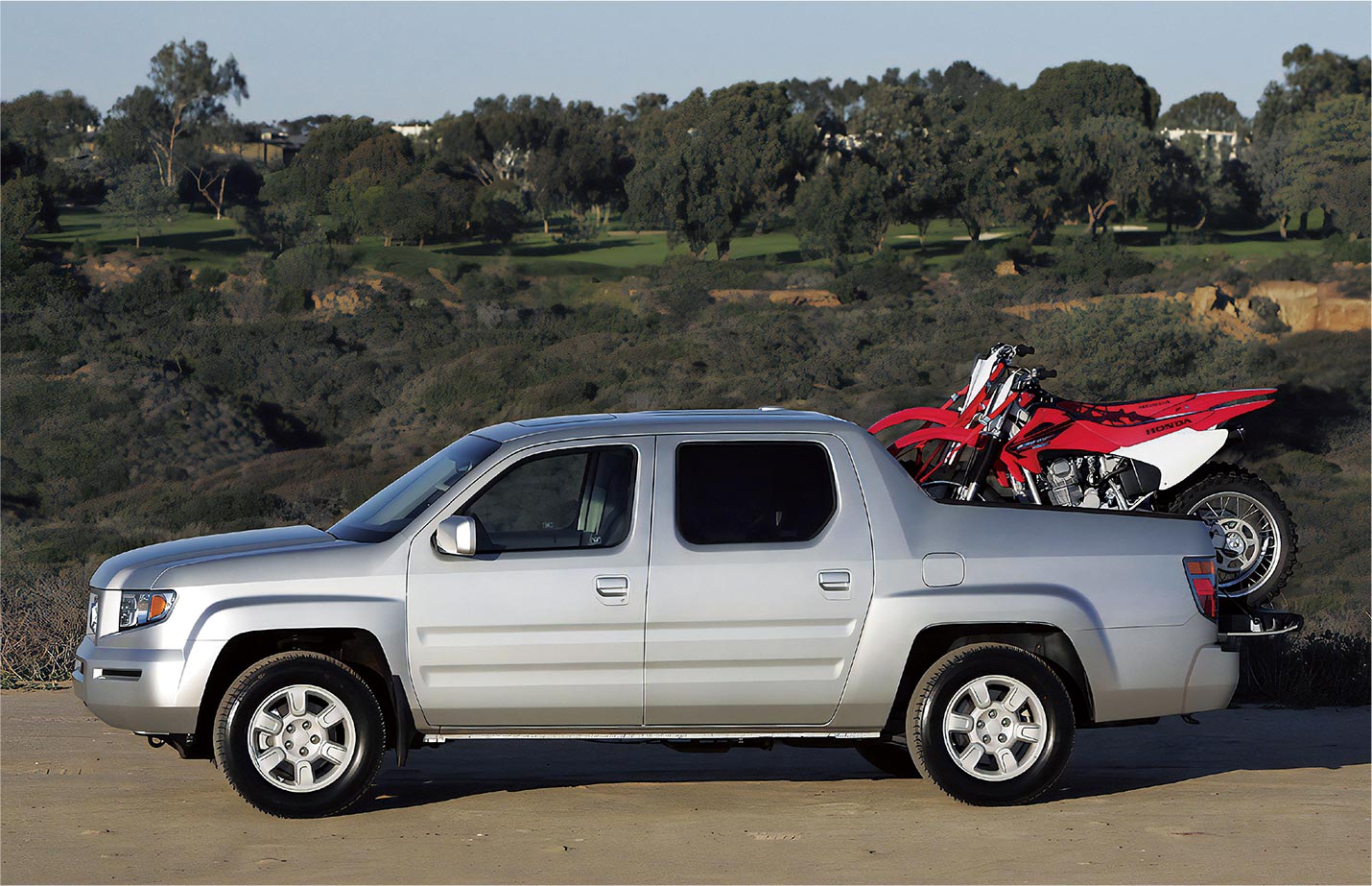
Ridgeline(2006 Model)
Alliance with GM
In April 2021, Honda announced its goals to increase the ratio of battery-electric (EVs) and fuel cell electric vehicles (FCEVs) within overall unit sales in all major markets combined to 40% by 2030, 80% by 2035, and 100% globally by 2040.
To accelerate electrification in North America, Honda decided to realize an earlier introduction of EV models by leveraging a strategic alliance with General Motors (GM), while also efficiently developing EV modes using “Honda e: Architecture,” Honda’s original dedicated EV platform.
Honda and GM had established a close collaborative relationship over the years. The relationship between the two companies was deepened first through the collaboration announced in December 1999 through which Honda supplied its V6 engines to GM. In 2013, the two companies began co-development of a next-generation fuel cell system and hydrogen storage technologies.
On June 28, 2021, Honda unveiled its plan for the introductions of EV models in North America in 2024, which would begin with the introduction of Prologue, the first volume all-electric SUV, to be followed by an Acura brand model (Acura ZDX, announced in August 2022). As its name represents, the Prologue will become an important model which will play a pioneering role for Honda in accelerating electrification in North America and working toward the realization of carbon neutrality.
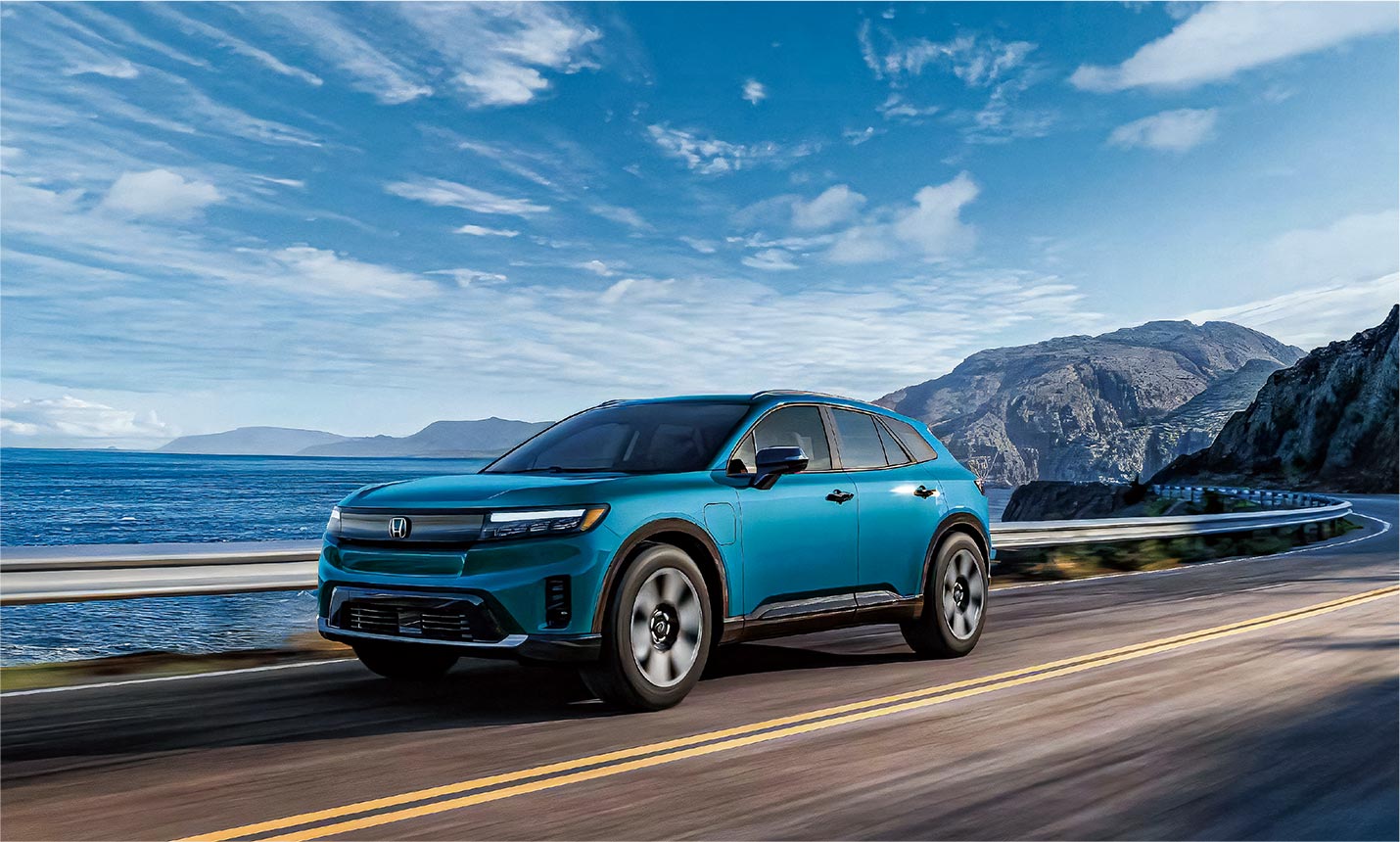
Prologue, the first EV jointly developed with GM.
At the core of EV development and production is the EV battery. Being able to procure a sufficient supply of high-performance batteries is a prerequisite for the success of volume EV models. To address this challenge, Honda adopted a procurement strategy optimized for each region. While collaborating with CATL in China and with Envision AESC in Japan, Honda decided to establish a joint venture (JV) with LG Energy Solution for EV battery production in North America.
In Ohio, Honda began local production of motorcycles in 1979 and automobiles in 1982. Now, Honda is establishing the new EV Hub in Ohio, which will serve as a center of Honda’s electrification strategy in North America.
This EV Hub includes the retooling of three existing plants where Honda will begin EV production: the Marysville Auto Plant (MAP), East Liberty Auto Plant (ELP) and Anna Engine Plant. These plants will play a role to solidify the foundation of Honda’s EV production that will be shared across Honda's entire North American auto production network in the coming years.
Honda’s EV Hub includes the new joint venture EV battery plant, which began construction in Jeffersonville, Ohio in 2023, with a plan to complete it by the end of 2024, and start mass production before the end of 2025.
EV batteries to be produced at this JV plant, near MAP and ELP, will be supplied exclusively to Honda plants in North America to produce Honda and Acura EVs to be sold in North America.
The 25 years between Honda’s 75th and 100th anniversaries will undoubtedly be a journey toward electrification. Just as Honda started a long journey of local production of automobiles about 40 years ago, the roadmap for the electrification in North America will begin from Ohio.
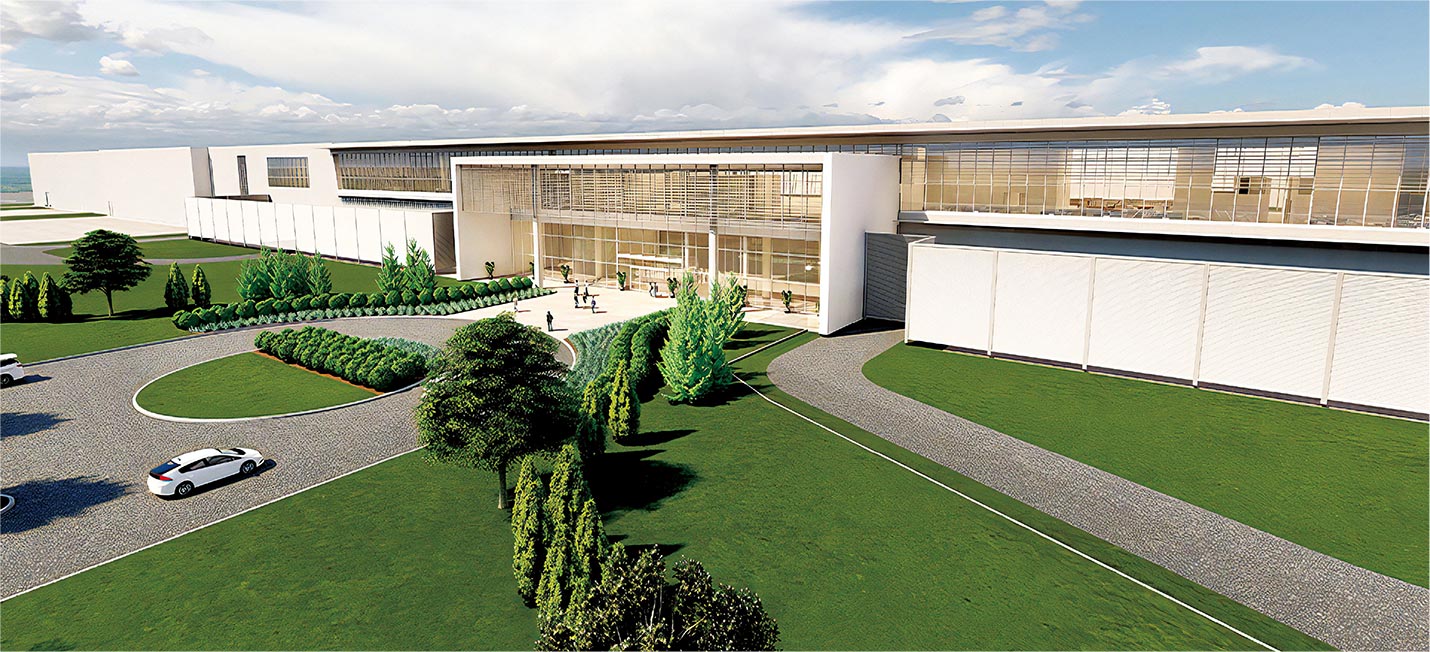
Lithium-ion battery plant through joint venture with LG Energy Solutions (as completed)
8.Coexistence with American Society: Initiatives to
Enhance the Daily Lives and Work of
Honda Associates and Members of the Community
Ever since Honda established its first local subsidiary in the U.S. in 1959, Honda has continued its activities with the unwavering commitment to become an integral part of society. This commitment was reflected even in the names of Honda companies in the U.S. Both American Honda Motor Co., Inc. (AHM) and Honda of America Mfg. (HAM) bore the word “America” in their names, indicating their spirit: “We are an American company, so let’s be an American company.”
However, merely becoming an American company wouldn't set Honda apart from local automakers. To find the true significance of Honda's existence in America, it was essential for Honda to be Honda, and become “Honda of America, or American Honda.”
In other words, Honda had a desire to thoroughly contemplate and instill the essence of what Honda is about, together with the American people. At HAM, it was called the "Honda Way," and at AHM, it was known as the "Honda Philosophy." Through ongoing discussions, associates of Honda operations in the U.S. sought to identify and create what Honda truly meant in America.
While the Honda Company Principle in Japan would naturally set the fundamental guiding principles, company leaders who created Honda in America decided not to simply copy the Japanese principle, but added supporting explanations so that American associates could fully understand it. This commitment to the local market had been passed down for many generations of Honda associates in America, who have been cherishing the unique corporate culture Honda established in America.
Making Sincere Efforts to be a Good Corporate Citizen
in America
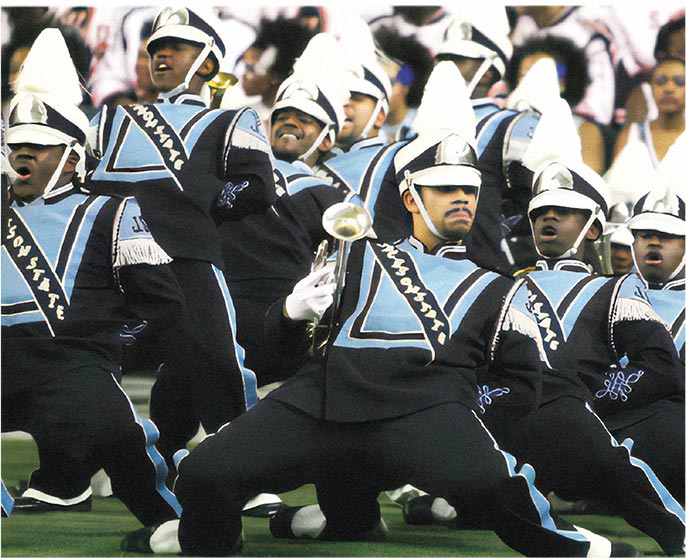 HBOB, a marching band intercollegiate competition that began with support for HBCUs
Honda has been continuing its efforts to become a good corporate citizen in the U.S. One such initiative has been offering support for Historically Black Colleges and Universities (HBCUs), which include more than 100 schools located primarily in the Southern states of the U.S. The special relationship between Honda and HBCUs began with the launch of the Honda Campus All-Star Challenge, an academic contest designed to showcase the excellence of HBCU students' academic achievements, in 1989. Moreover, in 2003, Honda held the first Honda Battle of the Bands (HBOB), where HBCU marching bands compete with their outstanding and soulful performance. Since then, over 20,000 student musicians have participated in HBOB. Honda's relationship with HBCUs further expanded in 2018 when Honda began contributing to the Thurgood Marshall College Fund (TMCF), the nation’s largest organization exclusively representing the Black College Community. Honda offers financial support including scholarships, internships and co-op positions to students pursuing an education in engineering, supply chain management and manufacturing-related fields at HBCUs.
Moreover, since being established by AHM in 1993, AHM has been supporting the Eagle Rock School, a year-round, residential and full-scholarship high school designed to help students who could not fit into the traditional educational environment. Located in the Rocky Mountains of Colorado, Eagle Rock not only operates as a school but also includes a Professional Development Center (PDC) that works with educators to help underfunded public schools all around the U.S. create healthy, high-functioning learning environments with the aim to improve student engagement.
As these initiatives indicate, in addition to making contributions to economic activities of American communities through expansion of employment through local production and local procurement of materials, Honda is making continuous efforts to assimilate into American society as a good corporate citizen in the areas of societal activities.
Just as there is never an end to developing better products, there is no finish line to Honda’s efforts to become a better corporate citizen. Honda will continue various activities to ensure that American customers take pride in owning Honda products. The spirit of “Let’s be an American company” has remained unchanged since the founding of AHM.
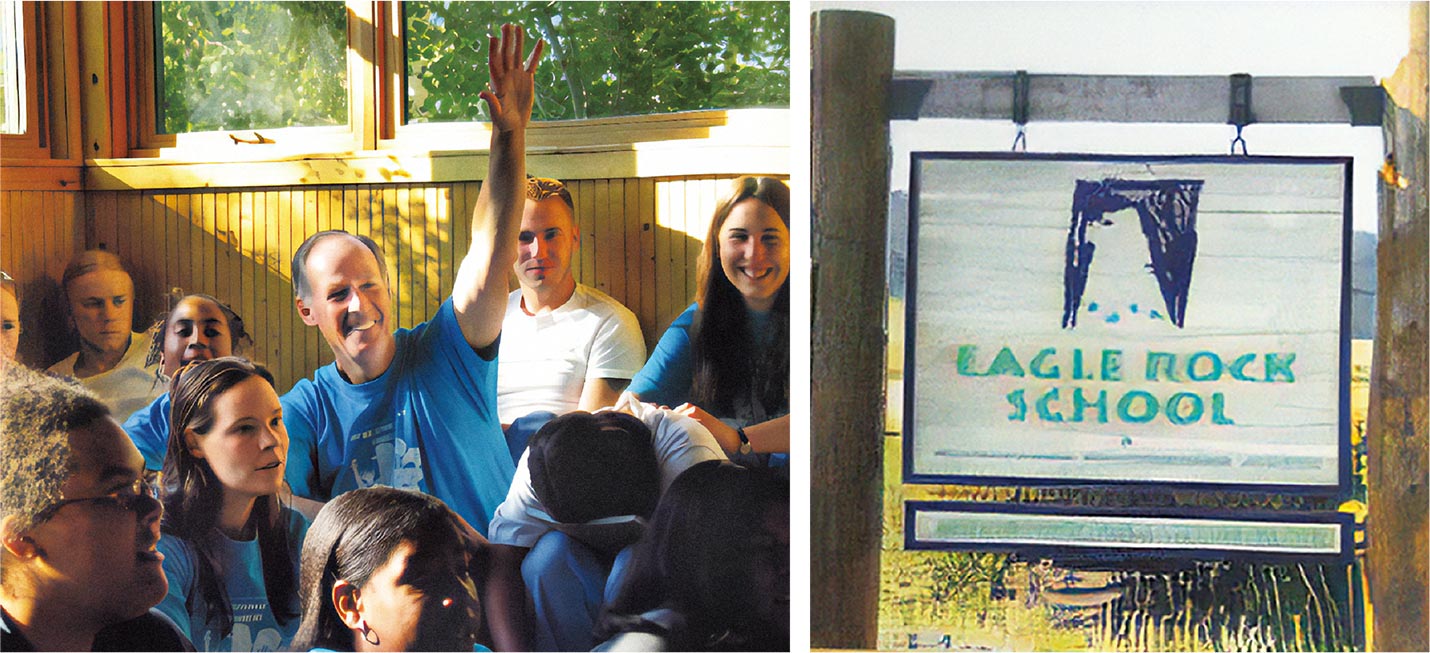
Eagle Rock School, a boarding high school with scholarships