
The NR4 That Never Raced
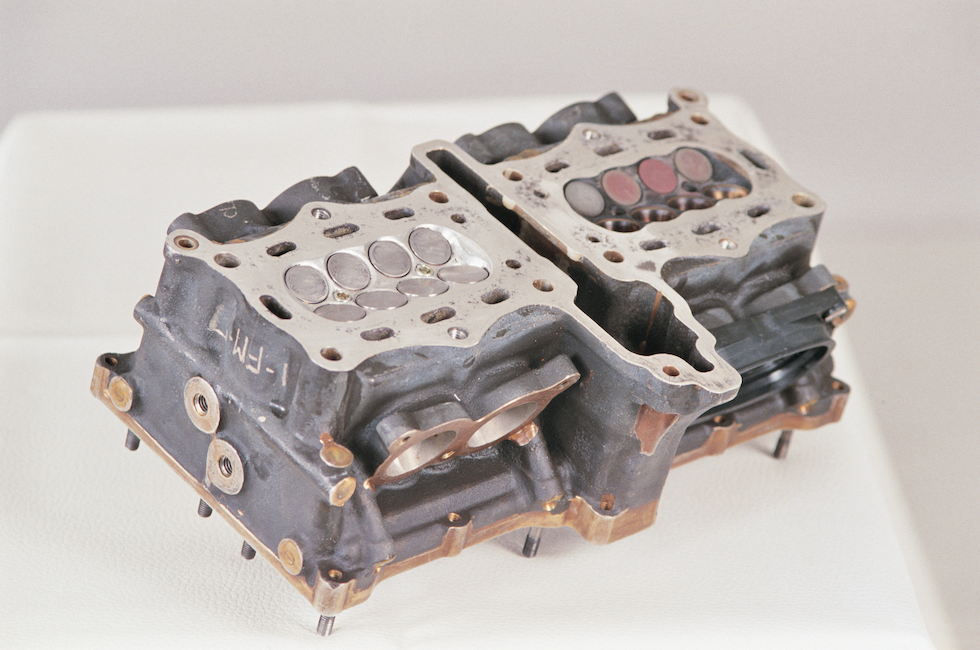
The cylinder head of the "3X" engine powering the NR4, the fourth-generation NR500. Each cylinder featured eight valves (intake and exhaust combined), with diameters of 18mm for the intake side and 16mm for the exhaust side; these dimensions remained consistent across the engines used in race-spec NR500s throughout the model's history. (Photo/Honda)
The British Grand Prix marked the third and final race of the NR500's sporadic appearances in the 1982 World Grand Prix season. Although the improved NR3-2.5X ridden by Ron Haslam suffered from carburetor issues during the race, Haslam, determined not to give up on his home Grand Prix, fought hard and managed to finish in 15th place. As the NR4 (the successor to the NR3) was never shipped to Europe for competition, the 1982 British Grand Prix became the final World Grand Prix event for the NR500 and, by extension, for any motorcycle powered by an oval-piston engine.
Just over a month later, in September of that same year, the NR4, the final iteration of the NR500, made its competitive debut.
The V4 engine powering the NR4 was designated the "3X." While it retained much of the design from its predecessor, the "2X," it incorporated a new design philosophy that boldly prioritized weight reduction and compactness. The cylinder bore dimensions, a major axis of 93.4mm and a minor axis of 41.0mm, remained unchanged from the single-cylinder "K0" test engine. Similarly, the 90° V-angle, the 37° valve angle (18.5° intake/18.5° exhaust), and the valve lift (7.0mm intake/6.5mm exhaust) were identical to those of the 2X. However, a key difference lay in the engine's mounting angle. Whereas the front cylinder bank of the 2X was positioned horizontally, the 3X was tilted upward by 25° to reduce the engine's overall length.
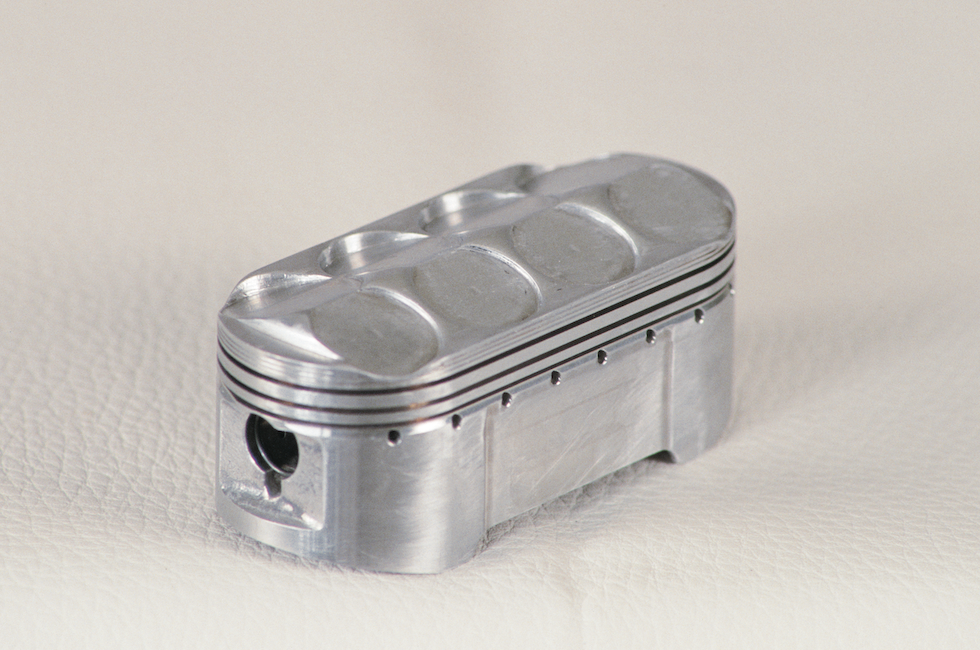
Forged aluminum pistons for the 3X engine. Consistent with the lineage of NR500 V4 engines, a three-ring configuration was used: self-tensioning top and second rings, and a bottom oil ring featuring an internal wavy expander spring. (Photo/Honda)
While the cam gear train in the 3X engine retained the central placement introduced with the 1X, the shafts were supported directly by the engine case, eliminating the need for the conventional cam gear holder. This design change reduced the engine's width by 40mm from 360mm in the predecessor 2X to 320mm. Additionally, the crankshaft support method was revised: instead of using a holder weighing several hundred grams per unit, the design now has the crankcase itself secure the bearing outer races. The separate-cylinder design was also abandoned in favor of integrating the cylinder barrels directly into the upper crankcase, adopting a "wet sleeve" configuration (in which the liner is cooled directly by the coolant). These changes achieved weight reduction while ensuring sufficient case rigidity. The 1X engine used in the NR2 weighed 64.5 kg, whereas the 3X engine was kept to 54 kg.
The engine produced a maximum output of 135 PS at 19,500 rpm, surpassing the NS500's output by 15 PS, a two-stroke machine from the same year (1982). The NR4 chassis housing this 3X engine featured a double-cradle frame constructed from pentagonal-section aluminum tubing, resulting in a vehicle weight of 140 kg (including engine oil and coolant, but excluding fuel). The power-to-weight ratio was 1.04, exceeding the 1.08 target set at the inception of the NR Project.
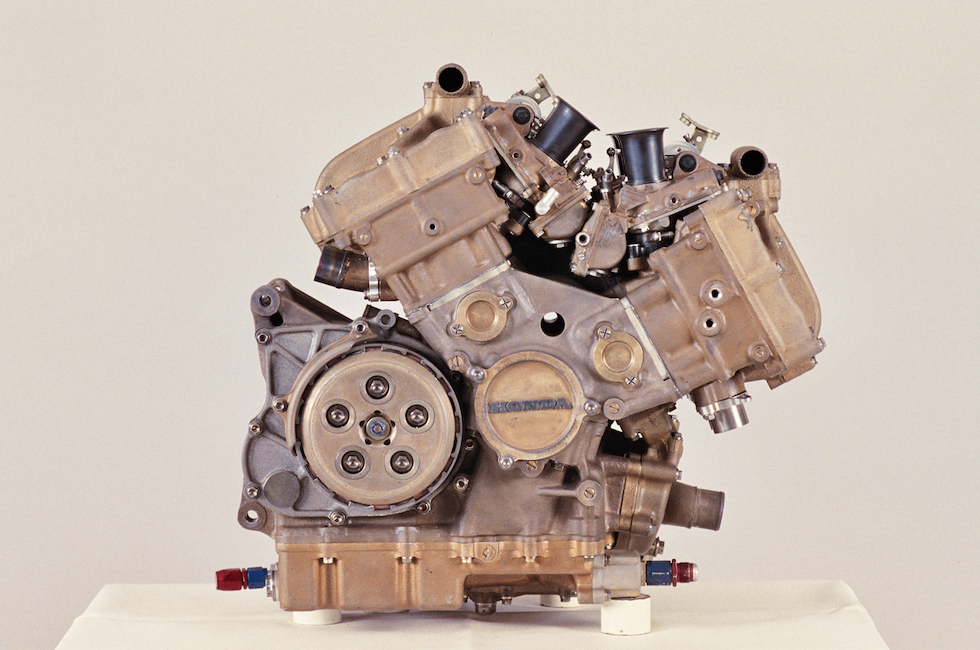
The right side of the 90-degree V4 "3X" engine. To achieve thorough weight reduction, non-load-bearing components such as the cylinder head cover, carburetor bodies, and oil pan were made from magnesium alloy. (Photo/Honda)
The state-of-the-art NR500, which delivers performance that matches or even surpasses 2-stroke machines of the same displacement, was set to make its race debut at the Japanese GP, the final round of the 1982 All Japan Road Race Championship. The race was scheduled for September 12. This timing coincided with the launch. On September 1, Honda Racing Corporation (HRC), a wholly owned Honda subsidiary specializing in motorcycle motorsports, was formed from the NR Project.
However, a massive typhoon dashed the NR4's chances. Although qualifying proceeded despite heavy rain, conditions were extremely hazardous, prompting HRC to instruct rider Kengo Kiyama to avoid pushing for a maximum-effort lap time. Consequently, Kiyama and the NR4 qualified only 14th. The following day, race day brought even more turbulent weather, leading to the cancellation of the 500cc class final. With no remaining rounds in the All Japan series that year, and no plans to field the NR4 in the West German GP (the only remaining event on the World Grand Prix calendar), the NR4 ultimately proved to be the final iteration of the NR500 and was effectively shelved without ever having the opportunity to demonstrate its true potential.
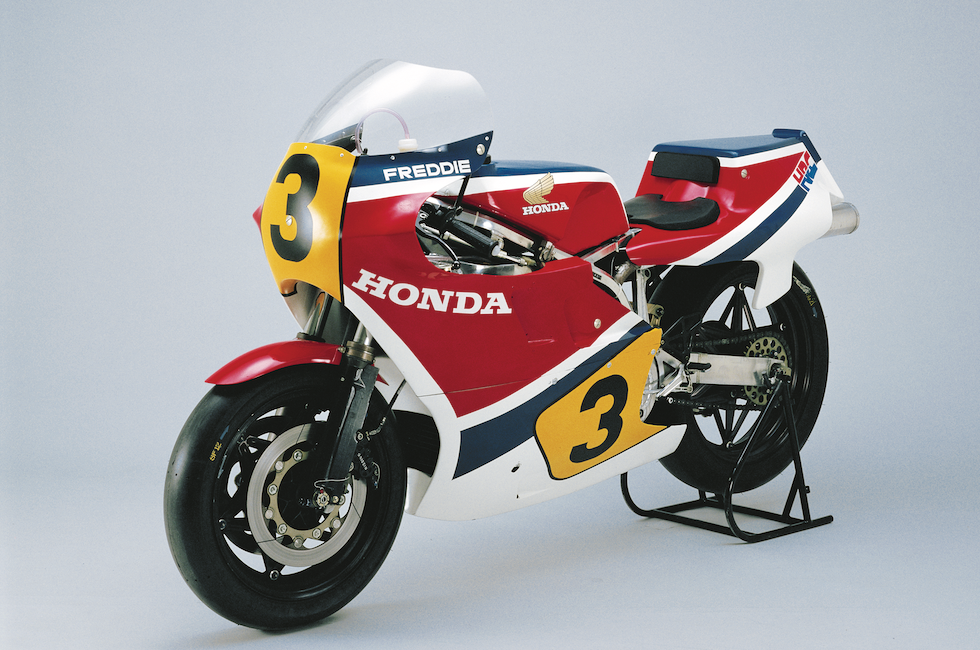
The NR4, featuring the 1983 Freddie Spencer livery. Spencer never actually raced this specific machine. (Photo/Honda)
Here is a photograph. It shows the Honda factory team livery used exclusively during the 1983 season, featuring a red-and-navy color scheme that was the reverse of the one seen in the World Grand Prix, along with the name "FREDDIE" and his 1983 race number. While Freddie Spencer became world champion that year riding the two-stroke NS500, the machine in this photo is not that bike; it is the NR4, the final iteration of the NR500.
The NR4 never competed in a race in 1983. Yet, the spirit of striving for victory through innovative technology remained undiminished. Many of the staff who developed the NS500 had also worked on the NR500, and they took pride in the challenge of a machine powered by a truly unique engine featuring oval-pistons and eight valves per cylinder. That is precisely why they lamented the fact that the NR4, the ultimate evolution of the NR500, never had the chance to demonstrate its capabilities. They couldn't help but wonder: "What if Freddie had ridden the NR4 to compete in the 1983 season...?"


