
Spencer Revs to 22,000 RPM
text=KIYOKAZU IMAI translation:SHINTARO URASHIMA
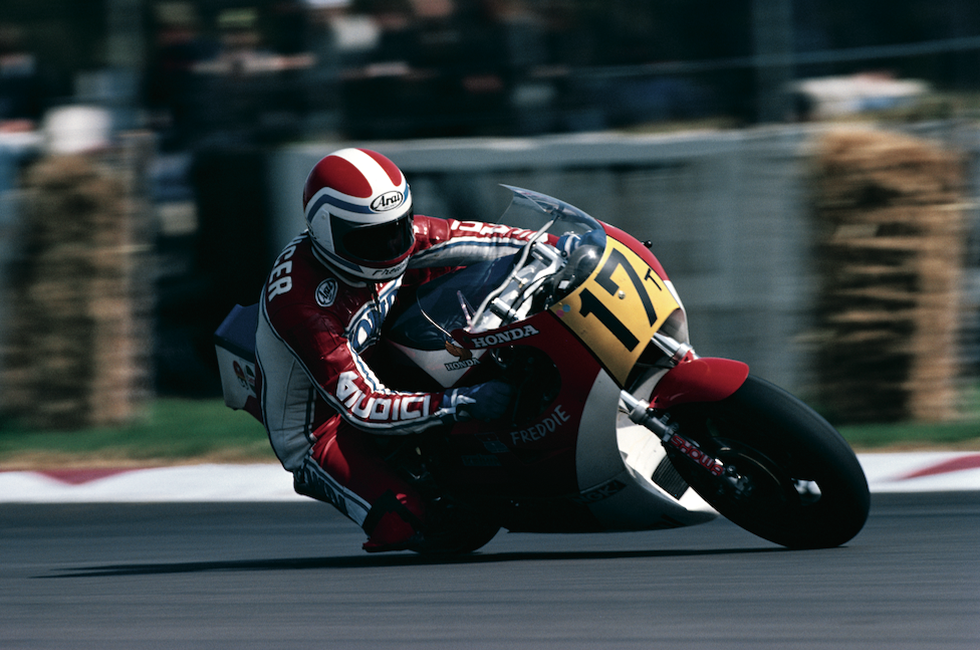
Freddie Spencer and the NR3 racing at the 1981 British GP. Amidst a field crowded with two-stroke machines, he charged hard, the roar of the four-stroke engine the only one of its kind echoing across the track. (Photo/Shigeo Kibiki)
1981 Laguna Seca & British GP: Demonstrating Potential
The "NR4": The Final Model That Never Raced
In July 1981, the NR Project brought the "2.5X" specification NR3 to the AMA Road Racing Championship event at Laguna Seca. It was a special race; the entry list included not only regular AMA riders but also several world-class elites, such as Yamaha's Kenny Roberts, the reigning World Grand Prix champion. Honda decided to challenge the field with the NR500, selecting Freddie Spencer as the rider.
Although Spencer was only 19 years old, Honda had long identified him as a talent destined to become a world champion; they had invited him to Japan in late 1980 to test the NR500 at Suzuka Circuit. During that test, he rode the "T-frame" NR2, and despite the unfamiliarity of both the track and the machine, he immediately clocked lap times close to the 500cc class record. Similarly, at Laguna Seca in July 1981, he rode the NR3 for the first time during a pre-race test a week before the event and once again demonstrated speed that rivaled the existing records.
Sure enough, Spencer and the NR3 won the qualifying heat race, a five-lap sprint held the day before the July 19th main event. What's more, they secured the victory by pulling away from "King" Kenny Roberts, who was riding a Yamaha YZR500. The members of the NR Project, who had spent two years without achieving results on the international stage and had worn worried expressions as a result, finally felt vindicated and relieved.
However, Spencer and the NR3 failed to finish in the two main heat races that constituted the actual Laguna Seca event. In Heat 1, a valve spring snapped on the sixth lap. Spencer's riding style placed a heavy load on the engine. He would shift up only when the engine stopped revving higher, rather than watching the tachometer, pushing the NR500 engine into uncharted territory at 22,000 rpm and causing the valve spring to fail. In Heat 2, he was forced to retire after a spark plug wire connection came loose; this, too, was believed to be a consequence of the extreme 22,000 rpm operation.
Nevertheless, it was a major achievement for the NR Project to demonstrate that by revving the engine to that extent and fully unleashing its potential, the NR500 could even outpace the likes of Kenny Roberts.
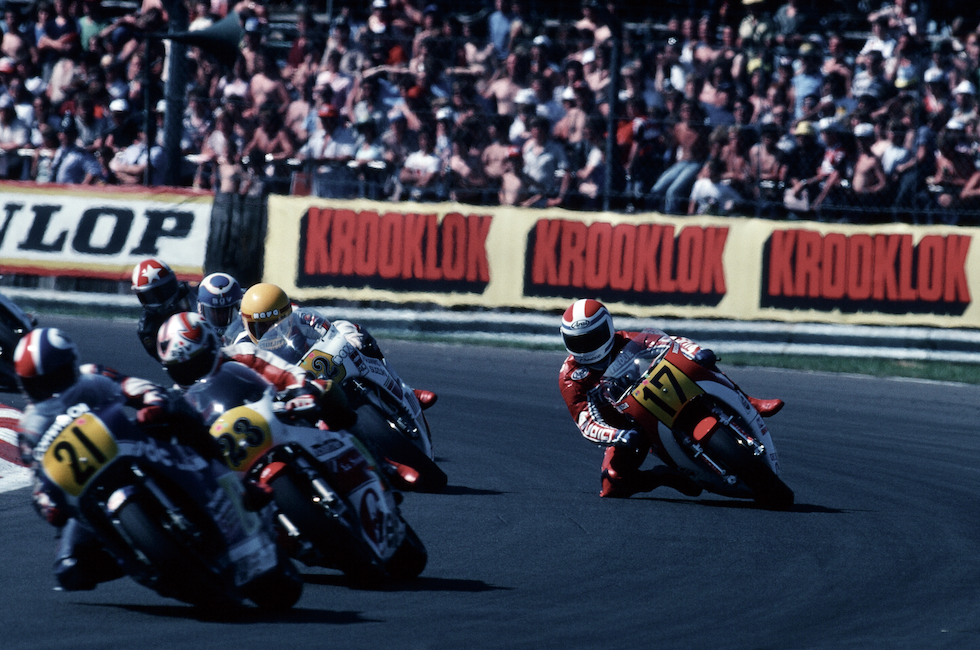
Competing in the 1981 British GP on the NR500, Spencer fell far behind at the start, a push-start procedure with which he was unfamiliar. But he subsequently charged forward with overwhelming speed, overtaking the formidable field of two-stroke machines one after another. (Photo/Honda)
The World Grand Prix British GP took place two weeks after the Laguna Seca race. It was Spencer, not the regular rider Takazumi Katayama, who rode the sole NR3-2.5X entered in the event. Katayama, fully understanding the situation, had ceded the role of racing in the British GP to Spencer.
When it came to the World Grand Prix with more competitive riders, things did not go as smoothly as the AMA race at Laguna Seca. Spencer and the NR3 still managed to qualify 11th. In the final race, his sluggish start put him near the tail end of the 40-bike grid. Over the next few laps, however, the 19-year-old American rider's performance on the NR500 was ferocious; he made a stunning charge, climbing all the way to fifth place by the fourth lap.
Yet, the NR3's 2X engine gave up the ghost on the fifth lap. Once again, Spencer had been pushing the engine into a "forbidden" rpm range, reportedly reaching 22,000 or even 23,000 rpm. Even special valve springs made from MAS-2, an improved version of the high-strength maraging steel, could not withstand such extreme engine speeds.
The NR Project staff were naturally disappointed. Nevertheless, it was undeniable that the NR500 had demonstrated clear speed on the World Grand Prix stage, changing the way Europeans viewed the machine.
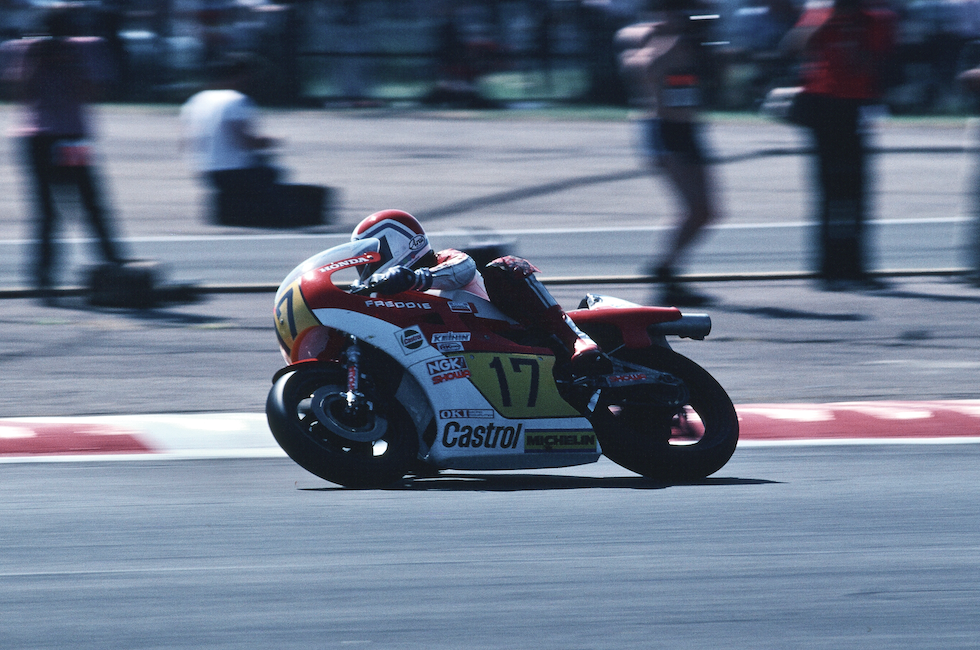
The speed Spencer demonstrated on the NR500 at Laguna Seca and the British GP brought great joy and confidence to the NR Project members. (Photo/Honda)
"We can make it even faster." This sentiment was shared by the staff involved in the NR500's development. Yet, they also understood the difficulty of realizing that goal. This was because the NR Project was simultaneously reaching the final stages of developing the new NS500 GP500 road racer, meaning the NR500 was no longer the team's primary contender.


