
Alongside the New Lead Contender: The NS500
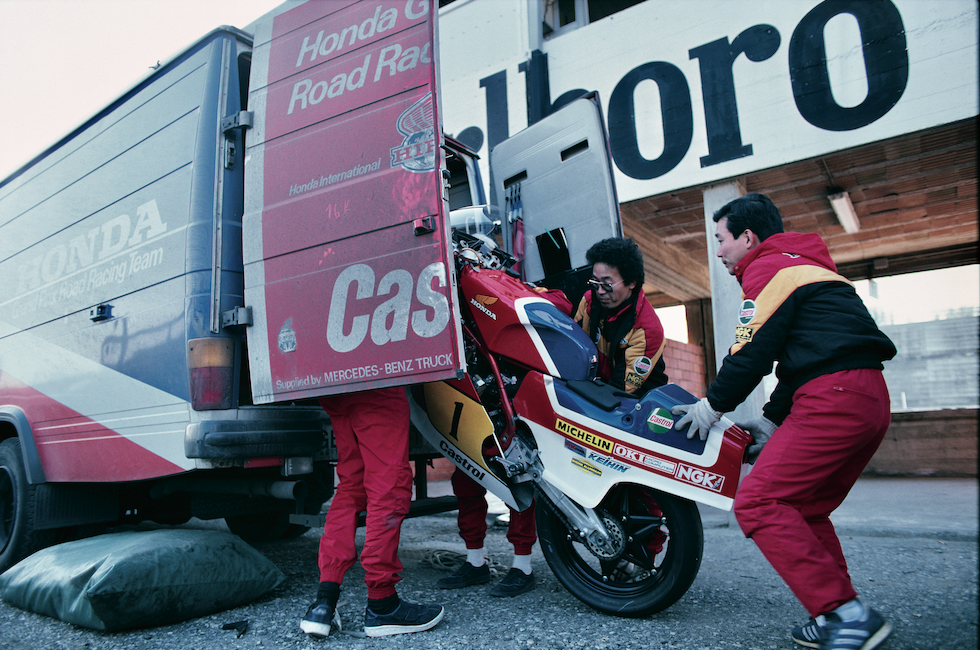
Before the start of the 1982 season, Honda brought its new NS500 machine to Misano, Italy, for track testing. The person on the far right of the photo, shown unloading the machine from the transporter, is Takeo Fukui, the overall leader of the NR Project, who would later serve as president of Honda. (Photo/Shigeo Kibiki)
By January 1981, track testing for the NR3 (featuring a newly designed chassis and engine) was underway, but its competitive debut had not yet occurred. The NR Project team had already decided to step the NR500 down from its role as the flagship machine.
At the time, Honda was in the midst of a fierce motorcycle sales battle known as the "HY War." Defeat was not an option; the principle applied equally to racing, where results directly influenced sales. Consequently, the mandate was to "win as soon as possible."
To meet this challenge, the NR Project team conceived the NS500, a new GP500 road racer. The machine was built by creating a brand-new engine, adopting the same two-stroke configuration as its rivals but using a unique V3 layout, and mounting it on a chassis that carried over technical specifications from the NR3. Development began in early 1981, and the prototype was completed by October of that year. Just over four months later, in March 1982, the machine made its World Grand Prix debut as Honda's new factory racer at the Argentine GP, the opening round of the season.
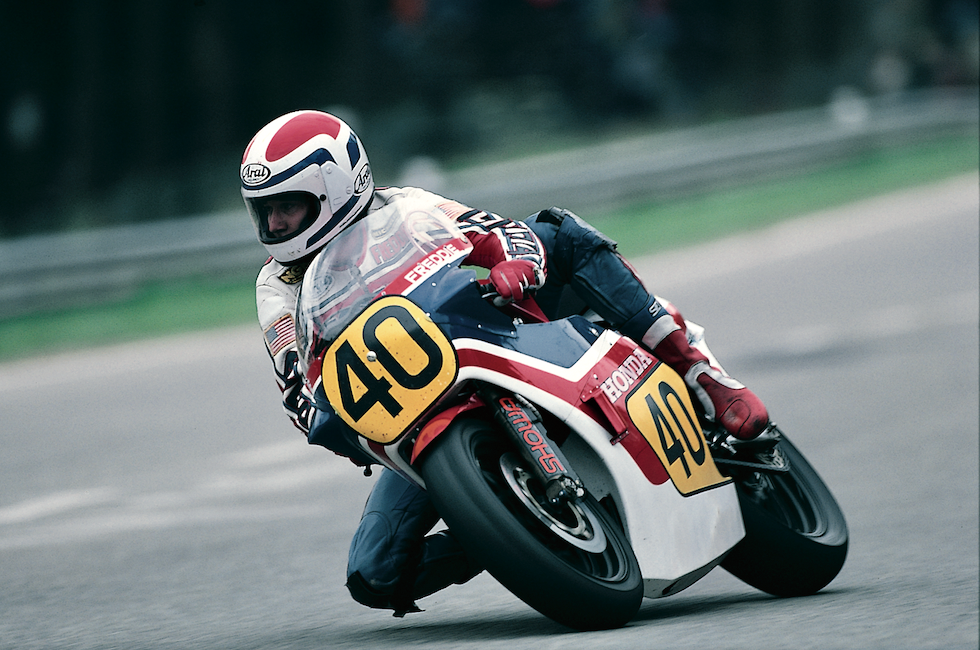
The two-stroke NS500 demonstrated high competitiveness from the start of the 1982 season, securing its first victory and Spencer's first at the Belgian GP in July of that year. (Photo/Shigeo Kibiki)
For the 1982 season, Honda decided to field only the NS500 in the World Grand Prix. However, this did not mean the NR500 project had been abandoned. Development of the "NR4", the fourth iteration of the NR500, had already begun in October 1981. Furthermore, an improved version of the NR3-2.5X was entered in three selected rounds at Suzuka of the 1982 All Japan Road Race Championship. Ridden by Kengo Kiyama in all three events, the bike failed to win but demonstrated performance capable of going toe-to-toe with the two-stroke machines.
This performance sparked a desire within the NR Project team to see how the evolved NR3 would fare in the World Grand Prix. Consequently, they arranged for "wildcard" entries in three rounds that had not originally been on the schedule. Ron Haslam, who had prior experience testing the NR1 and NR2, was selected as the rider; he finished 12th in the opening round, the Dutch TT. In the second round, the Belgian GP, he finished 11th, bringing the NR500 within striking distance of scoring championship points.
It is worth noting that the NS500, ridden by Freddie Spencer, won that same Belgian GP. It was an ironic twist of fate that the first victory for both Spencer and the NR Project was achieved on a two-stroke machine, thereby overshadowing the valiant effort put forth by the NR500.
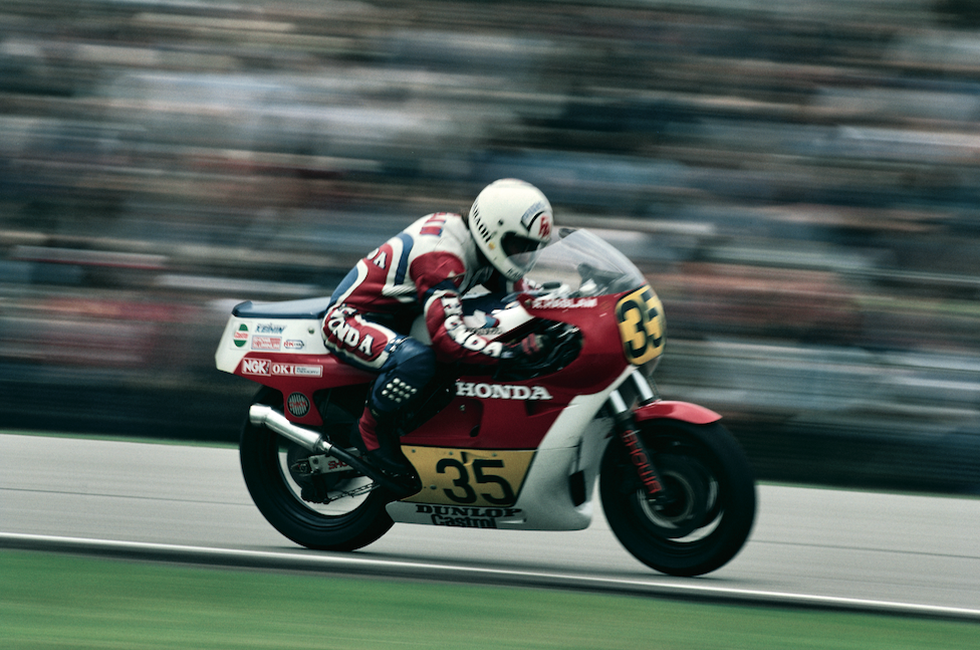
Ridden by Ron Haslam, who possessed extensive racing experience with four-stroke machines, the NR500 came close to scoring points in the World Grand Prix, where a top-10 finish was required. (Photo/Shigeo Kibiki)


