
To Beat a 2-Stroke Engine of the Same Displacement With a 4-Stroke Engine
The Project Named "New Racing"
zoom in on the image
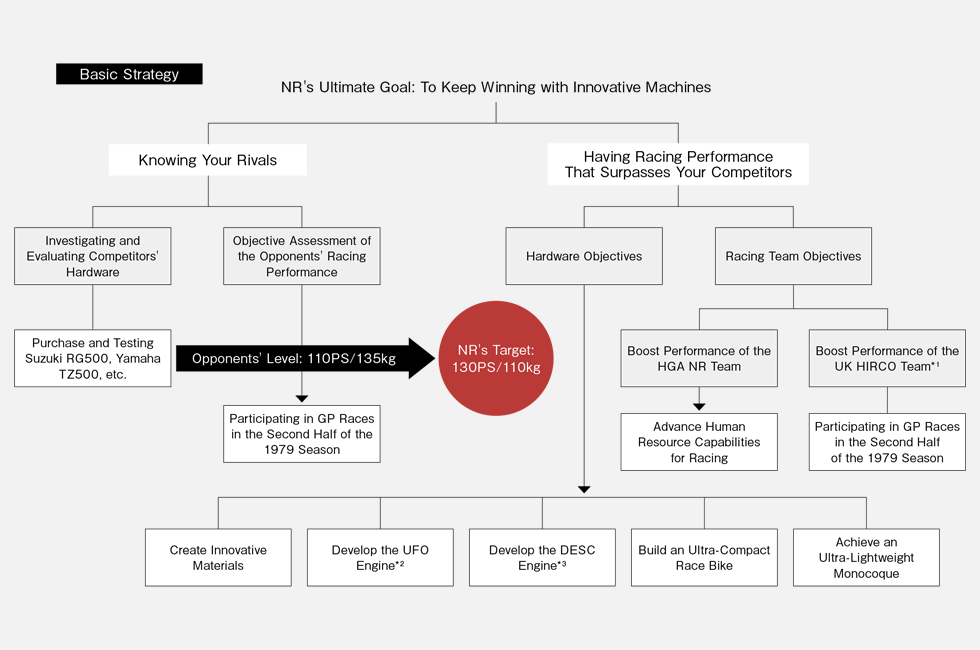
This flowchart, from the NR Road Race Project PHASE-1 Promotion Plan (November 1978), presents clear steps to reach the project's ultimate goal: surpassing rival manufacturers. It focuses on understanding opponents and building the skills needed to win.
*1: "UK HIRCO Team" refers to the World GP racing team established by the NR Project in the UK. "HIRCO" is an abbreviation for Honda International Racing Company Ltd.
*2: "UFO Engine" refers to an oval-piston engine. For secrecy reasons, the NR Project referred to the 8-valve, oval-combustion chamber / piston / cylinder technology as "UFO (Unidentified Flying Object)."
*3: "DESC Engine" refers to an engine equipped with a system that increases the density of the air-fuel mixture in the combustion chamber without a supercharger. "DESC" is an abbreviation for Direct Exhaust Super Charge. The idea was to open the air-fuel mixture valve on the exhaust port side twice and control it with a cam, but this was not implemented in the NR Project.
The name of the new project has been decided as "New Racing", or "NR" for short, operated by the newly established NR Block.
Many of the engineers gathered here had no racing or racing machine development experience. Honda recruited them with a focus on 'talent development.' Although highly capable, they faced development challenges and requirements in racing that differed from those in mass-produced motorcycles. Honda, from its 1960s racing activities, knew that such experience would greatly enhance an engineer's capabilities.
How should they approach the theme of "creating innovative technology"? Specifically, what vision should guide the development of the new GP500 road racer?
To address this, consider the context: At the time, the GP500 racer regulations allowed that whether the engine was a two-stroke or four-stroke, it had to have up to four cylinders and up to six gears. In World Grand Prix road racing, four-stroke bikes competed on equal footing with two-stroke bikes until around 1975. By 1977-1978, as engineers developed the NR Project, two-stroke bikes already dominated the 500cc class.
Two-stroke engines, with twice the combustion opportunities at the same engine speed as four-strokes, naturally yield more power for the same displacement. They also have fewer parts, making them lighter and easier to maintain. From a racing perspective, the advantages were undeniable.
"Even so..." thought the team leader, Irimajiri, and project leader, Fukui. "It wouldn't be interesting to do the same as everyone else."
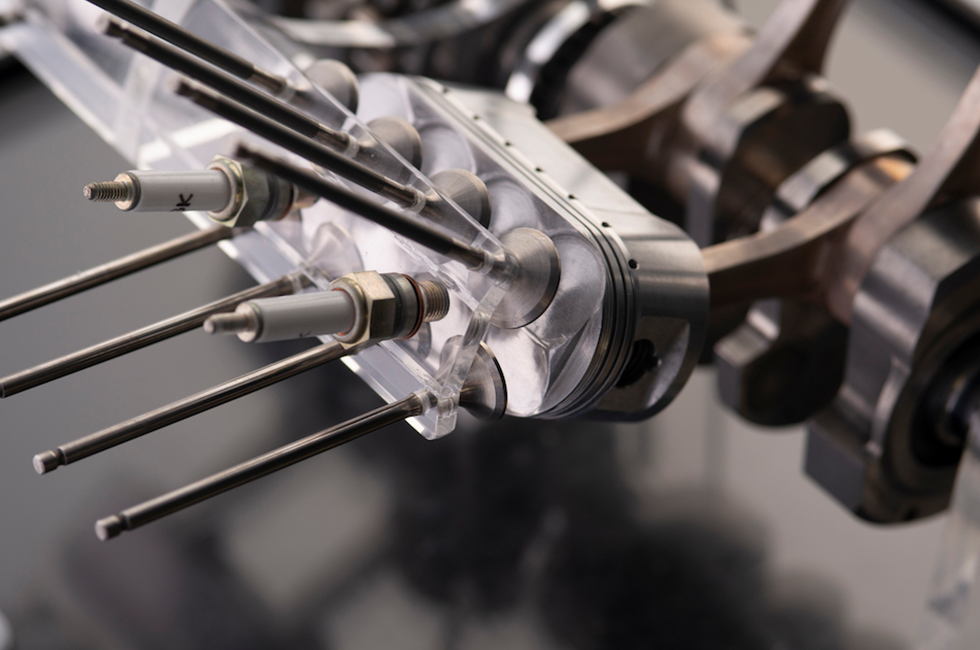
The NR500 engine was decided to be a four-stroke, intake- and exhaust-valve engine. However, to achieve power equal to or greater than that of a two-stroke engine of the same displacement, it required twice as many intake and exhaust valves and spark plugs, resulting in a combustion chamber and piston body that looked considerably different from those of a typical four-stroke engine. (Photo/Shinobu Matsukawa)
While a two-stroke engine would deliver power, it wouldn't bring real innovation. Four-stroke engines are essential for sports bikes seeking broader market appeal, so the new GP500 racer needed to be one. The challenge, then, was to outperform the two-stroke with a four-stroke. This was that kind of challenge...
Initially, the machine was developed before ultimately being named the "NR500." Notably, it was the only four-stroke among GP500 racers at the time.


