
"It's Not Interesting to Be the Same as Everyone Else"
text=KIYOKAZU IMAI translation:SHINTARO URASHIMA
The Background Behind the Planning of the First-Generation NR500:
"Creation of Innovative Technology and Human Resource Development"
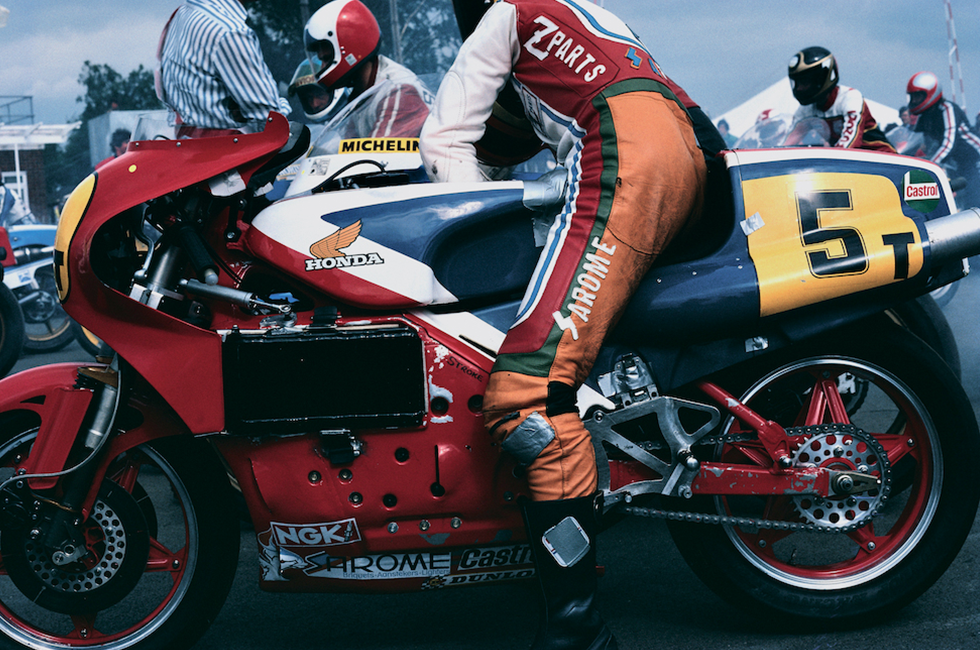
1979 Honda NR500 [NR1](Photo/Shigeo Kibiki)
In 1969, Honda released the Dream CB750 FOUR. As the first mass-produced motorcycle with a parallel four-cylinder engine, it became popular worldwide as an original big bike. However, after this initial success, the company struggled in subsequent years to produce a vehicle that would impress the market. As a result, during the 1970s, Honda's motorcycle sales stagnated in Europe and North America, where sports bikes were the main product.
This shift in focus was due in large part to Honda's intensive investment, from the late 1960s to the early 1970s, in strengthening its four-wheel vehicle business.
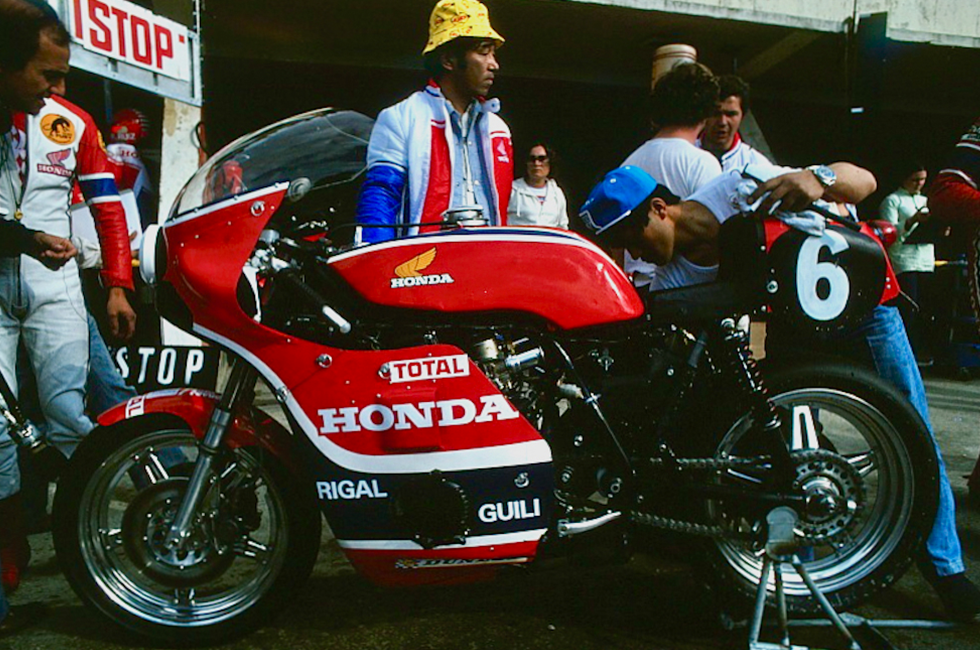
The RCB1000 won every race in the European Endurance Championship from 1976 to 1978, helping rebuild Honda's image as a "strong Honda." The photo shows the RCB1000 ridden by Hubert Rigal and Rene Guili at the 1976 Bol d'Or 24 Hours. The man wearing the yellow tulip hat is Michihiko Aika, president of RSC and director of the RCB project. (Photo/Shigeo Kibiki)
After successfully building its automobile foundation, Honda soon started to strengthen motorcycles business, which is the very foundation of the company. In December 1974, Honda established the Asaka R&D Center (known internally as ‘HGA’), a development institute specializing in motorcycles, within the Honda R&D Co., Ltd. And, it also took steps to resume its motorcycle racing activities.
At this stage in the mid-1970s, however, Honda did not yet have an organization ready to oversee the development of factory motorcycles or to manage racing activities. The company had halted its participation in the Road Racing World Championship ("World Grand Prix Road Race") in 1967, disbanding its Racer Design Office.
Despite ongoing organizational gaps, Honda's renewed racing ambitions led them to select the European Endurance Championship (which became the World Championship in 1980) as their target for resumption.
RSC (Honda Racing Service Center), Honda's motorsports subsidiary, was responsible for developing entry vehicles. Throughout the mid- to late-1970s, RSC primarily focused on competition parts for Honda motorcycle racers. This led to the development of the RCB1000, which utilized the Dream CB750 FOUR engine. Making its debut in 1976, the RCB1000 quickly began securing wins and went on to dominate the European Endurance Championship from 1976 to 1978.


