
Management
“Wear a Helmet, Protect Yourself” — Honda Vietnam’s Qualified Helmet Donation Initiative for First-Grade Students

POINTWhat you can learn from this article
- Honda Vietnam (HVN) is committed to achieving zero traffic fatalities by 2045 — five years ahead of Honda’s global goal.
- Responding to Vietnam’s unique traffic environment, HVN launched comprehensive traffic safety initiatives in 1999.
- Through the donation of qualified helmets and safety-education programs for all first-grade students nationwide, HVN is helping to raise road-safety awareness.
To achieve its goal of “zero traffic collision fatalities involving Honda motorcycles and automobiles globally” by 2050, Honda continues to advance a wide range of traffic safety initiatives. As part of these efforts, HVN launched its riding safety activities in 1999, and has donated qualified helmets*1 to first-grade students nationwide and delivered safety-training sessions for students’ parents every year since 2018. This issue of Honda Stories introduces some of HVN’s activities.
*1 Qualified helmets: Helmet complies with Vietnam’s national technical standards and has received official certification.
Pursuing zero traffic fatalities five years ahead of Honda’s global goal
HVN was established in 1996 as a local Honda subsidiary responsible for the design, production, sales, and after-sales service of motorcycles and automobiles. Since the launch of the “Honda Wave Alpha” in 2002—an instant hit with customers—Honda has maintained a market share of over 80% in the country (2024, statistic by VAMM — Vietnam Association of Motorcycle Manufacturers including Honda, Yamaha, Suzuki, Piaggio, SYM).
HVN established a Traffic Safety Center in Vinh Phuc Province (currently Phu Tho Province) in 1999 to promote rider training. Since 2008, HVN has been involved in the national project “Traffic Safety for Children’s Smiles,” led by the Ministry of Education and Training (MOET) and the National Traffic Safety Committee (NTSC).
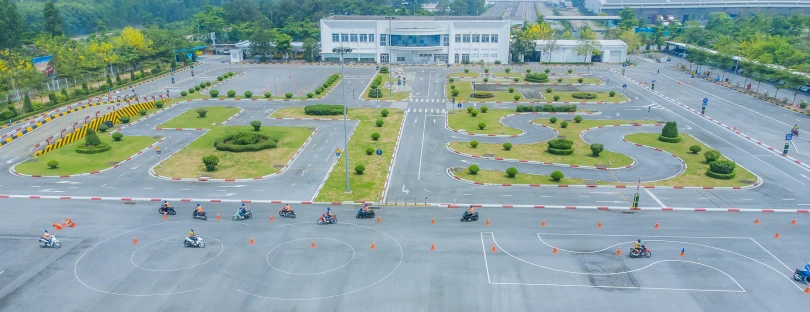 Traffic safety training session at HVN’s Traffic Safety Education Center
Since its founding, HVN has rolled out a wide range of traffic safety activities—from riding-training courses for farmers to traffic-safety programs for preschool children, high-school students, and vocational-school trainees.
Currently, HVN is working toward Honda’s goal of zero traffic collision fatalities involving Honda motorcycles and automobiles globally by 2050 and Vietnam’s national target of achieving zero fatalities due to road traffic accidents by 2045. To reach these milestones, HVN has established the “4E Strategy,” focusing on four key areas: Evaluation, Education, Engineering, and External Affairs. By collaborating closely with government agencies, HVN aims not only to achieve these goals but also to foster a safe traffic culture across Vietnam.
<Overview of 4E Strategy>
| Evaluation | Proposing effective solutions to improve traffic safety based on research findings on traffic accidents |
|---|---|
| Education | Providing traffic-safety education and materials to riders, pedestrians, and children |
| Engineering | Developing safe motorcycles, helmets, and related infrastructure |
| External Affairs | In partnership with government authorities to enhance traffic safety regulation in Vietnam |
Promoting safe riding practices for Vietnam’s unique traffic environment
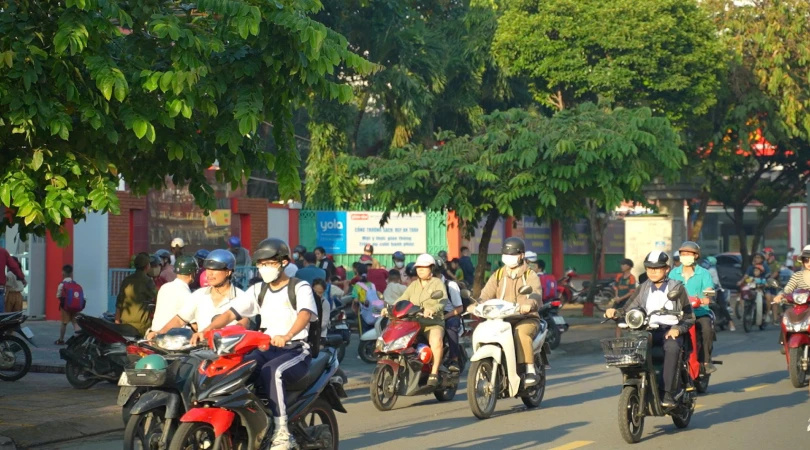 Hanoi traffic with a high volume of motorcycles
Motorcycles and mopeds are the primary means of transportation in Vietnam, with an estimated 770 motorcycles per 1,000 people and a daily total of 77 million motorcycles on the road*2. In recent years, Vietnam has made impressive progress in making roads safer for its riders through legislation, policy changes, awareness programs, and infrastructure improvements. However, the traffic fatality rate is still high among Southeast Asian countries.
Although helmet use was historically low, the government made helmet wearing mandatory on certain major roads in 2000 and nationwide in 2007. Strengthened enforcement and tougher penalties have steadily increased helmet-use rates among riders*3.
*2 Source: National Traffic Safety Committee(as of September 2024)
*3 Source: National Traffic Safety Committee(as of December 2017)
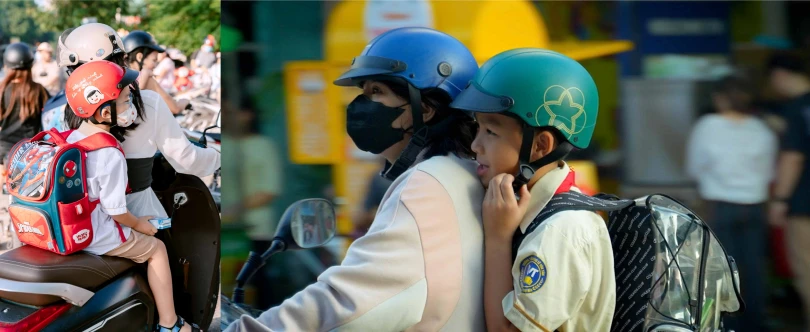 A rider riding with a child on the back seat
However, several challenges remain: riders wearing inexpensive and insufficient quality helmets that fail to meet national safety standards, incorrect wearing practices such as failing to fasten straps properly, and low helmet-use rates among passengers especially children.
Data shows that 42% of motorcycle fatalities and 69% of head injuries*4 were linked to not wearing helmets. Recognizing the importance of qualified, standard-compliant helmets in preventing fatal injuries, HVN launched a nationwide qualified helmet donation program for first-grade students in 2018.
*4 Source: WHO website
The goal of this project is to establish proper helmet-wearing habits among motorcycle users by increasing the use of nationally qualified helmets to nearly 100%, and to raise safety awareness among students and parents through training and communication activities. First-grade students at a key stage of cognitive development were identified as the ideal age group to build a lifelong habit of wearing a helmet whenever riding as a passenger.
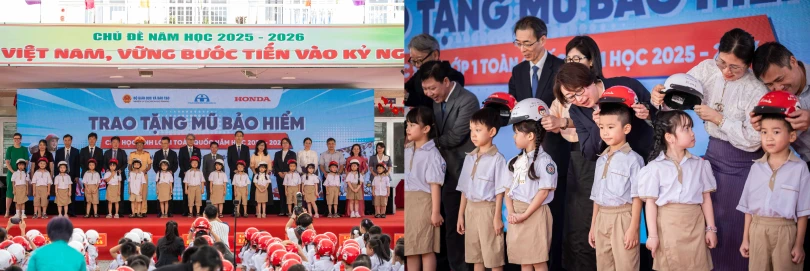 Donation ceremony held on October 2, 2025, attended by approximately 1,700 participants
Donating qualified helmets to first-grade students nationwide
In October 2025, HVN, together with the National Traffic Safety Committee (NTSC) and the Ministry of Education and Training (MOET), held its first helmet-donation ceremony at Van Bao Primary School. The event combined helmet donation with traffic-safety training for students and parents, drawing roughly 1,700 participants.
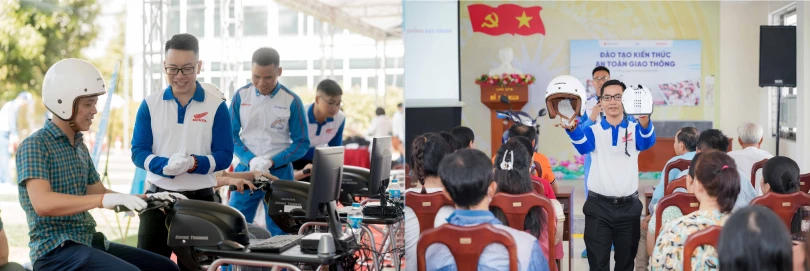 Parents participating in the training session
Notably, the event was attended by director of Honda Motor – CEO Toshihiro Mibe and Vice President Noriya Kaihara. The presence of Honda Motor’s top management at the ceremony served as a strong testament to the company’s highest-level commitment to traffic safety, underscoring how central this mission remains in Honda’s global priorities.
Regarding the decision to focus the donation program on first-grade students, the general director of HVN, Ms. Sayaka Arai explained:
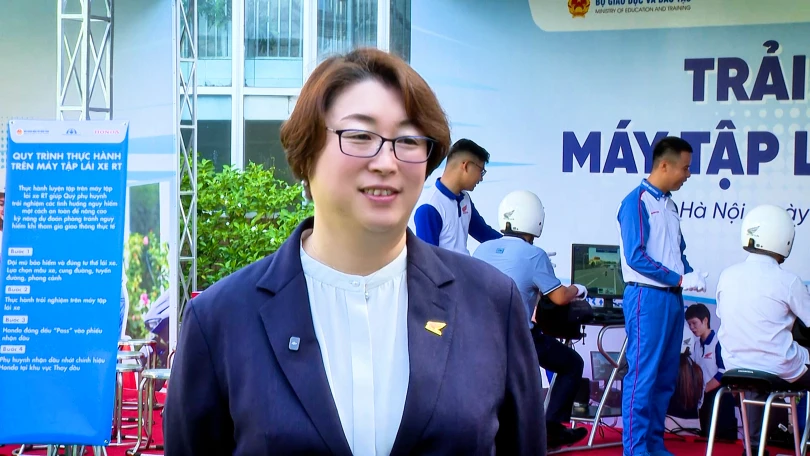 Ms. Sayaka Arai – General Director of Honda Vietnam
Parents shared positive feedback such as “the training was useful and memorable” and “it will help me teach my child how to wear a helmet properly.” Students also expressed excitement and appreciation. NTSC and MOET commented that “helmet donation is an essential activity for the new school year,” recognizing the value of HVN’s initiatives.
Since 2008, HVN has delivered traffic safety education to students across all school levels. From 2018 to this day, HVN has donated a total of 12 million qualified helmets and provided safety training to seven million children and parents. As a result, the helmet-use rate among children and students has improved from 37% before 2018 to 85% in 2024*5.
*5 Source: NTSC website and internal research by HVN & NTSC
Honda Vietnam believes that proper helmet use and early traffic safety education are key to building long-term safe road habits. We are proud to see our long-standing efforts making a tangible impact, and we will continue to strengthen these initiatives as we work toward achieving zero traffic fatalities in Vietnam by 2045.
For HVN, each helmet represents a promise—the promise of safe journeys to school and the promise of supporting every child’s dreams. In addition to motorcycle safety initiatives, HVN also actively implements driver-safety training programs for automobile customers, further strengthening its overall traffic-safety activities in Vietnam.
These initiatives complement HVN’s long-standing efforts to build safe and responsible mobility habits across all road users. Through ongoing collaboration, donation, and education, HVN remains committed to building a culture of traffic safety and creating a future where everyone in Vietnam can travel with peace of mind.







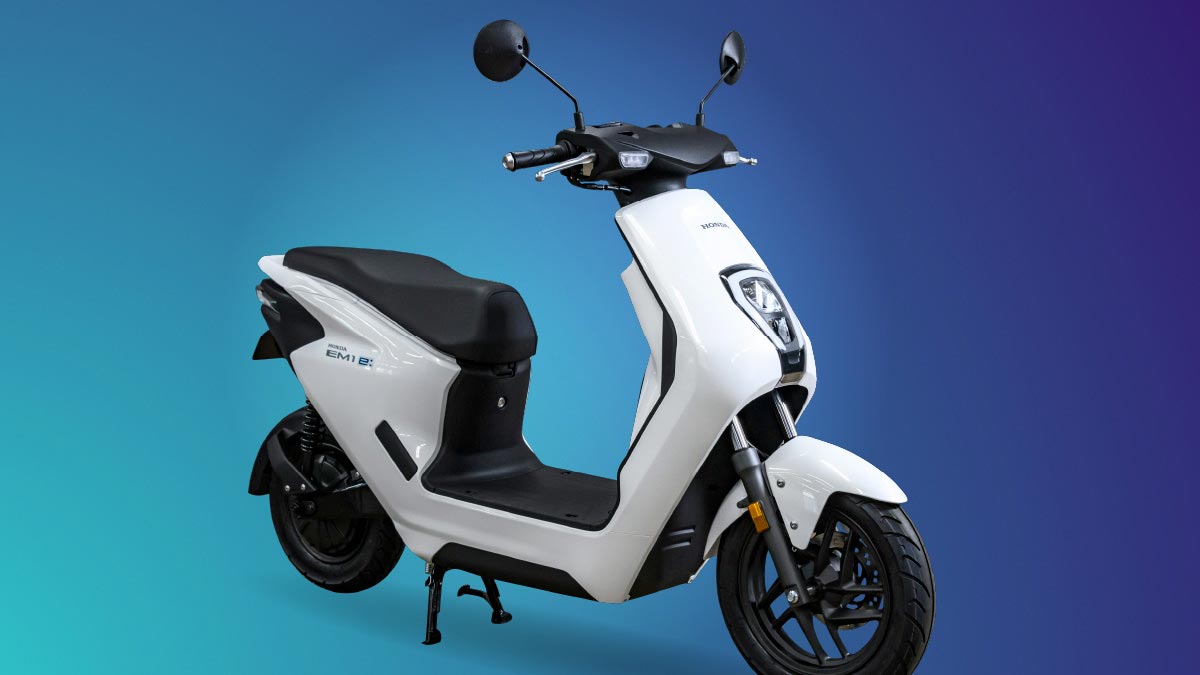
First-grade students are at a formative stage of thinking, so giving them the habit of always wearing qualified helmets when sitting on motorcycles is extremely important. We do hope that the lovely and qualified helmets given to pupils on their first day of first grade will create a memorable moment and encourage the habit of always wearing qualified helmets in traffic in the future.