
Management
Why Honda Takes on the Challenge of Space: Behind the Scenes of Sustainable Rocket’s Successful Launch and Landing Test, and Dreams Envisioned by its Engineers
POINTWhat you can learn from this article
- Honda is advancing projects in the space domain, including a circulative renewable energy system, space robotics, and sustainable rockets.
- Honda is challenging the space domain to enrich people’s lives by leveraging its core technologies.
- The development of sustainable rockets utilizes core technologies cultivated through such as automobiles, HondaJet, and Formula 1.
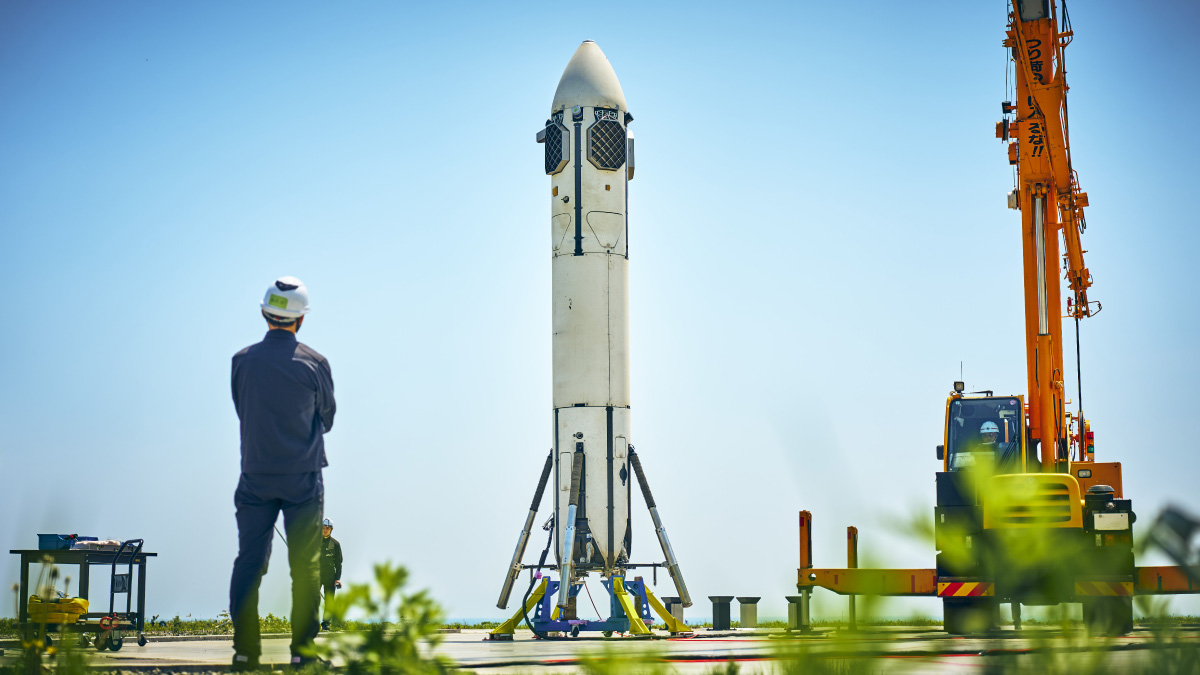
Honda began research in the space domain in 2019. While working on three projects—a circulative renewable energy system, space robotics, and sustainable rockets—Honda conducted its first sustainable rocket launch and landing test on June 17, 2025, reaching an altitude of nearly 300 meters. The test successfully verified key technologies, including rocket stability during ascent and descent and landing functionality.
But why is Honda challenging the space domain? What is Honda’s dream for rockets? Through interviews with the engineers who formulated Honda’s space strategy and developed the rocket for launch and landing tests, this issue of Honda Stories shares the significance of Honda’s space challenge and the untold stories behind the rocket research.

Chief Engineer, Sustainable Rocket Project Manager,
Space Strategy Office, Honda R&D Co., Ltd.
View More
Close
Junichiro Ishimura
Chief Engineer, Sustainable Rocket Experiment Implementation Manager,
Innovative Research Excellence, Honda R&D Co., Ltd.
View More
Close
Kenichiro Ikeya
Chief Engineer, Sustainable Rocket Development Manager,
Innovative Research Excellence, Honda R&D Co., Ltd.
View More
Close
Asao Uenodai
Honda takes on the challenge of space to expand human’s potential
Why did Honda take on the challenge of space? It feels like a bold endeavor.
![[Left] Ishimura, Sustainable Rocket Project Manager [Center] Ikeya, Experiment Implementation Manager [Right] Uenodai, Development Manager](/content/dam/site/global-en/stories/cq_img/177-2509-space-rocket-interview/09.webp) [Left] Ishimura, Sustainable Rocket Project Manager [Center] Ikeya, Experiment Implementation Manager [Right] Uenodai, Development Manager
[Left] Ishimura, Sustainable Rocket Project Manager [Center] Ikeya, Experiment Implementation Manager [Right] Uenodai, Development Manager
What kind of space-related projects is Honda currently working on?
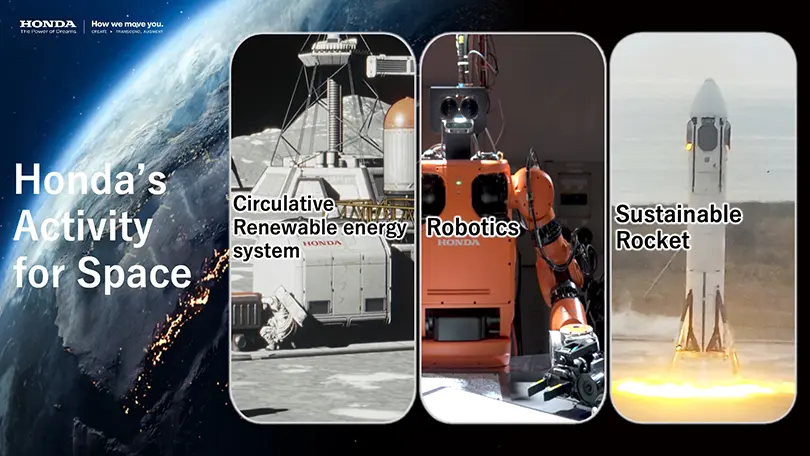
In the beginning, there were many teams conducting various research activities. We consolidated these efforts and established the Space Research Team in 2019, defining Honda’s objectives for space exploration and the key areas to focus on. Aligned with this policy, we are currently advancing three research projects. The rocket project is one such project.
1. Circulative Renewable Energy System
A system that generates and recycles oxygen, hydrogen, and electricity from sunlight and water. It aims to produce the oxygen, hydrogen, and electricity needed for long-term human activities in space on-site, for use in manned bases and mobile vehicles.
2. Space Robotics
Remotely operated robotics designed to work in a harsh space environment. Through these space robotics remotely operated by humans from safe locations, to be utilized in various locations such as the lunar surface and orbital facilities, Honda aims to expand humanity’s sphere of activity.
3. Sustainable rockets
Rockets to transport satellites and other payloads into space. Aim to realize sustainable space transportation through a reusable rocket powered by renewable fuel.
* For an overview of Honda’s space projects, refer to “Honda Introduces Initiatives in New Areas”
Why did you decide on rockets as a research theme?
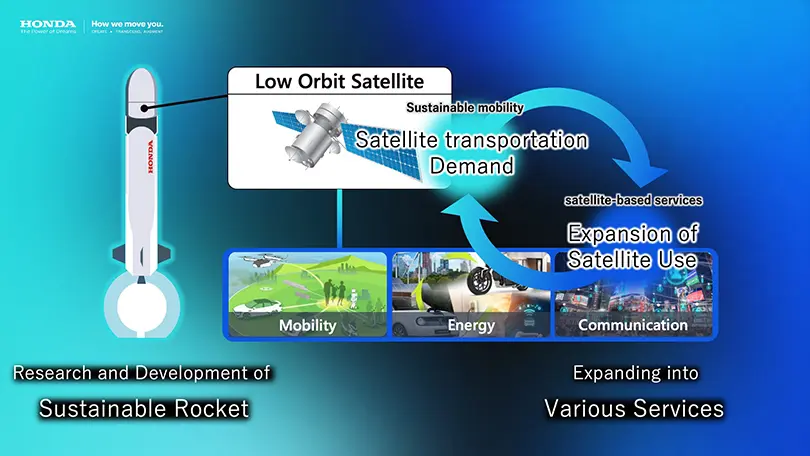
We believe that global economic activity will shift from the mobility of people and goods to the movement of data, leading to an explosive increase in data flow. Honda has expanded people’s lives through its mobility products on the ground and sea, and in the sky. It feels natural for Honda to contribute to the movement of data, and we see it as significant for Honda’s evolution as a mobility company.
To achieve this, we need more satellites for data communication, which makes rockets essential for transporting them into space. However, currently operational rockets are extremely expensive to launch, creating a high barrier to entry for private companies and startups. To solve this, we aim to contribute to the expansion of satellites by lowering this barrier through efforts like reducing rocket costs, improving convenience, and developing sustainable transport rockets.
To build a rocket only Honda can build, leveraging core technologies from automobiles, the HondaJet, and F1
Why did you take on the challenge of developing technologically-complex reusable rockets?
As a company conducting business on Earth, Honda always considers environmental impact in its research and development. The same applies to rockets. Even if the technological hurdles are high, we believe we should strive for sustainable reusability rather than discarding rockets after each use.
Which Honda technologies are applied to these rockets?
Broadly speaking, rockets have some components in common with automobiles, and we are leveraging core technologies such as combustion and airframe control developed through product development. We have also referenced technologies cultivated not only in automobiles but also such as the HondaJet and F1. In the development of our experimental rocket, we also consulted various departments within the company, which made us once again realize the breadth of the technologies and expertise Honda has cultivated.
What was the most challenging aspect of developing the test rocket?
The turbopump, which delivers methane and oxygen from the tanks to the rocket engine's combustor, was the most challenging. It plays a crucial role, essentially serving as the rocket's heart. Rocket engines use liquid propellants at extremely low temperatures, ranging from approximately -160ºC to -180ºC, and we had absolutely no prior expertise in this area within the company.
We knew that developing our own turbopump would be a high hurdle, but we remained committed to doing it ourselves. We persevered with development and were able to install it on our experimental rocket for the launch and landing test.
Why did you insist on developing your own turbopump?
The turbopump is so critical that its performance essentially determines the rocket's quality. Even if we ultimately outsourced this key technology, we believed it was vital to first attempt it ourselves to understand just how difficult it is.
In our launch and landing test, we launched the rocket to an altitude of 271.4 meters. Reaching that height is possible without a turbopump. However, Honda's ultimate goal is to deliver satellites into space. Since a turbopump will eventually be necessary for reaching space, we included it even at the experimental stage.
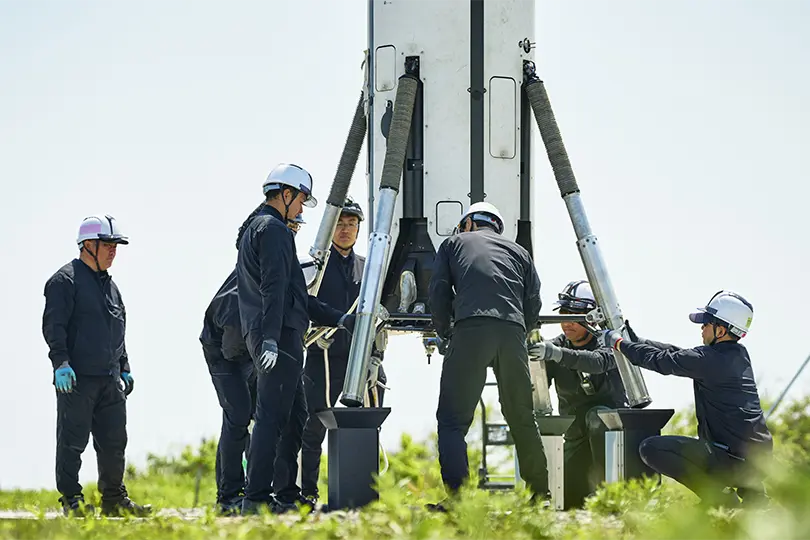 Preparing for launch and landing test
An indescribable tension: The moment of success in rocket launch and landing test
What was the atmosphere like at the ground for this first launch and landing test?
It was incredibly quiet on the ground just before launch, filled with an indescribable tension. No matter how thoroughly we prepared, we could not be certain it would go according to plan, although we anticipated every possible scenario. Everyone held their breath, staring at the rocket through the monitors.
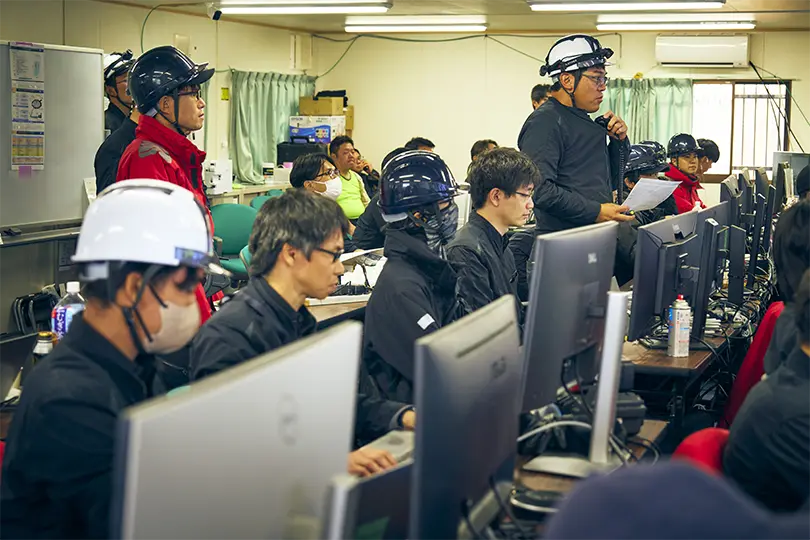 The project team just prior to launch and landing test
How did you feel when the rocket reached an altitude of 271.4 meters and landed safely?
While other members were in the control room monitoring the experiment on their screens, I was observing the experiment outdoors, sufficiently distant from the launch pad. I cannot forget the loud cheers over the radio when we received confirmation of a safe landing.
I cannot remember doing it, but when I checked the camera footage, I was literally jumping for joy. It was a bit embarrassing, but I really felt like crying, and I hugged the other members to share my happiness.
What we want to achieve, however, is making this not something special, but the norm. We want to create a world where private rockets travel between space and Earth as routinely as planes take off and land at airports.
Once we can do that, there will not be the heart-pounding excitement with every launch, or the cheers after landing, like we have now. So for now, I think it's alright for us to let our emotions show.
Watching the rocket landing footage, the grid fins (control wings) opening in the sky and then closing just before landing were also quite impressive.
Closing the fins allows for smoother post-landing safety checks, but strictly speaking is not necessary. But still, it does look cool. Think of it as an engineer's obsession.
Share your passions and dreams for future rocket research.
Space remains largely unexplored territory. Still, I firmly believe succeeding in this research will undoubtedly benefit society. Making space more accessible and enriching people's lives is a goal I intend to dedicate my utmost effort toward.
I also want to realize the same mission: to make use of space more accessible. In fact, about 20 years ago, I aspired to become an astronaut, and I have held a strong passion for space ever since. My personal dream of being involved with space is also a major driving force. If I could fulfill that dream using a rocket I built myself, nothing could make me happier.
Our founder, Soichiro Honda, left us with the words: "Don't work for the company; work for yourself." I want to contribute to society in the field of rockets and space while also realizing my own dreams.





Many Honda employees share a fundamental mindset that if something benefits people, they would give it a try. We do not see ourselves as doing anything outlandish. Beyond automobiles and motorcycles, space is simply another potential domain.
With limited energy resources on Earth, transporting energy for space activities from Earth every time or using disposable rockets to reach space is unsustainable. That is why establishing a system for energy circulation in space is essential for future society. We believe that by applying Honda’s diverse core technologies to these challenges, we can potentially contribute to realizing a sustainable society and enriching people’s lives.
Furthermore, the dream of young engineers to take on the challenge of space is how this project began. Giving tangible form to this aspiration holds significant meaning, leading us to conclude this endeavor is truly worthwhile.