Honda Is Transforming Itself to Remain the Customers’ Choice
-
Director,
Executive Officer
Chief Transformation Officer Mahito Shikama -
Director,
President and Representative Executive Officer
Chief Executive Officer Toshihiro Mibe -
Director,
Executive Vice President and Representative Executive Officer
Culture Transformation Officer Noriya Kaihara
Executive Roundtable Discussion
Honda is now facing significant changes in its business environment.
Customer values, technologies, and the competitive environment are all changing at unprecedented speeds.
In response to this challenging reality, Honda itself must also change, but how do we change our corporate structures and work processes to transform Honda?
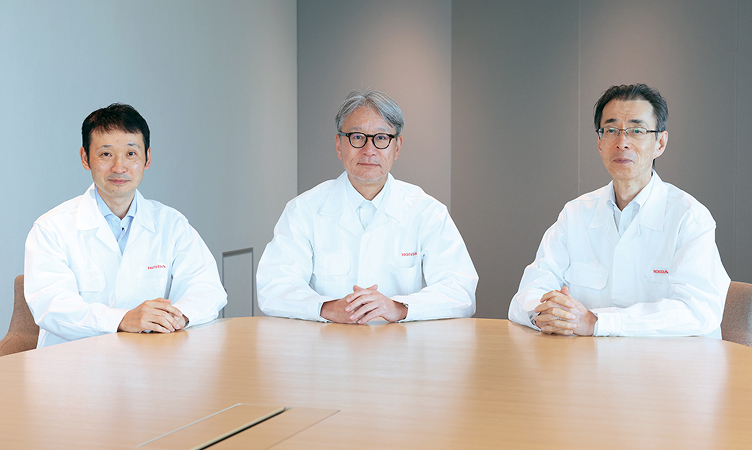
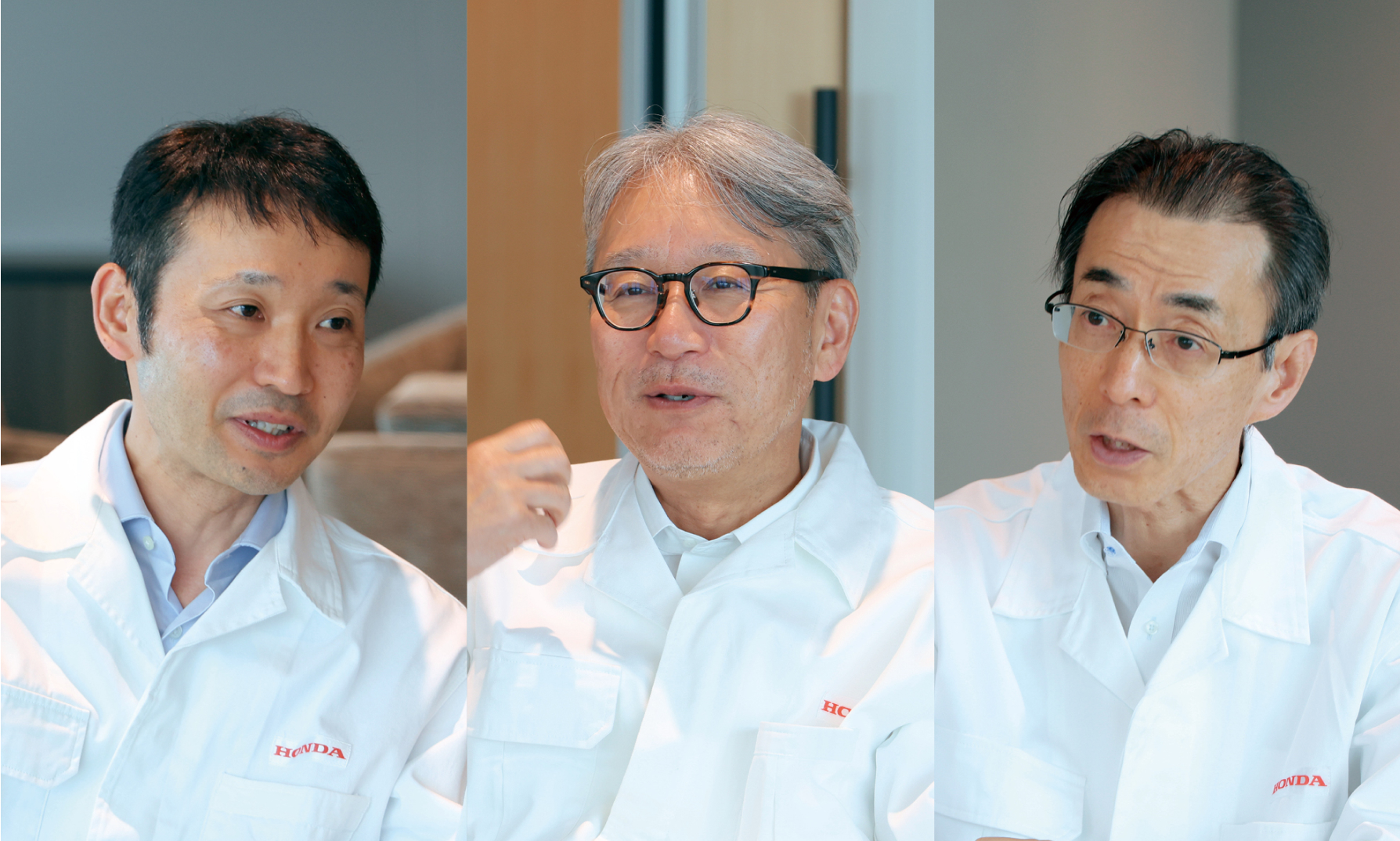
Chief Executive Officer Toshihiro Mibe, Culture Transformation Officer Noriya Kaihara, and Chief Transformation Officer Mahito Shikama discussed what needs to be done to transform Honda.
Updating Our Work Processes to Keep Delivering Value to Customers
Mibe:
What Honda now faces is not merely a temporary problem with its financial results. Rather, our business environment itself is undergoing significant changes.
Due to the policies and regulations of different countries, geopolitical risk, and changes in the competitive environment, there are an increasing number of situations in which business will not move forward based solely on conventional premises. The boundaries between the automotive industry and the IT industry are also diminishing, and efforts are accelerating to increase product value using software and data. Amid this trend, to keep customers choosing Honda, we need to revise our existing work processes and decision-making style to match the current business environment.
To continue delivering even better products and services to our customers even more quickly, we will fundamentally review how we work, and as a result, will achieve business growth and enhance corporate value.
I believe that it’s essential that we get this order correct in implementing Honda’s corporate transformation.
Shikama:
I feel strongly about the importance of speed. How quickly can we deliver the value required by our customers in a tangible form? To answer this question, we must change how we conduct development and operations, use data, and collaborate across departments.
Honda has invested time in building extremely careful processes in support of both quality and reliability. This is an invaluable strength of our company. However, amid a dramatically changing competitive environment, those processes alone are insufficient as our guiding premises.
An important role of our corporate transformation is to build a system that can capture changes in our customers and society, quickly make necessary decisions, and translate those decisions into front-line execution.
Kaihara:
Since our founding, Honda has always been a company that’s created new value by looking closely at society and our customers and thinking about what would be useful for them.
As our company has grown, we have accumulated experience and knowledge, and our rules and processes have taken shape. These are valuable assets supporting quality and trust. However, as the expectations of our customers also change, we must constantly re-examine whether we are only aiming to protect our existing systems.
There are people on the front lines who sense changes in customers or feel uneasy about our work processes. I believe that the transformation of our corporate culture starts with verbalizing and discussing those realizations and translating them into action.
Changing What Needs to Change to Protect Honda’s Uniqueness
Mibe:
There are certain things that Honda should never change. These include the Honda Philosophy, deciding to take on new challenges based on people’s dreams, expanding the possibilities for people through technology and ideas, and continuing to provide the joy and freedom of mobility in a sustainable format.
While these things don’t need to be changed, the method through which we continue to deliver to our customers the joy and freedom of mobility must change to adapt to the times.
Our previous successes and established rules represent valuable assets for Honda. However, if they prevent us from changing and achieving the next stage of growth, they must be revisited. To create products and services that exceed our customers’ expectations, we must rethink things, with value as the starting point, and without being limited by existing assumptions.
Kaihara:
We need to be careful with the phrase “Honda’s uniqueness.” If we see our past methods and rules themselves as Honda’s uniqueness, that can become a reason not to change what needs changing.
True Honda uniqueness is an approach that looks at our customers and works to deliver even better value to them by holding real discussions, tackling challenges, and seeing things through to completion with our colleagues.
To do so, it’s essential that we voice objections and speak up when something doesn’t feel right. Rather than saying, “This is always how we’ve done things,” we need to reframe the question as, “Is this really meaningful for our current customers?” Only by having these types of discussions will we be able to identify what should be changed and what should be preserved.
Shikama:
The same approach is necessary as we advance corporate transformation. The goal is not just to promote efficiency and automation.
Honda’s culture begins by asking, “Why are we doing this?” and by thinking thoroughly about our approach.
My goal in our corporate transformation process is not to reduce time spent on discussion or creation. Rather, it’s to use data and digital technology to free up time for our front lines to dedicate to value creation. The time that we create will be used to think thoroughly about value for our customers. I believe that this will lead to making the necessary changes while preserving Honda’s uniqueness.
Mibe:
Honda has a culture of open-minded discussion represented by Waigaya (Y-gaya). Rather than simply holding discussions, Waigaya is a process of gathering people with different approaches to talk in detail about how we achieve ambitious targets. Through the Waigaya process, we can identify solutions that are impossible for one person to reach. This is what has supported value creation at Honda.
What’s required now is to make that fundamental approach function in our current business environment. To exceed our customers’ expectations, we must think about what to change and what to improve. I’d like Honda to be a company in which every member can freely discuss this process in their own words.
Corporate Transformation (CX) Connects Top Management with the Front Lines and Changes the Systems That Deliver Value
Shikama:
Honda’s corporate transformation is an initiative to reconnect our top management, front lines, talent, data, and operations from the starting point of what kind of value we deliver to our customers.
In our corporate transformation initiative, we are clarifying our targets and roadmap and linking them to the initiatives of each of our Operations and projects.
Various transformation projects are already underway on the front lines, and we are visualizing the progress and results of each project as well as providing the necessary support.
Additionally, there are certain issues that cannot be resolved solely at the individual operational level. These include issues that span different departments, Honda’s data infrastructure, and shortages of talent and resources.
Resolving these kinds of company-wide structural issues and connecting front-line activities to company-wide results will lead to faster and higher quality decision-making by top management.
Mibe:
Top management expects corporate transformation to improve the quality and speed of decision-making.
Management decisions require a wide range of information, including not only vehicle units and sales, but also customer value, profit, cash flow, and real data. If we can confirm the necessary information in a timely manner, it will have a significant positive impact on both the speed and accuracy of our management decisions.
When information is siloed within certain departments, it delays our response to change. We need to create conditions through which the necessary people can access the necessary data and leverage it as company-wide knowledge. That will allow us to deliver tangible value to our customers more quickly.
However, the Company will not change just because we use AI or data. What kind of decisions are we using it for? Which processes will we change? Where do people add value? It’s important that we include these considerations in our AI and data use design.
Kaihara:
To leverage data and knowledge throughout the Company, our corporate culture must change. Each organization has roles and responsibilities. While these are necessary, if roles become too strongly defined, departments may consider their information and knowledge as “their property.”
In principle, the Company’s knowledge should be leveraged for the benefit of all of Honda. Although certain departments may manage certain information, we need to consider how we as a company leverage that information to enhance customer value. It’s also important that we make the best use of the wisdom of the past. Past decision-making includes the background of the eras in which it took place and the challenges faced by our predecessors. Sharing that knowledge and leveraging it to make decisions in the present will foster decision-making that is unique to Honda.
How do we incorporate the Honda Philosophy into the process of digitalization? This is what we must consider in the ongoing process of our corporate transformation.
Corporate Culture Reform Provides the Power to Execute Strategy
Kaihara:
Transformation of our corporate culture is an important theme in terms of our ability to implement strategy.
No matter how good the strategy or process we create, we will be unable to implement it if people’s actions don’t change. Not speaking up when we feel something is off, or prioritizing protecting the role of the department does not translate into company-wide value and makes it more difficult to create value for our customers. The Honda Philosophy includes the three principles of “Initiative, Equality, and Trust.” This entails that every person should think for themselves, share opinions regardless of their position, and hold discussions based on trust. It’s important that we create conditions in which we can experience this more fully in our everyday work.
Waigaya is essentially an initiative aimed at leveraging diverse opinions. Opinions may not align at first; however, as different viewpoints clash, eventually our directions align. I believe that process is what creates new value.
To foster this process, the nature of our people and organizations must change. Without being limited by departmental boundaries, we need to ensure that the necessary people can exercise their strengths in the necessary locations. We also need to support actions that lead to better results through horizontal collaboration.
We also must enable management to support front-line initiatives and to connect this process to transforming individual action.
Mibe:
The nature of top management itself must also change. We need a structure and culture in which realizations and any sense of unease from the front lines are translated more quickly into management decisions.
So that communication from top management does not become one-sided, we need to change both how we ask questions and how we receive feedback. If top management doesn’t change, the Company won’t change. This is precisely why we as the top management must lead from the front in advancing corporate transformation through dialogue with the front lines.
Transformation isn’t something that’s assigned to others. We must first change ourselves and then work together with the front lines to achieve transformation.
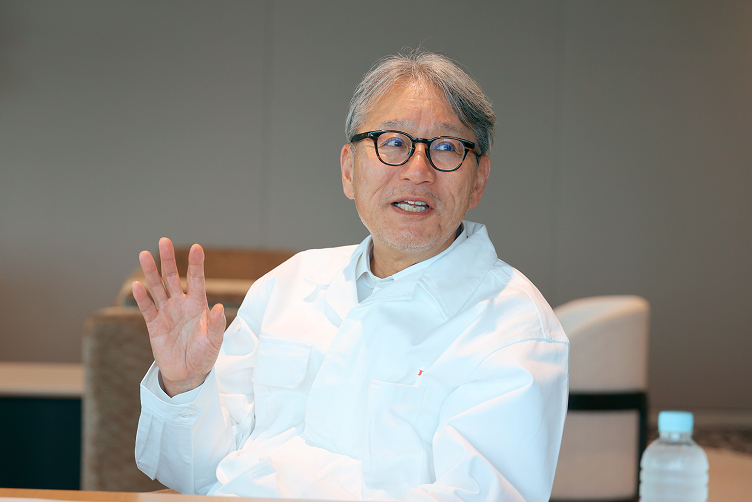
Shikama: “Corporate transformation” and “corporate culture transformation” are not separate activities. Even if we change our processes and data flow, the changes will not last if our people’s actions don’t also change. Conversely, even with a culture that embraces challenge, without structure we can’t produce results. That’s exactly why we must pursue both simultaneously. The front lines must think, decide, and then act to produce tangible results. If we can produce this kind of cycle, our transformation will be long-lasting.
Small Actions Add up to a Company That Society Looks to
Shikama:
So that our corporate transformation is long-lasting, we must take whatever action we can, no matter how small. It’s important that we create an environment in which we can quickly feel that something has changed.
Through a series of successful experiences, we will build an environment in which the front lines can feel how their actions have created positive changes. This accumulation of efforts will lead to company-wide change.
Kaihara:
The starting point for corporate culture transformation also includes each individual forming their own opinions. What issues do they feel exist in their current work? What could they do to deliver more value to customers and society? It’s important that they ask these kinds of questions in their everyday work and speak with those around them.
To do so, we need an environment in which people can say what they want to say and engage in frank discussion while maintaining mutual care and attentiveness.
It’s particularly important that Honda’s management both be receptive to the opinions of the front lines and support them in tackling challenges.
Honda will be able to change once we combine the collective strengths of our individual talent. As the Culture Transformation Officer, my goal is to draw out these strengths.
Mibe: We don’t want Honda to be a company that struggles to keep up with change. We want to be a company that anticipates change and not only meets, but also exceeds our customers’ expectations.
Our environmental and safety initiatives form the basis of our future initiatives. With that in mind, it’s important that our customers desire and want to choose Honda.
I believe Honda is expected to continue developing products and technologies and taking on challenges that exceed the expectations of our customers and society, while also increasing profitability.
Since our founding, both our customers and society have always expected something different from Honda than from other companies.
Honda’s uniqueness has always been our ability not only to meet but also to exceed those expectations.
It’s important we understand the voice of the market. However, if we create based only on market feedback, we will not be able to exceed our customers’ expectations. We must consider what lies beyond those expectations and propose value that our customers don’t even know exists yet. That’s the kind of company I want Honda to continue to be.
We must change what needs to be changed and refine our founding principles, whose essence must remain unchanged. To deliver the value that keeps customers choosing Honda, we are reconnecting our top management, front lines, talent, and data. Top management will lead the way while working hand-in-hand with our front lines to transform Honda into a company more capable of executing.