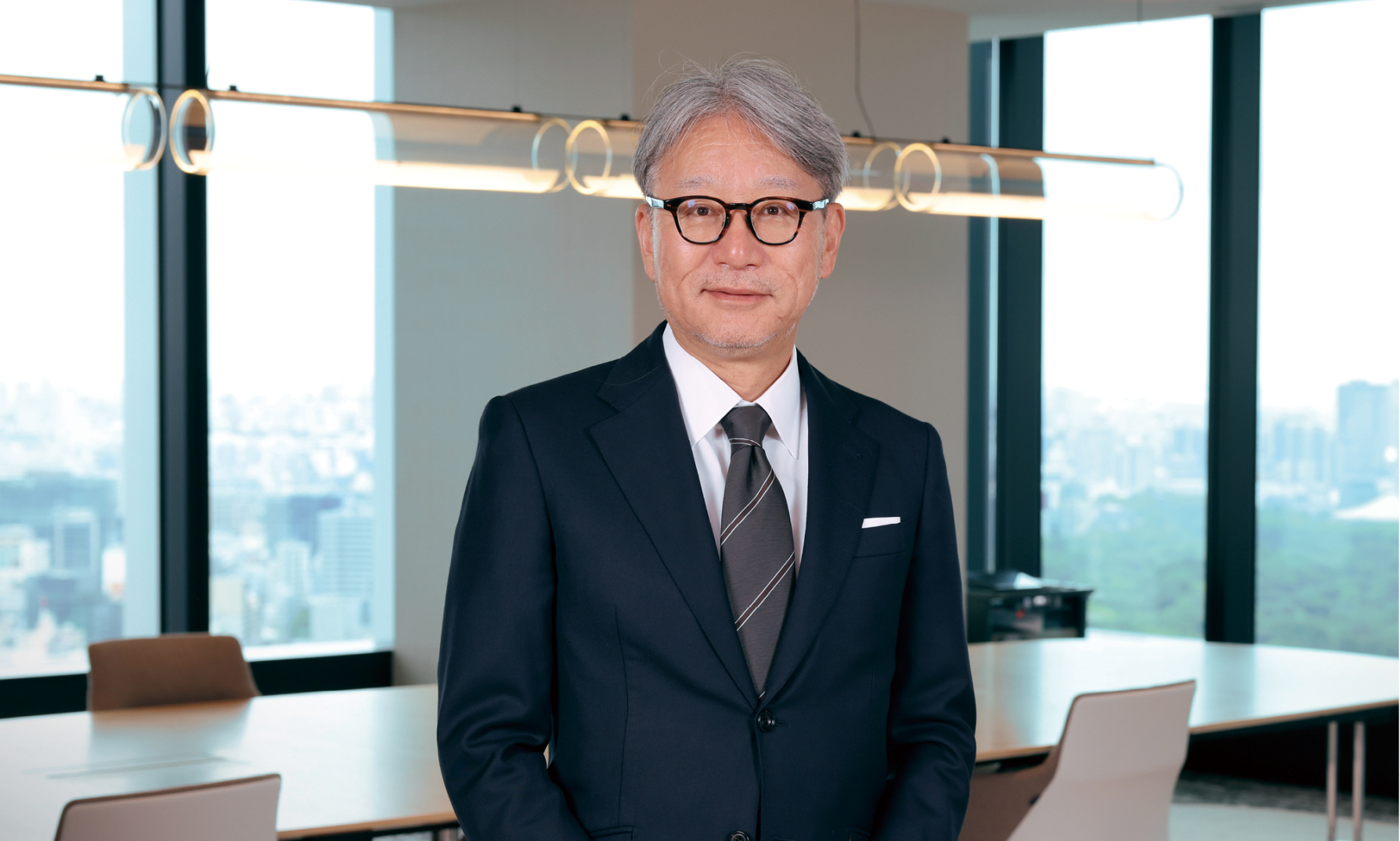
Delivering Enduring Value with Speed and Precision to Remain the Customers’ Choice
Director,
President and Representative Executive Officer
Chief Executive Officer
Toshihiro Mibe
CEO Message
Returning to a Customer-centric Perspective to Turn a Challenging Reality into the Starting Point of Transformation
Since our founding out of a desire to use technology to help people, Honda has delivered the joy and freedom of mobility. Expanding our business into motorcycles, automobiles, power products, marine equipment, and aircraft is also based on the desire to support the lifestyles and possibilities of even more customers.
Our origin remains unchanged. However, we’re now faced with a challenging reality that cannot be overcome with a continuation of the status quo. The losses recorded in the Fiscal Year Ended March 31, 2026 based on revisions to our automobile electrification strategy caused great concern for many of our stakeholders, starting with our shareholders. As Honda’s chief executive, I take those results very seriously.
Honda has been taking initiatives toward achieving carbon neutrality by 2050, but we made a decision to cancel the market introduction of three EV models in North America to avoid future losses. However, this is by no means an indication that Honda is withdrawing from the EV business. We continue selling EVs in accordance with local customer needs and the pace of EV adoption in each market. In North America, as well, we continue to lay the groundwork while carefully monitoring market conditions and the trend of customer demand.
That said, the fundamental issue facing our automobile business is not simply the slowdown in the EV market. The real question is whether we have truly been developing and manufacturing products that deliver the value our customers seek at the right price and the right time.
Honda’s hybrid vehicles are chosen by customers today because, even in challenging circumstances, we have remained focused on our customers and steadily refined our technologies and products. We will maintain this same approach in developing future products, including EVs. We will resolve technical issues one by one and steadily evolve our products so that customers can truly appreciate the value they offer.
The origin of the Honda Philosophy is a desire to help people. Improving our technologies and growing our businesses only become meaningful when we produce value for the customers and society that lie beyond that process. This experience of recording losses and revising our strategy has created an opportunity for us to ask ourselves whether our decisions and actions were sufficient when considering our origin. To remain our customers’ choice, we must review everything from our business structures to our decision-making and work processes.
Changing Honda’s Work Processes by Rebuilding the Automobile Business
Our first task is to make the automobile business a reliable revenue base by 2030. This initiative doesn’t only entail recovering profits. We must work to build a foundation that allows us to continue delivering attractive products to our customers and to continue making the necessary investments into the future.
We will pursue recovery in the automobile business through initiatives centered on three pillars. The first pillar is a strategic reallocation of our corporate resources. We will start by further improving our hybrid vehicles, one of Honda’s strong suits, while creating more products chosen by customers in key regions including North America, Japan, and India. Although hybrid vehicles are not the end goal, they will continue to be valuable in meeting customer needs during the transition period to carbon neutrality, and we will continue to evolve them both as an important technology and as products that support our business.
The second pillar driving our recovery in the automobile business is the thorough strengthening of our manufacturing structure. Competitive standards have changed dramatically. The speed of product development, costs, manufacturing systems, and application of digital technologies are all rapidly evolving. If development timeframes remain the same, technologies may already be out of date by the time sales launch. To deliver new value to our customers, Honda must review development cost, development timeframe, and development workload and change to a manufacturing framework that produces products more quickly and flexibly. As such, we are changing the entire flow of our manufacturing process from design and testing to manufacturing preparation and our supply chain, including our suppliers.
The third pillar driving recovery is the strategic utilization of external resources. In the age of software-defined vehicles (SDVs) whose value is updated through software, technologies in a wide range of fields including IT, communications, and energy enhance mobility value. As such, it’s not realistic to try to handle everything in-house. While identifying the sectors that Honda needs to hone itself, we also need to flexibly incorporate external technologies and knowledge and improve our speed, flexibility, and cost competitiveness.
In our regional strategy, we will first establish the cost competitiveness needed to compete in any market as the foundation of our approach to developing and manufacturing products. Rather than applying globally uniform specifications to each region, we will reassess the functions needed based on the value and price customers in each region seek. We will then share the knowledge gained in each region across Honda, transforming how we develop and manufacture products to deliver both the value customers want and Our first task is to make the automobile business a reliable revenue base by 2030. This initiative doesn’t only entail recovering profits. We must work to build a foundation that allows us to continue delivering attractive products to our customers and to continue making the necessary investments into the future.
We will pursue recovery in the automobile business through initiatives centered on three pillars. The first pillar is a strategic reallocation of our corporate resources. We will start by further improving our hybrid vehicles, one of Honda’s strong suits, while creating more products chosen by customers in key regions including North America, Japan, and India. Although hybrid vehicles are not the end goal, they will continue to be valuable in meeting customer needs during the transition period to carbon neutrality, and we will continue to evolve them both as an important technology and as products that support our business.
The second pillar driving our recovery in the automobile business is the thorough strengthening of our manufacturing structure. Competitive standards have changed dramatically. The speed of product development, costs, manufacturing systems, and application of digital technologies are all rapidly evolving. If development timeframes remain the same, technologies may already be out of date by the time sales launch. To deliver new value to our customers, Honda must review development cost, development timeframe, and development workload and change to a manufacturing framework that produces products more quickly and flexibly. As such, we are changing the entire flow of our manufacturing process from design and testing to manufacturing preparation and our supply chain, including our suppliers.
The third pillar driving recovery is the strategic utilization of external resources. In the age of software-defined vehicles (SDVs) whose value is updated through software, technologies in a wide range of fields including IT, communications, and energy enhance mobility value. As such, it’s not realistic to try to handle everything in-house. While identifying the sectors that Honda needs to hone itself, we also need to flexibly incorporate external technologies and knowledge and improve our speed, flexibility, and cost competitiveness.
In our regional strategy, we will first establish the cost competitiveness needed to compete in any market as the foundation of our approach to developing and manufacturing products. Rather than applying globally uniform specifications to each region, we will reassess the functions needed based on the value and price customers in each region seek. We will then share the knowledge gained in each region across Honda, transforming how we develop and manufacture products to deliver both the value customers want and competitive prices.
In line with this direction, we will steadily rebuild our automobile business while drawing on the strong foundations of our motorcycle and financial services businesses to strengthen Honda as a whole. Furthermore, by bringing together the strengths of our motorcycle, automobile, power products, and financial services businesses to deliver a broader range of value to customers, we will drive sustainable growth across Honda.
Maintaining Our Environmental and Safety Targets While Evolving the Pathway toward Achievement
Our aim is not merely an immediate recovery in earnings. We are looking beyond that, asking ourselves what unique value will continue to make Honda the customers’ choice. By confronting this question, we are shaping a strategy for sustainable growth.
Honda’s goal is to realize a sustainable society in which everyone can enjoy the “joy and freedom of mobility.” At the center of this goal are the keywords of “environment” and “safety.” Even amid changes in the business environment and technology roadmap, our direction for 2050 remains unchanged: 1) to achieve carbon neutrality for all products and corporate activities Honda is involved in and 2) to achieve zero fatalities worldwide from traffic collisions involving Honda motorcycles and automobiles. This is not mere idealism, but a responsibility that must be fulfilled as a comprehensive mobility company.
However, there is more than one path to get there. Although we believe that EVs will play an important role in the future, not all applications will be replaced by a single technology. Rather, tailored to different factors such as regional energy policies, customer usage patterns, commercial or industrial applications, and mobility that supports daily life, we will combine a variety of methods including EVs, hybrid vehicles, fuel cells, carbon-neutral fuels, and carbon-offset technology.
It’s the responsibility of management to balance fulfilling our social responsibility as a company and creating good products that are chosen by our customers. Honda has always valued and worked hard to develop environmental and safety technologies. We’ll continue to face environmental challenges head on and deliver the joy and freedom of mobility in a sustainable format.
Our approach to safety is identical. The freedom of mobility is based on the ability to travel with peace of mind. Through next-generation ADAS, software, and data applications, we will balance the joy of driving with a secure and comfortable mobility experience. Honda’s mission is to transform the environment and safety into values that the customer can truly experience in their everyday travel.

Connecting Technology to Our Business and Value Creation Process
Honda has many technologies that it has refined over the years, including engines, electrification technologies, safety technologies, intelligent technologies, control technologies, software, and data. However, possessing technologies is not the same as having the value of those technologies recognized by customers and the market. Even with superior technologies, if we cannot deliver the products and experiences chosen by our customers, we will not be able to continue to provide value to society.
We are further strengthening the link between our technologies and their commercialization. We are sharpening our execution to ensure we clearly identify our target customers, define the products and services that will resonate with them, and establish long-term commercial sustainability.
The possibilities for Honda as a comprehensive mobility company are not limited to land-based mobility. There is still plenty of room for growth in mobility that expands human possibility from the air, the sea, and space to any new mobility frontiers of the future. What is important is that these possibilities do not remain dreams and that they instead lead to value for our customers and growth for our businesses.
To realize these dreams, we are transforming the way we work. This transformation will be driven by the expectations of our customers and not be limited to improvements in individual divisions. Instead, we will link product planning, technology, development, manufacturing, sales, service, and data-driven improvement in a single process, creating a structure that will continuously generate value for all of Honda.
Connecting internal data is not the goal but the starting point. The real job beyond that of considering what kind of value we discover and deliver to our customers is a job that can only be performed by people. AI and digital technology will not replace people. Driven by the individuality, skills, experiences, and passion to make things better that are shared by every member of Honda, we will incorporate digitalization to enhance and accelerate the creation of new value.
Moving Forward with All Honda to Transform Dreams into Real Value
For Honda, dreams are not separate from reality. “Wouldn’t it be great if we could do this?” “If we could achieve this, people’s lives would really improve.” At Honda, we believe in the power to turn those visions into reality.
Transforming the previously impossible into the possible and surprising the world in a positive way—this kind of track record creates new value. What “The Power of Dreams” means to Honda is the desire to transform individual dreams into the power to move people and society forward. Transforming dreams into reality and continuously delivering value that moves our customers’ hearts and enriches their lives—this is the driving force behind growth unique to Honda.
Companies that grow are companies that transform value the customers themselves are not yet aware of into reality and deliver it to society. However, transforming dreams into reality is not only a matter of large-scale technological development. It’s present in every job, from small improvements to monumental challenges.
In this sense, returning to our origin doesn’t mean returning to the old way of doing things. Driven by the Honda Philosophy that acts as the starting point of all our activities, we must shape value that is useful to people in a way that fits the current age. Refusing to change is now our greatest risk. We need to be a company whose management supports individual associates challenging themselves by considering how to make things better, sharing their opinions, and taking action.
We need to move forward with both establishing a revenue base for our automobile business and fleshing out a sustainable growth strategy. As a comprehensive mobility company, we must transform ourselves to continue delivering the joy and freedom of mobility in a sustainable format while fulfilling our environmental and safety responsibilities. All of this is to meet the expectations of our customers and society—and go beyond them by delivering new excitement. With dreams as our driving force, Honda will continue to take on challenges. I invite you to, please, place your hopes in the future of Honda.