Initiatives for Automobiles
For its automobiles, Honda has been promoting conventional 3R (reduce/reuse/recycle) activities as well as ensuring proper processing when disposing of used products.
The Company will engage in new businesses and services such as horizontal recycling, repurposing, and refurbishing as part of its shift to a circular business.
This section describes the resource circulation efforts related to new and used vehicle sales.
Initiatives for Battery Lifetime Management Commercialization (Business Innovation)
For batteries installed in the N-VAN e: released in 2024 and the N-ONE e: released in September 2025, Honda works to maximize battery value by upgrading battery monitoring functions and conducting lifetime management through conversion from on-board use to stationary use.
The battery monitoring function, which determines the state of deterioration of components and other factors, enables efficient utilization of resources and reduces the economic burden on automobile users.
Expanded Use of Sustainable Materials for Floor Carpet Mats (Circular Design, Circular Value Chain)
Starting in April 2024, Honda adopted a sustainable material, recycled PET material, for the floor carpet mats, a Honda genuine accessory for the N-VAN light vehicle. It is significantly lighter than conventional mats. The use of sustainable materials is an effort to consider recyclability after use and to contribute to a circular society in the future. As of the fiscal year ended March 31, 2026, the application of this sustainable material has been expanded to five models: CR-V, N-WGN, N-ONE, PRELUDE, and N-ONE e:.
Expanded Use of Recycled Materials from Automobile Bumpers for Parts of New Vehicles (Circular Design)
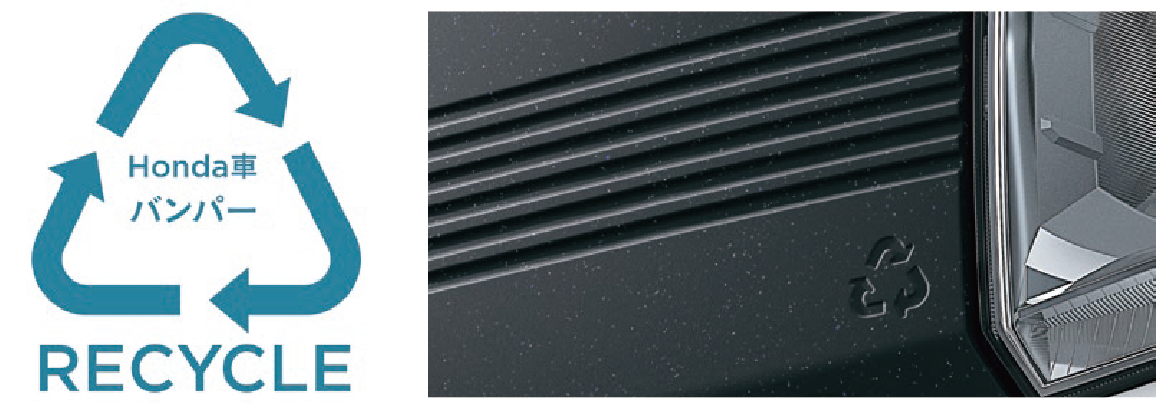
For the N-VAN e: released in 2024, Honda collected and crushed discarded bumpers from Honda vehicles, revitalized them as sustainable materials, and reused them as accessories for vehicle exteriors and other parts.
For the front grille parts, a technology was applied to randomly mix the bumper paint of past Honda models, leaving a rough finish, so that the pattern is unique and attractive.
Launch of Services Related to Refurbishing Used Vehicles (Business Innovation)
In September 2023, Honda’s Japanese used vehicle business launched Imakore+ (Plus), a program to install new Honda genuine accessories to used vehicles.
In its North American used vehicle business, in addition to the Wireless Apple CarPlay/ Android Auto Upgrade released in January 2024, Honda launched an upgrade service to retrofit Blind Spot Information in September 2025.
These initiatives contribute to the efficient use of resources by restoring and enhancing product value through refurbishment and the provision of usage services, thereby creating new added value, enabling products to be used throughout their full lifecycle, and increasing opportunities to recover vehicles at the end-of-life stage.
Launch of Horizontal Recycling to Recirculate Aluminum Sheet Offcuts (Advanced Recycling)
In March 2026, the Saitama Factory Automobile Plant began horizontal recycling that reuses press offcuts from aluminum hoods as aluminum sheet for vehicle bodies. This initiative has been adopted for the aluminum hood of PRELUDE.
While aluminum reduces energy consumption during driving through weight reduction and lowers environmental impact, producing primary aluminum requires a large amount of energy. In addition, one challenge was that press offcuts are easily affected by impurities and are difficult to reuse.
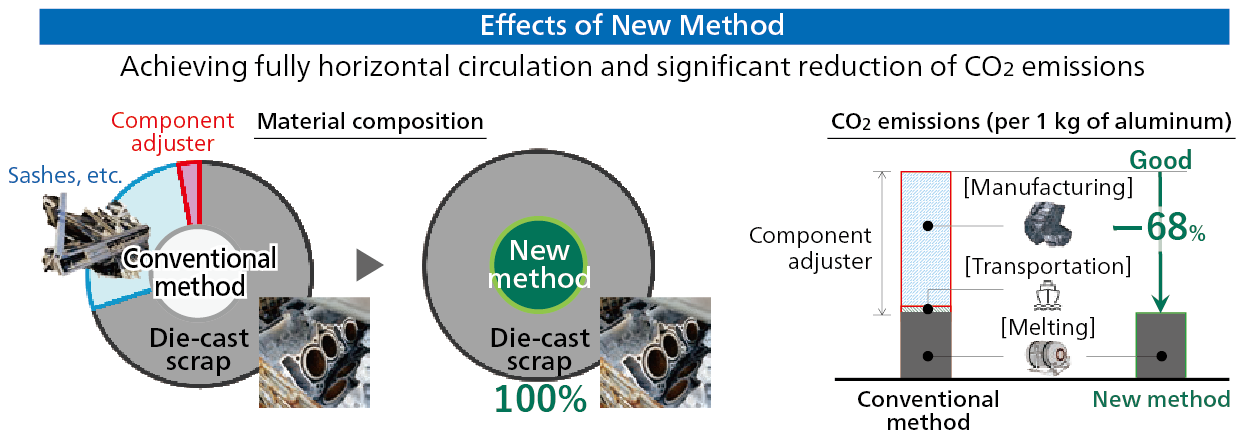
This initiative has optimized the sorting and collection methods for offcuts and improved impurity removal, achieving closed-loop recycling. As a result, offcuts that had previously been sold as scrap can now be reused as high-quality raw material, helping reduce the use of new aluminum ingots and contributing to lower CO₂ emissions in the manufacturing stage.
Going forward, Honda will leverage the know-how gained through this initiative to consider expanding applicable parts and deploying it to other plants, aiming for further advancement of aluminum resource circulation.
Mass Production of Horizontally Recycled Acrylic Resin from ELVs (Circular Value Chain, Advanced Recycling)
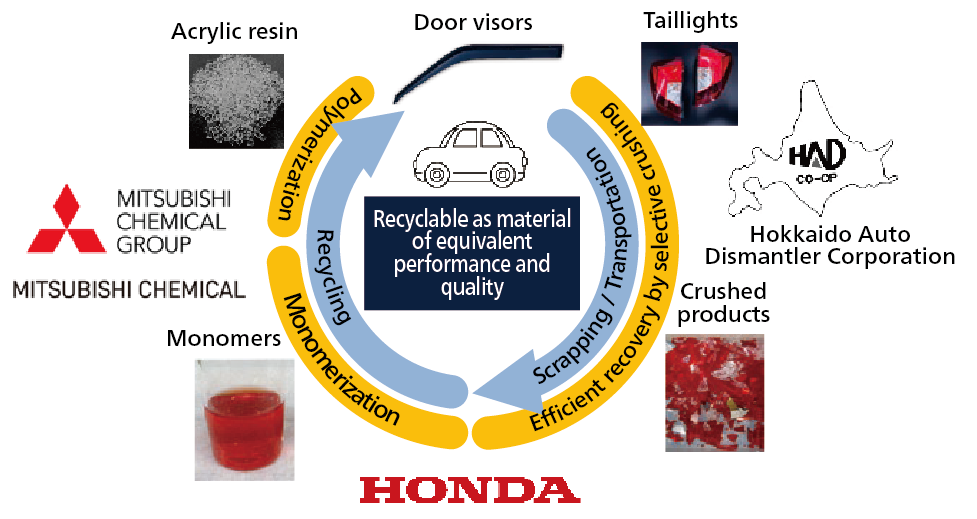
Honda has adopted recycled acrylic resin recovered and regenerated from ELVs for door visors and has been selling them since September 2025 as Honda genuine accessories for the new N-ONE e: kei car class passenger EV. The use of recycled acrylic resin makes them items aimed at reducing CO₂ emissions and environmental impact.
Conventionally, the majority of resin derived from ELVs has been used for fuel and other purposes due to the technical challenges of sorting and recycling, and has not been recycled into products.
Honda, in collaboration with Hokkaido Auto Dismantler Corporation and Mitsubishi Chemical Corporation, conducted a demonstration test on the horizontal recycling of acrylic resin (from August 2021 to February 2022), establishing an efficient scheme for the entire operation.
Through this test, we developed a recovery method that prevents contamination by foreign materials and a regeneration technology equivalent to virgin materials, paving the way for the world’s first* mass production of horizontally recycled products.
This initiative will enable a reduction in the use of virgin materials and a 50% reduction in CO₂ emissions during the production and disposal of acrylic resin.
Moving forward, we will continue to research and develop advanced recycling technologies that support the creation of value chains and sustainable resource circulation to realize a circular society, and work with partner companies to implement these technologies in society.
Based on Honda’s research (as of April 2025)
Realizing Resource Circulation through Co-Creation with Customers

To realize resource circulation, Honda has been conducting activities to communicate and promote resource circulation at regional environmental events since the launch of N-VAN e: in October 2024, with the aim of promoting customer understanding and empathy for the initiative.
At the events, in addition to showcasing products to which sustainable materials are applied, we introduced services for product use based on resource circulation principles and our upcycling initiatives that effectively utilize spare parts scheduled for disposal. We also explained that products and services that make efficient use of resources not only reduce environmental impacts through waste reduction but also lead to new value provision.
Honda sees this initiative as an opportunity to encourage customers to consider how products should be handled after use. By fostering understanding and empathy for Honda’s resource circulation philosophy and initiatives, as well as deepening mutual understanding between our customers and Honda, we aim to realize a sustainable society based on resource circulation.
Co-Creation of Circular Value by Expanding Options for Recycled Resources

Honda works to maximize resource value based on the principle of vehicle-to-vehicle circulation.
As a result of advancing collaboration and co-creation with companies that support Honda’s vision for a circular society, products have now been launched that use recycled materials derived from discarded bumpers supplied by Honda as part of the raw materials and achieve a recycled polypropylene usage rate of 92% to 94%.
This initiative expands the potential uses of recycled materials and contributes to broadening the scope of resource circulation.
Since the 1990s, Honda has been collecting and recycling bumpers replaced during repairs at dealerships and circulating them as recycled materials.
While maintaining circulation for automotive applications as the basic principle, Honda will maximize resource value and contribute to realizing a sustainable circular society by selecting optimal applications according to the characteristics of recycled materials, based on quality standards and material properties.