Toward an
“Accident-Free Society”
Where Everyone Can Use The Road Safely
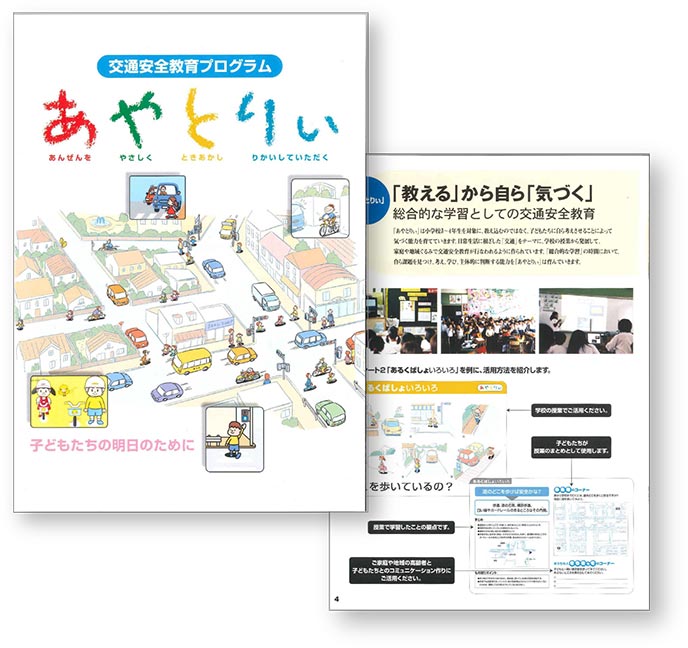 Developed for 3rd and 4th grade elementary
 school students, Ayatolli is a traffic safety education
program to learn, realize and study traffic safety.
Even now, Honda’s global safety slogan, “Safety for Everyone” expresses the company’s commitment to pursuing safety tailored to the needs of each individual, with the idea that improving the safety of each member of society will result in a safer society as a whole and promote progress toward an “accident-free society.” Honda is also currently involved in traffic safety activities for all ages, from children to the elderly, based on its desire to create an “accident-free society” where every user of the roads is safe, not just those who drive cars or ride motorcycles.
Traffic rules are an essential part of everyday life, whether urban or rural, and traffic safety education is especially important for children advancing from early childhood to school age, whose range of activities tend to expand accordingly. However, it is especially difficult for children to learn traffic safety through any single study experience, so Honda has worked to develop educational materials that enable children to regularly think about traffic safety on their own, as well as group learning programs that allow them to learn through the ongoing repetition of activities they can enjoy with their peers.
One such traffic safety education program is called “Ayatorii,”*2 which utilizes Honda’s accumulated expertise in hazard prediction to help children better understand and learn about aspects of traffic safety along with their parents, teachers, neighbors and others. The name “Ayatorii” is derived from a Japanese saying that roughly translates as “understanding safety through a clear and gentle explanation.”
In 1995, the “Ayatorii” program was introduced as a study class for third graders at select elementary schools around the city of Suzuka. After proving its effectiveness, by 1997 it was expanded to every elementary school throughout the city. In 1999, “Ayatorii Hiyoko” was developed for children aged four to five years. “Ayatorii Hiyoko” program included worksheets and a CD-based sound-guessing game*3 designed to hold the interest of young children. Over the years this program has seen various improvements to better help educate children in traffic safety in an enjoyable way without getting bored. Educational materials like the “Ayatorii Hiyoko” large-format traffic safety worksheet continue to be used by local traffic instructors in traffic safety classes for young and school age children.
- Developed by the Suzuka Mobility Study Group, which was established in 1996 by Honda and Suzuka City to promote a better traffic environment for the future of the city.
- A quiz in which children listen to a CD recording of various sounds from the urban traffic environment and are asked to guess what the sounds are.
Expanding Safe Driving Promotion Activities Overseas
In 1972, Honda’s Traffic Safety Promotion Operations began conducting its activities overseas. At the company’s annual press conference that year, Soichiro Honda stated his intention of expanding Honda’s Safe Driving promotional activities overseas, with the express goal of reducing traffic accidents around the world, and not just in Japan.
Among Honda’s overseas subsidiaries, Honda Motor do Brasil (HDB, later MotoHonda da Amazonia Limitada (HDA)) was the first to take up these Safe Driving training activities, starting with the “Honda Mobile Course,” which was offered throughout Brazil from 1973 through 1977. This course was held in collaboration with a major Brazilian oil company, and consisted of motorcycle caravans that would travel all over the country holding motorcycle riding demonstrations and offering test rides.
Movie screenings and other events were also organized to display and promote motorcycles, interspersed with lectures on traffic safety. These events were also supported by local police forces, who agreed to block off public roads for the purpose of holding motorcycle demonstrations and offering test rides.
In this way, with the cooperation of Honda dealerships and traffic administration officials in other countries and regions, Honda Safe Driving Operations was able to steadily expand its promotional efforts, especially in countries where Honda already had sales offices.
Honda’s Safe Driving activities have expanded to include
43 countries and regions worldwide.
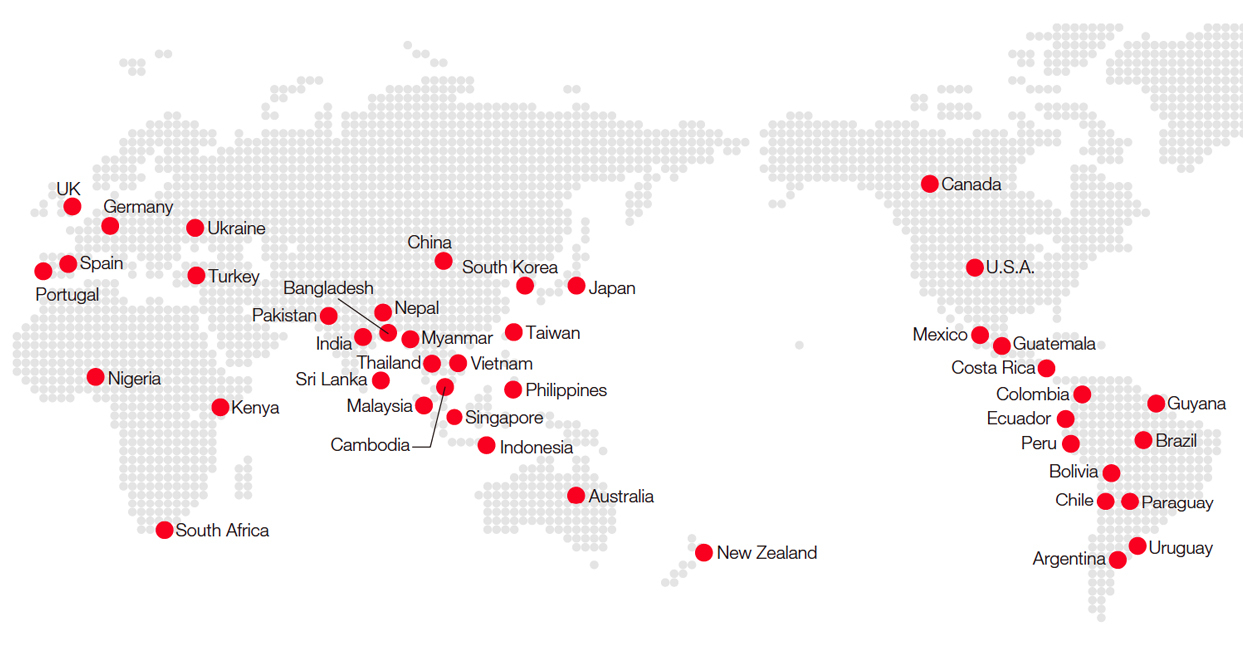
Countries and regions where safety promotion activities are conducted
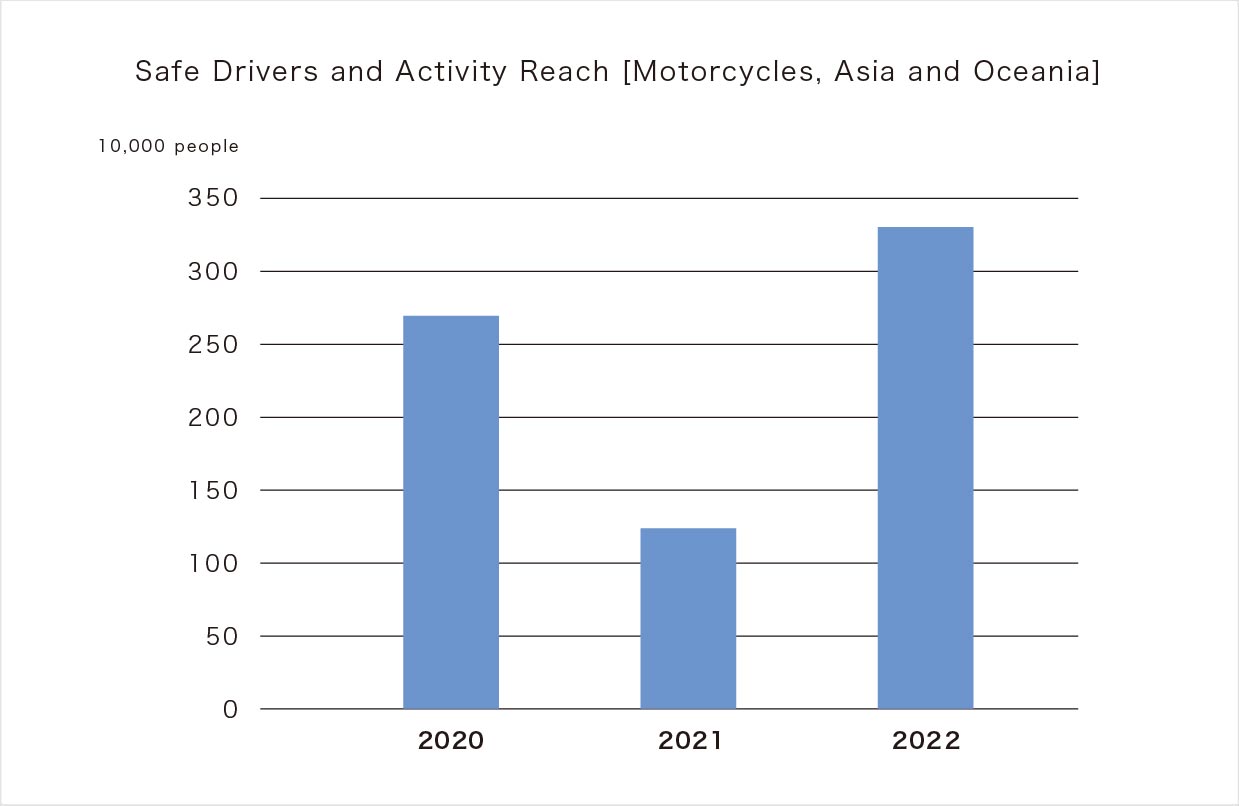
As of 2023, Honda has conducted its Safe Driving promotional activities in 43 countries and regions around the world, starting with Japan. Although motorization has progressed rapidly in many emerging countries, there are still many areas where laws, regulations, traffic rules, and road infrastructure are not yet in place, and the increasing number of accidents that have resulted in traffic fatalities has become a serious social problem. Honda has been working in close cooperation with local governments and other related organizations to conduct activities tailored to the traffic conditions experienced in each country. In addition to safety advice at the time of sale, in 2022, about 3.3 million people participated in motorcycle and automobile seminars organized by local subsidiaries and dealers mainly in Thailand, Vietnam, and India.
Reducing Accidents in a Rapidly Growing Market
In Southeast Asia, Honda’s Safe Driving promotional pioneer was Thailand’s A.P. Honda (APH), which made the decision to begin actively promoting safer motorcycle riding at a September 1988 task force meeting. Then president of APH, Michio Kitamura, stated his belief that “Honda must be proactive in addressing safety issues in order to make motorcycles more accepted by the public in the years ahead.” Underpinning this was the fact that the Southeast Asian motorcycle market had been seeing rapid growth along with the economic developments of the region, and motorcycle sales had jumped from around 300,000 units throughout the first half of the 1980s to about 500,000 in 1988 alone.
The APH task force decided that the most important thing it could do to promote motorcycle safety nationwide would be to train safety instructors at dealerships, and use these dealerships as bases from which to more broadly expand their Safe Riding activities. The task force also realized that it would need to gain the understanding and cooperation of regional governments and mass media outlets, since both of these tend to have a strong influence on public opinion.
In January of 1989, APH established its own Traffic Safety Promotion Operations (APH Safe Riding Office) within APH headquarters. This new office started small, with just one APH manager, three staffers, and APH board member Arak Pomprapar appointed as general manager. To support this team, Honda Japan’s Traffic Safety Promotion Operations immediately dispatched a Safe Riding specialist to Bangkok to conduct a two-week-long professional instructor training program for these five members. This effort was also supported by additional advisory services provided by other staff from Traffic Safety Promotion Operations.
Lowering the Barriers to Safe Riding Promotion Activities
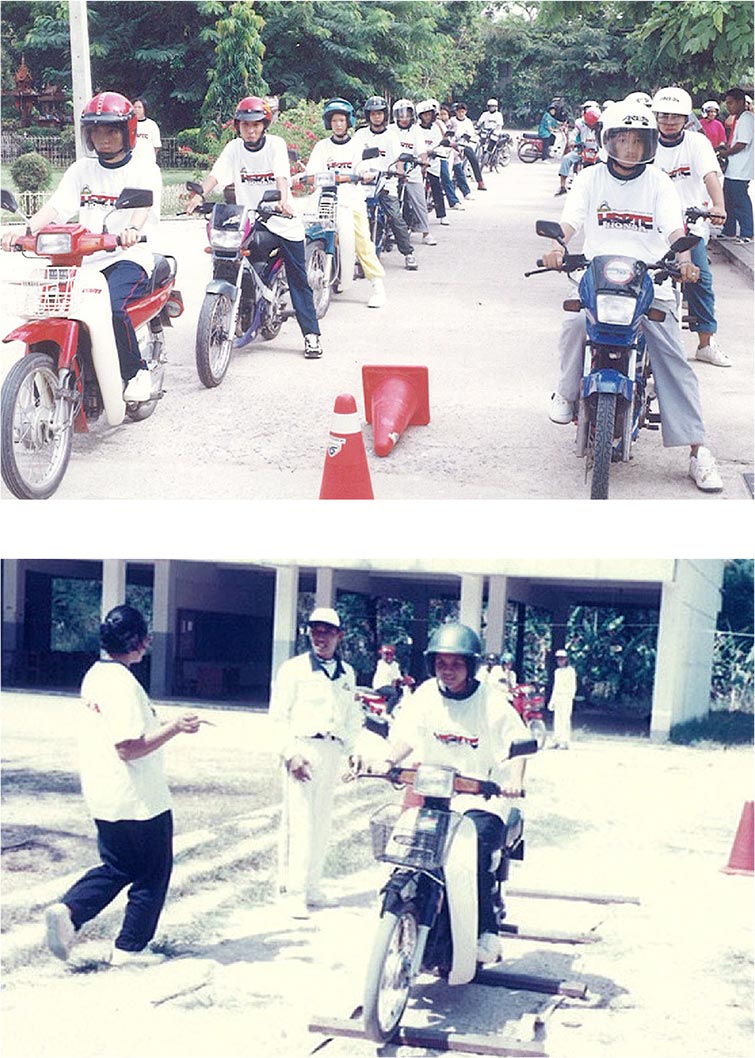 Basic Course to learn proper driving through experience
Prior to APH’s Safe Riding promotional activities, safety efforts were mostly limited to motorcycle dealers simply bundling helmets with the motorcycles and scooters they sold, hoping that this alone would reduce injury in the event of an accident. Beyond that, there was very little communicated by sales staff to customers about how to ride their new motorcycles more safely. For this reason alone, APH knew that it would be a challenge to rely on its dealerships to serve as the core of its Safe Riding promotion program.
APH General Manager Kitamura recalls, “We knew success would hinge on figuring out how to work with dealerships that were simply unaccustomed to talking with their customers about riding safety.” APH Traffic Safety Promotion Operations knew that stronger measures and better messaging would be needed if the promotion of riding safety was to ever get off the ground.
The first step in changing local dealership engagement with Safe Riding promotional activities was to add “Safety” to Honda’s list of conditions for being certified as an exclusive Honda dealership. This “4S” policy required exclusive dealerships to satisfy Honda’s requirements in the four areas of Sales, Service, Spare Parts... and Safety. This new Safety factor would further require that dealerships satisfy two specific conditions in order to be certified:
1. The dealership must have at least two trained instructors per location assigned to providing Safe Riding instruction.
2. The dealership must hold at least two Safe Riding seminars per year.
At the same time, APH sales staff, who are in the position to encourage dealers, should also confirm the implementation of safe riding promotion activities at the dealers they are in charge of, with evaluation points.
The goal was to benefit customers, dealers, and APH itself by lowering any barriers to participation in Safe Riding promotion activities, namely by making these activities less formal and easier to take part in. Creating a successful track record through these activities would then provide more leverage to lobby the government and police to introduce a driver’s licensing system that included a practical training component.
With this agenda in mind, APH offered dealers two different Safe riding promotion curriculums: the “Safety Caravan,” where customers could learn safe riding techniques while enjoying themselves, and the “Basic Course,” which sought to teach proper riding techniques through hands-on personal experience. In either case, the key point was that Safe Riding training be packaged in such a way that made it “friendly and not overly serious.”
The “Safety Caravan” was a two day and one night joint touring event designed for participants take APH’s “Introductory Riding Safety Course.” Teaching correct basic riding techniques, a two-hour course was conducted just before the caravan’s departure, with the goals of raising safety awareness and enhancing motorcycle riding enjoyment. The general manager of one Chiang Mai dealership recalled: “The caravans encouraged people to wear helmets and ride in a neat and orderly fashion. Over time this also helped show motorcycling in a more positive light, which in turn gave the public a better sense of security about motorcycles.”
On the other hand, the “Basic Course” was mainly targeted at such opinion leaders as the police, businesses, schools, and other organizations, and was structured specifically to educate riders about APH’s approach to safe riding education.
Dealerships Offer Practical Safe-Driving Advice
In 1994 Honda initiated a program called Pre-Delivery Safety Advice(PDSA). Under this program, before the keys to a newly purchased vehicle were handed over to the customer, an instructor from the dealership would spend some time with the customer going over a variety of driving safety issues, including reviewing important traffic signage, going over potentially dangerous driving scenarios and their related driving techniques, explaining ways to avoid accidents while operating the vehicle, and offering a checklist of important vehicle inspection points and procedures to help ensure safety. The program also offered a “safety advice card” inspired by the emergency safety cards found in airplane seat pockets.
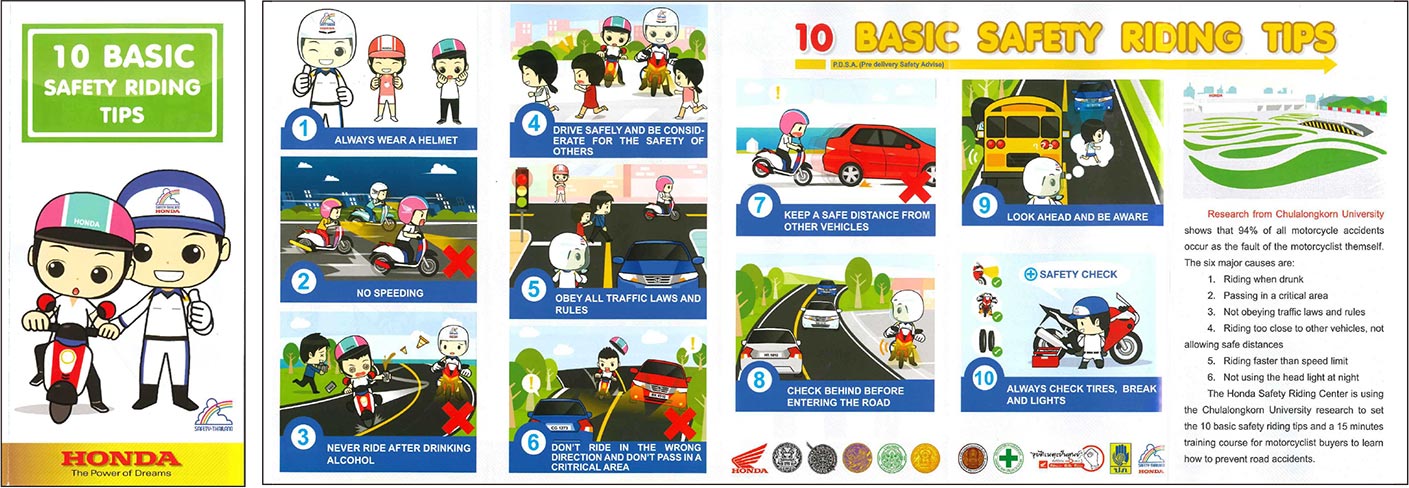
PDSA pamphlet
As Arak Pumprapar recalls: “The name ‘PDSA’ was suggested by Tatsuhiro Oyama, who was then general manager (later president of APH). We thought that conveying important information with simple, easy-to-understand illustrations was a good idea, so we adopted the safety advice card and soon began using it.” The Thai Department of Land Transport (DLT) agreed with APH’s idea and expressed its support for the project, and soon thereafter all of the various safety tools created by APH were marked with the official DLT logo.
In the interests of boosting general understanding of Honda’s efforts in the area of driving safety, General Manager Arak Pomprapar began making direct approaches to official bodies such as the Thai National Safety Bureau, which oversees traffic administration, the Thai Land Transport Bureau, which oversees the issuing of driver’s licenses, and various regional police forces.
It’s easy to see the correlation that the more people riding motorcycles without proper safety training, the more accidents will occur, and it was for this reason that APH suggested that the Land Transport Bureau add practical skills testing to their licensing system requirements. As Kitamura recalls, “We told them that if the government wasn’t in a position to do this, then we at Honda, with our expertise in such training, would take the lead in establishing a practical skills training and testing system for the benefit of the people of Thailand. With such a licensing system eventually put in place, we would then be able to have our dealerships assist people in obtaining their licenses.”
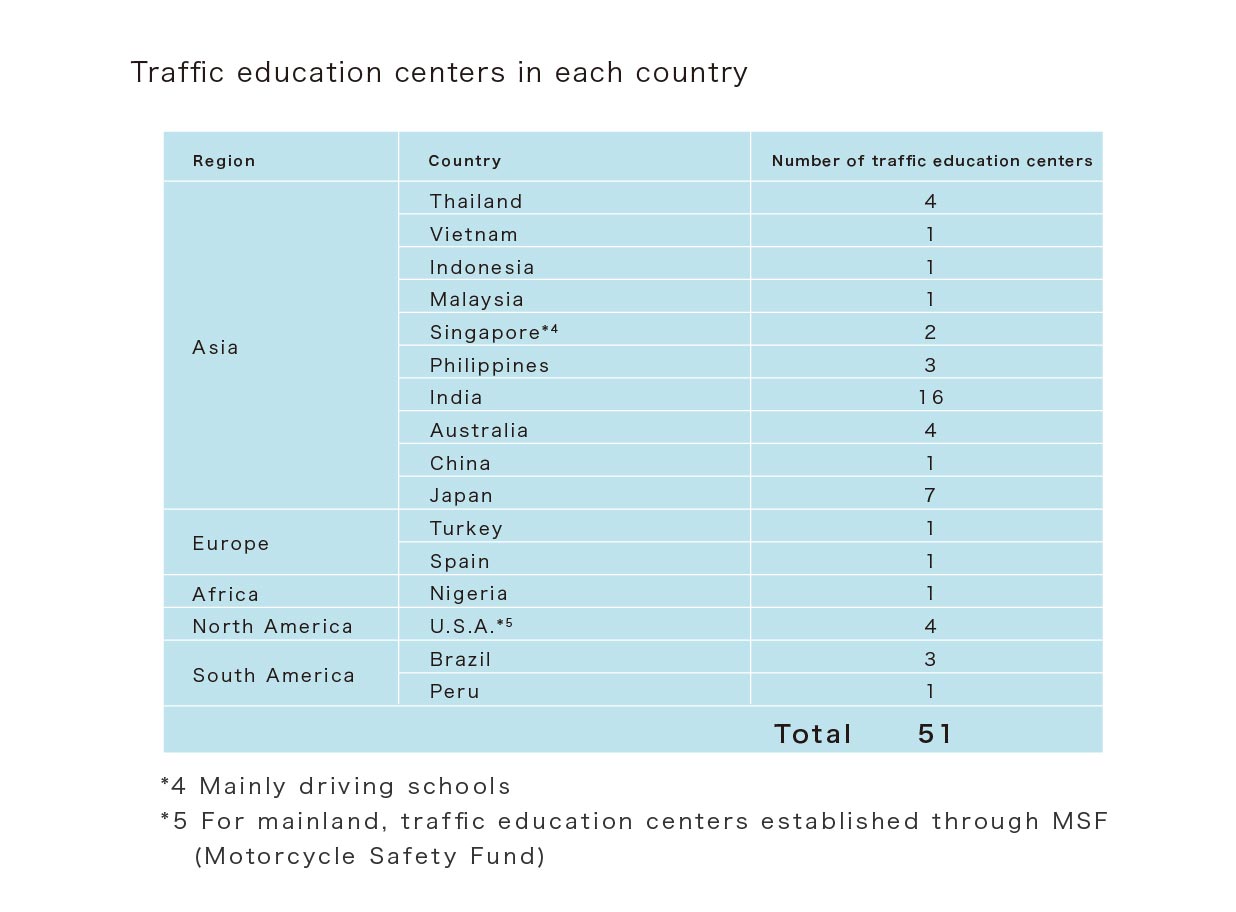
The Safe riding promotional activities that have been underway in Thailand since 1989 continue to this day. In fiscal 2000, the Thai government revised its motorcycle driver’s license system to require a four-hour practical skills training course. In 2004, APH’s Traffic Education Center became the first private facility to issue government-approved license exchange certificates, and the Traffic Education Center has since been entrusted with the role of designated driving school in Japan.
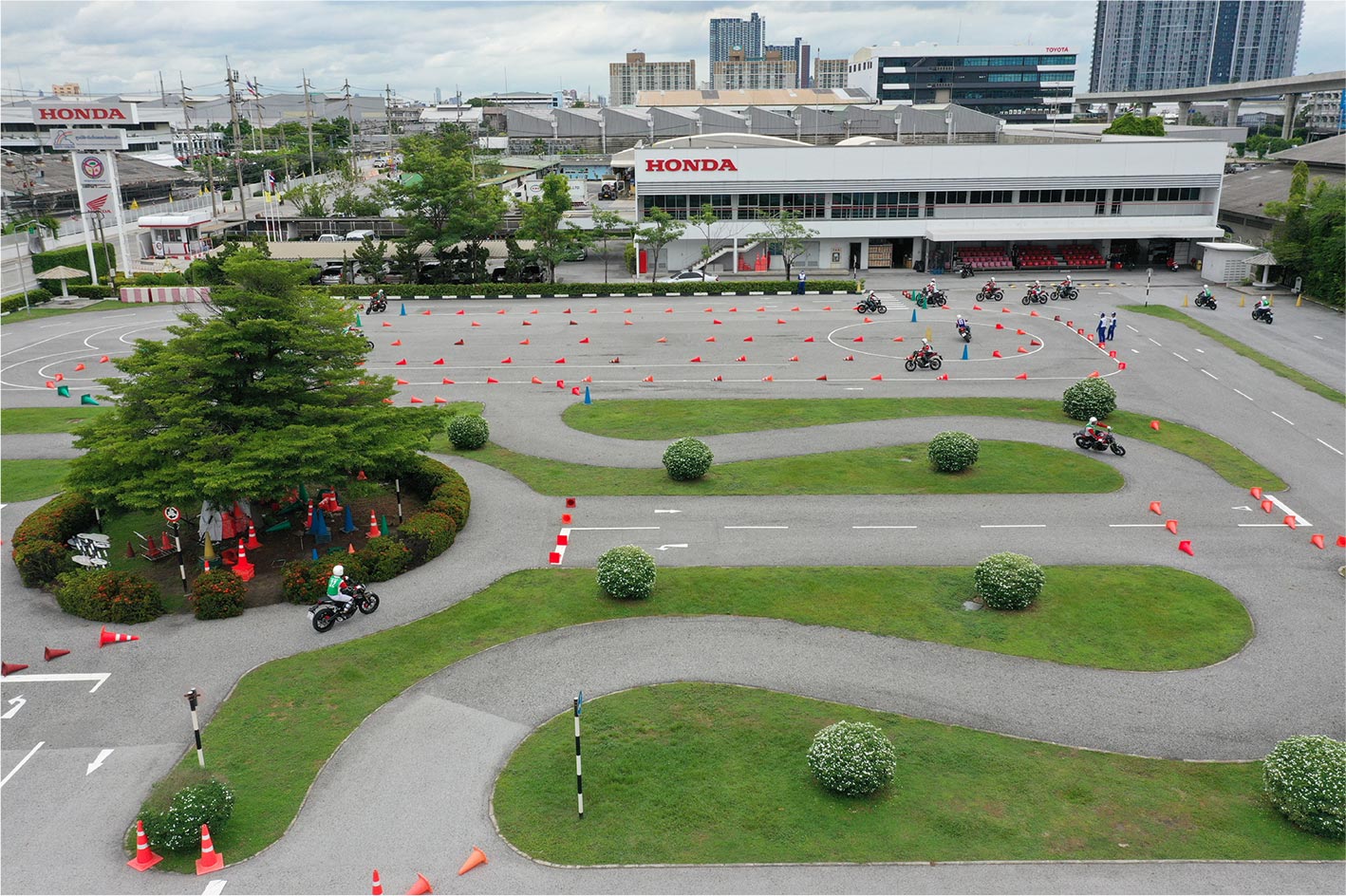
APH Traffic Education Center, the first private facility in Thailand to issue government-approved license
exchange certificates opened in 2004.
In 2021, the Office of the Undersecretary of the Prime Minister of Thailand honored Honda of Thailand Manufacturing (TH)*6 with a “National Treasure” designation in recognition of the many ways its “Honda Safety Thailand” safe driving promotional activities have contributed to Thailand’s social development and improved the quality of life for the Thai people.
Activities to promote the safe driving of cars are conducted by Honda Automobile (Thailand) Company Limited (HATC), a local subsidiary responsible for manufacturing and selling automobiles. HATC has further established an internal department to promote Safe Driving activities, and this department has been holding Safe Driving seminars both inside and outside the company, and coordinating Safe Driving campaigns with related organizations. In 2010 HATC began training dealership staff to be Safe Driving instructors, with the aim of disseminating traffic safety knowledge more widely across society. Staff members take a three-day Safe Driving instructor training course at a Traffic Education Center in Thailand, which qualifies them to offer pre-delivery safety advice (PDSA) at their dealership, to hold safety mini-classes for those who wish to participate, and to offer hazard prediction training. They also work to help customers understand the “Honda SENSING” driving safety support system installed in in Honda vehicles.
- In March of 2021, a new company was created through the merger of local motorcycle sales subsidiary A.P. Honda Co., Ltd., Thai Honda Manufacturing Co. Ltd., which oversees the manufacture of motorcycles and power products, and the holding company HPD Co., Ltd.
Looking to the Future
“Honda has been providing education in traffic safety for more than half a century, ever since we created our Traffic Safety Promotion Operations in 1970. Our efforts are based on the philosophy that building safety features into the hardware alone is just the beginning, and that we must also see to the ‘software’ aspects of our products, namely by making efforts to impart safety-related knowledge and understanding about how to use our products correctly.
“To this end we have continuously worked to improve our efforts and design activities, both in Japan and overseas, according to the prevailing conditions in each individual country and region. Currently, our activities are centered on Honda’s Traffic Education Centers and dealerships. However, in the future we will also need to reach out more directly to customers who may not have direct contact with Honda.
“Through the digitalization of our educational techniques and the dissemination of information via social networking and other means, we intend to create an information environment that will help both Honda vehicle users and others around the world to deepen their understanding of traffic safety. We will, of course, continue to develop these activities in Japan, and our aim is to achieve the challenging goal of ‘zero fatalities’ in traffic accidents involving Honda motorcycles and automobiles worldwide by 2050. We hope to continue expanding our best practices in this field to other countries with a special focus on emerging markets.”
- 2023 statement by Noriaki Abe, Director of the Honda Traffic Safety Promotion Operations
Promoting traffic safety education as the education
of a lifetime.
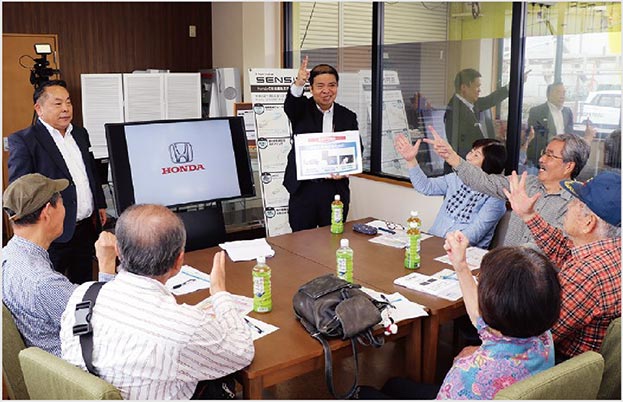 “Minna-de Anshin” (“Safety for Everyone”
 Safe Driving Behavior Assessment), a program for elderly drivers
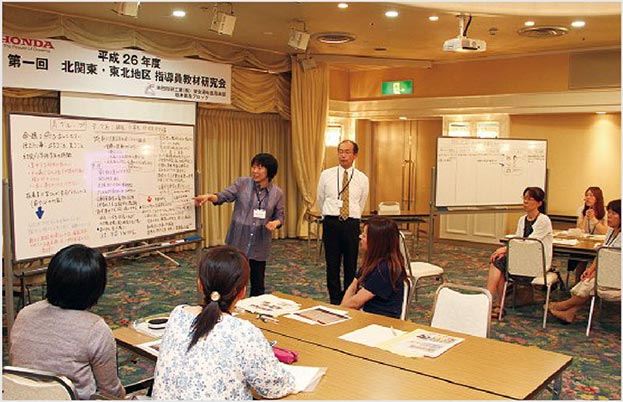 Study sessions with local traffic safety instructors
Honda considers traffic safety education to be lifelong education that is constantly evolving, and is working to develop its educational programs for everyone from young children to the elderly.
In order to best disseminate these programs throughout Japan and the world, collaboration with local communities is essential. The staff at Safe Driving Operations has developed a network of local traffic instructors, and carefully monitors the opinions and suggestions of local traffic safety instructors in order to update existing programs and develop its new programs and related educational materials.
Aiming to raise the level of instructors throughout
the Asia-Pacific region
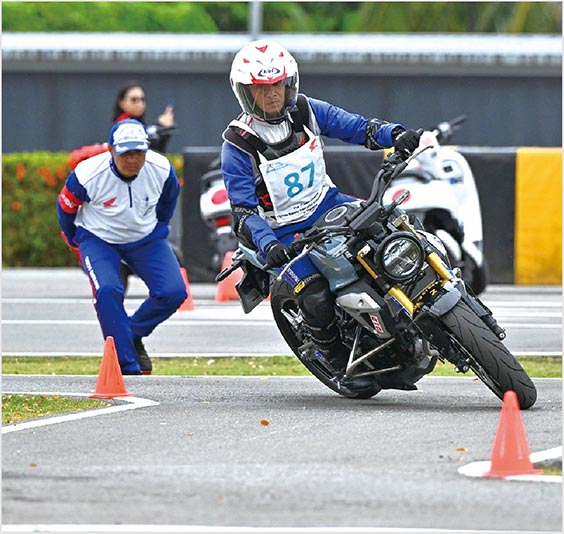
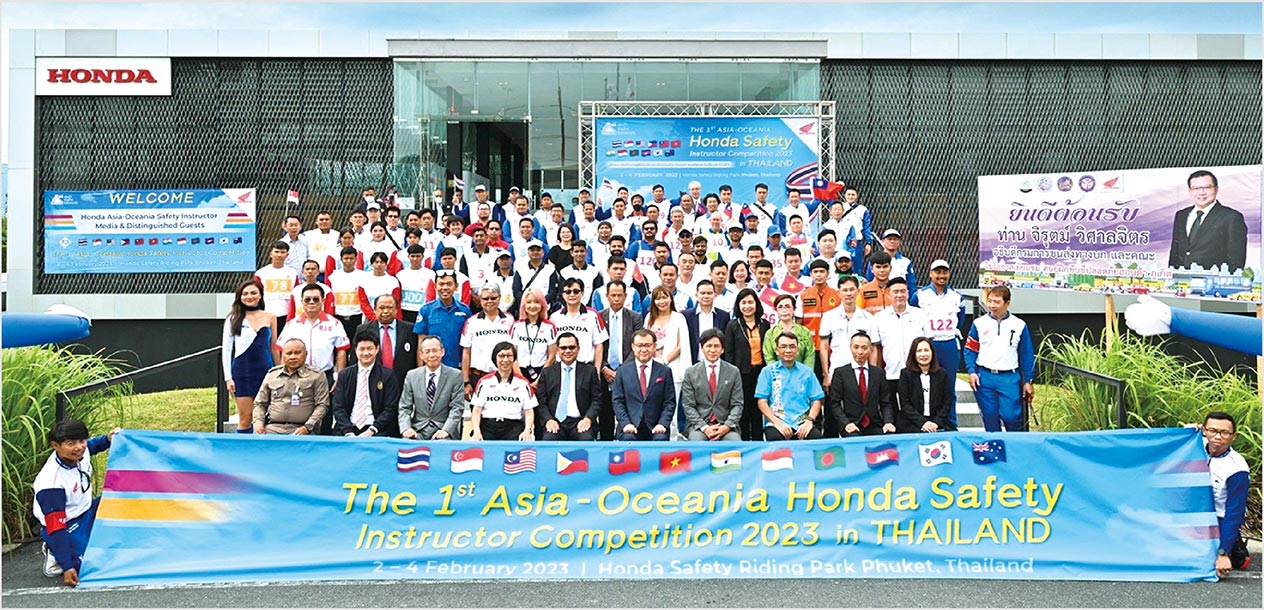
In February of 2023, the first-ever instructors convention in the Asia-Pacific region was held in Phuket, Thailand. This event was attended by 116 instructors from 12 different countries and regions, including instructors from the Honda Traffic Education Centers located in each country, as well as instructors from local subsidiaries. Competition consisted of three practical skill events for motorcycles and automobiles, including slalom, as well as side-presentations that focused on the theme of improving educational methods. This convention provided an opportunity for instructors from various countries and regions to come together to improve their teaching skills and Safe Driving techniques.