
Approaching Initial Performance Targets With the Newly Designed "2X" Engine
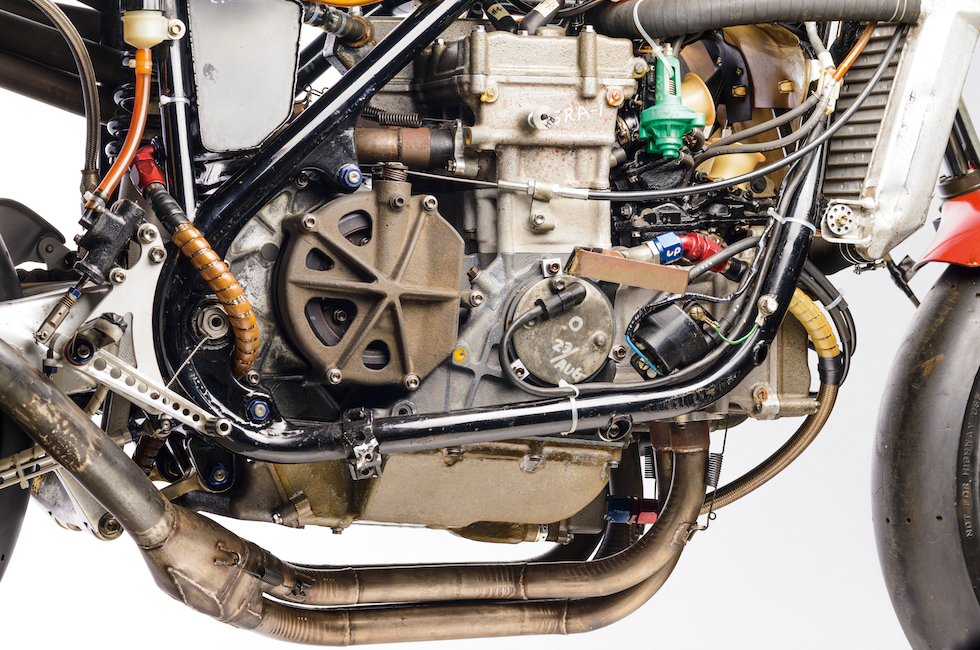
The engine area of the NR3, the third-generation NR500. The installed "2X" engine produced 130 PS at 19,500 rpm during bench testing in September 1981. (Photo/Shinobu Matsukawa)
Following the T-frame-based NR3-1X, the NR Project developed the NR3-2X frame, which featured a genuine double-cradle design. It utilized a continuous loop of round chrome-molybdenum tubing running unbroken along both sides of the chassis, with a dual-pipe configuration for the top section behind the steering head. This frame debuted at the Japanese GP (All Japan Championship round) in April 1981 and was used in the Suzuka 200km race in June 1981, where Kengo Kiyama secured the NR500's only victory. However, starting with that race, a 16-inch front tire was adopted, and this specific configuration was designated the "NR3-2.5X." Takazumi Katayama subsequently rode this NR3-2.5X specification at the Dutch TT (GP of the Netherlands), and Freddie Spencer rode it at the Laguna Seca round of the AMA Championship and the British GP.
The third chassis developed for the NR3 was Honda's first aluminum frame. Created by replacing the round chrome-molybdenum tubing of the NR3-2X with square aluminum tubing, it was designated the "NR3-3X" by the NR Project. Although this aluminum NR3 frame was never used in actual competition, its design elements were incorporated into the subsequent NR4 frame and were further carried over to the aluminum double-cradle frame used on NS2A-AL and NS2B versions of the NS500, Honda's next-generation GP500 factory racer powered by a two-stroke engine.
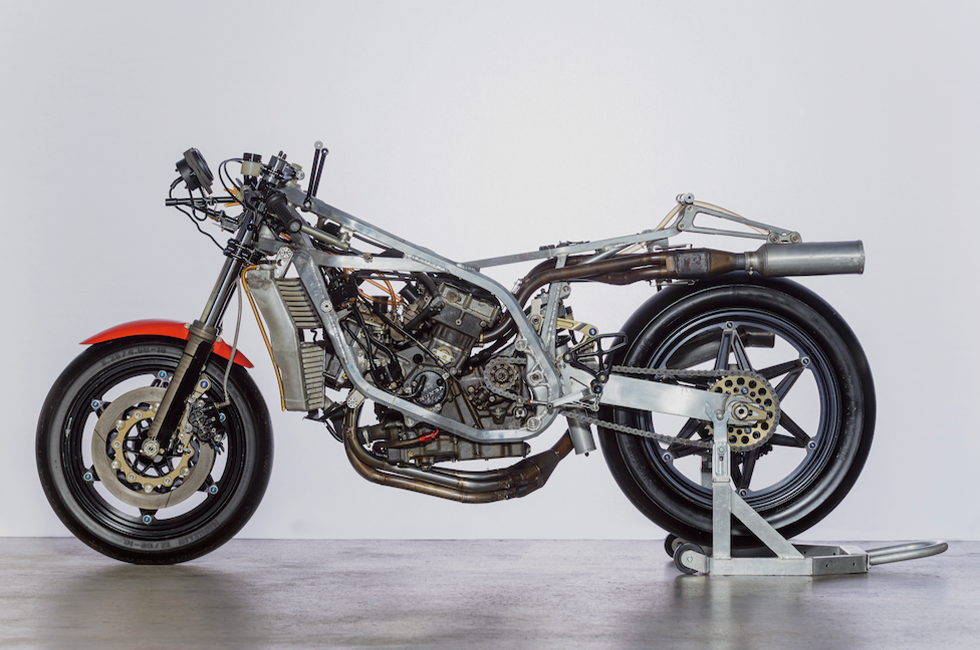
The NR4 is the final model of the NR500 series. Its chassis retained the specifications of the NR3-3X's aluminum double-cradle frame. (Photo/Shinobu Matsukawa)
The "2X" engine installed in the NR3 delivered remarkable performance improvements. The NR Project team designed this engine from scratch once again, this time altering even the V-angle; by shifting from the previous 100° to 90°, they theoretically eliminated primary crankshaft vibration. Additionally, they downsized components such as the crankcase, significantly improving the engine's fit within the chassis and reducing its overall weight.
In terms of performance, the intake tract length was shortened, and the intake ports were straightened to increase intake flow velocity. Valve lift was also increased from 6.5 mm to 7.0 mm on the intake side and from 5.7 mm to 6.5 mm on the exhaust side. The carburetor bore diameter was expanded from 28 mm in the 1X model to 30 mm in the 2X. Furthermore, the included valve angle already narrowed to 40° (20° intake / 20° exhaust) in the 1X was tightened further to 37° (18.5° intake / 18.5° exhaust) to achieve even higher combustion efficiency.
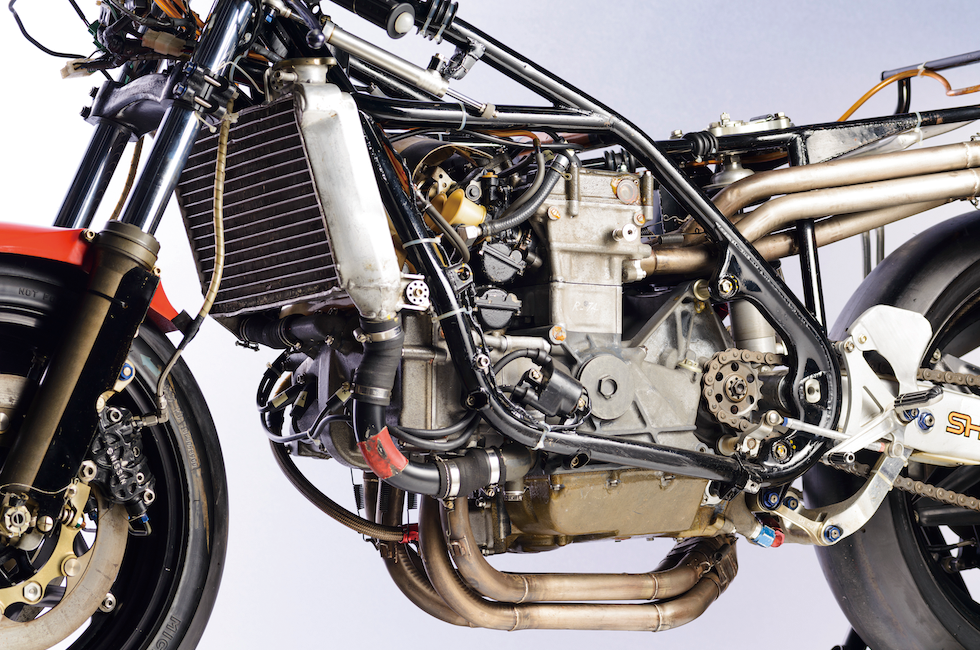
For the "2X" engine installed in the NR3, the lubrication system was switched from the conventional wet-sump design to a semi-dry-sump setup. This change was prompted by bench test results confirming that allowing air to mix with the engine oil reduced friction, thereby increasing power output. (Photo/Shinobu Matsukawa)
Maraging steel, a special material first adopted as a standard specification for valve springs in the "1X" engine (referred to as "MAS material" within the NR Project), underwent further refinement through a collaboration between Honda R&D and the material manufacturer, resulting in the development of "MAS-2," which offered enhanced toughness and wear resistance. A new issue arose regarding valve spring resonance in the ultra-high-RPM range; however, after repeatedly testing various valve lift profiles to eliminate this problem, the design was perfected to ensure reliability at speeds exceeding 20,000 rpm, up to 21,000 rpm.
As a result of these improvements, the oval-piston, 8-valve NR500 engine, specifically the "2X" version used in the 1981 NR3, finally achieved the 130 PS target set at the project's inception. (Engine bench tests recorded 130 PS at 19,500 rpm in September 1981, and 135.1 PS at 19,500 rpm in October 1982 using a magnesium piston specification.)


