
Addressing the Fragility of the Original Engine While Boosting Output
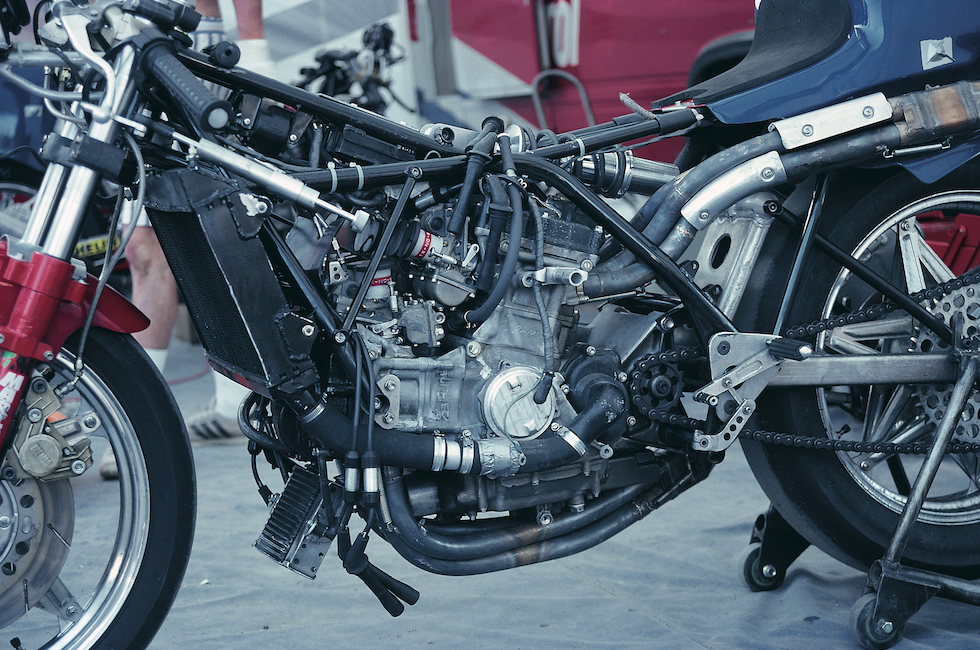
The NR2 featured a 100-degree V4 "1X" engine suspended within a Maxton diamond frame. Lacking lower frame rails to cradle the engine from beneath, the chassis lacked high rigidity. (Photo/Shigeo Kibiki)
At Maxton, the company entrusted by the NR Project with developing the NR2 chassis had its head, Ron Williams, personally fabricate the frame by hand. Working from the full-scale mockup of the NR2's V4 engine (originally designated "1X" during the NR500 development phase) sent from Japan, he cut, bent, and brazed chrome-molybdenum tubing to construct the NR2 frame. It was a traditional design known as a diamond frame.
Maxton was also given the responsibility of determining the suspension setup. While the original NR500 (NR1), which featured a monocoque frame, used a linkage-type rear suspension, the NR2 employed a design in which the swingarm was connected directly to the chassis via a single shock unit. Regarding the front forks, Maxton opted for conventional (upright) forks from a European supplier with no direct ties to Honda, moving away from the ambitious upside-down forks used on the NR1.
Chassis development for the NR2 began in April 1980, but due to repeated specification changes, it was not until mid-June that the bike was ready for racing. By that time, the season for the World Grand Prix road racing championship, comprising ten rounds in total was already past its fourth race.
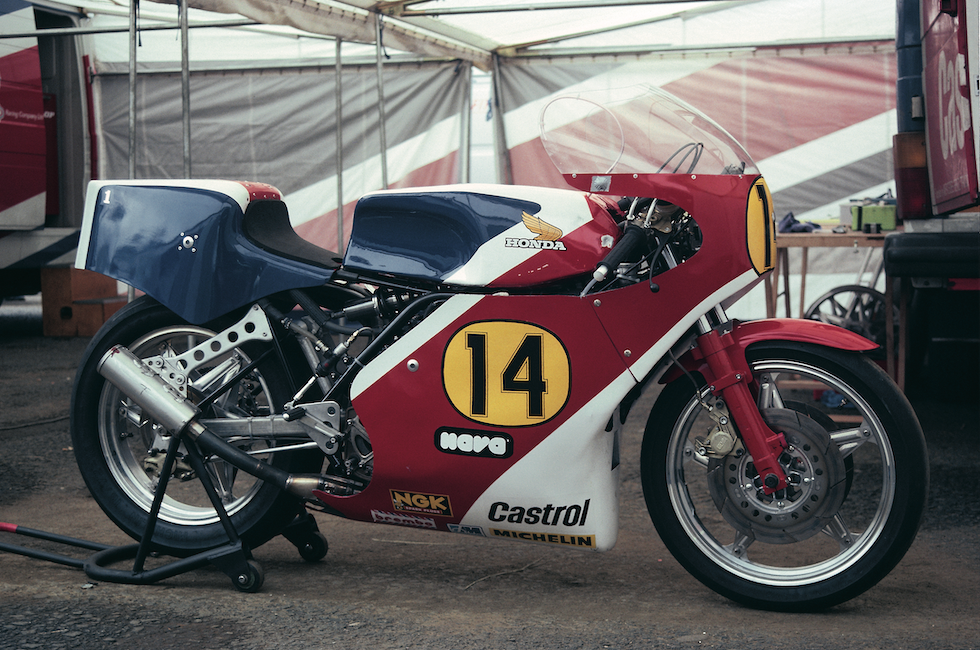
The NR2 featured bodywork crafted by Maxton, with a shape that was considered somewhat old-fashioned even for its time. It was fitted with 18-inch wheels at both the front and rear. (Photo/Shigeo Kibiki)
Regarding the engine, the development strategy focused on evolutionary refinement. The "1X", the second iteration of the NR500's V4 engine, aimed primarily to resolve the durability issues that had plagued its predecessor (the "0X") and to boost power output, which remained insufficient.
The primary cause of the 0X engine's fragility was the failure of the camshaft drive gears due to resonance. A design change was initially implemented to incorporate a vibration-absorbing rubber damper into one of the cam gears, but this proved inadequate. Consequently, the 1X design featured a damper with significantly greater capacity positioned at the end of the camshaft. This solution hits the mark; cam gear failures were eliminated, and the NR500 engine never again suffered from such issues throughout its subsequent evolution.
Although the 1X engine represented an evolutionary step, it featured a completely redesigned crankcase; the most significant change was the relocation of the power take-off point of the cam gear train to the center of the crankshaft. This move was also intended to enhance engine rigidity. While increasing the number of crankshaft journal and holder assemblies from five to six added weight, reliability was prioritized. With that foundation established, the NR Project team then tackled the other critical objective: increasing power output.
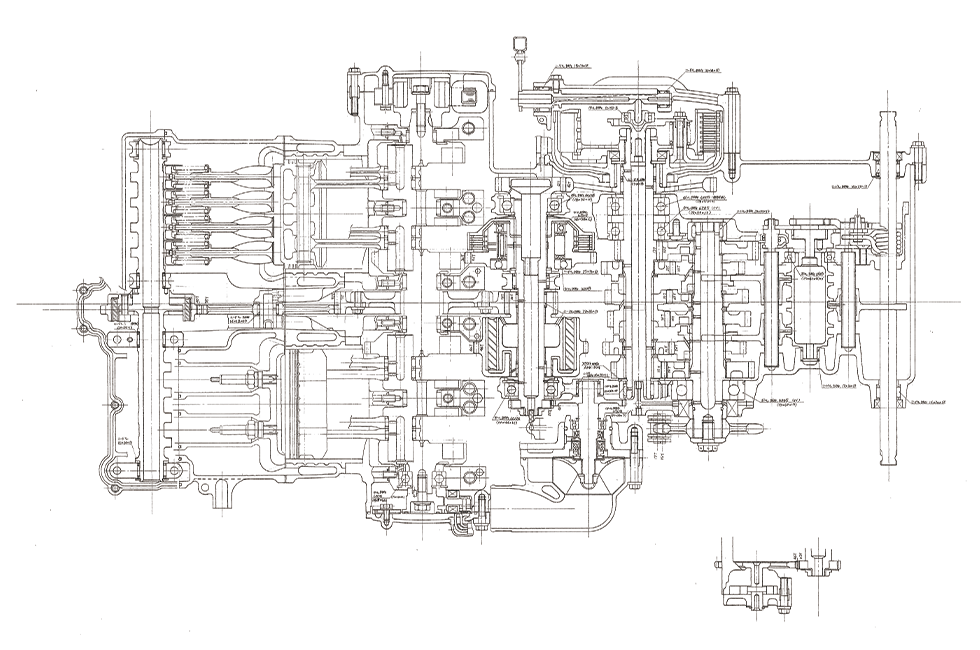
A longitudinal cross-section of the 1X engine. The cam gear train, located at the right end of the 0X engine, was relocated to the center, and the crankshaft configuration was changed from the 0X's five-journal design to a six-journal design.
While the 1X retained the 0X's 100-degree cylinder bank angle (V-angle), the included angle between the intake and exhaust valves was narrowed from 65 degrees (30° intake / 35° exhaust) in the 0X, as used in the NR1 race bike to 40 degrees (20° intake / 20° exhaust). As a general rule for four-stroke engines featuring a pent-roof combustion chamber (where the chamber ceiling resembles a gabled roof), the combustion chamber becomes more compact as the intake and exhaust valves are positioned more upright, thereby reducing the valve angle; this improves combustion efficiency and yields greater power. Indeed, while the 0X engine produced a maximum output of 100 PS when first introduced to racing, the 1X, with its 40-degree valve angle, achieved 122.6 PS at 19,000 rpm by May 1980.
However, this evolution did not come without drawbacks. As a result of a design that prioritized increased strength and durability, the weight of the 1X engine alone rose to 64.5 kg, up 7 kg from its predecessor, the 0X. This meant it was more than 15 kg heavier than the two-stroke, four-cylinder engines it sought to defeat.
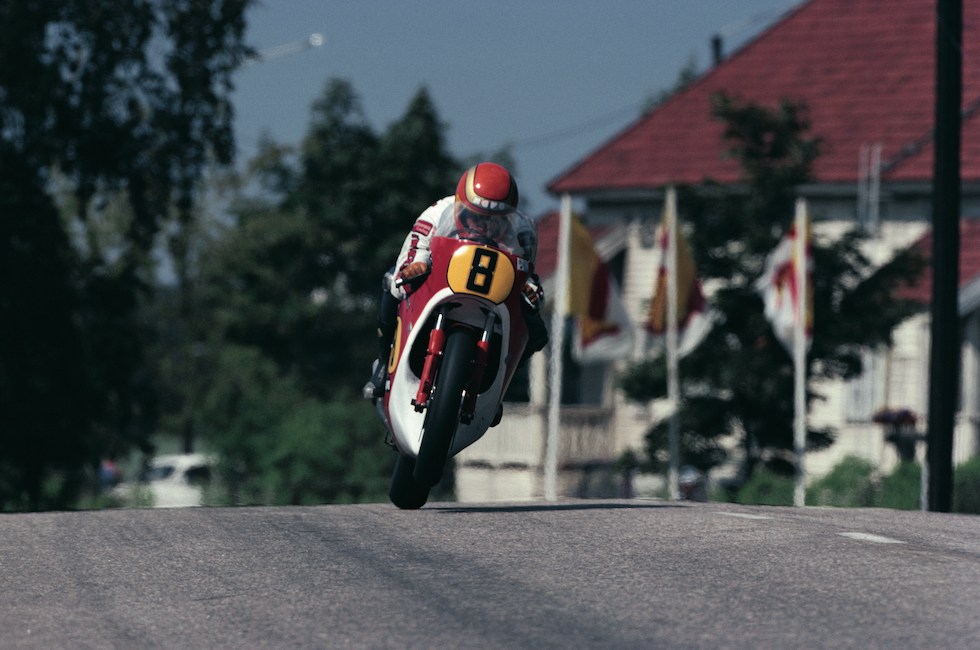
The NR2 being ridden by Takazumi Katayama at the 1980 Finnish GP. The oval-piston engine had developed enough power to cause the wheelie naturally when accelerating at full throttle over the section where the track transitioned from a slight uphill to a flat stretch. (Photo/Shigeo Kibiki)


