Honda P2 Humanoid Bipedal Robot Recognized as IEEE Milestone
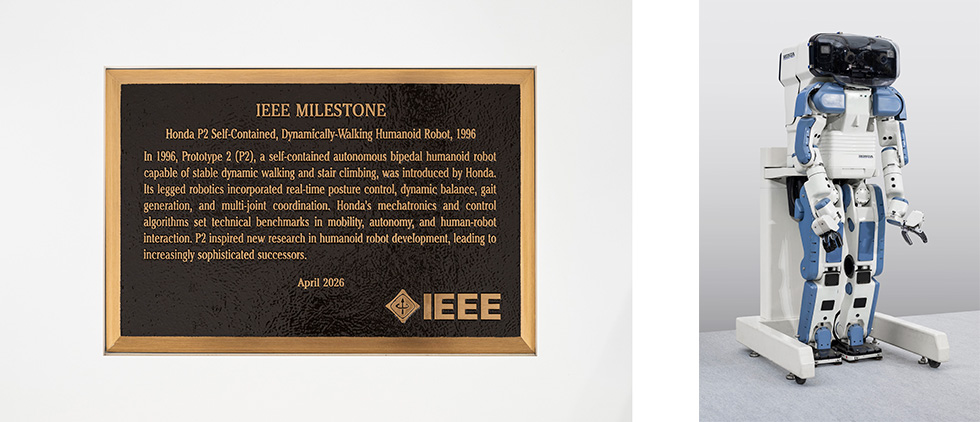
TOKYO, Japan, April 28, 2026 - Honda Motor Co., Ltd. today announced that the P2 bipedal humanoid robot Honda introduced in 1996 has been honored as an official IEEE (Institute of Electrical and Electronics Engineers) Milestone.
A commemoration ceremony was held today at Honda Wako Building in Saitama, Japan, and the milestone plaque was presented by Professor Toshio Fukuda, Professor Emeritus of Nagoya University, who served as the 2020 IEEE President and CEO, the first ever IEEE President from the Asia Pacific region.
This marks the second time that Honda has received recognition as an IEEE Milestone, following the Honda Electro Gyrocator*1 recognized in 2017.
The U.S.-based IEEE is the world’s largest non-profit organization of technical professionals in the areas of electrical, electronics, information and communication. With over 530,000 members in more than 190 countries, IEEE is the trusted voice in a wide variety of technology areas including computer, biomedical, telecommunication, electrical, aviation and electronics. With the IEEE Milestones program, IEEE honors historic achievements of groundbreaking innovations in the areas of electrical, electronics, information and communications technologies, which are at least 25 years old and have made a significant contribution to the advancement of society and industry. Since the start of the program in 1983, IEEE has honored 293 milestones*2 in the world before March 2026.
In this recognition, Honda was acknowledged not only for its achievement in control technology for bipedal walking amassed through the development of the P2 robot, but also for creating a new concept of robots —equipped with flexible intelligence and designed for a wider range of applications beyond industrial uses. This includes serving societal and assistive roles, such as serving as a personal assistant for people — and for establishing a technological benchmark in the field of human–robot interactions.
The technologies amassed through the research and development of P2 were carried forward into ASIMO, a humanoid robot Honda announced in 2000, enabling more natural and smoother walking that closely resembles human gait, as well as the ability to perform tasks and provide assistance while blending into people’s daily lives. Furthermore, those fundamental robotics technologies have since been continuously applied in a wide range of technological fields, including remote-controlled avatar robots and “multi-fingered hand” robots, eVTOL aircraft, and space robots.
Honda will continue to advance its initiatives to help people and augment their possibilities through continuous research and development of robotics technologies.
About P2
Developed as the second-generation prototype of an autonomous humanoid bipedal robot, for which Honda began research in 1986 recognizing that it would be the starting point of all areas of human mobility technology, the P2 was first unveiled to the public in 1996. Unlike the “static walking (shuffling gait)” then commonly used for bipedal robots, the P2 realized more natural, human-like walking motion — which was considered unattainable at that time — using a walking control algorithm*3 developed independently by Honda. Moreover, original Honda control technology capable of estimating various road surface conditions and external forces contributed to the enhancement of posture stability. With the real-time generation of leg movements, the P2 achieved the ability to walk on uneven floors and slopes, as well as ascend and descend stairs.
Reason for the IEEE Milestone recognition
An excerpt from IEEE Milestone Wiki*4
The Honda P2 humanoid robot, introduced in 1996, represents a historic milestone in robotics history. At a time when most global robotics research was focused on quadrupeds or wheeled robots with limited autonomy, P2 stood out for its fully integrated architecture and human-scale physicality and demonstrated real-world feasibility of human-like locomotion by overcoming challenges such as real-time feedback control*5, surpassing contemporaneous quadruped and wheeled robots in versatility and adaptability. Its development marked a major shift in robotics—from machines optimized for industrial tasks to intelligent, mobile agents designed for social and assistive roles. Its technological and conceptual breakthroughs paved the way for the ASIMO series and inspired international research in humanoid robotics, setting a trajectory that continues to shape the industry today.
Comment by Toshihiro Mibe, Global CEO of Honda
“We would like to express our sincere gratitude for recognizing the Honda P2 autonomous humanoid bipedal robot, as a prestigious IEEE Milestone. We would also like to extend our deepest appreciation to all those who have supported us and worked together with us to overcame numerous challenges to achieve this recognition. We understand this recognition is an acknowledgment not only of the total technical excellence of P2 as a robot, but also of the challenging spirit demonstrated by Honda engineers who devoted themselves to the research and development of P2. Going forward, Honda will continue to take on challenges in difficult technological development, serving people worldwide with the ‘joy of expanding their life’s potential.”
*1 The world’s first (based on Honda internal research) map-based automotive navigation system Honda commercialized in 1981.
*2 For the list of key IEEE Milestones, please refer to https://ethw.org/Milestones:List_of_IEEE_Milestones
*3 Original Honda control technology consists of ground reaction force control, target Zero Moment Point (ZMP) control, and landing position control.
*4 IEEE Milestones Wiki: Milestone-Proposal:Honda's P2, First Bipedal Robot, 1996 - IEEE Milestones Wiki
*5 A control technology that enables the robot to maintain balance in real time using the whole body, adjusting to factors such as its own body tilt and floor inclination.