Climate Change-related Disclosures
(Response to the TCFD Recommendations)
In treating responses to climate change and energy-related issues as crucial in the environmental field, in April 2021,
Honda announced, its vision to “realize carbon neutrality for all products and corporate activities Honda is involved in by 2050.”
Hence, Honda has declared our support to the Task Force on Climate related Financial Disclosures (TCFD), established by the Financial Stability Board (FSB), as well as disclosing information based on the information disclosure framework recommended by the TCFD.
Risk management
Honda has established the Risk Management Committee to identify, check and discuss the status of company-wide priority risks which are deemed important for the entire corporate entity. Climate change-related risks such as risks related to environmental regulations and natural disasters caused by climate change are also managed and monitored by the Committee, which leads to promoting more effective risk management activities while considering the characteristics of respective Operations. The Corporate Strategy Operations evaluates and identifies climate change-related risks by conducting scenario analysis in line with TCFD recommendations, reflecting external and internal risk information which includes company-wide priority risks. The results of the scenario analysis of climate changerelated risks are shared with the Risk Management Committee. Climate changerelated risks are mainly addressed by the Corporate Strategy Operations, Business Operations and Regional Operations as well as by each respective Operation, Supervisory Unit, subsidiary and cross-departmental task force. Important matters related to risk management including the responses to the climate change-related risks are discussed by the Committee, and details of their activities are reported to the Executive Council as appropriate. For more explanation of the risk assessment and management process, please refer to Risk Management.
Honda ESG Report 2025 | P202 Risk Management
Strategy
To achieve more sustainable corporate management, Honda identifies and evaluates short-, medium-, and long-term climate change-related risks and opportunities, reflects them in the corporate strategy, and promotes initiatives to generate new business opportunities through advancing Honda’s technologies, products and services. Honda will continue its efforts to enhance the corporate resilience.
Scenario Analysis Overview
To evaluate and examine the impacts of climate change on our business, Honda has defined multiple scenarios and conducted the scenario analysis noted in the TCFD recommendations. This includes a scenario with significant policy transition which is based on the target laid out in the Paris Agreement “to limit the temperature increase to 1.5°C above pre-industrial levels” (1.5°C scenario) and a scenario where environmental regulations are not strengthened, leading to physical risks increase (4°C scenario).
In the scenario analysis, Honda has examined climate-related risks and opportunities for motorcycle, automobile, and power products businesses in accordance with the classification of the TCFD recommendations and quantified the medium- to long-term financial impact under the scenario to the extent possible for evaluation and analysis.
For the scenario analysis based on the TCFD recommendations, we primarily used the following scenarios.
1.5°C Scenario
Honda refers to NZE (Net Zero Emissions by 2050 Scenario) and APS (Announced Pledges Scenario) of the IEA (International Energy Agency) and the IPCC (Intergovernmental Panel on Climate Change) AR6 SSP1-1.9.
As part of the 1.5°C scenario, Honda assumes that measures to achieve carbon neutrality by 2050 will be promoted across the world in the long-term and that the development and use of new technologies will promote the widespread use of carbon-free products and renewable energy. Additionally, we have assumed that the transition to a circular economy will accelerate. In the automobile industry, despite uncertainties due to policy changes, we assume even more stringent regulations on fuel efficiency and Zero-Emission Vehicles (ZEVs) in the long-term, and, as a result, producing a rise in demand for Electric Vehicles (EVs) and Fuel Cell Electric Vehicles (FCEVs) — although mainly in developed countries.
Furthermore, in the motorcycle, automobile, and power products businesses, we assume that customers’ sense of value will shift, with an increasing number developing a preference for carbon-free products and services.
4°C Scenario
Honda has developed our 4°C scenario by using IPCC AR6 SSP3-7.0. In the 4°C scenario, we assume that irreversible environmental changes will occur, leading to more frequent and more severe natural disasters.
Risks and Opportunities and Honda’s Responses*1
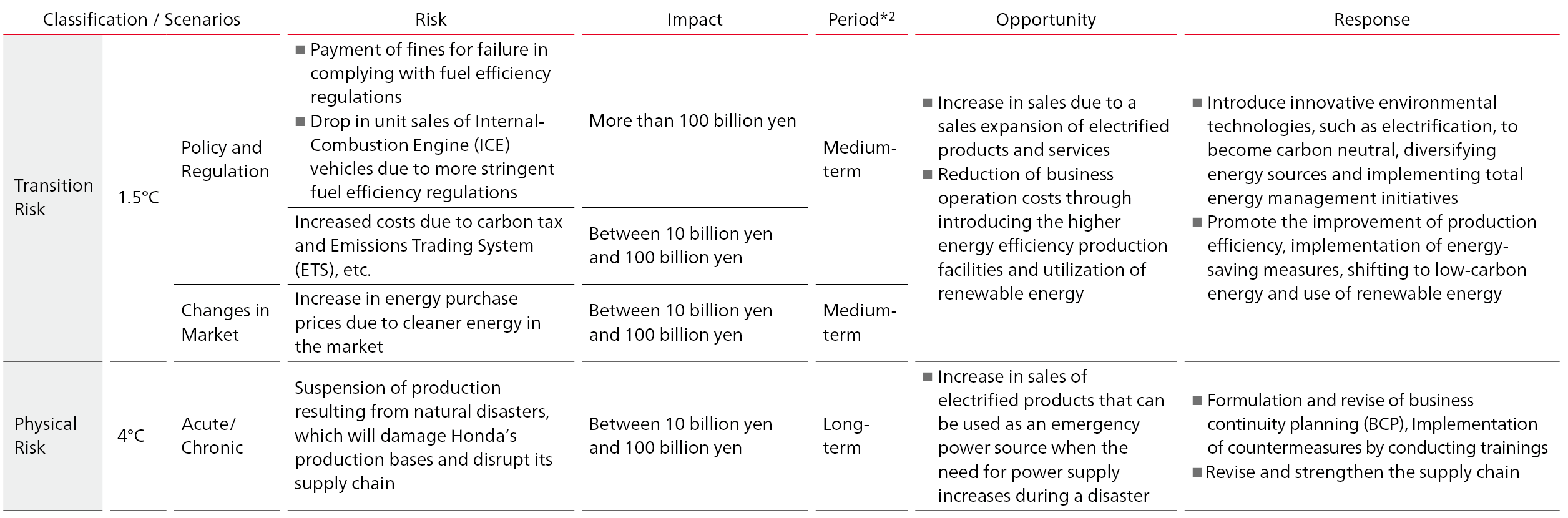
- This list is not intended to be exhaustive and does not cover all risks and opportunities or Honda’s measures with respect thereto.
- The timeframes are defined based on the timing of the effects that are expected to occur. The short-term refers to within one year (aligned with the annual action plan period), the medium-term covers the period from the next two years through the fiscal year ending March 2031 (aligned with medium-term management plan period), and the long-term covers periods beyond the fiscal year ending March 2031 through 2050 (2050 as the benchmark year for Honda’s carbon neutrality goals).