Climate Change
Initiatives for Carbon Neutrality and Clean Energy
Honda, as a comprehensive mobility company, believes it is essential to actively promote GHG emissions reduction efforts by calculating and disclosing GHG emissions from its global business activities. To achieve this, Honda follows “GHG Protocol*1,” which is the most commonly used standard for GHG accounting worldwide. Since 2012, Honda has been calculating GHG emissions across its entire supply chain and converting these emissions into CO₂ equivalents for disclosure.
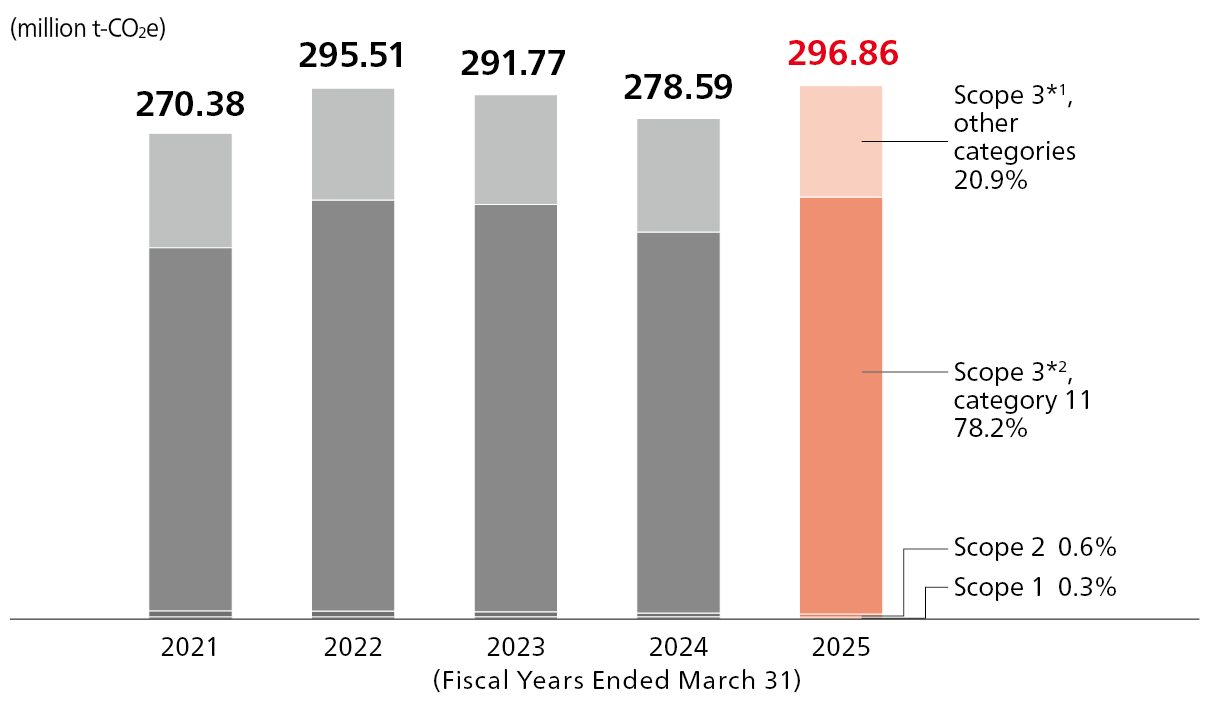
In the fiscal year ended March 31, 2025, Honda’s total GHG emissions worldwide amounted to 296.86 million t-CO₂e. Scope 3 Category 11, which pertains to CO₂ emissions from product use, accounts for approximately 80% of this total. The remaining 20% is comprised of three categories: “Scope 1” emissions from direct corporate activities, “Scope 2” emissions from indirect energy use, and “Scope3, Other Categories” emissions from upstream processes such as resource extraction and downstream processes related to resource disposal.
Honda aims to achieve carbon neutrality by 2050. To achieve this, the Company is prioritizing reductions in CO₂ emissions from product use (Scope 3 Category 11) and from its own business activities (Scope 1 and 2), setting these as key milestones for its efforts.
Total GHG Emissions (Scope 1, 2 & 3)
- GHG Protocol: The Greenhouse Gas Protocol was developed by the World Business Council for Sustainable Development (WBCSD) and the World Resources Institute(WRI).
- For Scope 3 Categories 1, 4, 9, and 12, we have made some changes starting in FYE Mar. 31, 2025. These categories are disclosed after recalculating past performance.
- For Scope 3, Category 11, the IEA SMP Model was used for calculations until FYE Mar. 31, 2021, while the IEA Mobility Model (MoMo) has been used since FYE Mar. 31, 2022. Additionally, some calculations have been revised starting from FYE Mar. 31, 2023.