How Honda Approaches Electric Motorcycles: Branding for a New Market
Creating electric vehicles that only Honda can achieve
Electrification is accelerating across the mobility industry. The challenge Honda took on in the electric motorcycle market to achieve carbon neutrality was branding. Creative Director Taro Nishimoto, who worked on the branding and design, discusses how they defined “the value Honda creates” in this new domain and incorporated it into the design.
First, what prompted you to start considering branding for electric motorcycles?
Nishimoto
It began with Honda's company-wide policy announced in 2021 of aiming to achieve carbon neutrality by 2050. When Electrification Business Development Operations was established internally in 2023, new EV-focused manufacturers were beginning to emerge in India, the world's largest motorcycle market. Restrictions were also starting to emerge on internal combustion engine (ICE) vehicle access in certain European cities. Despite the limited market size, the development of electric models began in earnest to prepare for the potential future expansion of the electric vehicle market.


What kind of electric vehicle development did you aim for in this new market?
Nishimoto
Electric vehicles face challenges such as range, cost, and charging infrastructure, and there was little information available about the target customer base. We needed to rethink everything from the ground up—starting with users and use cases—and development became extremely chaotic. There were many debates within the company, but we eventually settled on a clear direction: our goal was to take on challenges that exceeded customer expectations; we shouldn't just replace engines with motors, but create electric motorcycles that only Honda can achieve.
What value can only be achieved through electrification?
What kind of electric motorcycle can only Honda achieve?
What kind of future are we aiming for?
We needed to stop and re-think everything from scratch.
You established “Expected Life. Unexpected Discoveries” as the brand promise of Honda’s electric two-wheel business, declaring Honda’s commitment to co-creating a world filled with comfort and excitement alongside people.
Nishimoto
Honda will target a wide range of customers in the electric motorcycle market, from compact commuters serving as daily transportation to high-end FUN models. The brand promise must be inclusive and not biased toward a limited audience. After extensive discussions with members involved in the electric vehicle business, the phrase “Expected Life. Unexpected Discoveries” was ultimately born.


Nishimoto
At the same time, we recognized that we needed to take on new challenges in design. Amidst the overwhelming presence of Honda's ICE motorcycle lineup, how could electric vehicles embody a “new Honda”? We decided not to focus solely on the styling of individual products and instead defined the value proposition of electric mobility itself. We worked to unify the concepts and styling of multiple models, steering the direction toward branding the entire electric model lineup.
We began by defining our value proposition as a brand. Reflecting on global environmental changes and our current circumstances, we had many discussions with the team and ultimately established four core values: “Freeing people from anxiety and barriers,” “Stimulating instinct and sensibility,” “Coexisting with people and society,” and “Resonating with intelligence.”
What specific possibilities can be realized through these four core values propositions for electric motorcycles?
Nishimoto
“Freeing people from anxiety and barriers” aims to provide more people with the joy and freedom of mobility.
We believe that we can reduce physical anxiety and burden by leveraging the characteristics of electric vehicles. For example, we can improve footing by utilizing the highly flexible body layout of electric vehicles and reduce the burden of pushing the bike by using motor assistance. Furthermore, we may be able to free users from economic barriers by combining network-based vehicle management with new financing services. There are people who cannot ride motorcycles for various reasons, and those who find it burdensome. We believe that the power of inclusive design and technology can extend the joy and freedom of mobility to more people.


Nishimoto
“Stimulating instinct and sensibility” maximizes the joy of control, delivering a more emotional riding experience.
Electric vehicles not only offer overwhelming torque and smooth acceleration from the motor, but also enable precise control of the vehicle body. Control tailored to the rider's skill level and situation, along with the refinement of the riding experience, will become major strengths for electric vehicles in the future. This is where the knowledge and technology Honda has cultivated through years of ICE vehicle development and racing activities will prove invaluable. Furthermore, in the area of HMI*, we believe improvements like improved handlebar switch operability and highly visible GUIs* will enable instant recognition and intuitive operation, helping deliver the joy of riding.
*GUI: Graphical User Interface
Nishimoto
“Coexisting with people and society” represents a new form of relationship between machines, people, and society.
Accident prevention and other advanced features will evolve through connectivity and coordinated control via V2V* communication going forward. Furthermore, as V2X* technology advances, it could help reduce environmental impact by more efficiently guiding mobility across society as a whole. Communication between people and vehicles, including through HMI, will also become more information-dense. We will explore how motorcycles can connect with people and society to achieve a richer form of mobility society.
*V2X:Vehicle to Everything


Nishimoto
“Resonating with intelligence” expands the possibilities of each user’s mobility life through motorcycles that evolve and grow alongside them.
Personalization and the use of AI are now becoming commonplace. However, leveraging the vast amount of data generated by Honda's massive sales volume—not just from machines and users—also holds the potential to create entirely new experiences. We will provide people with “unexpected discoveries” by returning data to them and further reflecting it into our products.
Embodying Honda's Electric Motorcycle Brand Through Design
The design philosophy embodied in “Precision of Intrinsic Design”
Honda aimed not for decorative styling, but for a stripped-down beauty that emphasizes the fundamental function and performance of motorcycles.
This “Precision of Intrinsic Design” embodies Honda's philosophy in the electric era: pursuing the essence.


What are your design philosophies and approaches?
Nishimoto
The consistent design direction for electric vehicles is “Precision of Intrinsic Design.” This represents the philosophy of not creating unique designs simply because it’s electric, but rather stripping away excess to create designs that are true to function. ICE engines possess the beauty of function and form combined, but it is difficult to express functional beauty in the appearance of batteries. However, rather than hiding them, we want to utilize their layout and structure and elevate them naturally into the design. Our goal is not to rely on fakery or gimmicks to make the design work. We believe that by relentlessly pursuing and refining the necessity of function, performance, materials, manufacturing methods, and layout, we can ultimately express newness that is unique to electric vehicles. This is the intrinsic design Honda should strive for.
Nishimoto
In addition, ICE vehicles have certain layout constraints and established principles, such as placing the engine beneath the fuel tank. There is also a fundamental physical process: air is drawn in, mixed with gasoline in the engine, ignited, and then expelled. Expressing this process beautifully has been a design standard. Conversely, electric vehicles are powered by batteries and motors, which allows greater layout freedom and expands design possibilities. Honda aims to express a newness that transcends the conventional design framework while still capturing the inherent appeal and functional beauty of motorcycles. The EV OUTLIER CONCEPT, unveiled at the Japan Mobility Show 2025, was born as one such possibility.

Transcending the boundaries of styling to design relationships between people and society
What are the design priorities for newly launched electric motorcycle brands?
The four core values propositions revealed a possibility beyond mere form—the potential to design relationships with society itself.


How are you going to incorporate the design concept and four core values propositions into the actual design?
Nishimoto
As an example, current ICE models feature intentionally distinctive face designs to differentiate themselves in the market and build identities for each product line. Honda has built many strong product brands through such designs, including the CBR, Africa Twin, and PCX, all of which have gained significant customer support.
However, we believe there is also a direction for clean, simple face designs that blend into cityscapes by incorporating values like “coexisting with people and society” into the design, rather than asserting its individuality as a product. What exactly are designs that convey the individuality of a brand not by expressing differences, but by blending into society and harmonizing with it? This is a new challenge we are taking on.


Nishimoto
New designs are emerging for HMI as well. It creates an environment where riders can focus on riding through instant recognition and intuitive operation, maximizing the joy of riding while also providing instant judgment, operation, and assistance for a safer mobility life with greater peace of mind.
We are also exploring possibilities for communication directed at both riders and the public. For example, we believe that it will be possible in the future to convey messages like “Please go ahead” to children waiting at crosswalks through the interface. We believe Honda's electric motorcycles should embody more than just stylistic beauty, novelty, or functionality; they should also incorporate their relationship with society and underlying philosophy into the design.
The newly announced Honda WN7 features an impressive serene yet futuristic design that effectively utilizes colors that are common to electric motorcycles. What is your design philosophy with regards to CMF?
Nishimoto
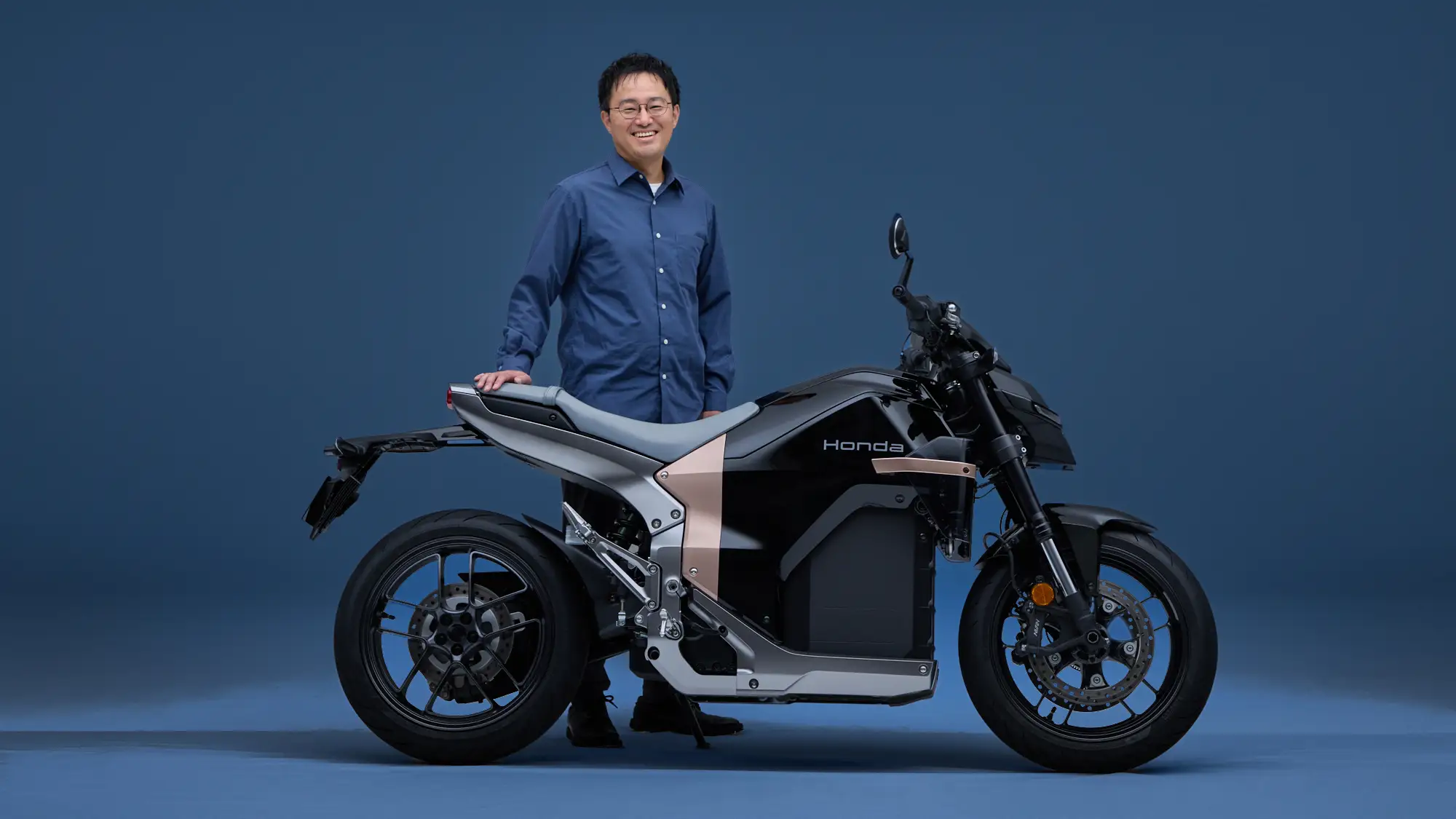
We are also approaching CMF design from the perspective of the brand's desired vision. Color preferences vary around the world, influenced by factors such as cultural background, religion, and climate. We chose black as the base color to create a common global brand, as it possesses a universality that is less susceptible to regional influences. We also used a nuanced gold, close to copper, as the accent color. This gold embodies the essence of quality, individuality, and uniqueness as a Japanese motorcycle brand. While this color palette is less common for motorcycles, we aimed for CMF that blends into urban and natural environments while radiating a distinct presence based on the theme “Harmonize and Eminence.”

The Future Envisioned by Honda's Electric Motorcycles
Corporate responsibility and vision for the future of mobility: Aiming to be a brand that people count on
Nishimoto
Honda sells over 20 million motorcycles a year, making it the world's largest motorcycle manufacturer by sales volume. This also means that we bear significant responsibility as a mobility manufacturer. This is an era where the very nature of our company is being questioned, even before brand or marketing. We take pride in delivering the joy and freedom of mobility to people worldwide. At the same time, our manufacturing sites will continue to emit CO2 and generate waste from paints and materials as long as we keep producing products. The Earth's resources are finite, and we cannot turn a blind eye to this reality. I believe that we must continually consider what the brand should be, beyond just business or the perspective of electric versus ICE.


Nishimoto
Regardless, we must recognize our responsibility as a company delivering numerous mobility solutions to the world and explore various possibilities. Without this mindset, we risk losing our relevance as both a company and an electric motorcycle brand. That is precisely why we cannot abandon the goal of carbon neutrality for the future.
We have also set the goal of zero traffic collision fatalities by 2050. To achieve these goals, we will continue to take on challenges with an eye toward the future, even if the technologies involved do not immediately lead to mass production. In terms of design, we must consider the ideal form not only in terms of exterior styling, but also in terms of reducing environmental impact and connecting with society and people.


Nishimoto
The origin of Honda lies in the belief that “technology is for people.” Honda's technologies have been born from our commitment to people and our sense of social responsibility, as seen in the development of the CVCC engine to meet the Muskie Act, the practical implementation of airbags, and the adoption of fuel injection for motorcycles in the ASEAN region. We aspire to remain a company that constantly considers people and society, and I believe that design should also be an extension of this philosophy. It is precisely by continuing to take on challenges with this mindset that we ultimately create what is uniquely Honda and build a brand that people truly count on.
Finally, what is your vision for the ideal electric motorcycle of the future?
Nishimoto
When people experience Honda products, they gain new discoveries and growth that lead to richer, more fulfilling lives. At the same time, technological advancements such as electrification contribute to society's overall well-being and sustainability by reducing traffic accidents, improving mobility efficiency, and lowering energy consumption. Individual dreams and societal progress can coexist. I would like to create such a future through original technology and design.

Profiles

Taro Nishimoto
Motorcycle and Power Products
Creative Director