Material Research
Center
Innovating with revolutionary materials to create a future filled with hopes and dreams
The Material Research Center continues to work towards creating an innovative material technology beyond the boundaries of business fields, to create Honda’s vision, the “joy and freedom of mobility”, and to realize mobility, which expands all possibilities.

Environmental technologies for realizing sustainable living
Honda aims to achieve a “zero environmental impact society” throughout the lifecycle, including corporate activities, to ensure sustainable living for people on this planet. At the Material Research Center, specific initiatives include research and development in areas such as “circular and environmentally friendly materials”, “additive manufacturing materials,” “functional materials for mobility electrification” and “material lifecycle DX”.
Initiatives on metallic materials
Realizing a resource-circulating economy requires “horizontal recycling”, a process that returns recycled materials to the same products. Consequently, we are developing advanced sorting technologies and dismantling methods to prevent contamination of metal scrap. Furthermore, we are pursuing impurity detoxification technology to ensure the performance and quality of metal scrap materials despite impurity contamination.
Initiatives on organic materials
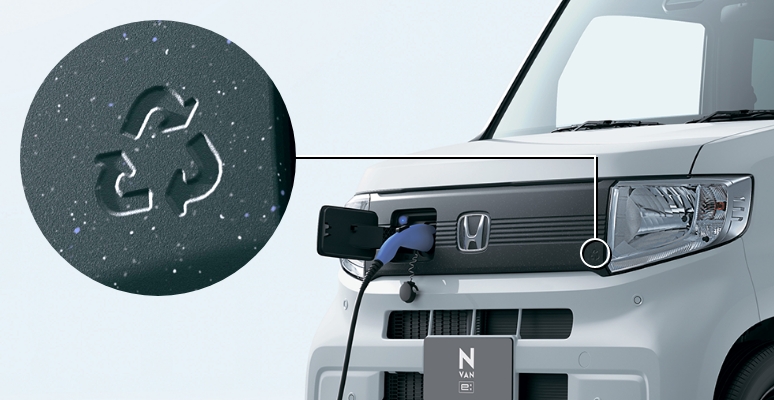
Since 1996, Honda has incorporated recycled plastic from collected bumpers into its vehicles, including the front grille of the “N-VAN e:” and “N-ONE e:”, a component where aesthetics are key. We are also developing pyrolysis and monomer recycling technologies to enable the horizontal recycling of diverse organic materials.
Initiatives on paints and water resource circulation
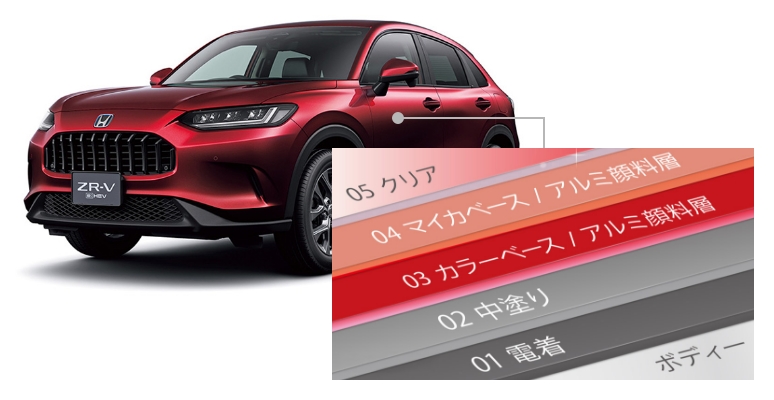
We are developing low-energy-curing adhesives and paints to reduce CO2 emissions in manufacturing. In our paint lines, which use significant amounts of water, we are implementing a water collection and recycling system for water resource conservation.
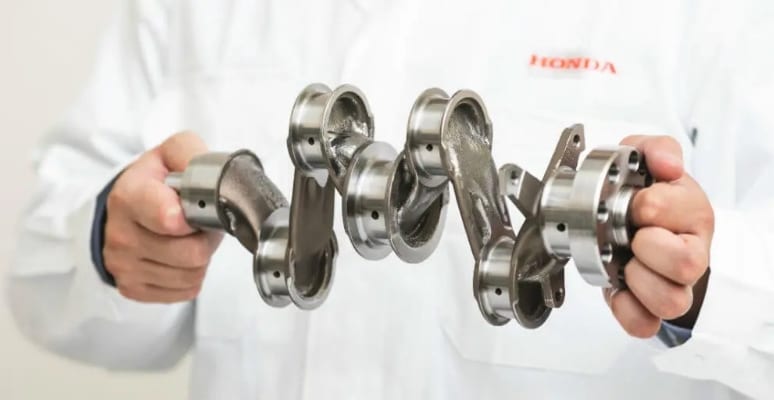
Initiatives on additive manufacturing technology
Additive manufacturing (AM) technology, also known as 3D printing, is a process that creates parts directly from 3D data without molds. In pursuit of innovative mobility, we are engaged in research and development of high-performance materials and processes that capitalize on the features of AM technology.
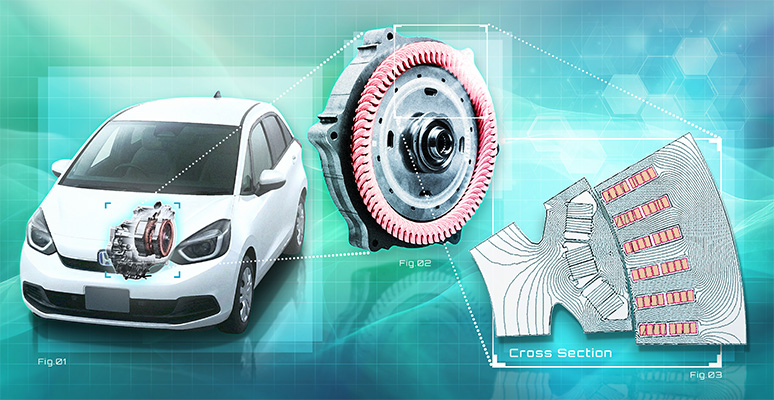
Initiatives in Functional Materials
The advancement of the electrified power unit (eAxle) requires innovations in functional materials that determine performance, especially motor materials that are the key to improving efficiency. To enhance performance while minimizing the use of rare resources, in addition to materials technology, we are engaged in research and development that creates high-performance materials in the shortest possible time by integrating multiple fields such as electromagnetism, thermal engineering, mechanical engineering, chemistry, and computational science.

Initiatives on material lifecycle DX
The method of quantitatively assessing the environmental impact throughout the entire lifecycle, from raw material extraction to disposal of the products, is called Life Cycle Assessment (LCA). Using digital technology to build an intensity database for product constituent materials, the Material Research Center significantly contributes to quantifying the benefits of low-carbon technologies and studying environmental impact reduction during product planning and development.

Future material technologies for human joy
In today’s rapidly changing world, Honda aims to anticipate the times and solve social issues while creating future value. At the Material Research Center, we are working on research and development in specific areas such as “ultimate semiconductor materials,” “fuel cell and hydrogen-related materials,” “future energy materials,” “Carbon-Negative and Biotechnology Solutions,” and “materials informatics” as concrete initiatives.
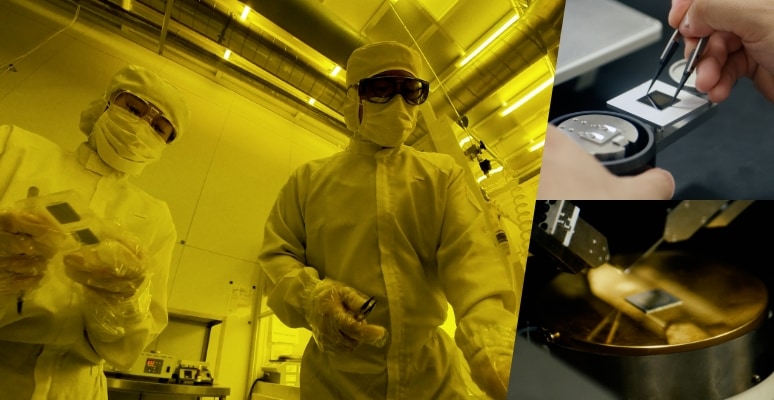
Initiatives on ultimate semiconductor materials
Downsizing power units and maximizing mileage through energy efficiency are key technologies for electrified mobility. Our research and development focuses on high-performance, low power consumption power-semiconductor materials throughout the process from material to device integration, essential for these advancements.
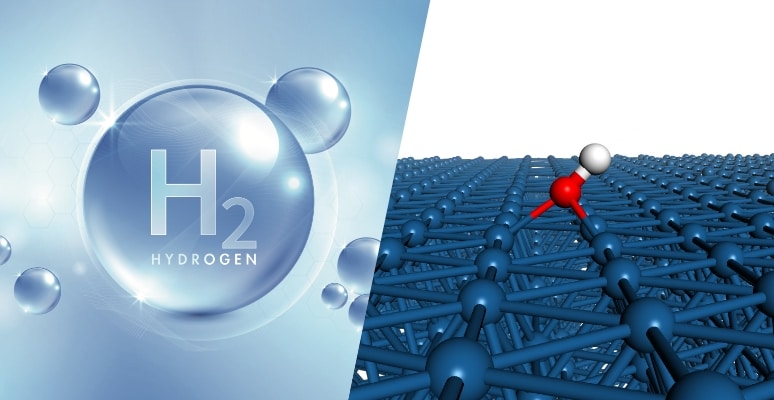
Initiatives on fuel cells and
hydrogen-related materials
Our catalyst material design technologies, developed through engine research, are being applied to the “use”, “production”, and “storage” aspects of a hydrogen-based circular economy. We are working on research and development of materials aimed at evolving fuel cell technologies and creating new value, based on innovative catalyst materials.
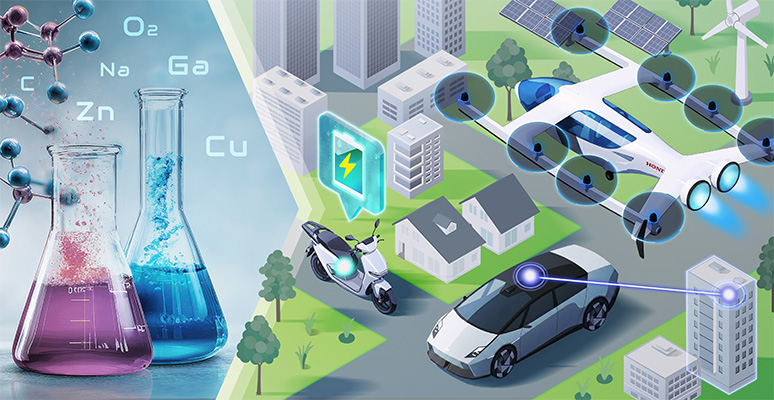
Initiatives for Future Energy Materials
To support the energy society of the future, we are conducting research on next-generation energy materials, looking beyond the current trend of electrification. Building on fundamental sciences such as physical chemistry, inorganic and organic chemistry, polymer chemistry, and physics, we integrate knowledge from electrochemistry and electromagnetics to pursue the realization of liberation from conventional charging through energy transmission, and the development of innovative energy sources.
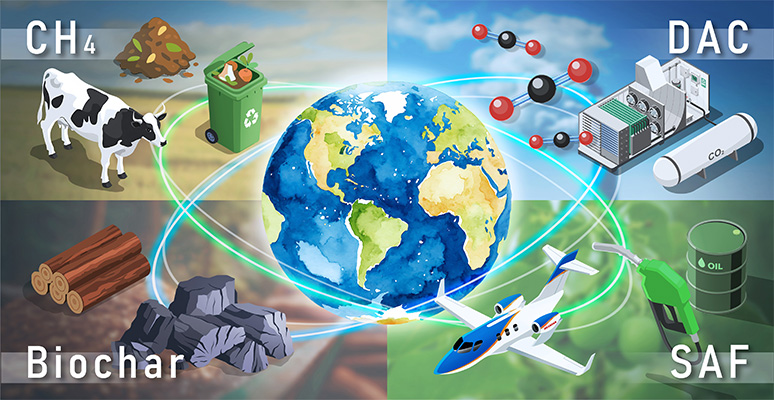
Initiatives in Carbon-Negative Technologies and Biotechnology Solutions
To achieve Honda’s goal of carbon neutrality by 2050, we are engaged in research and development of carbon-negative technologies. In addition, for the electricity and fuels required for mobility, we aim to reduce CO2 emissions and transition away from fossil fuels by exploring the potential of biogas power generation and biomass-derived fuels.
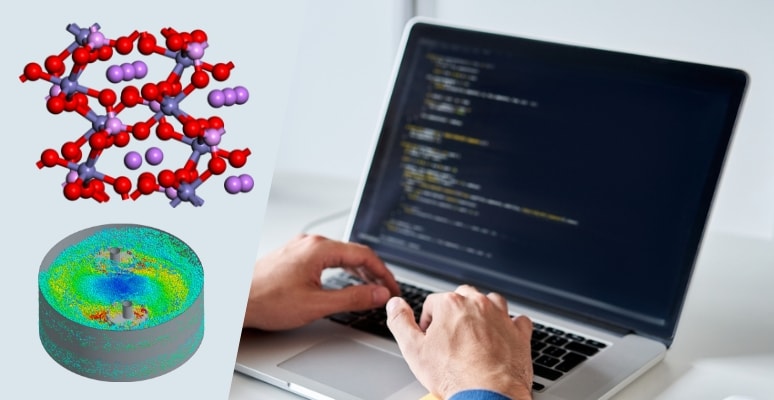
Initiatives on materials informatics
Materials informatics (MI) is a technology that combines “computational science”, such as material simulation, and “data science”, such as machine learning, to explore innovative materials. Utilizing Honda’s unique and diverse data, we are pursuing research and development of materials aimed at creating new value.