CRF Stories
CRF: A New Generation of Four-Stroke Motocrosser
In the late 1990s, the world of racing began to face a new challenge. Even competition machines were expected to address environmental concerns, and the shift toward four-stroke engines—producing fewer harmful emissions than two-stroke engines—was becoming increasingly inevitable.
Honda’s two-stroke motocross machines had already established a remarkable legacy. Since the release of the Elsinore CR250M in 1972, Honda’s CR series had won the loyalty of motocross riders around the world and captured numerous titles in major international competitions.
Building on this proud heritage while responding to the demands of a new era, Honda set out to develop a four-stroke motocrosser capable of matching the performance of its celebrated two-stroke machines. The project began entirely from scratch.
Looking ahead to the 21st century, Honda selected a newly developed water-cooled, four-stroke, OHC, four-valve single-cylinder engine with a displacement of 449 cm³. Compact and lightweight yet capable of high output, it would form the heart of a new generation of motocross machines.
A world debut in Japan
To evaluate the machine’s potential in direct competition with rival motorcycles, the development team chose to debut the prototype in real racing conditions.
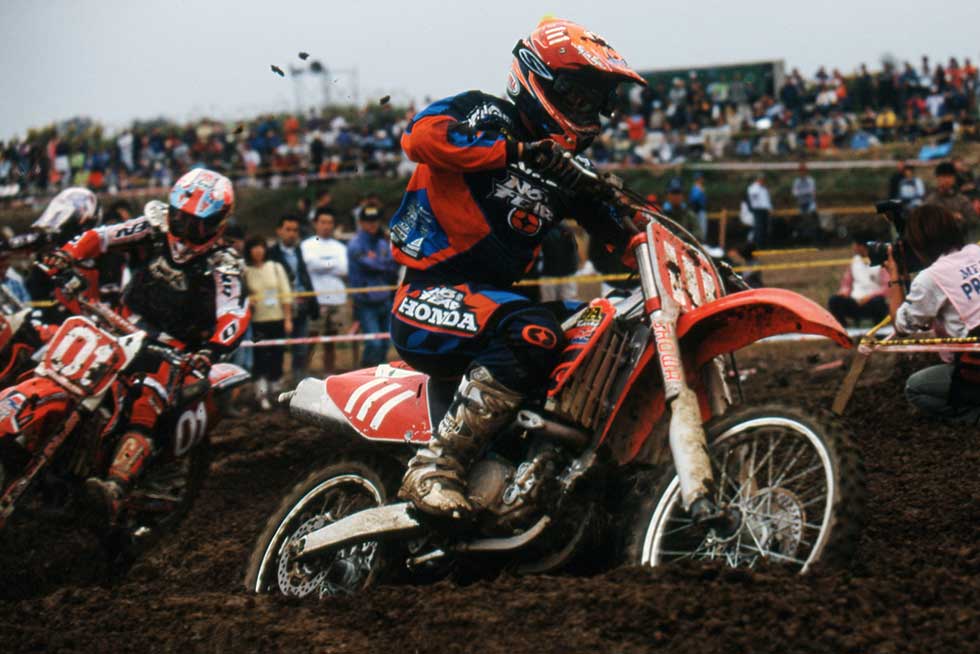
The stage was the final round of the MFJ All Japan Motocross Championship, the Japanese Grand Prix, held in October 2000 at Honda Airport Riders Park in Okegawa, Saitama.
The class selected was the fiercely competitive International A-Class 250cc category, where both 250cc two-stroke and up to 450cc four-stroke machines competed together.
Honda entrusted the machine to Sébastien Tortelli, the French rider who had won the 1998 Motocross World Championship 250cc title. During the 2000 season, Tortelli was already competing successfully in U.S. motocross aboard the CR250R.
With little time for testing, Tortelli lined up for the prototype’s first race appearance.
The result was dramatic.
He won Heat 1, demonstrating the machine’s potential immediately. In Heat 2, he was caught in a crash at the start and was forced to restart from the back of the field. Even so, he charged through the pack to finish second, securing overall victory.
Against a field that included many of Japan’s top riders and invited international competitors, Honda’s new four-stroke motocrosser delivered a stunning world debut.
Although the machine’s name, displacement, and production plans remained undisclosed, the impressive performance quickly sparked anticipation among motocross fans eager to see the bike reach the market.
The development team’s bold decision to test the machine in real competition proved both successful and inspiring.
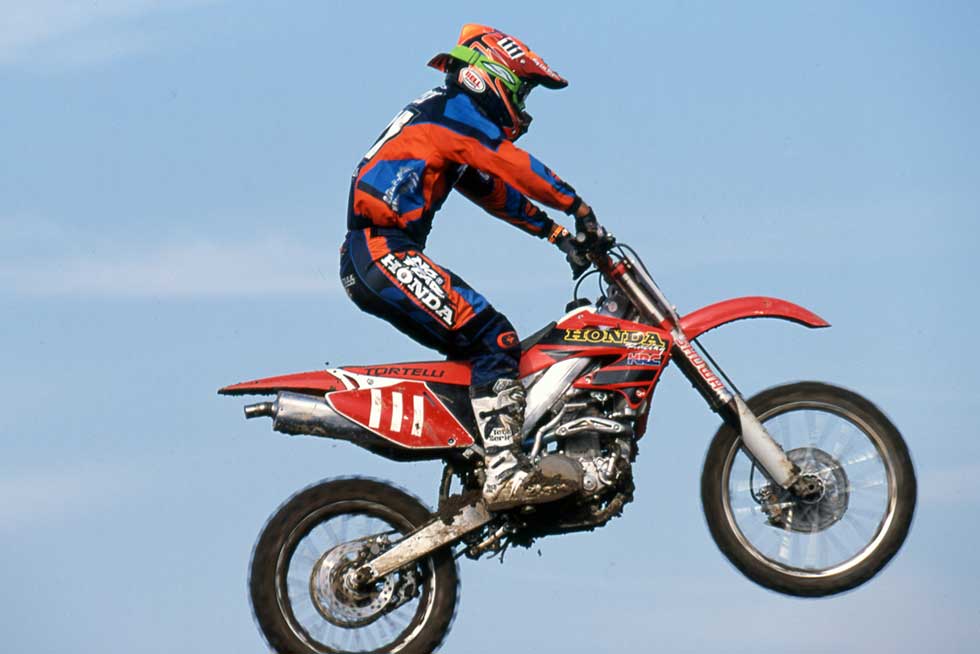
Sébastien Tortelli with the four-stroke motocrosser under development
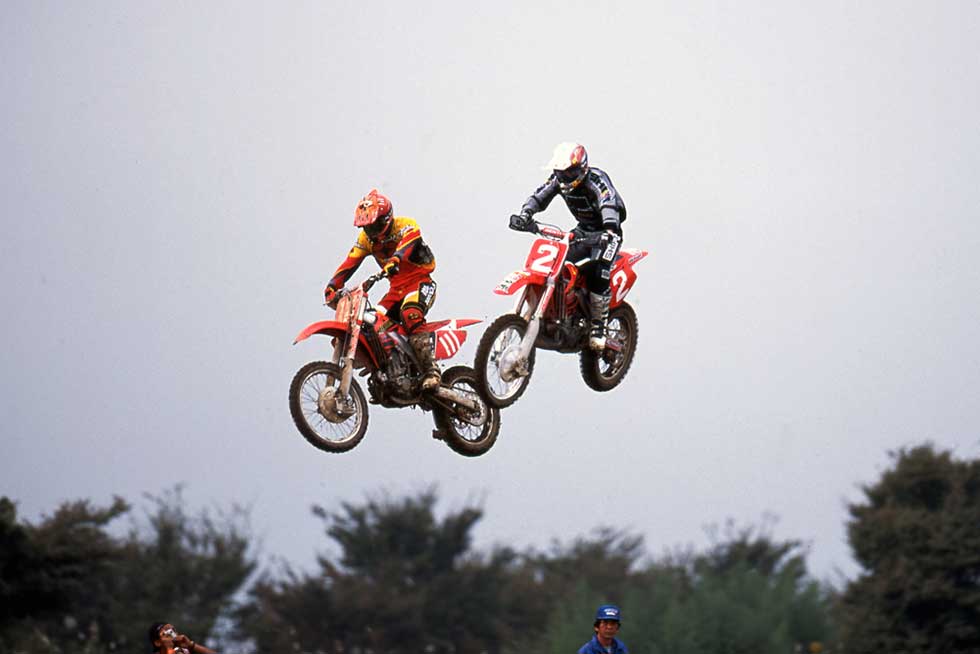
In the foreground, number 2 is TEAM HRC rider Yoshitaka Atsuta on the factory RC250M.
Behind him is Sébastien Tortelli on the four-stroke motocrosser.
A battle between Honda’s two-stroke and four-stroke machines unfolds on track.
Refining the CRF450R through competition
In 2001, Honda continued development by entering the All Japan Motocross Championship International A-Class 250cc category with TEAM HRC rider Kazuyoshi Odagiri.
By this stage, the machine had been given its official name: CRF450R.
Through demanding races, the development team continued refining the machine while improving reliability ahead of production.
In its debut season, Odagiri secured three heat victories and finished second in the overall championship standings, proving the machine’s high performance potential.
The title that year went to fellow TEAM HRC rider Yoshitaka Atsuta, riding the works two-stroke RC250M.
2001: the CRF450R finally arrives
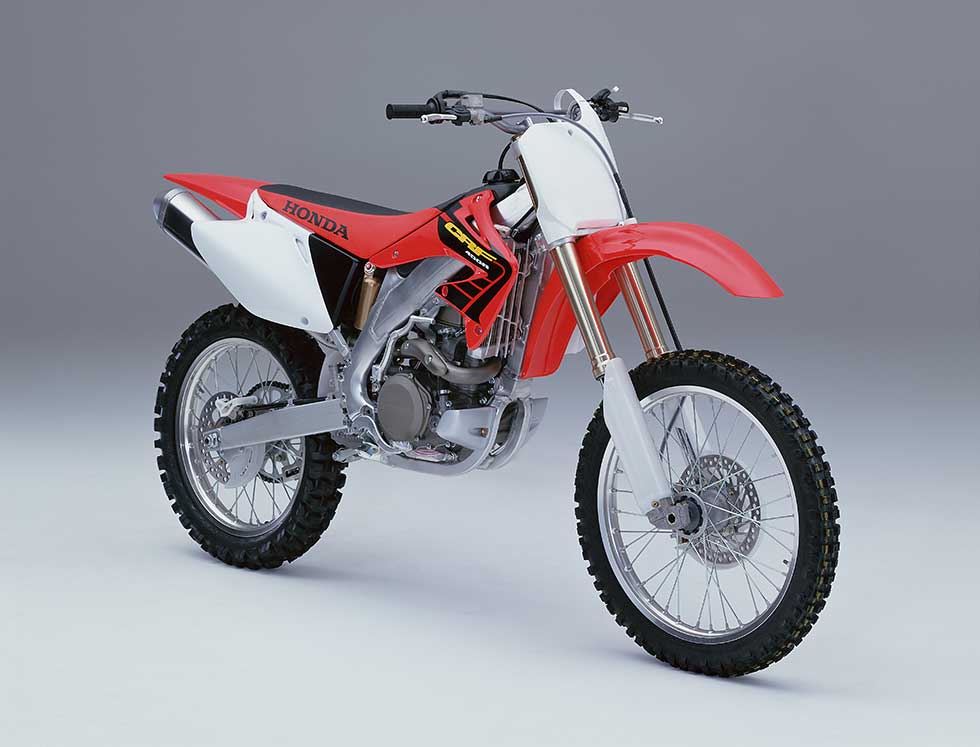
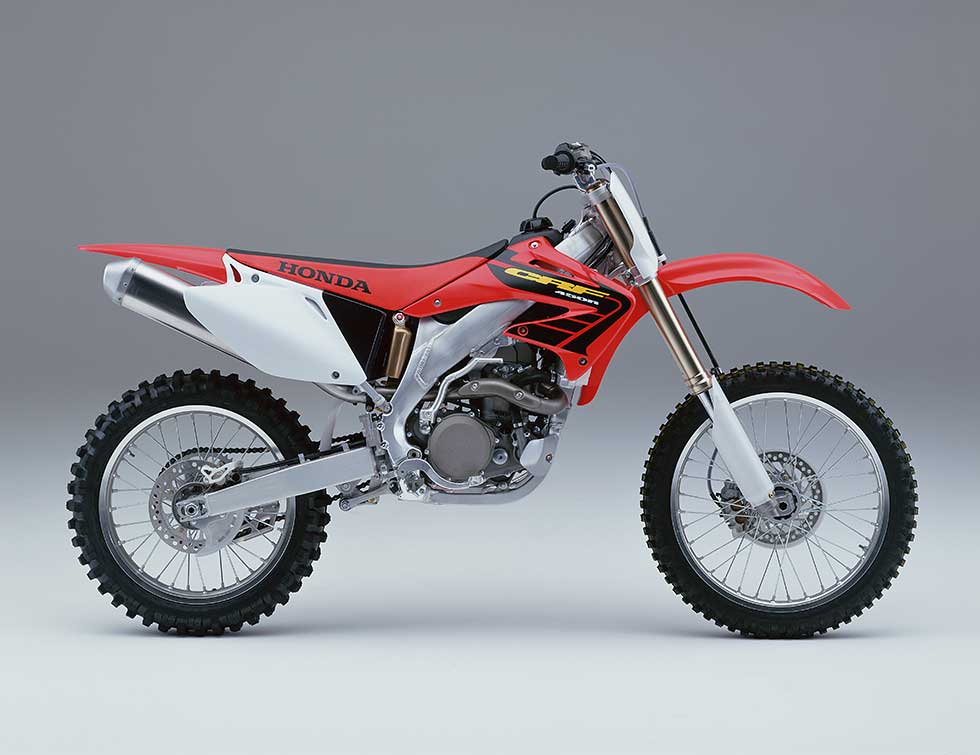
In November 2001, the long-awaited CRF450R was released in Japan.
The name CRF signified a new generation of motocross machines. It combined CR, the name long used for Honda’s two-stroke motocrossers, with F, representing four-stroke.
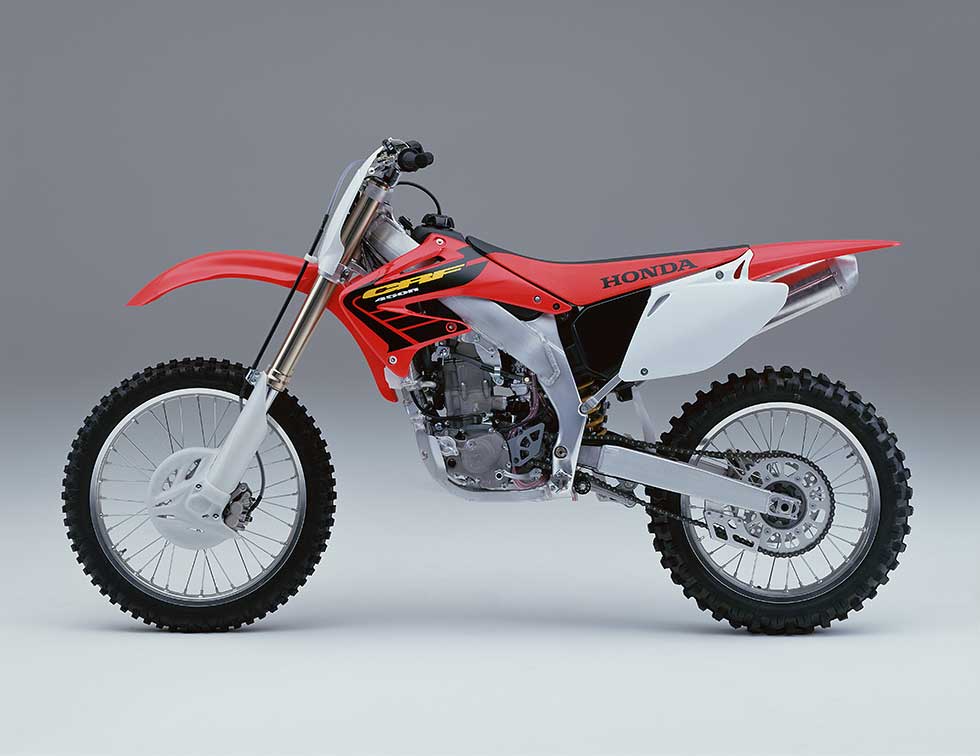
2001 CRF450R
Engine
The CRF450R featured a newly developed water-cooled, four-stroke, OHC, four-valve single-cylinder engine with a displacement of 449 cm³.
Maximum output reached 41 kW (55 PS) at 9,000 rpm, delivering performance comparable to the two-stroke CR250R, which produced 43.4 kW (59 PS) at 8,500 rpm.
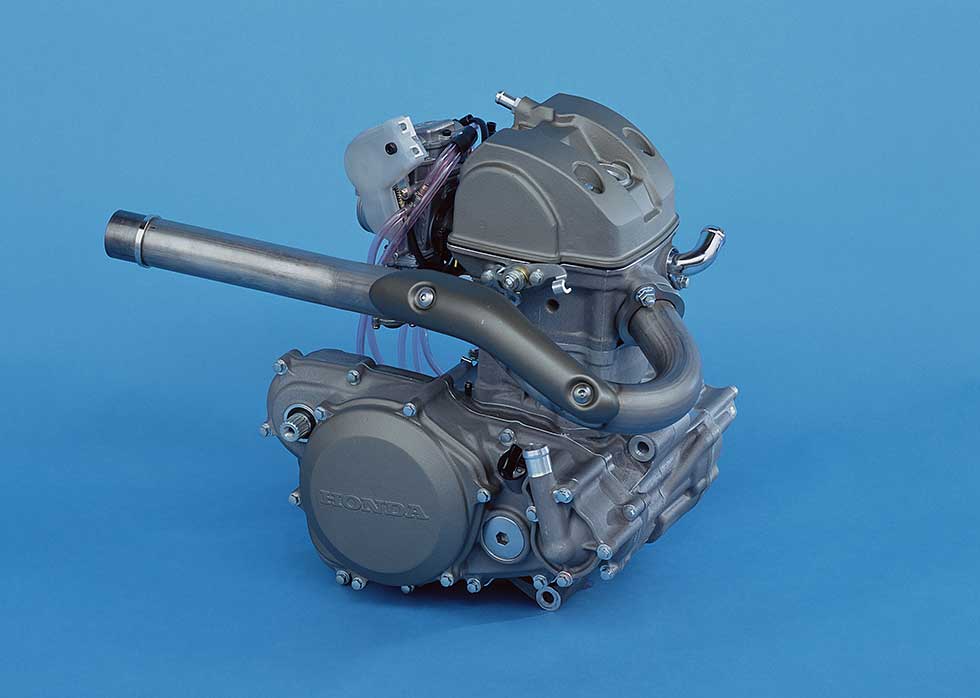
CRF450R engine
The engine incorporated Honda’s proprietary Unicam valve train system.
A single camshaft directly actuates the intake valves, while the exhaust valves operate through rocker arms. This layout enables higher engine speeds and greater output than conventional OHC systems while also contributing to a more compact cylinder head design.
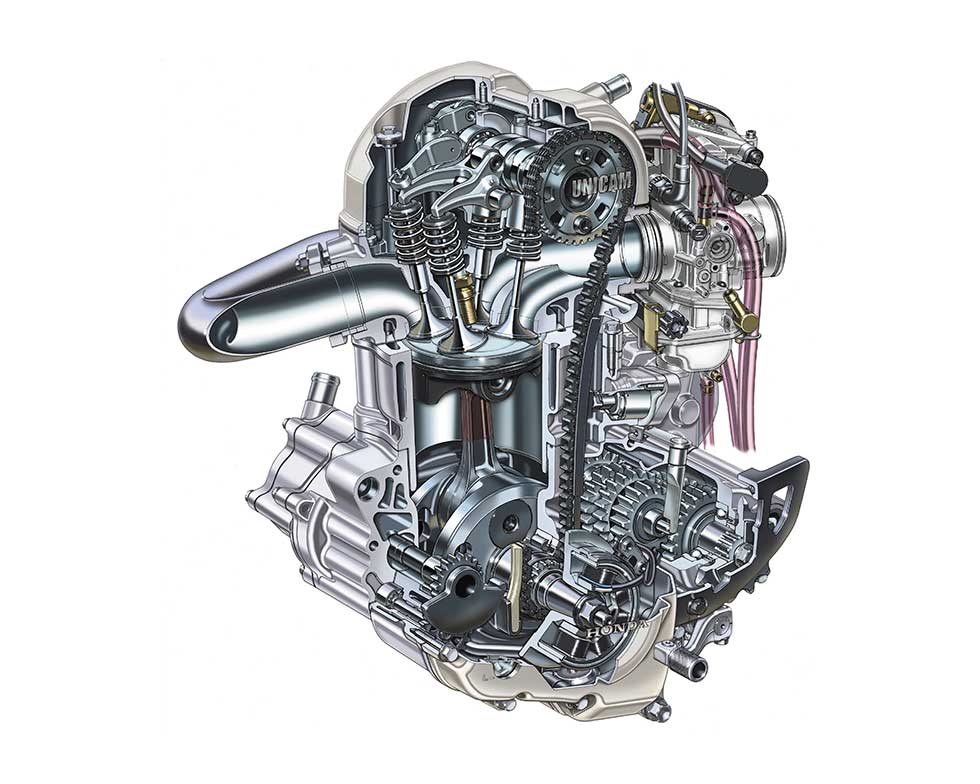
Engine cutaway
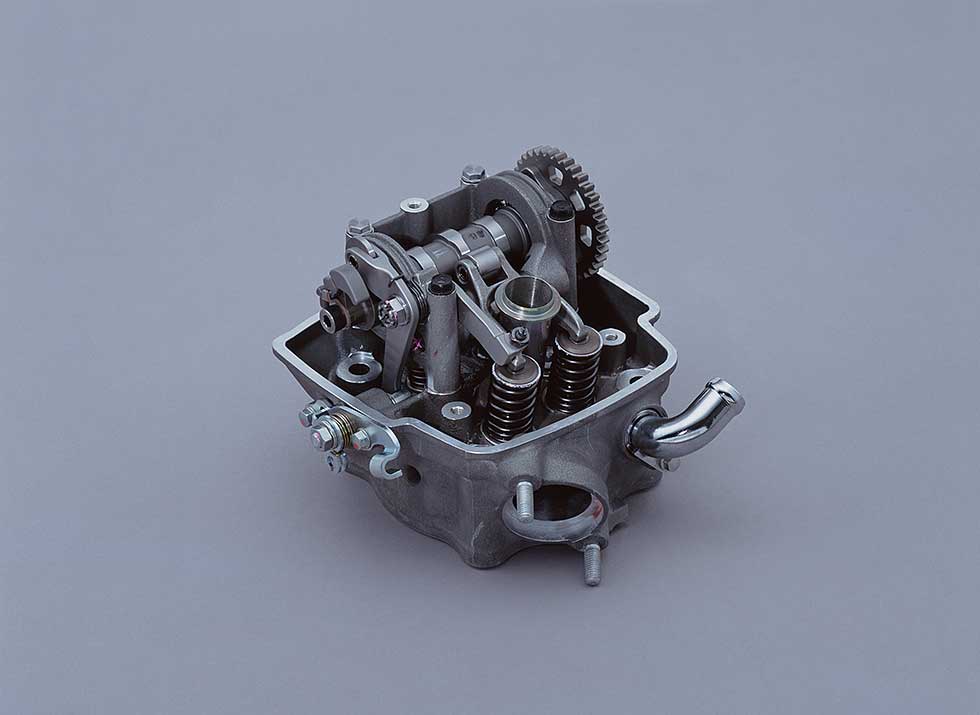
Unicam valvetrain
The exhaust system uses a lightweight titanium exhaust pipe, paired with an aluminum silencer designed for easy replacement of the glass wool packing.
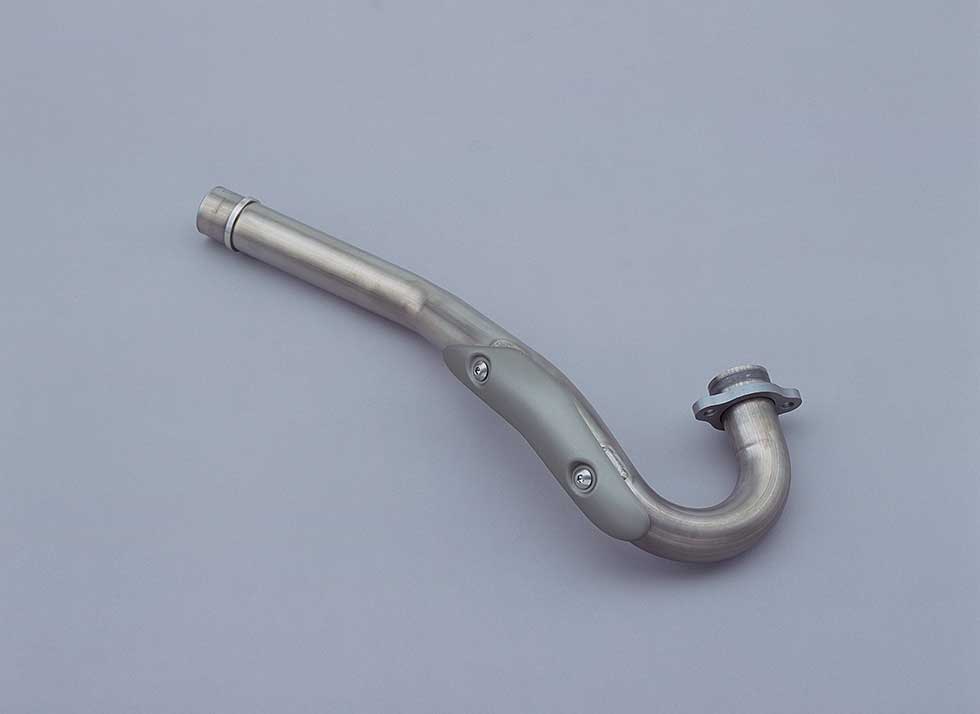
Titanium exhaust pipe
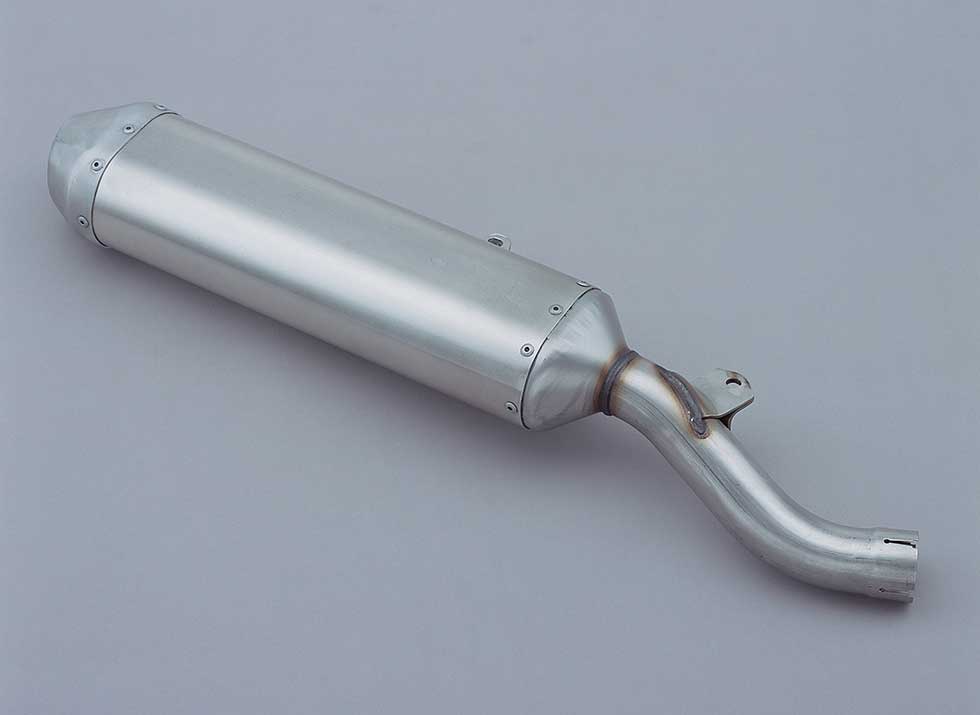
Aluminum silencer
The cooling system features dual radiators for enhanced heat dissipation.
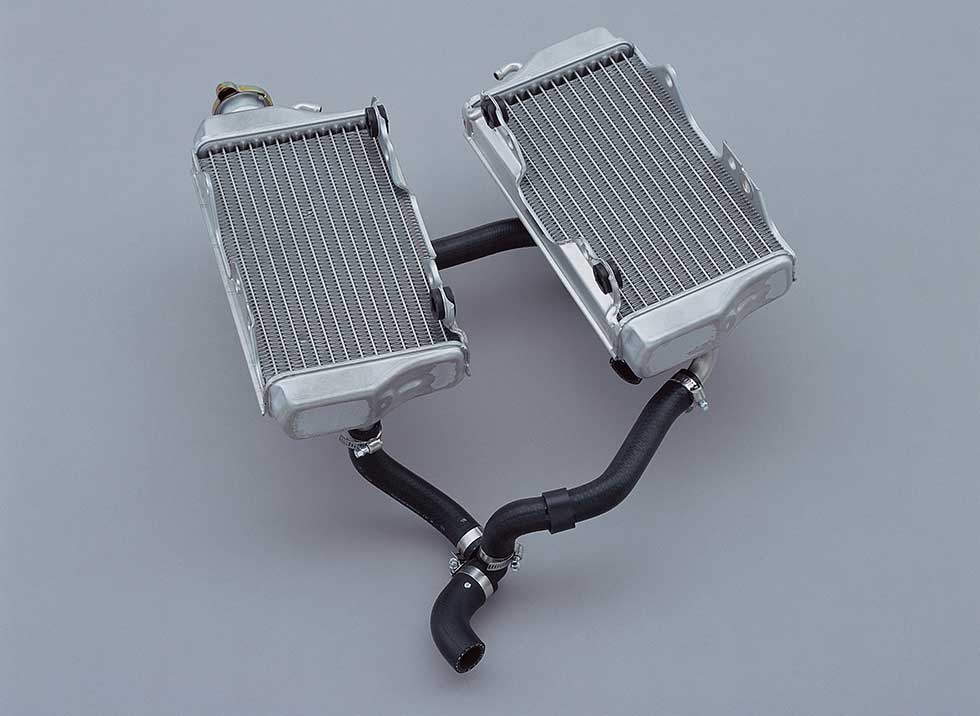
Dual radiators positioned on both sides
Chassis
The frame design is based on the semi-double-cradle twin-tube frame used on the 2002 CR250R, optimized specifically for the CRF450R.
The front suspension derives from the CR250R but incorporates settings tailored for the CRF450R.
At the rear, a dedicated swingarm works with Honda’s proven Pro-Link suspension system, delivering durability and precise handling.
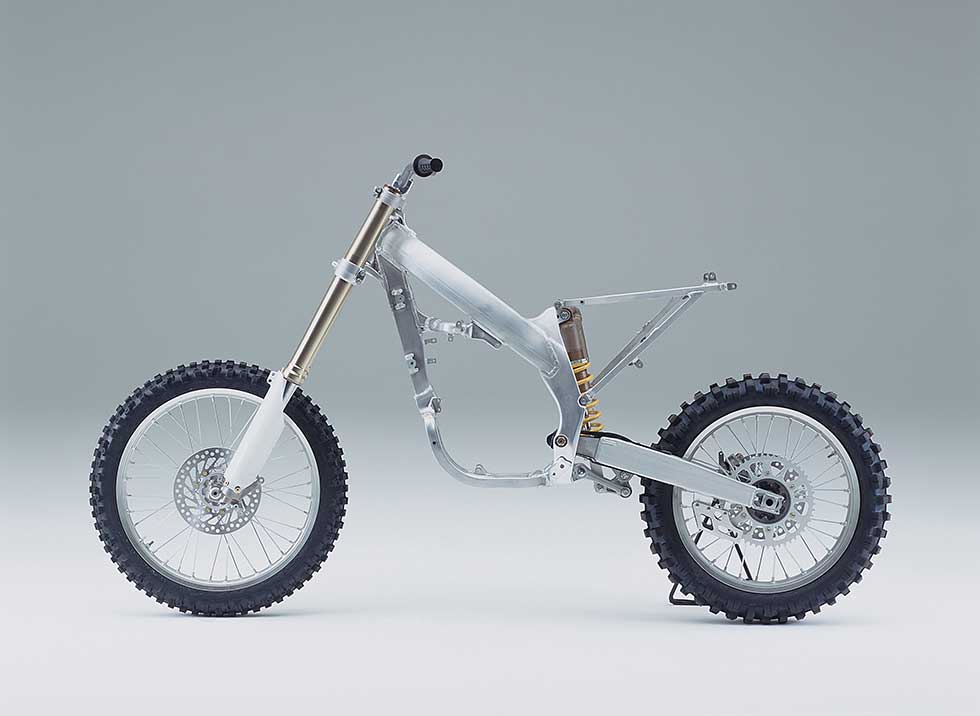
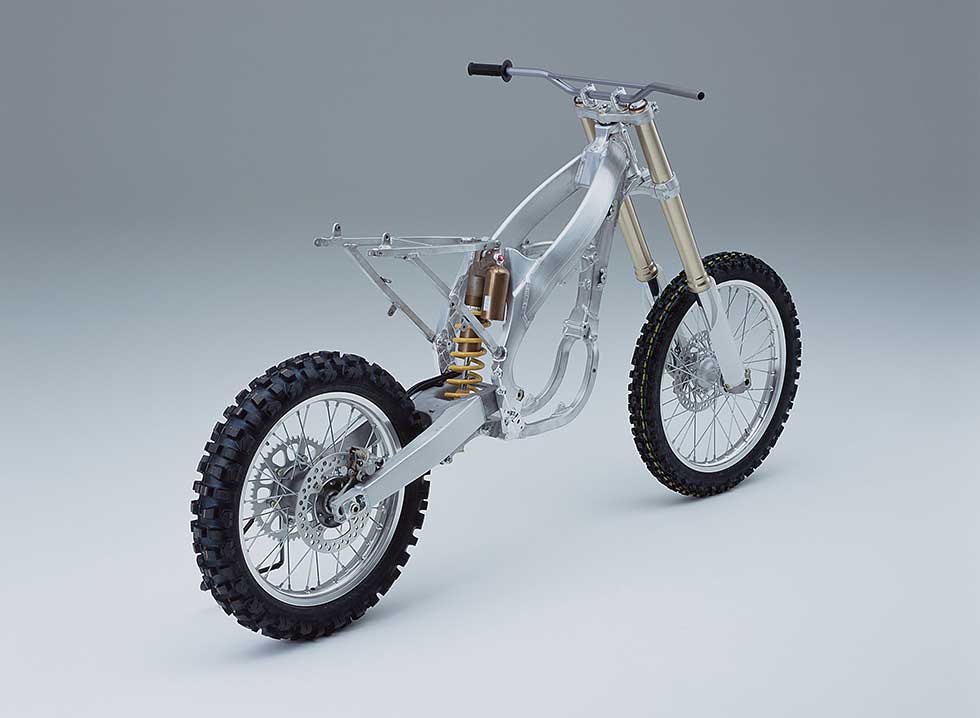
CRF450R chassis configuration
The CRF450R quickly gained strong support from riders during the 2002 motocross season, alongside the two-stroke CR250R.
Its arrival also marked a turning point for Honda’s motocross lineup. With the introduction of the CRF450R, Honda began accelerating the transition from two-stroke to four-stroke motocross machines.
2001 CRF450R
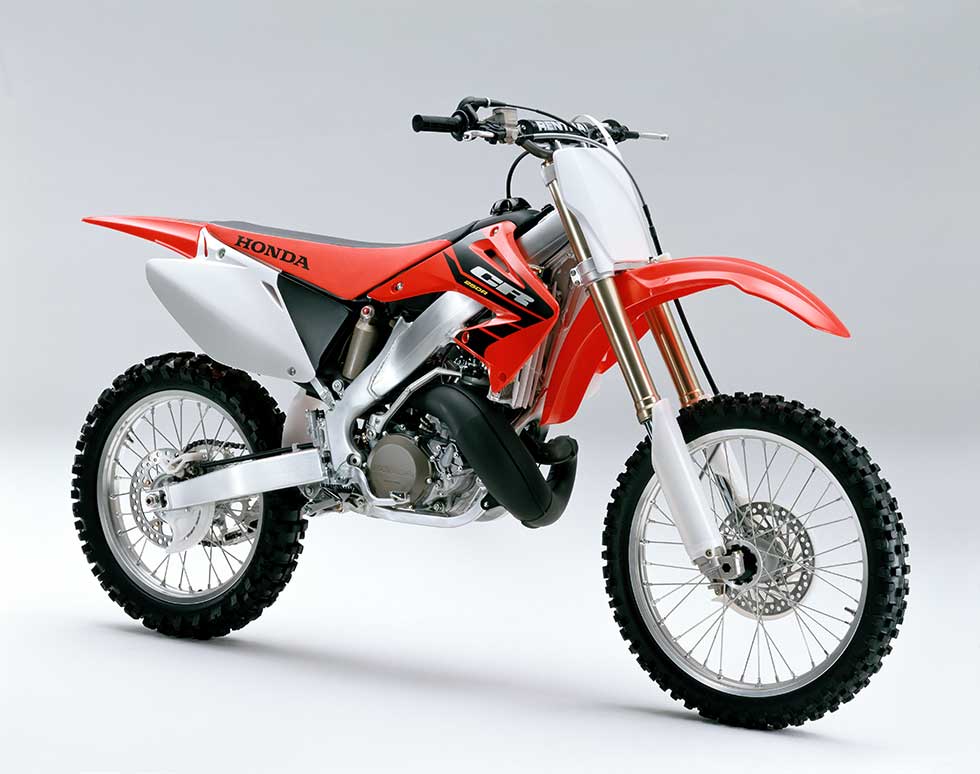
2001 CR250R