Honda Develops Underlaying Technology
for In-motion Wireless Charging of EVs, Including Large Commercial Vehicles
TOKYO, Japan, October 5, 2026 – Honda R&D Co., Ltd., the R&D subsidiary of Honda Motor Co., Ltd., jointly with Taisei Corporation (Taisei) and Taisei Rotec Corporation (Taisei Rotec), has developed underlaying technology for a magnetic coupling wireless power transfer road system (“WPT road system”), which will enable wireless in-motion charging of EVs. The three companies are planning to conduct demonstration testing of the system from the Japanese 2027 fiscal year (starting April 1, 2027) onward.
Honda R&D is working on this technology as one of the steps toward the realization of a next-generation mobility society where people can enjoy the freedom of mobility while also reducing the environmental impact of mobility products and services.
The system combines proprietary technology of each company: a Honda high-power-density power receiver/transmitter units compatible with DC power distribution; a Taisei high-response DC power supply system; and Taisei Rotec technology for embedding equipment in roads. With these technologies, the system achieves high-power wireless power transfer (WPT) and excellent ease of installation in road pavement, envisioning applications for a wide range of mobility products, from passenger EVs to large commercial EVs.
Striving to realize carbon neutrality by 2050 and offer the joy and freedom of mobility to more people around the world, Honda is pursuing the development of new technologies and offering of new services with an eye toward widespread use of EVs in the future. Including the launch of Honda Charge, an EV charging network service in Japan, Honda is taking various initiatives with a focus on improving the convenience of EV use through the expansion and enhancement of charging infrastructure. Looking further ahead, Honda has been working on the development of dynamic wireless power transfer (DWPT) technology since 2021, which will enable wireless in-motion power supply to vehicles.
DWPT technology is expected to enhance the convenience of EVs by supplying power to vehicles while they are in motion, thereby reducing the frequency of charging needed at home or at charging stations. Initially, Honda will strive to put DWPT technology into practical use in the logistics and transportation sectors, where DWPT technology is expected to deliver significant benefits.
Jointly with Taisei and Taisei Rotec, Honda has been conducting research and development of the magnetic coupling WPT road system since 2025, which has resulted in the development of the underlaying technology for the system.
Based on this underlaying technology, the three companies will further accelerate their joint research and prepare for demonstration testing to be conducted on public roads from the Japanese 2027 fiscal year onward.
Overview of the joint research
As part of their joint research toward real-world implementation of DWPT for EVs, the three companies have been conducting experiments and validation testing on a test roadway at the Future Technology Field for Taisei Group/Satte (T-FIELD/SATTE). Through these tests, the three companies verified the effectiveness of their technologies for a WPT system, road pavement structures, and road construction methods intended for use in demonstration testing on public roads with large commercial vehicles.
Respective joint research roles of the three companies
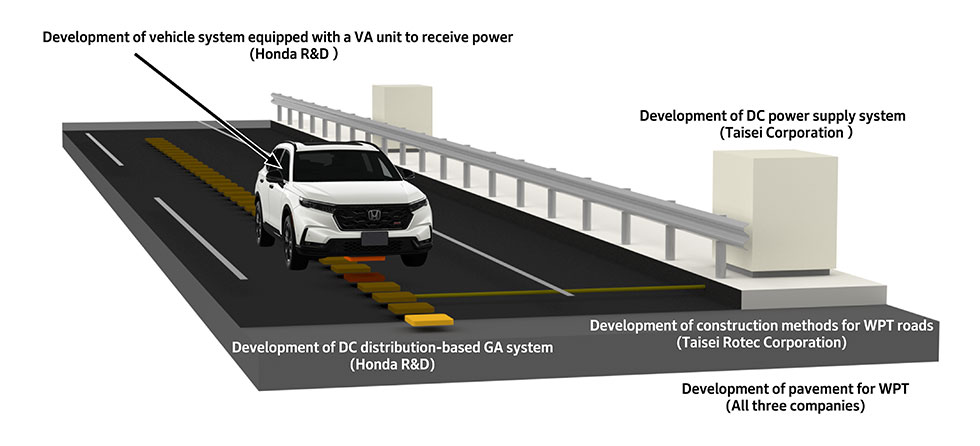
The DWPT system consists of three key components: 1) a DC power supply system on the ground, 2) a DC distribution-based ground assembly (GA) system that connects multiple GA units (power transmitter units) embedded in the road using a DC connection, and 3) a vehicle assembly (VA) unit (power receiver unit) installed on the vehicle. The respective roles of the three companies are shown in the table below.
| Company | Overview of respective roles |
| Taisei Corporation | Development of DC power supply system |
| Honda R&D Co., Ltd. |
|
| Taisei Rotec Corporation | Development of construction methods for WPT roads |
| Three companies |
|
Key features of WPT road system technology subject to this joint research
To achieve the real-world implementation of a WPT road system, it is essential to develop 1) GA units and pavement structures with sufficient strength to withstand the loads of large commercial vehicles, and 2) a power transfer system capable of handling high-power transfer to EVs driving at high speeds, while also offering excellent practicality for installation in roads.
To this end, using the test roadway at the T-FIELD/SATTE, the three companies conducted verification testing of technologies to address the following key challenges:
1) The GA units and pavement structures must be capable of withstanding the traffic of large vehicles with a gross vehicle weight of approximately 20 tons.
2) The DC power supply system must be capable of supplying high-power electricity to a DC distribution-based GA system with high responsiveness and stability.
3) The GA units must have highly practical installation and the ability for future upgrades.
Through this joint research and testing, the three companies have developed the underlaying technology for the WPT road system with the following features:
( 1 ) GA units and pavement structures capable of withstanding large commercial vehicle traffic:
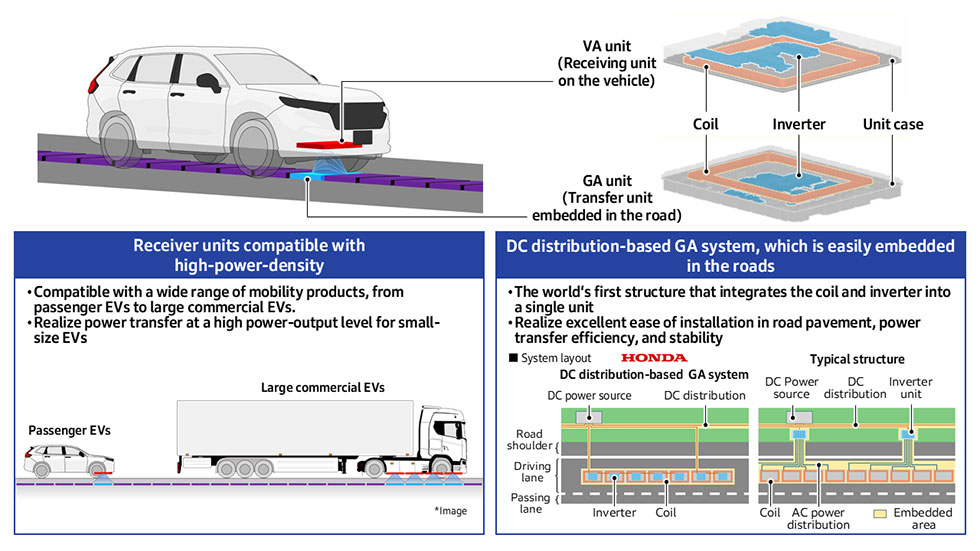
With the application to large commercial vehicles in mind, the internal structure of the GA units has been optimized to ensure sufficient strength and durability of the pavement structure, including the embedded GA units. This enables the WPT road system to withstand long-term use with traffic including large commercial vehicles with heavy loads.
( 2 ) DC distribution structure for highly efficient and stable power supply:
The GA system to be embedded in the road integrates the inverter and coil within each unit into a single DWPT unit for the first time in the world*1. The system enables power transfer through DC distribution. In addition, in combination with a DC power supply system on the ground, the GA system enables highly responsive and stable high-power WPT.
( 3 ) Practical road and equipment structure designed for ease of installation and upgrading:
With application to existing pavement in mind, the GA unit features a structure that accommodates milling and embedding installation. In addition to measures to address uneven surfaces that may occur on milled road surfaces, the adoption of a DC distribution structure simplifies wiring in the embedded sections, thereby reducing the number of components and the amount of installation work required. This GA unit structure improves the ease of embedding not only in existing pavement but also with future pavement renewal work.
Future initiatives
First, starting in late 2026, a test drive roadway will be constructed at the Future Technology Field for Taisei Group/Tamura (T-FIELD/TAMRA). On this roadway, the three companies will conduct various testing including 1) long-term durability evaluation through a loading test equivalent to 1-million-wheel loads (based on a 49 kN load per wheel) using actual vehicles, 2) DWPT performance tests, and 3) tests to evaluate measures to address electromagnetic field leakage. Through these tests, the three companies will strive to ensure both power transfer performance and the safety of the GA units as structures embedded in the roadway.
Following this phase, the three companies will continue to further develop their WPT road system technology with a view to real-world operation. This will include verification of performance at high power output levels of up to 150 kW for potential application to large commercial vehicles, as well as verification of the reliability of WPT performance for vehicles traveling at high speeds.
The three companies will also participate in the “Tateyama Project,*2” a demonstration testing project for DWPT technology to be conducted by East Nippon Expressway Company Limited (NEXCO East) on the Tateyama Expressway in Chiba, Japan, from the Japanese 2027 fiscal year onward.
Honda is planning to showcase its initiatives related to the research and development of DWPT technologies at multiple industry events, including the Japan Mobility Show Bizweek (to be held October 13-16, 2026 at Makuhari Messe in Chiba, Japan) and the ITS World Congress 2026 (to be held October 19-23, 2026 at Gangneung Olympic Park in Gangneung, South Korea).
Striving to realize a sustainable mobility society where people can enjoy freedom of mobility well into the future, Honda will continue to pursue co-creation with a diverse range of partners beyond the automotive industry, including road infrastructure-related businesses, government agencies and energy-related businesses.
*1 The world's first such DWPT unit publicly disclosed as of the end of September 2026. (Research by Honda)
*2 NEXCO East press release: https://www.e-nexco.co.jp/en/pressroom/head_office/2026/0526/00016228.html