INDEX
Why Honda Outboard Motors Have Always Been Four-Stroke
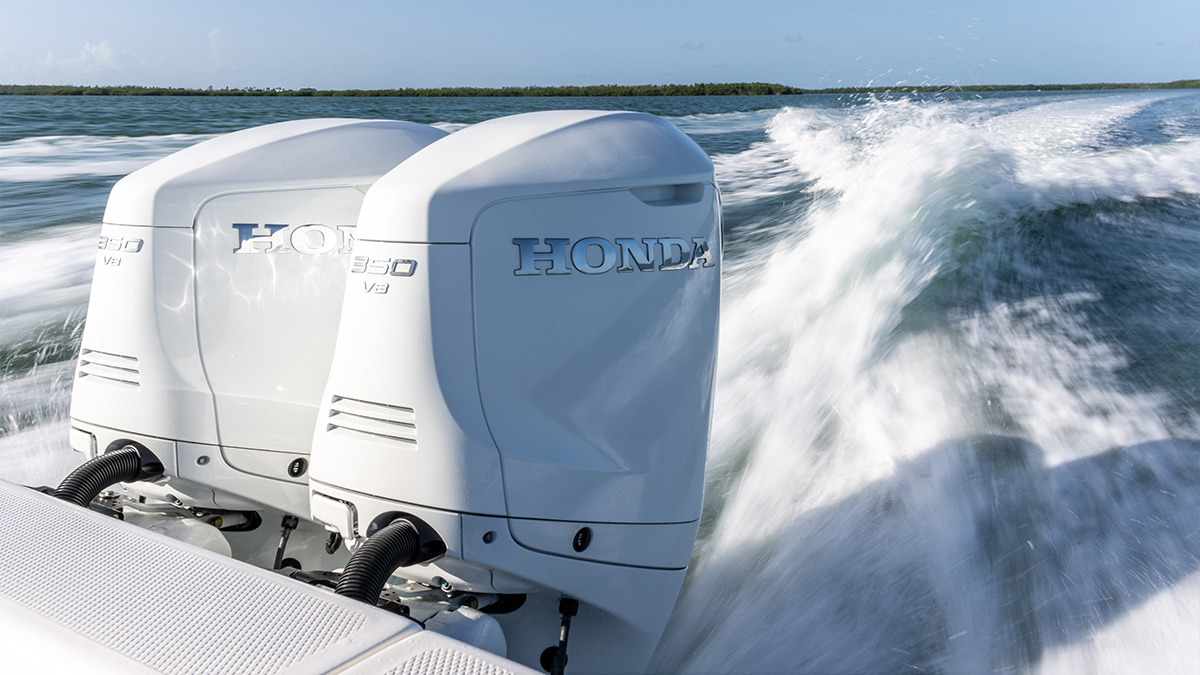
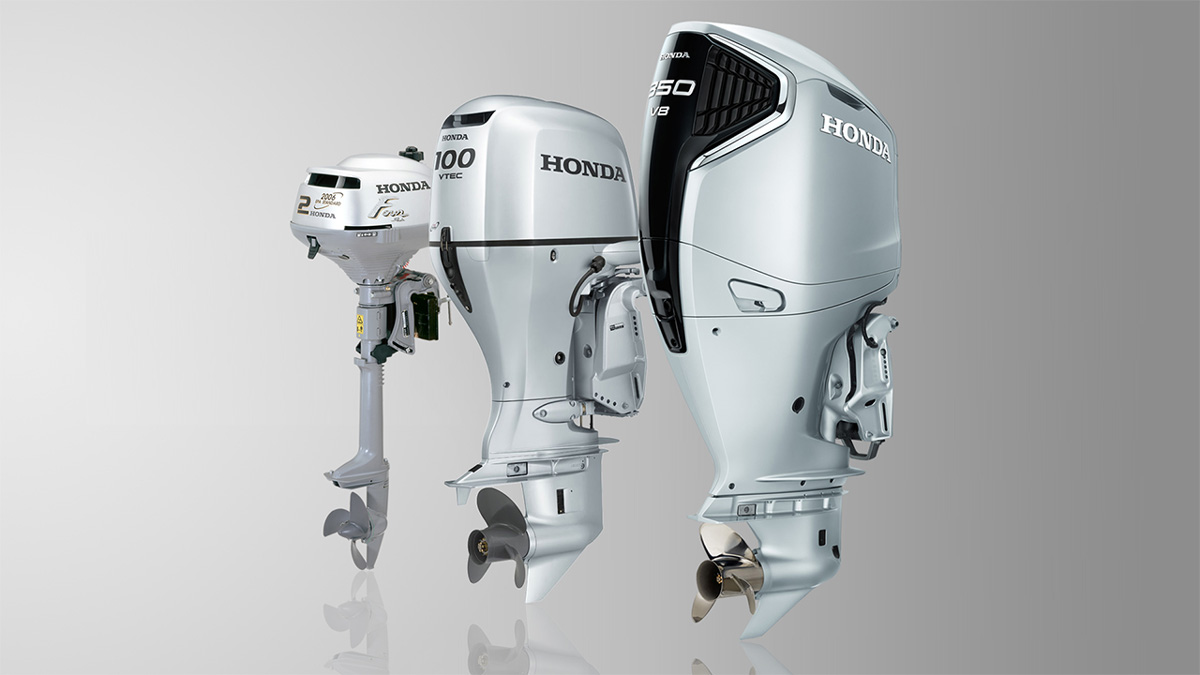
The BF350, launched on February 23, 2024, is Honda's flagship outboard motor and the first to use a V8 engine. It produces a powerful propulsive force of 350 horsepower from its displacement of 4,952 cm3. The BF350 offers high propulsion thanks to its strong torque, while its newly designed crankshaft achieves outstanding quietness and low vibration. It also boasts class-leading fuel efficiency, designed with the aim of being an environmentally friendly and economical outboard motor.

In outboard motors, the engine and drive unit that turns the propeller are integrated into a single unit, with the engine mounted inverted at the top.
In outboard motors, the engine and drive unit that turns the propeller are integrated into a single unit. When installed at the rear of a vessel lacking its own power source, they function as the power unit that enables it to operate as a motorboat. Honda has consistently sought to develop outboard motors with low environmental impact based on founder Soichiro Honda's philosophy that “watercraft should not pollute the water.”
The majority of outboard motors in the marine market when Honda first entered in 1964 were two-stroke engines. Two-stroke engines mix lubricating oil with fuel for combustion, causing unburned gas containing oil to be discharged into the water. As a result, they are considered to have a higher environmental impact than four-stroke engines. Driven by a strong commitment to the environment, Honda has consistently produced four-stroke outboard motors since launching its first outboard motor, the GB30, in 1964, even as two-stroke outboard motors dominated the market.

The recreational boat market—including marine leisure and fishing—has expanded in recent years, primarily in North America and Europe. The need for higher output and mounting multiple outboard motors side-by-side is growing, stemming from demands for faster arrival at fishing grounds in the fishing industry, primarily in emerging nations, and for carrying more passengers in the tourism industry. In addition, low vibration has become a crucial factor in the product appeal of outboard motors from the standpoint of comfort at sea for those onboard.
Therefore, Honda leveraged the strengths of its outboard motor range cultivated through years of outboard motor development, which include outstanding durability, reliability, and economy, to develop the large BF350 outboard motor for leisure use and other water activities. The numbers in Honda outboard motor model numbers, including the BF350, represent horsepower.
V8 with 60-Degree V-Bank Angle and Cross-Plane Crankshaft

While the standard bank angle for a V8 engine is 90 degrees, a 60-degree bank angle has been used for the BF350.

A 60-degree bank angle was chosen because large outboard motors are typically used when mounting multiple outboard motors side-by-side, and there is a desire to install as many motors as possible within the limited width of the boat. This makes a narrower engine width advantageous.

To achieve a regular interval ignition configuration for a V8 engine, 720 degrees (one cycle of a four-stroke engine) is divided by 8, resulting in 90 degrees; thus, a V8 engine's bank angle is typically set to 90 degrees. Honda chose 60 degrees because it allows for a narrower engine width.
The V-type multi-cylinder configuration is the mainstream design for high-output outboard motor engines. Honda selected a V8 configuration when developing the BF350. Prior to the BF350, the 3.6L V6 in the BF250, launched in 2011, had the largest displacement and cylinder count. V8 engines generally employ a cylinder bank angle of 90 degrees when used in automobiles, as it allows for regular interval combustion at 90-degree crankshaft angles. However, for outboard motors, a bank angle narrower than 90 degrees is preferable because, when considering mounting multiple outboard motors side-by-side, a smaller outboard motor width allows for a narrower mounting section on the boat. However, reducing the V-bank angle restricts the layout of the intake system positioned inside the bank. In consideration of this, a 60-degree V-bank angle was selected for the BF350.

The flat-plane configuration has the advantage of eliminating exhaust interference between the banks. This makes it easier to increase the engine's maximum output, but secondary inertia force (vibrations at twice the engine speed) remains. Therefore, a secondary balancer rotating at twice the engine speed is required to cancel these vibrations.

The cross-plane configuration offers superior vibration characteristics but struggles to achieve maximum output due to exhaust interference. Primary inertia couple (vibrations at the same speed as the engine) remains, but this can be canceled by balanced weight at both ends of the crankshaft.
There are two types of crankshafts: the flat-plane (single-plane) type, where the crank pins are arranged at 180-degree phase (appearing as a “-” when viewed axially), and the cross-plane (double-plane) type, where the crank pins are arranged at 90-degree phase (appearing as a “+” when viewed axially). The flat-plane type has less exhaust interference between the four cylinders on one side, facilitating higher output. However, it cannot cancel the secondary inertia force occurring at 180-degree intervals without a two-axis secondary balancer. Conversely, the cross-plane type does not generate secondary inertia force (vertical motion), but there is exhaust interference between the four cylinders on one side, posing challenges for achieving high output. In addition, a single-axis balancer is required to cancel the 360-degree interval primary inertia couple (precession).
The BF350 uses a cross-plane crankshaft to achieve superiority in terms of vibration and create a more luxurious feeling, while also adopting a 60-degree V-bank angle. In V8 engines with a 60-degree V-bank angle, it is common to achieve 90-degree regular interval combustion by incorporating a 30-degree offset (phase difference) in the crank pins. However, this specification cannot cancel both primary inertia force and primary inertia couple without a balancer rotating in the opposite direction to the crankshaft.
Vibrations caused by unbalanced inertial forces are easily felt by the body, similar to the vibration of a mobile phone, making them undesirable from a product appeal standpoint. Therefore, crankshaft balancing is crucial for reducing vibration in outboard motors. Since outboard motors lack a transmission mechanism like automobiles, a high RPM range is continuously used during high-speed operation, making vibration suppression in this range a particularly critical challenge. In addition, given the nature of outboard motors that frequently operate in high RPM ranges, vibration is predominantly caused by the inertia force and inertia couple originating from the main moving parts, rather than torque fluctuations due to combustion. Therefore, determining the crankshaft specifications is crucial when developing a low-vibration outboard motor.

When using a cross-plane configuration with a 60-degree V-bank angle, achieving regular interval combustion requires offsetting the left and right crank pins by 30 degrees, as opposed to a 90-degree V-bank angle where pins can be shared. However, this arrangement fails to fully cancel the primary inertia couple using balanced weight on the crankshaft, resulting in vibration.

Honda used a crank pin with a 60-degree offset to achieve perfect balance. This completely cancels out the primary inertia couple. Issues with irregular interval combustion and crank strength were resolved by using high-strength materials developed for the NSX.
Calculations showed that a 30-degree crank offset in a V8 engine with a 60-degree V-bank angle generates primary inertia couple. Adding a balancer is the standard method to cancel this couple, but it requires accepting the resulting drive loss and increased number of parts. To avoid these problems, the BF350 uses a 60-degree crank pin offset and incorporates balanced weight on the crankshaft. This enables the primary inertia couples from each bank to completely cancel each other out, significantly reduced primary inertia couple while avoiding drive loss and an increase in the number of parts. While this configuration results in irregular interval combustion for the BF350, testing has confirmed that the impact on output is negligible. In fact, distributing peak engine noise resonance creates a more luxurious sound.
Introducing New Technologies Like VTEC and Lean-Burn Control
A 60-degree offset on the crank pins reduces the overlap between the offset pins when viewed axially along the crankshaft. While a small overlap poses challenges in ensuring strength and dimensional accuracy, the BF350 crankshaft is made from the same high-strength material as used for the crankshaft in the second-generation NSX. A special manufacturing process is also used to create a twisted crank by twisting the journal after forging and before it cools, thereby ensuring strength and dimensional accuracy.
In a V8 engine with irregular interval combustion and a 60-degree crank pin offset, differences in intake air volume per cylinder were found to make it impossible to appropriately manage combustion at all cylinders using a single fuel injection map. For this reason, the BF350 employs 8-cylinder individual fuel injection maps to achieve optimization. In addition, VTEC has been adopted to achieve both low-to-mid-range power and maximum output. This variable valve timing and lift control mechanism switches the opening/closing timing and lift amount of the intake valves according to the engine speed range.
The use of 8-cylinder individual fuel injection map control and VTEC also contributes to achieving good fuel efficiency. In addition, oxygen feedback enables highly precise lean-burn control, contributing to even greater fuel efficiency. Outboard motors tend to operate frequently in the cruising range, where engine speed is maintained at approximately 50 to 80% of full throttle. Oxygen feedback control enables operation in this cruising range using lean-burn combustion, where the fuel ratio is leaner than the theoretically optimal fuel injection amount.

The BF350 significantly reduces water dousing of the oxygen sensor by repositioning the point where exhaust gas and cooling water flows join, thereby improving the reliability of lean-burn control.
An outboard motor is structured so that both the exhaust gas from the vertically mounted engine at the top and the engine's cooling water are discharged through the lower propeller section. Conventionally, the structure generally joined the cooling water (return water) and exhaust gas flows near the tip of the exhaust pipe and within the extension case. For this reason, oxygen sensors placed within exhaust channels could be doused with water drawn into the exhaust channel by exhaust pulsation or vacuum formation when traveling at low speeds or rapidly decelerating.
With this in mind, Honda reexamined the structure of its extension cases and instead adopted a structure that separates the exhaust and cooling water channels for the BF350. Exhaust gas and cooling water channels are separated until the top edge of the gearcase, while the oxygen sensor is placed at the topmost point of the cylinder head, resulting in reduced risk of the sensor being doused with water. This enables the oxygen sensor to consistently and accurately estimate the oxygen concentration in the exhaust gases, ensuring good fuel efficiency through precise lean-burn control.
Plateau honing, a cylinder surface machining process that achieves a smooth finish to the cylinder inner walls and increases oil retention, was also applied to the BF350 as a technology contributing to fuel efficiency. This marks the first time Honda has used plateau honing for its outboard motors. Launched in the year marking the 60th anniversary of Honda's marine business, the BF350 builds on and refines fuel-efficient performance—a universal theme for Honda outboard motors—while also achieving low vibration and noise despite its powerful 350 horsepower engine. It meets market demands for even higher performance and even greater fuel efficiency.
Specifications