
Management
Honda’s Passion for Victory Cultivated through F1 Challenge: The Spirit Inherited in Automobile Development
POINTWhat you can learn from this article
- Technologies honed in F1, including foundational concepts and specific techniques, are being fed into Honda’s mass-produced vehicles.
- Successfully creating “the best engine in the world” in F1 has instilled a spirit of challenge and pride in Honda
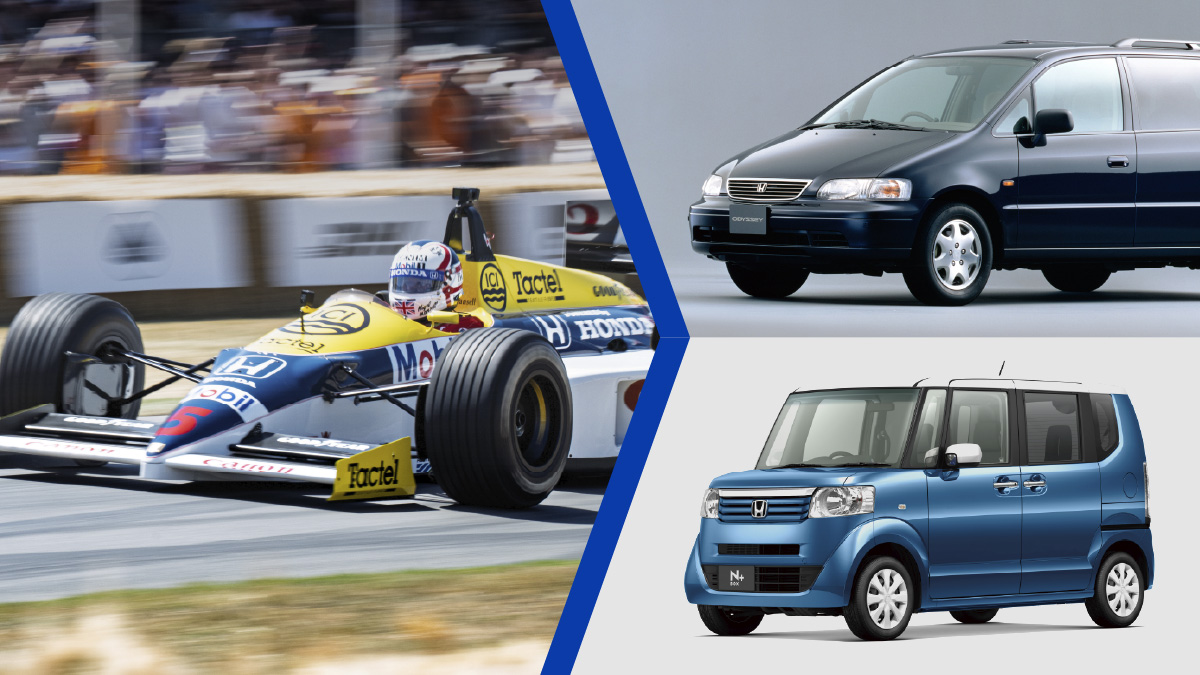
- Development of the first-generation Odyssey engine and N-BOX was also an unprecedented challenge, benefitting greatly from F1 experience
In July 2025, the Goodwood Festival of Speed, an annual motorsports event, was held in Goodwood, West Sussex, UK. Honda participated for the second consecutive year. Not only did Honda showcase a variety of products, including cars and motorcycles, it also conducted a demo run of the Williams Honda FW11, the car that brought Honda its first F1 Constructors’ Championship*1 title in 1986.
In this issue, we interviewed to Yasuaki Asaki, who was involved in developing the Honda RA166E engine that powered the FW11. He later went on to lead the engine development of the first-generation Odyssey, and the Accord, as well as the development of the first-generation N-BOX (currently sold in Japan). He shared insights on the significance of Honda’s F1 challenge, as well as the influence F1 has had on Honda’s mass-production vehicle development.
*1 Constructors’ Championship title is awarded to the team that accumulates the most points over a single season.
Former Executive Officer, Honda R&D Co., Ltd. and Director & Managing Executive Officer , Honda Racing Corporation View More Close Yasuaki Asaki
Read MoreFW11 demo run in Goodwood Festival of Speed 2025
The Goodwood Festival of Speed is a historic motorsports event held since 1993, established by Lord Charles Gordon-Lennox, Duke of Richmond, in the UK. Over 200,000 visitors attend this four-day event each year, in which Honda participated for the second consecutive year. In addition to showcasing its latest motorcycles, cars, and robotic lawn mowers, Honda featured a demo run of the FW11, the car that gave Honda its first F1 Constructors’ Championship victory in 1986. The 1.5-liter V6 turbo engine RA166E which produced 1,050-horsepower or more roared back to life on the 1.16-mile (1.856 km) hill climb course.
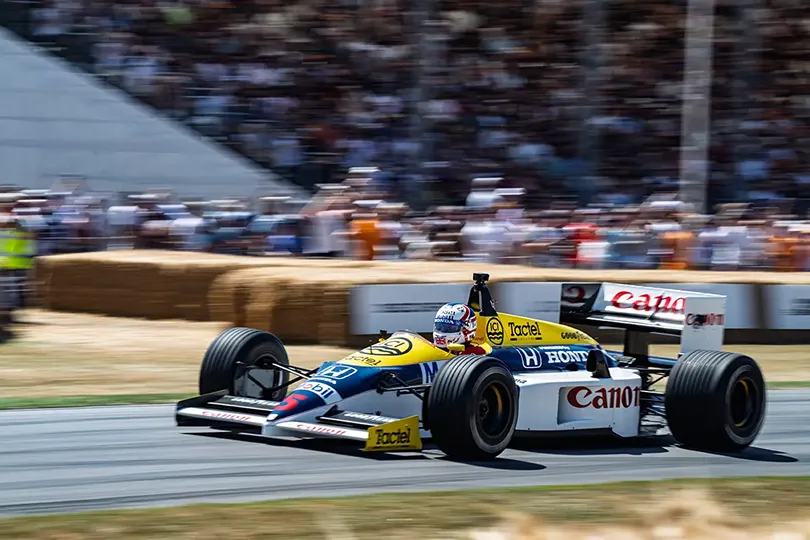 Nigel Mansell drives the FW11 at Goodwood
The FW11, driven by Nigel Mansell and Nelson Piquet, claimed nine wins out of 16 rounds in 1986, giving Honda its first Constructors’ Championship in Formula 1. That year, fuel restrictions for each race were introduced, prompting Honda engineers to refine combustion technology to balance fuel efficiency and power. This advancement in combustion efficiency also laid the groundwork for improvements in its production vehicles.
During this period, Honda introduced a Data Logger System (later evolved into the Telemetry System), which enabled real-time monitoring of the car condition and the driver’s operations during races. This system laid the foundation for modern mass-production vehicle development technologies, including remote software updates.
While technologies refined in F1 are cutting-edge and cannot be directly applied to mass-produced vehicles, the underlying concepts and some technologies are incorporated. Furthermore, beyond technology, the engineers’ determination to win and their challenging spirit, honed in the world’s premier motorsports category, are also applied to mass-production development.
Yasuaki Asaki, who was involved in F1 engine development until early 1986, and later served as head of mass-produced vehicle development and F1 power unit development, shared his insight on Honda’s challenging spirit that has been passed down from F1 participation to mass-production vehicle development.
Taking pride in creating the “best engine in the world” through F1: Honda’s challenging spirit and confidence
Nigel Mansell drove the FW11 once again at Goodwood. How did this make you feel?
What was the F1 development team’s atmosphere like at the time?
Even if others wondered why we were so confident despite lack of experience, we didn’t fear failure and boldly took on reckless challenges. There was an atmosphere of doing whatever it took to succeed.
Honda started as a small company in a ruined, post-war Japan, making motorcycles by attaching engines for wireless radios attached to bicycles. In 1959, at a time when the country was still struggling to recover from the war, they entered the Isle of Man TT races, which was considered the pinnacle of motorcycle racing at the time. It was a daring challenge, but it claimed its first victory just two years later.
When Honda decided to enter Formula 1 in 1962, we hadn’t even sold a single car yet, but won our first F1 race in 1965. In the early 1970s, when the U.S. enacted the Muskie Act*2, a strict air pollution control legislation, even major manufacturers gave up on meeting the regulations, but Honda said it could do it, and developed the CVCC*3.
So back then, Honda was full of eccentric pioneers who had achieved seemingly impossible feats. I was one of those eccentric individuals.
*2 Muskie Act: Informal name of the U.S. Clean Air Act Amendments of 1970 that significantly strengthened regulations on vehicle emissions. Its primary goal was to drastically reduce the amount of nitrogen oxides, hydrocarbons, and carbon monoxide emitted by vehicles.
*3 CVCC: A low-emission engine introduced by Honda in 1972, acronym for “Compound, Vortex, and Controlled Combustion.”
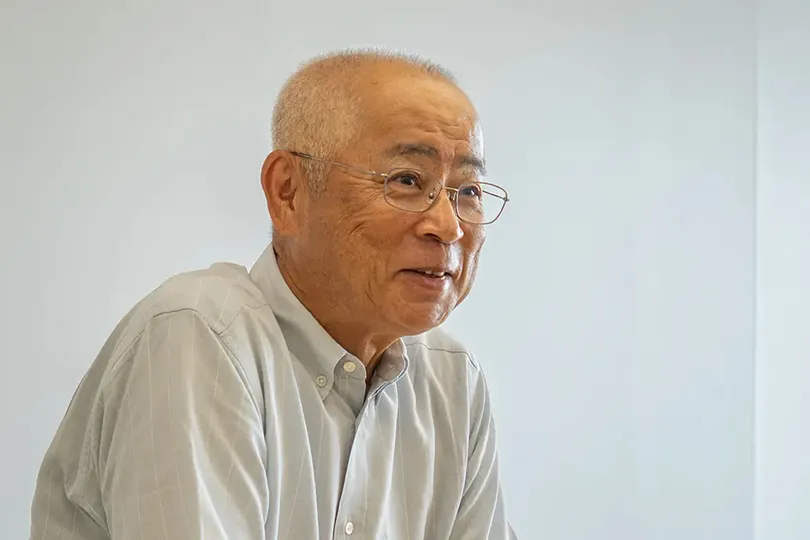 Yasuaki Asaki was involved in Honda F1 engine development
What memories do you have of your F1 engine development experience?
When Honda returned to F1 in 1983, we modified a 2-liter V6 turbo engine originally developed for F2. I think the goal was to keep development costs and man-hours down, but this engine was not suitable for F1.
At the time, my job was to test the engine and identify the causes of problems. Although I was a newcomer who had just joined the company, I realized in my testing that the engine was not good enough, and I even confronted my boss. Looking back now, I must have been a troublesome subordinate.
After that, I worked with the design team to improve the engine and enhance its competitiveness. However, the engine initially broke down frequently. I wondered if we could win races with this engine, but starting around 1985, we began to win.
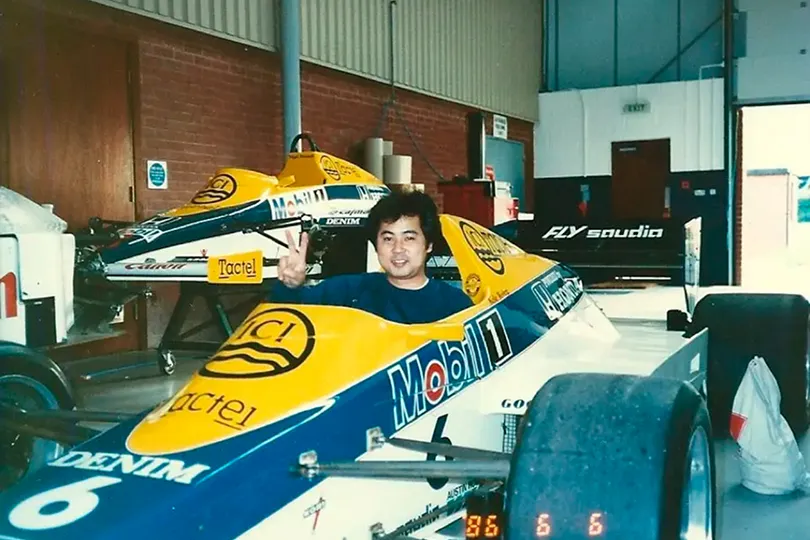 Asaki sits in the FW10 cockpit (1986)
Why do you think you could build an F1-winning engine?
I was a cocky young man in my mid-20s, confident that I was the one to make an innovative engine. In F1, the top category where renowned sports car manufacturers and European giants were fiercely competing, there was no way we could win by copying others. I felt that we had to believe in our technical capabilities and pursue perfection more than anyone else to win, and worked tirelessly on engine development.
In the end, winning led to a deserved confidence and experience that we created the “best engine in the world” for F1, and Honda and I possess the world’s best technology. That success allowed me to face challenges later while maintaining the mindset that we would overcome any challenge or barrier.
In 1986, I moved to the mass-production vehicle development, but even there, I never thought we would lose to other companies. The fact that we had become the best in the world in F1, where technical prowess is fiercely developed, became a source of strength for me. Perhaps the victory in F1 also became one of the factors that contributed to Honda’s corporate culture of challenge and pride in its technical capabilities.
First-generation Odyssey and N-BOX inherit Honda’s challenging spirit cultivated in F1
How did you apply the challenge spirit and confidence cultivated in F1 in your work in mass-production vehicle development?
After moving to mass-production vehicle development, I was involved in the development of the V6 engine for the second-generation Legend and the engine for the first-generation Odyssey, which was released in 1994. The first-generation Odyssey was especially a new challenge for Honda.
In Japan at the time, when people thought of spacious cars, station wagons and 1-box wagons were mainstream, and the term “minivan” was virtually unknown. However, as Japan became more affluent and the number of families with children increased, we believed we needed a new kind of family car. We proposed to upper management the development of a minivan that could be produced at an existing factory (Sayama Factory).
Upper management responded, “Why not sedans for family customers?” However, our development team, driven by a sense of urgency that Honda had no future without a vehicle like the Odyssey, persisted in our arguments and eventually secured approval for the project. The first-generation Odyssey went on to become a huge hit and transformed Japan’s automotive society.
 First-generation Odyssey
Later, when I was in charge of development, the concept for the first-generation N-BOX, released in 2011, was also formed after a lot of challenges. We brought the minivan philosophy from the Odyssey to the kei car (small segment in Japan) and aimed to create the most convenient car for raising children. It was like a “mini minivan.” This model also became a hit and has become an important model that supports Honda to this day.
Did your experience of F1 development also play a role in creating the N-BOX?
At that time, kei cars already accounted for about 30% of new car sales. Due to the global financial crisis and the strong yen, exports were difficult, so we had no choice but to focus on selling cars domestically, specifically kei cars, to boost sales. However, Honda had few models that could compete with other automakers in terms of cost and price, leading to a situation where we couldn’t sell or make a profit. In these circumstances, I was tasked with developing a new kei car.
Kei cars have constraints on body size and engine displacement, as is the case with F1 regulations. Within these constraints, the mindset that we could not be the best in the world without ideas and technologies that others had not imagined is also the same as in F1. Needless to say, we wanted to be the best in this segment as well.
 Asaki was the development leader of the first-generation N-BOX
To create a competitive car, we believed it was necessary to incorporate technology that others could not replicate even after several years of effort. Each automaker has its own philosophy and technology, and Honda has its own way of doing things. Once we thought we wanted to sell cars like others did, and wanted to be like them, we wouldn’t be able to create something better, and we would lose. I felt that would make Honda’s existence meaningless.
We therefore decided to utilize Honda’s unique technologies to create a kei car with an unrivalled spacious interior. That was the first-generation N-BOX. The new-concept engine prioritizing combustion efficiency and the unique center fuel tank layout enabled us to achieve an unmatched level of spaciousness, which I believe was the reason the N-BOX sold well. To be honest, there was a strong sense of crisis that if this kei car didn't sell, Honda would be in trouble, so I was truly relieved when it was well-received by customers.
Honda’s purpose of continuing its challenge in F1, the world’s premier motorsports category
Through your comments, it is clear that the confidence and philosophy cultivated through F1 had a positive influence on Honda’s mass-production vehicle development and corporate culture.
One of the reasons I find F1 remarkable from an engineer’s perspective is that it does not have a system like BoP (Balance of Performance), which imposes handicaps to prevent teams from dominating. BoP is adopted in races like SUPER GT and the 24 Hours of Le Mans, where winning cars have additional weights or their horsepower is restricted to reduce performance differences with other cars, to make the race more exciting. Those races are also entertaining and attractive as events.
But, as an engineer, I personally believe that even if a team wins a race where BoP is implemented, it cannot be said that they won through pure technical superiority. F1 is one of the few “fair” categories where fundamental technology determines whether you win or lose, and I believe Honda’s continued challenge in F1 holds significance as a place to cultivate absolute confidence and skills among engineers. Now that Honda has decided to return to F1 in 2026, I hope they will continue to keep on winning.

What do you look forward to with Honda in the future?
I hope Honda will continue to be a company that grasps the needs that arise as the world changes and uses technology to solve problems based on dreams such as “I wish we could do this.” F1 development should help nurture people who continue to take on challenges with this spirit.
The results of F1 development members competing with the world may likely be reflected in their achievements 10 or 20 years from now. When they become leaders and strive to achieve in mass-production vehicle or new areas development, I believe their experience in F1 will be invaluable. I hope that they will rise to lead Honda during tough times, and contribute to further corporate growth.






I remember celebrating with the development team when the engine I had been working on since my second year in Honda won the championship. It was a joyful moment.