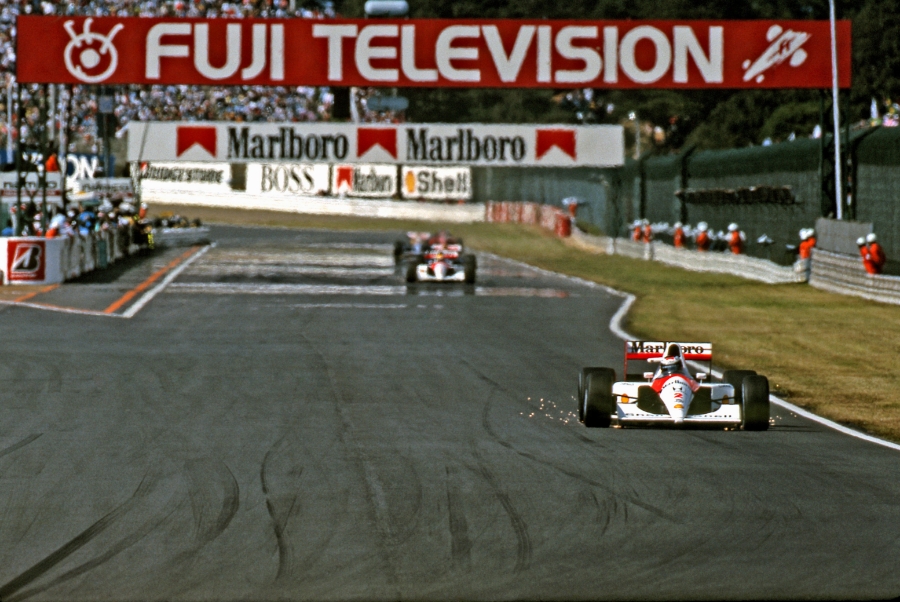
Speed and strength alone cannot tell the tale of the dramatic rise of an extraordinary talent to the world stage.
60-percent win rate:
Senna’s incredible speed in the junior categories
In 1980, Nelson Piquet won the F1 World Championship, leading more Brazilian drivers to aim for a European debut. One such driver was the up-and-coming Ayrton Senna da Silva, who had won the South American Karting Championship and was second in the World Karting Championship standings in 1979 and 1980. In 1981, Senna was introduced by Brazilian F1 driver Chico Serra to the British constructor Van Diemen, and gained entry into the Formula Ford 1600 (FF1600) series. Senna thrived in FF1600, winning 12 of the 20-race season to claim two titles, the ROC and Townsend Thoresen. There were already many Brazilian star drivers, and Senna, failing to secure a sponsor, returned to Brazil.
Unable to give up his dream, Senna negotiated with Van Diemen and returned to the U.K. just prior the start of the 1982 FF2000 season. He went on to claim the British and European titles, with 16 of 18 wins in the U.K., and six out of eight in Europe. After his year-long detour, Senna debuted in F3 from the prestigious West Surrey Racing team.
At the time, Martin Brundle, in his second year in the British F3 championship, was a strong contender for the title, having finished fourth in the previous year. Senna won the first nine rounds of the season, but Brundle had also accumulated points with eight second-place finishes and one third, setting the stage for a one-on-one battle between Brundle and Senna. In Round 10 at Silverstone, Brundle led, Senna crashed, and Brundle won. The tide changed drastically. As Senna frequently crashed, Brundle steadily accumulated wins and points. By the final round, Brundle had a one-point lead over Senna. In the decisive finale, Senna drove with a special setting that he and his engineers had devised, and gained outstanding speed. Senna won the race by far, claiming the series championship with an astounding 12 wins out of 20 races. At the Macau GP held at the end of the year, said to be the world F3 championship-deciding race, Senna won both heats, in front of the whole world. The following year, in 1984, Senna made his F1 debut with Tallman.
15 poles and strength in rain
Shining talent in pre-Honda Senna
From the time of his debut in 1984, Ayrton Senna was the center of attention in the world of Formula 1 racing. A particularly famous performance was the rainy Monaco GP, where he rose from 13th on the grid to second by Lap 19, and overtook race leader Alain Prost, just before the race was red-flagged on Lap 32. Although he did not win the race, his speed in the rain left a lasting impression. After three podium finishes that year, Lotus team manager Peter Warr was convinced of Senna’s talent, and bought him out of his contract with Tallman. In only his second year with the team, Senna had moved to a top team, gaining the environment to aim for victories.
In 1985, Senna's first year with Lotus, he quickly distinguished himself in Round 2, the Portuguese Grand Prix. It was a track he liked, qualifying third and finishing third the previous year. This year, he qualified on pole for the first time with an 0.5 second gap to his closest opponent. In a rain-soaked race, he drove brilliantly, lapping everyone up to third place, to claim his first F1 victory. He went on to take pole positions at San Marino, Monaco, Detroit, Italy, Europe (Brands Hatch), and Australia. In Round 13, a rain-drenched Belgium, he was unchallenged as he drove through rapidly changing conditions to win his second grand prix.
In 1986, he claimed pole position in 8 out of 16 races. The highlight was Round 2, Spain, where he qualified 0.826 seconds ahead of Nelson Piquet (Williams Honda), and won the race by 0.014 seconds over Nigel Mansell. In his two years with Lotus Renault, Senna had won four races, in difficult conditions such as rain or city streets, largely due to his skills. To take full advantage of his talent, Senna expressed his desire for Honda engines, the most powerful engines at the time. Honda was also attracted to Senna’s speed, and in 1987, the following year, Honda began supplying engines to the Lotus team.
Three-time champion with Honda
All decided at Suzukaた
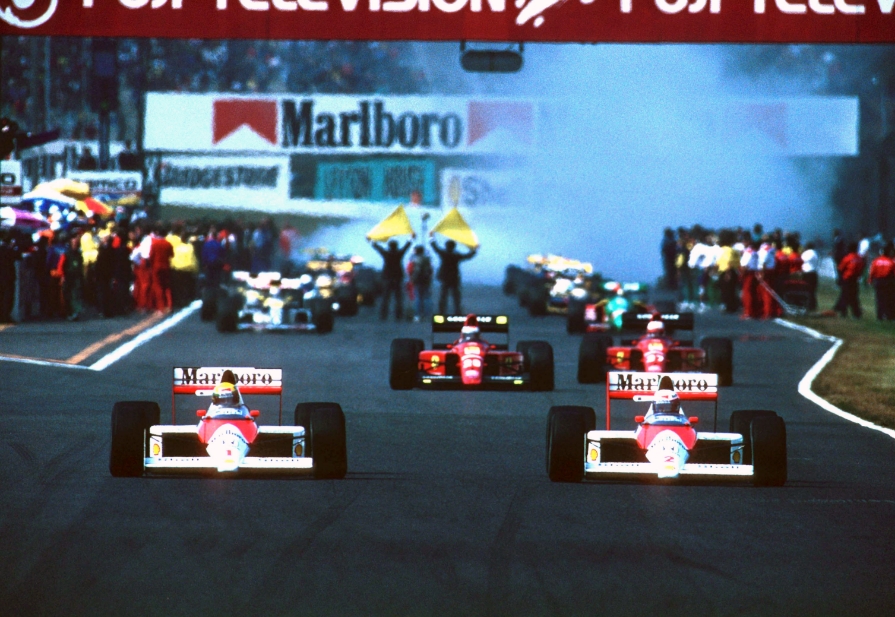
At the 1987 Italian Grand Prix, Honda announced it would begin supplying engines to, and that Ayrton Senna would join, the McLaren team. Two-time world champion Alain Prost and Senna driving together, with a racing machine that was designed by Gordon Murray, who many called a genius, and powered by Honda, made a true dream team.
In the 1988 season, Honda opted to continue with turbo engines despite the restrictions on boost pressure, and continued to take advantage of its engine superiority. This decision resulted in 15 wins out of the 16 races. The title-decider in Round 15, Suzuka was a one-on-one battle between teammates Senna and Prost. Senna won after a poor start, but Prost had more effective points, giving him the title.
McLaren Honda’s dominance continued into 1989, with 10 wins from 16 grands prix. Once again the title was contended between Senna and Prost, but Prost became frustrated throughout the season and chose late in the season to leave McLaren. The championship was again decided at the Japanese GP, but Senna and Prost collided at the chicane on Lap 47, wiping Prost out of the race, which Senna managed to win only to be disqualified. Once again, Prost took the title, but their teammate rivalry was fierce, and Senna vs. Prost became a trend in F1.
In 1990, the Senna vs. Prost battle crystallized even further when Prost moved to the Ferrari team gaining strength with every race. The third championship-decider was, again, at Suzuka. Senna’s proposal to the Fédération Internationale du Sport Automobile (FISA), to switch his pole position to the outside lane, where there was better rubber grip, was refused, and Prost had the advantage from starting from the outside lane on the front row. Senna and Prost collided at the first turn, and both drivers retired from the race. Despite the DNF, Senna had won the title.
Senna’s third title came the following year, in 1991. Prost dropped out of contention due to Ferrari’s decline, but instead Williams’ Nigel Mansell rose to the challenge. In the Japanese GP, where the title would be decided, Senna let teammate Gerhard Berger lead the race, while he himself held off Mansell. The battle ended on Lap 10 when Mansell ran off the track at Turn 2, and Senna, who had secured his third title, then passed Berger to take the lead. On the last turn on the last lap, Senna slowed for Berger to take the victory.
Senna was crowned world champion three times out of four decisive races at Suzuka, all with Honda. All of his victories were with Honda, and all of his titles were decided at Suzuka. This is an essential episode in the Senna legend.