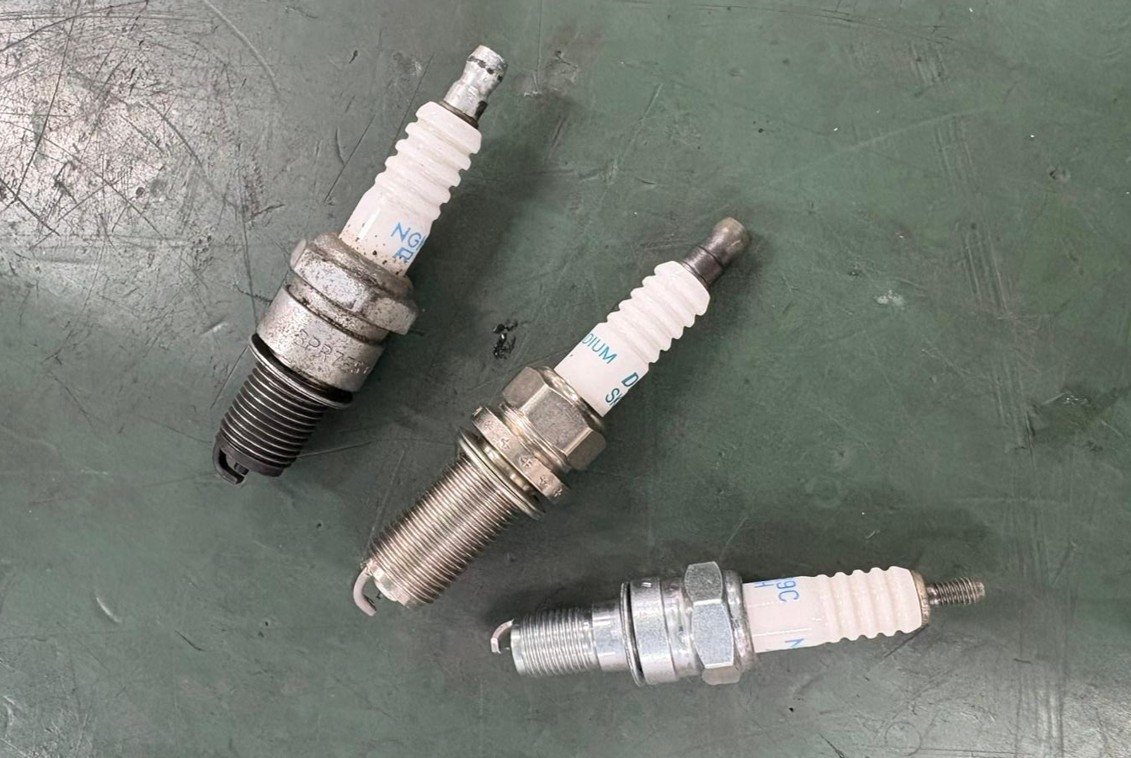


I imagine you're feeling worried. Have you checked the condition of the ignition system, especially the spark plugs?

The...spark plugs? I feel like I've heard of that before, but...
What exactly do those parts do?

Let’s take a look!
1.The Role of Spark Plugs
So...spark plugs? What exactly do those do?

Let me provide a simple explanation.
A spark plug is, as the name suggests, a plug that ignites a spark. More specifically, it is a part that ignites gasoline.
Generally speaking, ignition is one of the three key elements of gasoline engines (good mixture, compression, and sparking).
Sounds like a very important component for the engine.
So, how do plugs go bad?
If the electrodes curl up and accumulate dirt over time, it can reduce engine power and fuel economy.
Is that something you can easily tell by looking at it...?
Yes. If the electrodes are visibly curled up or dirty, they must be replaced. In some cases, gaps may be identified and adjusted. However, since iridium plugs are hard, it is recommended that they be replaced without gap adjustment.
If you're worried about your spark plugs, have your dealer take a look!
2.Types and Replacement Period

Earlier, you mentioned iridium spark plugs, but what are the different types?

There are two main types of spark plugs commonly used on motorcycles today.
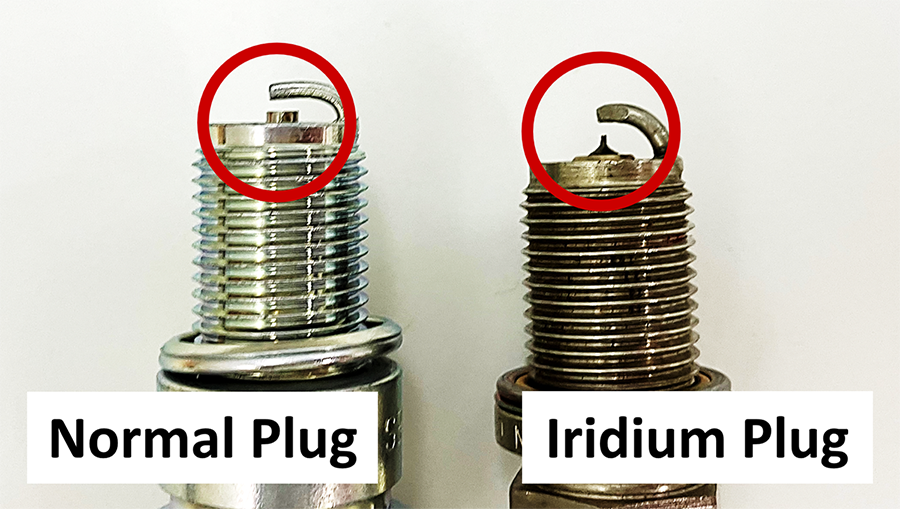
What are sometimes called “normal” (nickel) plugs are known for being inexpensive. However, the electrode portion of these plugs is prone to wear.
Iridium plugs, on the other hand, are characterized by their electrode portions, crafted in great detail, and their high durability. So that's why they're more expensive.
This makes sense.
How much difference does it make in terms of durability?
While regular plugs are recommended to be replaced approximately every 20,000 kilometers, iridium plugs are recommended to be replaced every 40,000 kilometers.
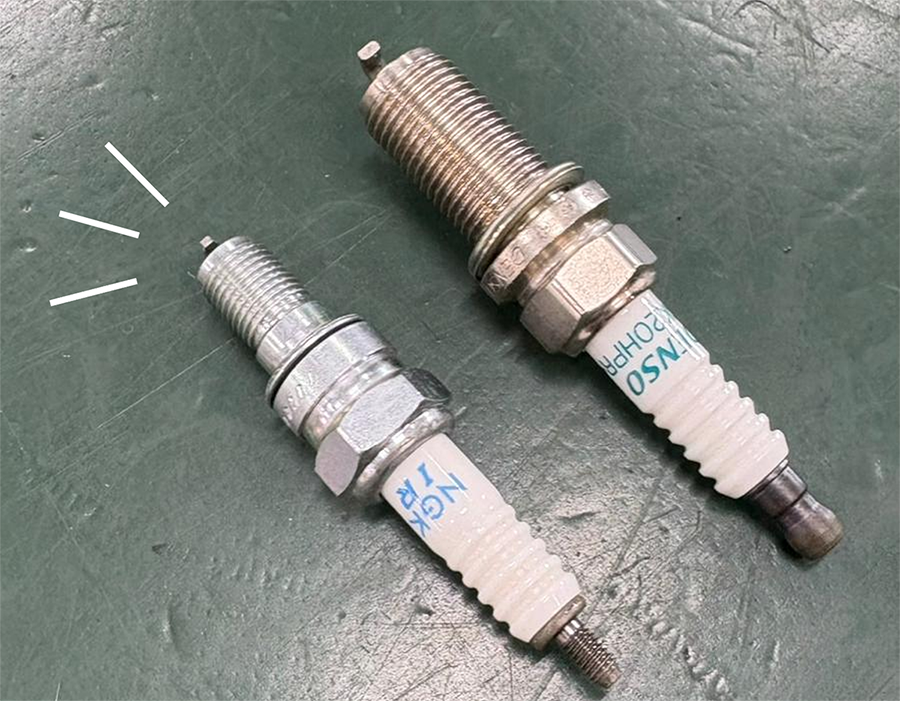
Even with the same type of plug, the size of the threaded part varies greatly depending on the type of vehicle!

If I had to choose between normal plugs and iridium, I would choose iridium!
But I couldn't possibly be able to tell what size plug I have in my bike.
This is important! Do be aware that not all bike models can use iridium spark plugs.
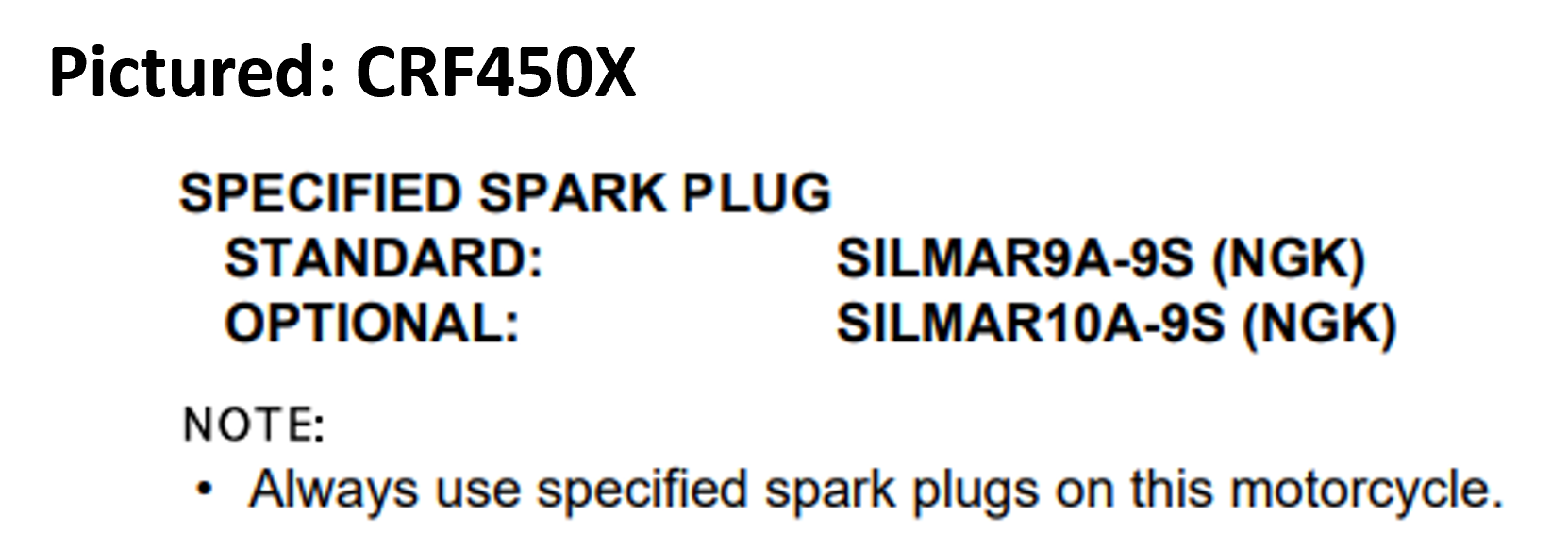
You can check what kind of plugs your bike uses from the Service Data page of the Owner's Manual.
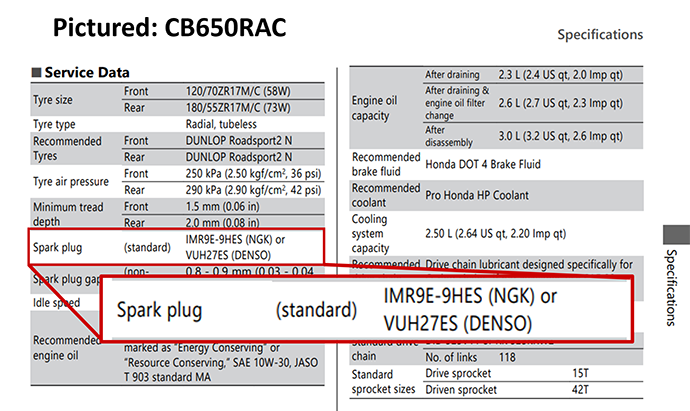
As shown in the example above, spark plugs are designated by manufacturer, and as shown in the example below, there are designations for different heat values for bikes used for competitions!
I’ll definitely take a look at my owner's manual.
3.About the Heat Range
What kind of plug should I choose for what kind of use case?
What do you mean by the “heat range” you were talking about earlier?
The heat range is one of the important points in selecting plugs.
A plug's heat range shows the degree to which it dissipates heat.
A plug with a high heat range (easy to dissipate heat) is recommended for those who frequently use high RPMs, such as on sport bikes or those that are driven at high speeds. On the other hand, for those who may be commuters or otherwise drive mostly in cities and towns, or for those who sometimes spend long periods of time idling, a plug with a lower heat range (less heat dissipation) is recommended.

In terms of structural differences, plugs with a higher heat range have a structure that is less prone to heat retention. The depth of the gas pocket is shallower than that of a plug with a lower heat range.
Also, the plug name includes a number, which tells you whether it has a high or low heat range. Note that different companies express this number differently!
There are so many differences, it's hard to tell...
Just carefully check the information provided by your bike manufacturer about compatibility and choose the one that works for your bike!
Mine is a sports bike, but I don't rev it into the high RPMs, and I spend a lot of time idling in morning traffic on my commute to work, so I wonder if I should go for a lower heat range...
You might be right about that. Spark plugs are consumable parts, so replacing them at the appropriate time will not only prolong the life of your bike, but also reduce the risk of breakdowns!
If there’s anything you aren’t sure about, you should talk to your dealer.
Their professional team will determine whether or not there is a need to change from your current plug situation.

Sounds good! I’ll talk to the staff at my dealer when I go in for my next inspection.🎵
Lately, I've been feeling that the bike I use to commute to work is not in good shape...the engine seems to be running worse than before.