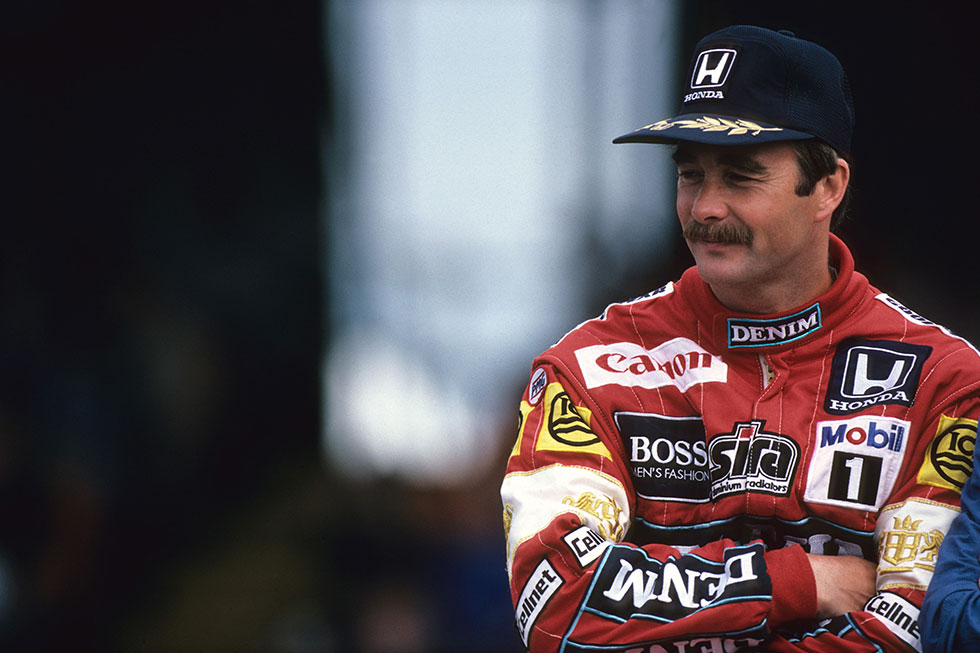
Season Ends with Crash during Qualifying, Dashing Hopes of Consecutive Titles
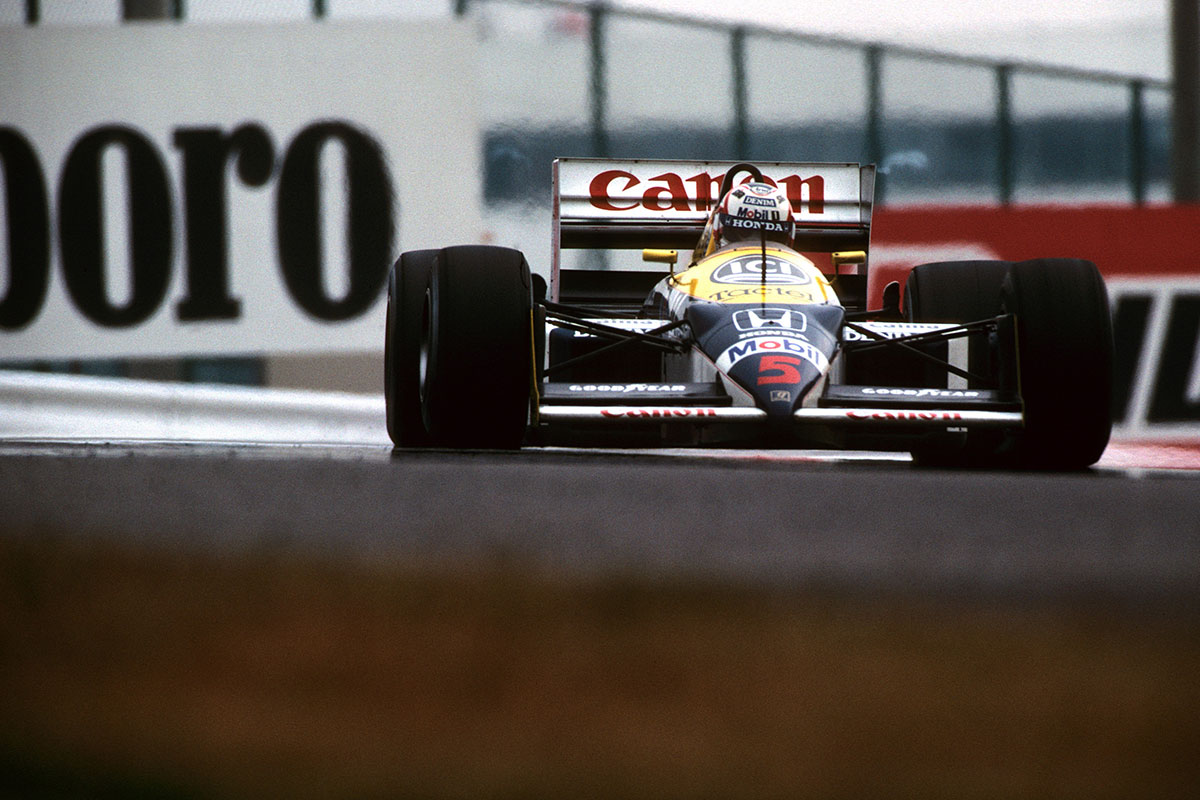
Unrivalled fan favorite for the title, but…
25 years after the Suzuka Circuit opened in the fall of 1962, it was set to host an F1 Grand Prix for the first time. The performance of Honda-powered cars and the efforts of Satoru Nakajima (Lotus Honda), the first full-time Japanese F1 driver, had sparked a surge in F1 popularity in the country. However, an unexpected championship decision shook Suzuka and the entire F1 world. Nigel Mansell (Williams Honda), the central figure in the drama, was injured in a crash during qualifying, effectively ending his slim chances of winning the championship.
After the previous race, the Mexican Grand Prix, the points standings were: Nelson Piquet (Williams Honda) with 73 points and three wins (total points 76), Mansell with 61 points and six wins, Ayrton Senna (Lotus Honda) with 51 points and two wins, and Alain Prost (McLaren TAG) with 46 points and three wins. Mansell needed to win both the penultimate Suzuka and final Australia rounds to beat Senna and claim the championship. The Constructors’ Championship had already been decided by Round 13, the Spanish Grand Prix, with Williams Honda securing its second consecutive title.
Grand Prix week typically begins on Friday, but for inaugural events or those following major renovations, Thursday is reserved for practice sessions. Suzuka kicked off with a free practice session on Thursday afternoon. Mansell, who had prior experience at Suzuka from Honda testing, set the fastest lap in both the Thursday and the Friday morning sessions. On Friday, he clocked a time of 1 minute 42.101, a dominant performance that left the rest of the field nearly a second behind.
Suzuka was already buzzing with excitement by Friday’s qualifying session. For most Japanese fans, it was their first chance to see an F1 race live. It had been a decade since the last F1 Grand Prix was held at Fuji Speedway.
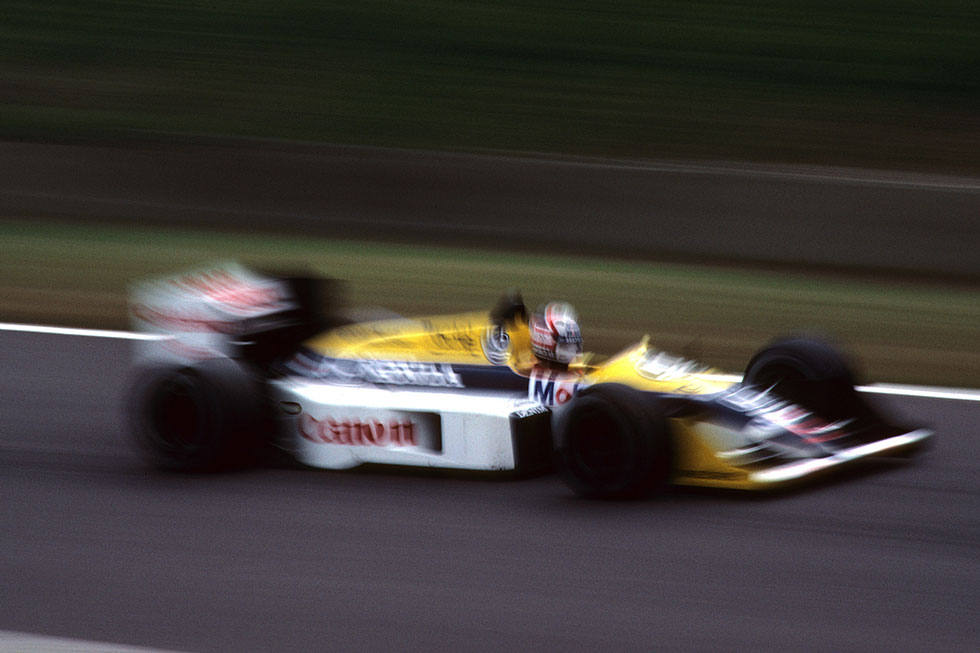
Major accident on the S-Curves, injuries and withdrawals result
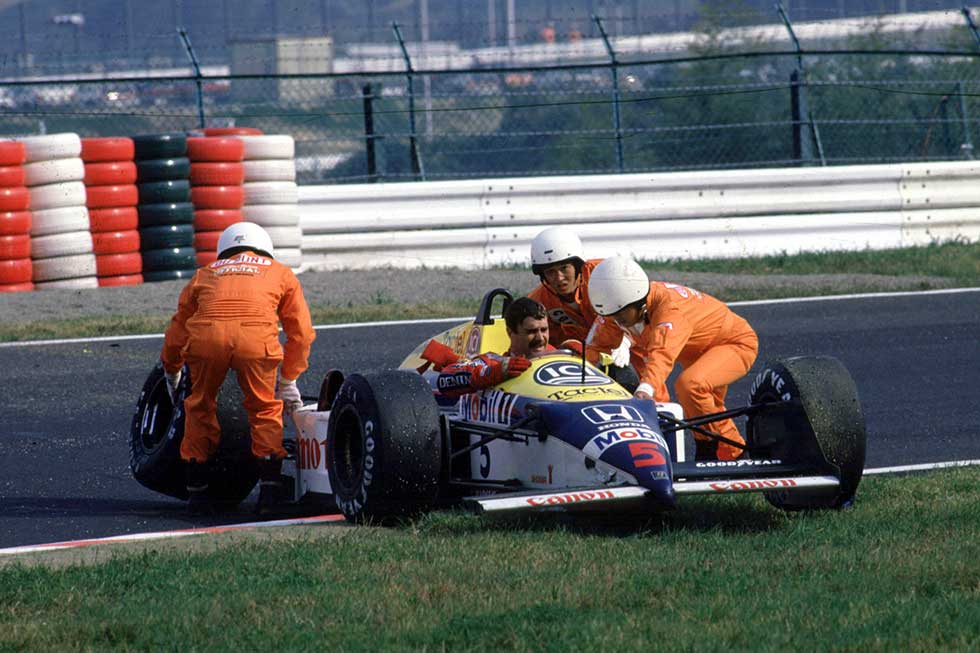
The first qualifying session began at 1:00 pm on Friday and had only been underway for 15 minutes. Mansell recorded a time of 1 minute 42.616 seconds, but Piquet immediately bettered that with a time of 1 minute 41.423 seconds. Despite still having 40 minutes remaining, Mansell quickly had his tire warmers removed and went for another attempt. As he attempted to navigate the S-curve at 200 km/h in fourth gear, he spun out on the dirty track, collided with the outer tire barrier while facing backward, and the FW11B was launched into the air before crashing back down onto the track. Mansell was unable to leave the cockpit on his own. Mansell, who had removed his helmet and was grimacing in pain, had suffered severe injuries to his waist and spine and was rushed to a hospital in Nagoya by helicopter. Although he had no fractures, he was not cleared to race, and returned to the U.K. over the weekend. Mansell’s withdrawal from the race was confirmed, as was Piquet’s third championship title (the first two in 1981 and 1983 with Brabham). However, no-one in Piquet’s team was smiling. “I didn't want it to end like this,” Piquet commented. The intense title battle between Mansell, willing to win or crash, and Piquet, who was steadily aiming for second place and accumulating points, came to an abrupt end at Suzuka before the race.
Called the uncrowned king
With Mansell absent, the race was won by young Gerhard Berger (Ferrari). It was an unexpected result for Ferrari, winless for two years, to claim victory at Honda’s home track. Piquet, who had secured the title, was somewhat deflated and, while battling with Senna for third place in the final 47 laps, retired after his engine emitted white smoke and he pitted. The Lotus Honda team saw Senna overtake Stefan Johansson (McLaren TAG) on the final lap to claim second place, while Nakajima finished sixth to secure points. The 220,000 spectators who gathered over the three-day weekend cheered enthusiastically for their strong performance.
Mansell’s three-season story with Honda came to an end with the accident at Suzuka. For Mansell, it was disappointing to not achieve consecutive titles, but it was three years in which he proved his speed and was rapidly recognized as a top driver. The second Honda F1 era had secured two Constructors’ titles in the three years, solidifying its position as the top engine manufacturer. Mansell’s contribution to its growth was indispensable.
Mansell, who continued to pursue victory, moved to Ferrari in 1989 but failed to contend for the title, earning the unfortunate nickname “The Uncrowned King.” It was not until 1992, his second year back at his former team Williams, that Mansell finally achieved his long-sought World Championship title.