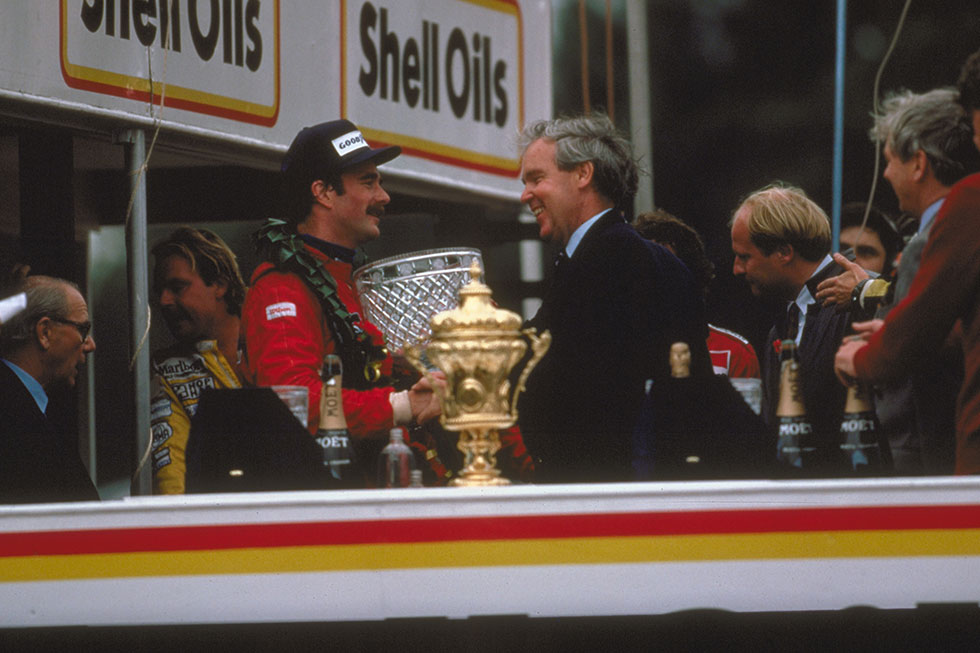
Maiden Win After 72 Grands Prix
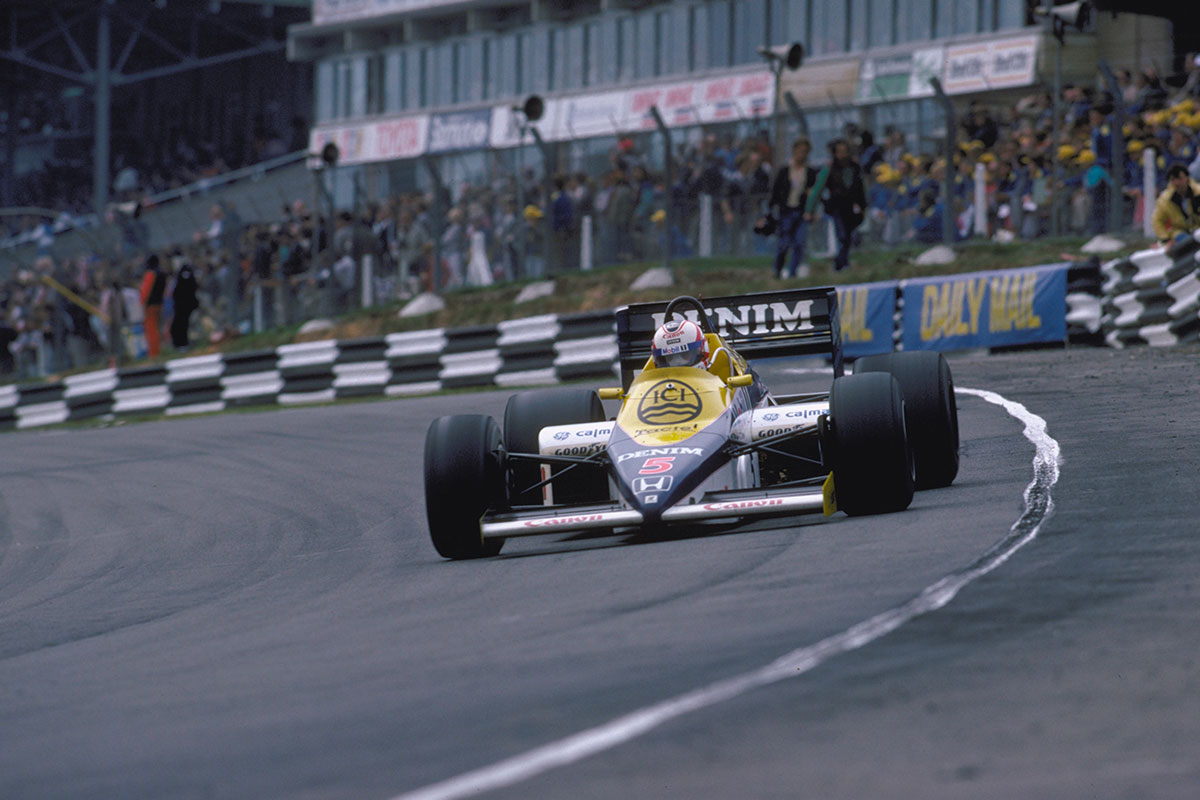
Rapid growth along with Honda’s evolution
Honda’s second era of F1 activities began midway through the 1983 season, marking its return to F1 following a 15-year hiatus. Initially, Honda established Spirit to participate in F1 testing and supplied engines to Williams, which had won the Constructors’ Championship in 1980-81, starting from the final two races of the 1983 season. Honda’s full-scale participation began in 1984, with drivers including 1982 Champion Keke Rosberg and Jacques-Henri Laffite. The first Honda 1.5-liter V6 turbo engine was powerful, but had a narrow power band and lacked reliability. However, in the scorching 1984 Dallas GP, Rosberg’s outstanding performance secured the team’s first victory in Honda’s second era. The following year, 1985, Laffite returned to his former team, Ligier Renault, and Nigel Mansell joined Williams Honda. Mansell immediately began to show impressive performance, matching Rosberg’s bold driving style. Although Rosberg was dominant in qualifying for the first half of the season, by the end of the 16 races, Mansell had rebounded to qualify better than Rosberg in 7 out of 16 races. Once Honda’s improved E-spec engine was introduced in Round 5, Canada, both the car’s, and Mansell’s true potential became apparent, increasing his chances of winning.
Mansell secured his first podium finish of the season with a second-place finish at the Belgian Grand Prix, between rookie Ayrton Senna (Lotus Renault) and that year’s champion Alain Prost (McLaren TAG). Since then, he went on to secure his first victory at the European Grand Prix held at Brands Hatch in the UK. This first victory, achieved at his home Grand Prix, was a long-awaited triumph, in his 72nd F1 Grand Prix start.
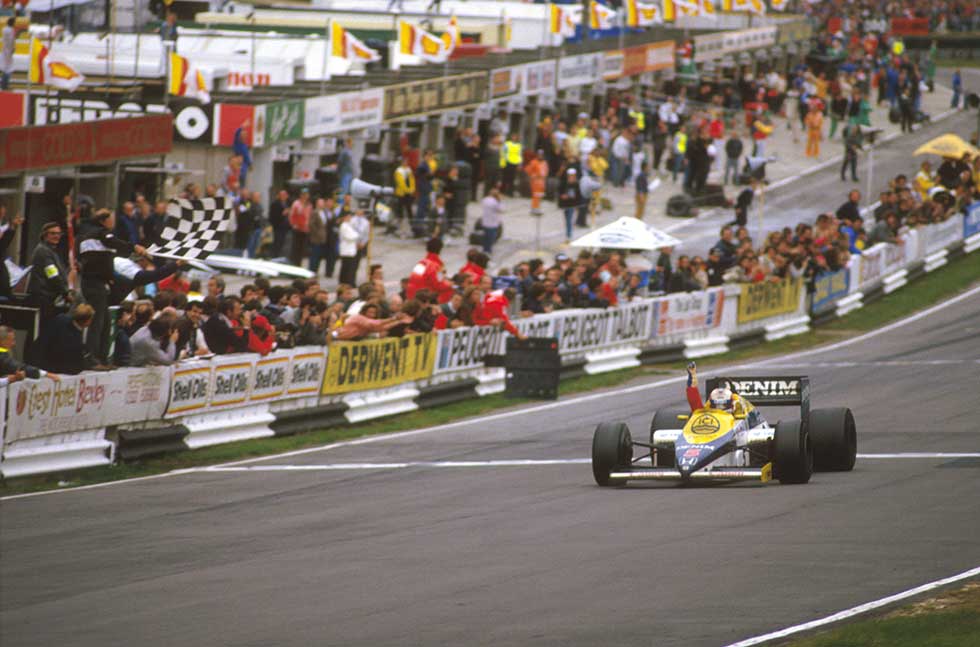
Rosberg’s nice assist
Mansell, who had qualified third, was quick off the mark and moved up to second, but briefly went off the track at Turn 2 and was overtaken by Rosberg and Nelson Piquet (Brabham BMW). Rosberg continued to pressure Senna, who was in the lead, but on Lap 7, Senna closed the inside at Turn 4, causing contact. Piquet, who was caught up in the incident, retired from the race. Rosberg, who had a puncture on his left rear tire, returned to the pits for a tire change and rejoined the race nearly a lap down. Rosberg returned just ahead of race-leader Senna and Mansell. On Lap 9, at Turn 3, Rosberg slowed down and skillfully blocked Senna, allowing Mansell to pass at the corner exit and take the lead. At the time, there was no obligation for a lapped car to yield its position, so Rosberg continued to block Senna, allowing Mansell to extend his lead. Rosberg demonstrated excellent teamwork, playing a significant role in extending Mansell’s lead.
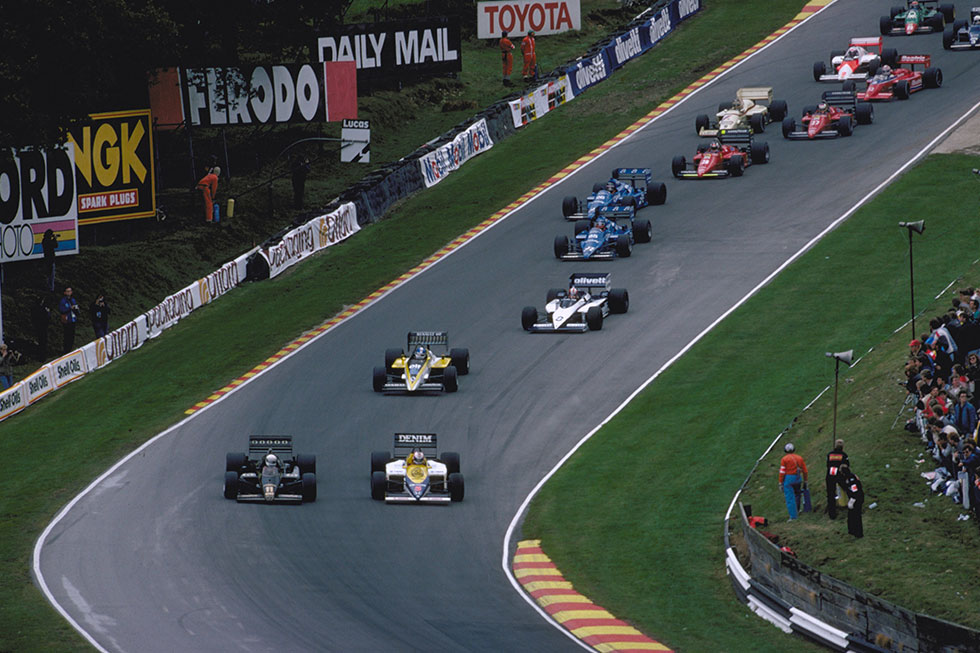
Honda dominates Brands Hatch
Mansell held onto the lead until Lap 75. Rosberg, instrumental in Senna being forced to slow down, made a fierce charge to unlap himself, ultimately finishing in third place. The speed of the E-spec engine over the race distance was dominating, and in a post-race interview, when Senna was asked, “Where was Mansell faster?” he replied, “Straight-line speed and acceleration.” From this point onward, Senna is said to have become increasingly aware of the Honda engine’s superiority.
With 120,000 spectators watching, Mansell took the checkered flag, raising his right fist in celebration. This marked the first F1 Grand Prix victory for a British driver since James Hunt’s win at the 1977 Japanese Grand Prix, ending an eight-year drought.