Past Events
Goodwood 2005

Goodwood Festival Report Vol.3
Stewart Graham rode the hill climb course on the grounds of the Goodwood Festival of Speed, on his Honda RC166 in magnificent lean-with riding form. The clear, truly soul-stirring, full-throttle exhaust sound rang out. As the sound intoxicated onlookers, for a moment, it seemed as if time jumped back forty years.
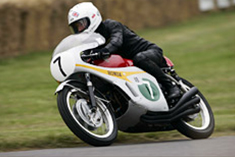
The RC166, thunders up the hill climb course with its clear exhaust sound, and riding form exactly as it would have been at the time. The rider is Stewart Graham.
Honda’s first foray into the world’s top level of motorsports was not the F1 race in 1964 with the RA271. In October 1946, just after the end of World War II, Soichiro Honda established the Honda Technical Research Institute. A mere eight years later, in 1954, Soichiro announced his intention to participate in the world’s premier Isle of Man TT races.
In 1962, Honda built Japan’s first full-scale racing track, the Suzuka Circuit, at a time when Japan did not have enough circuits, and knowledge of motorsports was virtually nonexistent. Under such circumstances, it was nothing less than sensational that a newly established postwar motorcycle manufacturer would declare its intention to challenge the world’s most prestigious motorcycle race.
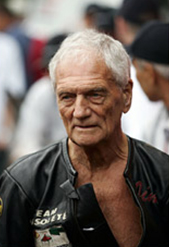
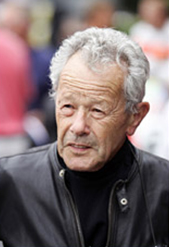
Luigi Taveri (right) and Jim Redman (left), the riders who took Honda to glory in its early days of world class motorcycle racing.. They still look fearless, and their expressions, those of true champions who achieved glory at the pinnacle of racing.
It realistically took five years from Soichiro’s declaration of participation in the Isle of Man TT races to Honda’s first appearance in 1959. However, in April 1961, three years after Honda began competing in the World Grand Prix championship, including the Isle of Man TT races, Australian rider Tom Phyllis won the 125cc class of Round 1, the Spanish Grand Prix, on a Honda RC143. This was the first Grand Epreuve win for a Honda-built machine in the 125cc class. In the following round, the West German Grand Prix on May 14, Japanese rider Kunimitsu Takahashi on the RC162 became the first Japanese rider to win a grand prix in the 250cc class.

Luigi Taveli on his RC149. Honda had challenged the dominating 2-stroke bikes with a 125cc air-cooled 4-stroke 5-cylinder engine that revved to over 20,000 rpm. The RC149’s transmission was 8-speed.
In Round 4, the Isle of Man TT races, Honda dominated both the 125cc and 250cc classes, finishing first through fifth in both. Honda also won the constructors’ champion in both classes. Soichiro’s dream since his Isle of Man TT races declaration was realized. Furthermore, while GP racing at the time was dominated by 2-stroke bikes, which were lighter and could easily produce more power, Honda opted to challenge the norm and win with 4-stroke bikes. This was a dream come true for Honda, which demonstrated its characteristic of not doing things the same way others.
Honda racing bikes continued to dominate, and in 1966 Honda won the constructors’ championships in all classes of the WGP except for the 50 / 125 / 250 / 350 / 500 cc sidecar classes, for the first time in history. Honda made history by winning all five classes. This success in motorcycle racing led directly to Honda’s entry into F1. Honda, which had just entered the automobile industry, was able to produce its own F1 car in a short time because of its technological expertise accumulated through motorcycle racing, but it would ordinarily never have considered entering F1 at that time.
People in Europe, especially in the UK, who witnessed Honda’s success on the race circuit over the years, paid special affection to the Honda brand. In other words, Honda became a great hero to them.
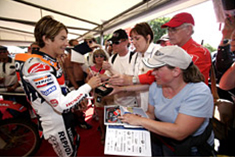
Nicky Hayden, a young rider with the future of MotoGP on his shoulders. Now competing at the top level, he said he was honored to ride with other legendary Honda riders.
Suddenly, the RC166 had ridden out of sight.
The ten motorcycle racers brought to the Goodwood Festival of Speed 2005, for which Honda is the main sponsor, have more Honda history behind them than can be described in a few pages. Motorcycle racers and F1 racers are the two axes to tell the story of Honda’s racing spirit. They are both valuable assets for Honda, a company that continues to manufacture both motorcycles and automobiles with world-class technology. As a Japanese, this writer could not help but feel a sense of pride hearing the cheers for the RC166 echoing off the trackside.