Metrics and Targets, Global Management

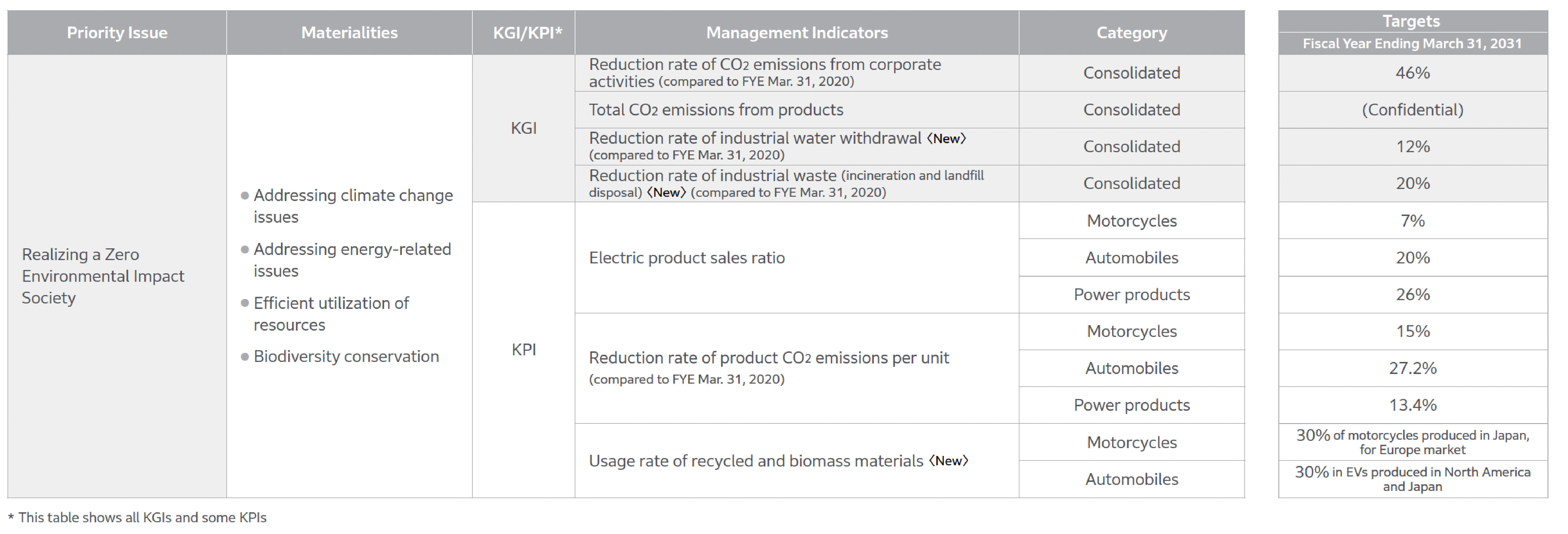
List of Company-wide Environmental Targets (KGI/KPI)
Honda GHG Emissions in the Fiscal Year Ended March 31, 2025
As a responsible company operating in the mobility industry, Honda believes in the importance of calculating and disclosing GHG emissions in order to drive progress in initiatives to reduce global emissions.
As the first milestone in this endeavor, in August 2012, Honda disclosed estimates of GHG emissions for the fiscal year ended March 31, 2012 across its entire value chain in conformity with the GHG Protocol, currently the world’s most widely used GHG emissions accounting standard. The Company became the world’s first mobility company to release estimates of emissions not only from its own business activities (Scopes 1 and 2) but also from all upstream and downstream activities (Scope 3), extending from the procurement of raw materials to the transportation and customer use of Honda products and ending with the treatment of end-of-life products.
Honda continues to calculate and report the GHG emissions from its entire value chain and is making improvements to obtain more accurate emissions readings. The Company is doing this in Scope 3 (other indirect emissions), for example, by widening the boundaries of data collection for categories that account for the largest proportion of estimated emissions, and by improving the accuracy of the calculation methods.
For Scope3 Category 11, the scope of calculation has been extended from about 90% of global sales to volume to approximately all in total. The conditions used in calculating figures such as annual distance traveled and lifetime years of use have been changed and are now based on the newer IEA Mobility Model (MoMo) instead of the conventional IEA SMP Model.
The calculations for the fiscal year ended March 31, 2025 show that GHG emissions from Honda business activities were 2.64 million t-CO2e, and total emissions from the value chain, including other indirect emissions, were 296.86 million t- CO2e. Honda will continue to monitor and manage data and utilize this information in the actual implementation of emissions reduction measures.
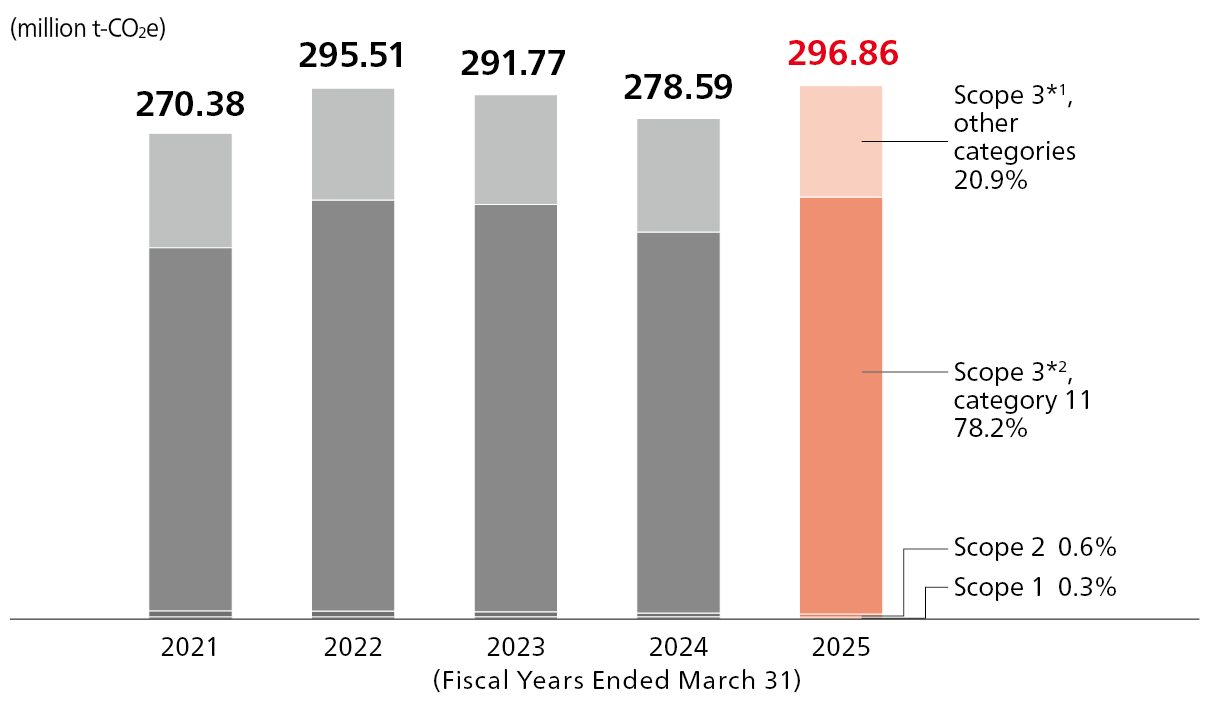
- For Scope 3 Categories 1, 4, 9, and 12, we have made some changes starting in FYE Mar. 31, 2025. These categories are disclosed after recalculating past performance.
- For Scope 3, Category 11, the IEA SMP Model was used for calculations until FYE Mar. 31, 2021, while the IEA Mobility Model (MoMo) has been used since FYE Mar. 31, 2022. Additionally, some calculations have been revised starting from FYE Mar. 31, 2023.
Environmental Management Structure
Honda is promoting Group-wide efforts to realize a society with zero environmental impact throughout its life cycle.
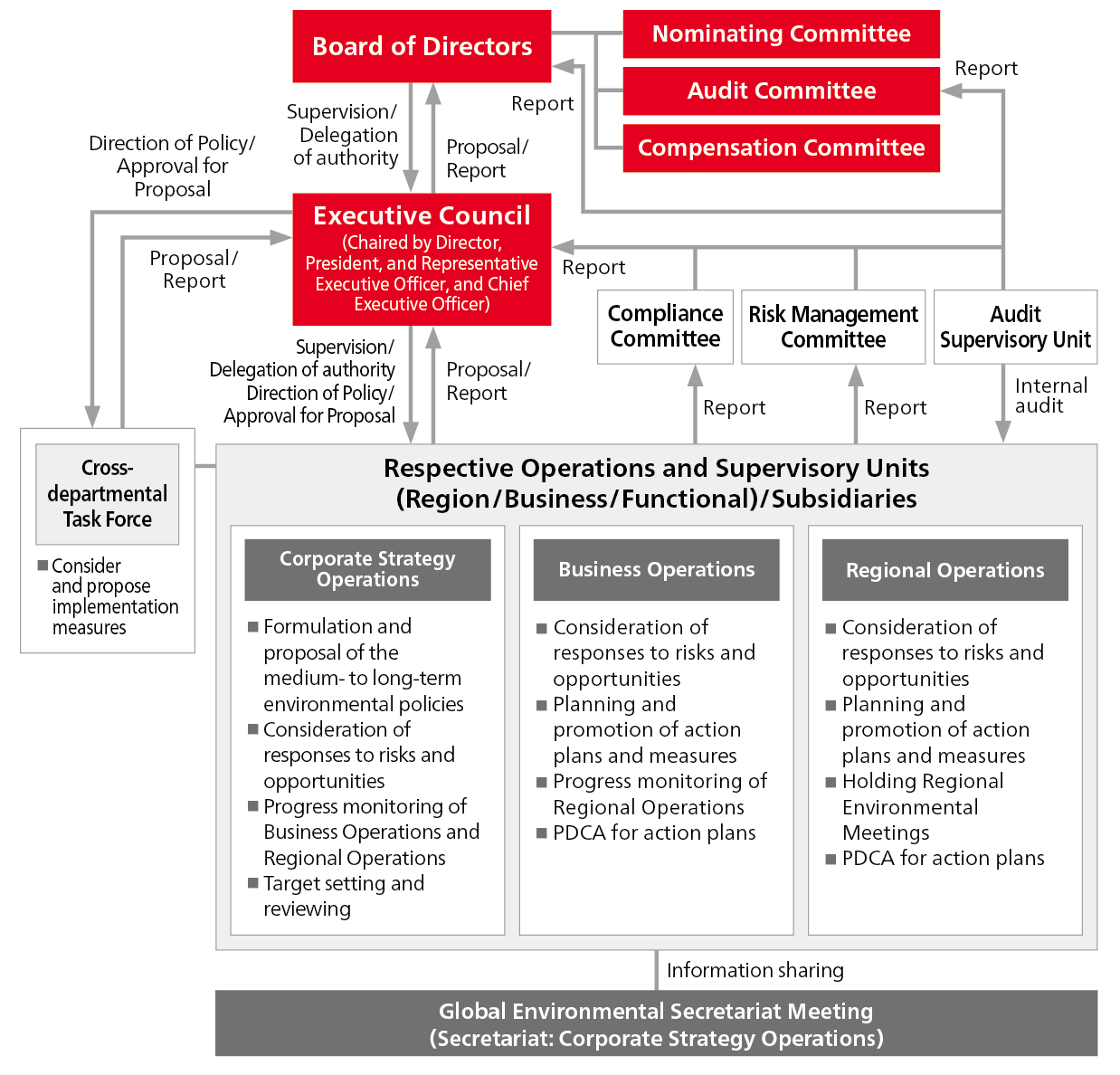
Honda’s long-term management policies and medium-term management plan are approved and resolved by the Executive Council (chaired by the Director,President, and Representative Executive Officer, and Chief Executive Officer) and the Board of Directors. The Board of Directors is the final supervisory body, covering actions to address climate change issues. The Executive Council deliberates in advance on matters to be resolved by the Board of Directors and discusses important management matters within the scope of authority delegated to it by the Board of Directors.
In response to the need to address various risks associated with business activities and to oversee business operations for the sustainable development of society and Honda, Honda has designated knowledge in ESG and Sustainability, including ability in addressing climate change issues, as one of the necessary skills and appointed directors accordingly.
Each Operation and Supervisory Unit and subsidiary formulates and promotes action plans and measures based on the company-wide long-term management policies and medium-term management plan, and important matters are reported and approved at the Executive Council as appropriate. Respective Business Operations and Regional Operations formulate action plans and promote measures based on the global medium- to long-term environmental policies, based on information shared at the Global Environmental Secretariat Meeting (Secretariat: Corporate Strategy Operations). Each of Regional Operations holds a Regional Environmental Meeting to promote the PDCA cycle within Regional Operations. Each of Business Operations monitors regional progress and promotes the PDCA cycle within Business Operations. The Corporate Strategy Operations monitors the progress at Business Operations and Regional Operations and considers revisions to the medium- to long-term environmental policies and targets as necessary.
Important matters are reported and approved at the Executive Council and reported and resolved at the Board of Directors. For important cross-departmental issues such as addressing climate change issues, a cross-departmental task force is formed to consider and propose action plans and measures as appropriate, and important matters are reported and approved at the Executive Council.
Compliance and risk management related to the environment, including climate change, are operated by the Company’s basic policies for the development of internal control systems.
Honda ESG Report 2025 | P185 Basic Approach
Toward the realization of a society with zero environmental impact, Honda’s Board of Directors and Executive Council regularly monitor the progress of KGIs for which the Board of Directors is responsible for supervision and KPIs for which the Executive Council is responsible for execution, thereby reinforcing management governance. Please refer to Item 6 B. “Compensation.” in the Form-20F for details of the executive remuneration system linked to financial and non-financial indicators.
Form-20F | https://global.honda/en/investors/library/form20_f.html
Environmental Management Structure
Environmental Management System
Honda’s existing global vehicle assembly and product assembly plants have acquired ISO 14001, an international certification for environmental management systems (as of March 2025). Therefore, the coverage of environmental management systems is virtually 100%.
Honda will continue to promote activities to acquire this certification.
Current Status of Compliance with Environmental Regulations
In accordance with Honda’s Environment Statement, the Company has introduced environmental management systems at all business sites and in each division. Along with promoting continuous efforts to improve environmental performance, it strives to comply with its own voluntary environmental standards, which are more stringent from an environmental perspective than any national or local regulations.
In the last five years, Honda has not committed any serious noncompliance with environmental laws and regulations, paid substantial fines/sanctions in breach thereof, or recorded any major chemical releases.
In addition, no environment-related complaints were received through the official complaint resolution program.