Approach

Environmental Impacts Recognized by Honda
Honda recognizes that all business activities have environmental impacts.
To address these challenges, it is important to consider the environmental impacts of each stage of the product lifecycle.
Honda identifies the main environmental impacts as: CO₂ emissions, use of fossil fuel-derived energy,
extensive resource extraction and waste, and impacts on biodiversity.
Main Environmental Impacts in the Product Lifecycle
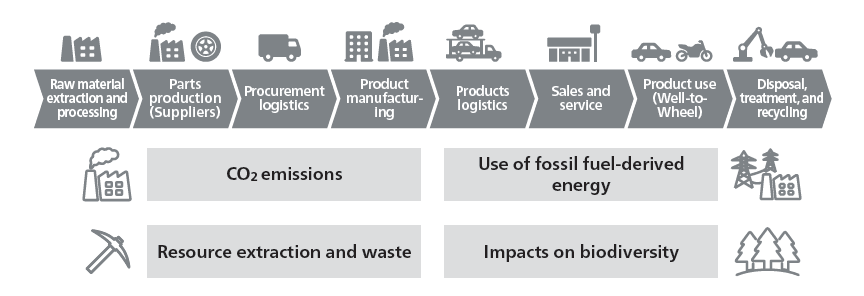
Honda, aiming for sustainable business practices, has set achieving a “Zero Environmental Impact Society”
as one of its company-wide priority issues. To comprehensively reduce interlinked environmental impacts,
Honda has established four materialities*1to guide its efforts.
- We select “Priority Issues” by comprehensively analyzing social issues from the perspective of sustainability, aligning them with Honda’s strategic direction, and defining the particularly focused issues for each priority issue as “materialities”.
Priority issue
Zero Environmental Impact Society
Materialities

Triple Action to ZERO
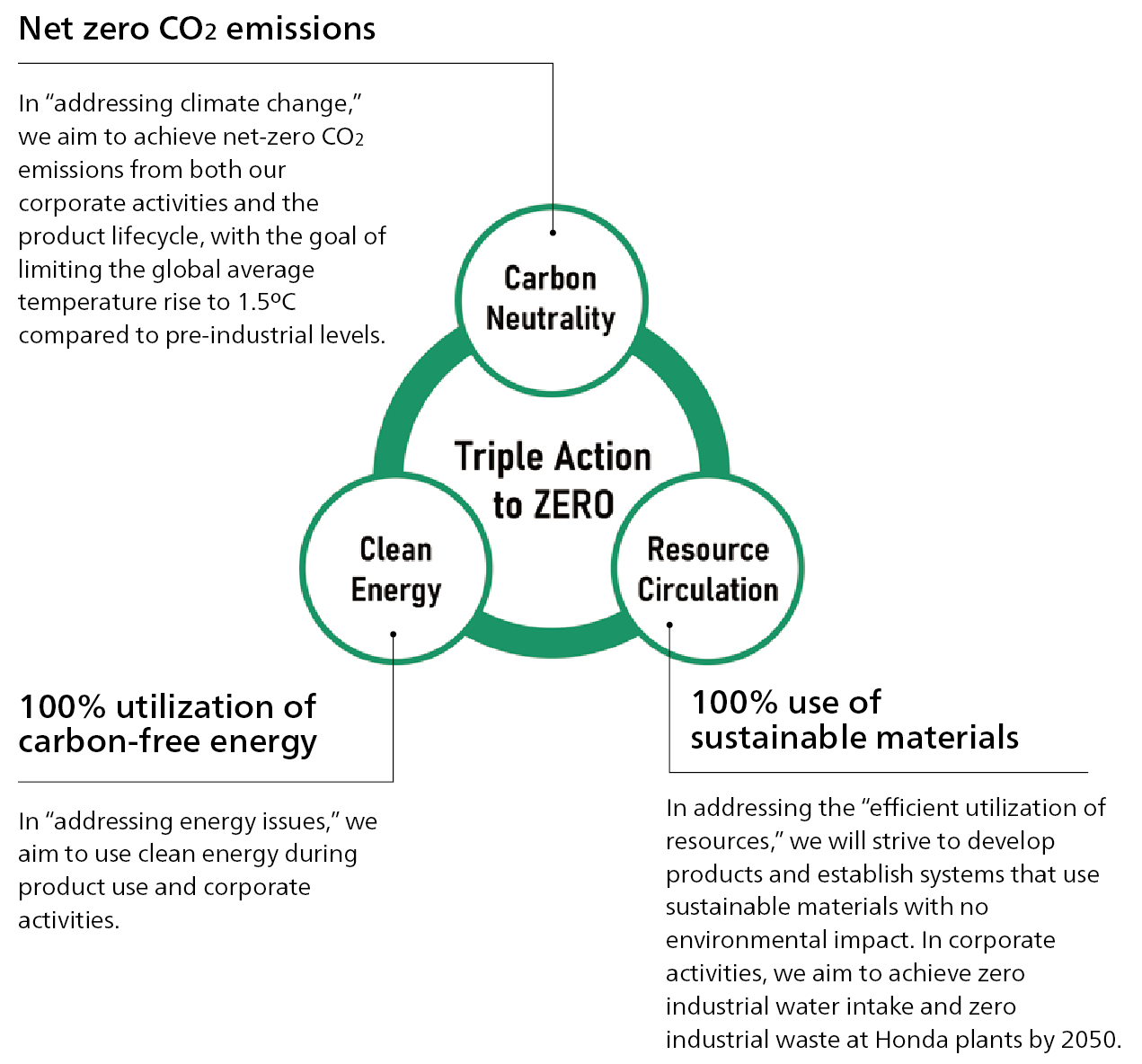
In our efforts to achieve a “Zero Environmental Impact Society,” we are working towards our vision by 2050 of net zero CO₂ emissions, 100% utilization of carbonfree energy, and 100% use of sustainable materials. These visions are encapsulated in the concept of “Triple Action to ZERO,” a concept that consolidates three key initiatives: “Carbon Neutrality,” “Clean Energy,” and “Resource Circulation”.
We position “Triple Action to ZERO” as the core concept guiding our efforts.
The three initiatives of “Triple Action to ZERO” are closely related and we aim to maximize synergistic benefits by considering their linkages. The “Triple Action to ZERO” initiatives are also linked to the international demand for preserving
biodiversity and fostering harmony with nature. In advancing these initiatives, we will consider “Nature-based Solutions*2” as well.
- Nature-based Solutions (NbS) nvolve advancing societal challenges while conserving and restoring natural ecosystems.
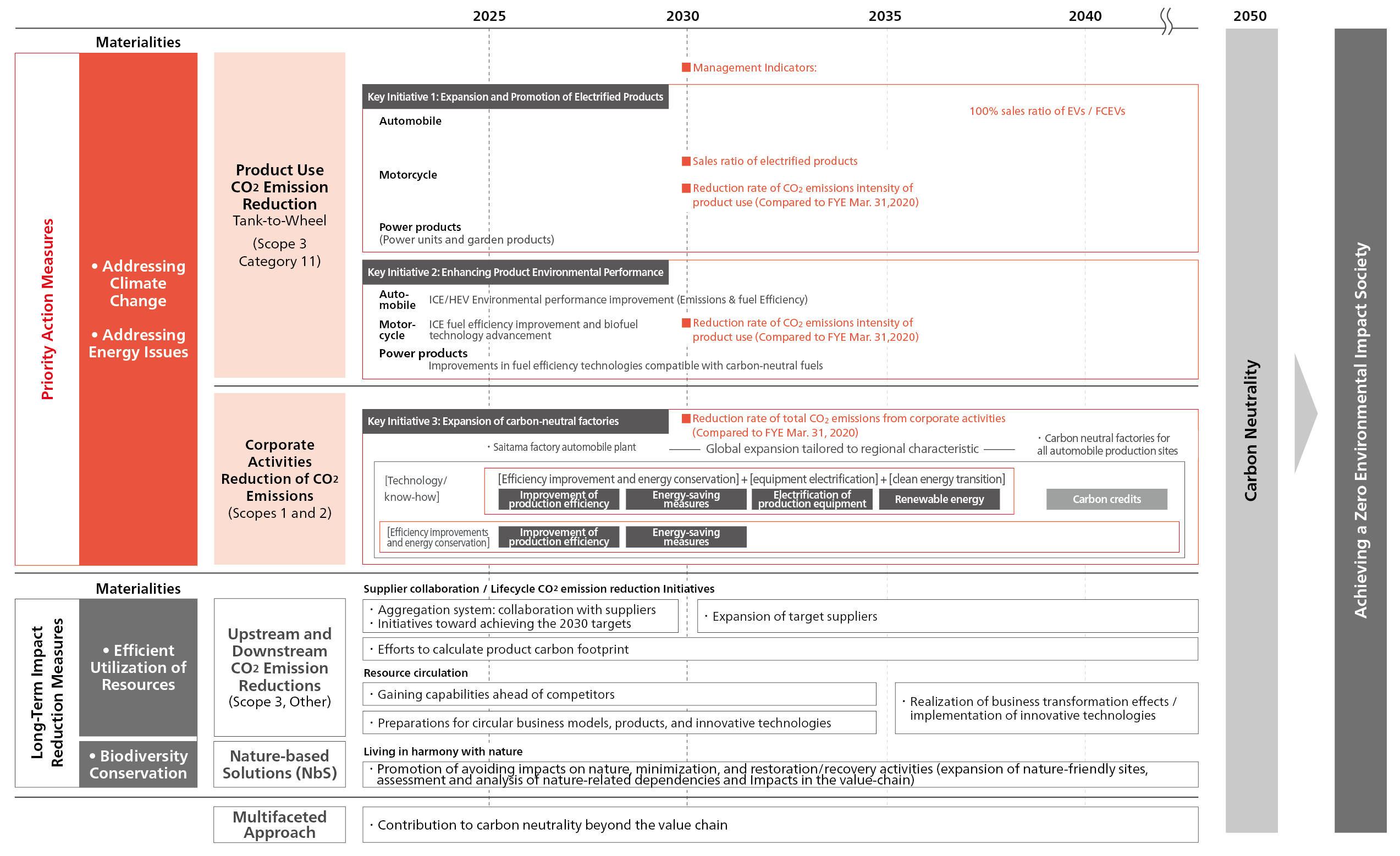
Key Initiatives and Milestones for Achieving Materiality
Our company aim for “carbon neutrality by 2050” across the entire product lifecycle, and is focusing on the four materialities and is prioritizing “addressing climate change” and “addressing energy issues.”
As priority actions, the Company is working on reducing CO₂emissions from product use and corporate activities, breaking these efforts down into more specific initiatives that the Company plans to implement as concrete actions. Specifically, CO₂ emissions are tracked for various product groups within each business segment, as well as for individual product factories and manufacturing equipment. This approach helps in quantifying CO₂ reduction amounts for each product and factory.
For long-term impact reduction measures related to the materiality of “efficient utilization of resources,” Honda is in the initial phase of preparing initiatives that may require business transformation beyond existing frameworks to achieve carbon neutrality, including efforts aimed at reducing CO₂ emissions in future upstream and downstream processes. We also recognize the importance of considering natural impacts, such as the materiality of “biodiversity conservation,” while advancing these initiatives. Therefore, Honda is aiming not only to achieving “carbon neutrality by 2050” but also to pursuing a long-term perspective toward realizing “a zero environmental impact society.”
Furthermore, to achieve carbon neutrality on a society-wide scale, Honda is taking on the challenge of multifaceted initiatives in addition to the electrification of mobility.
Achieving Carbon Neutrality by 2050
Honda supports the Paris Agreement*1 and aims to achieve carbon neutrality across all Honda products
and corporate activities by 2050, with the aim of realizing a society with zero environmental impact.
Roadmap Towards Carbon Neutrality by 2050
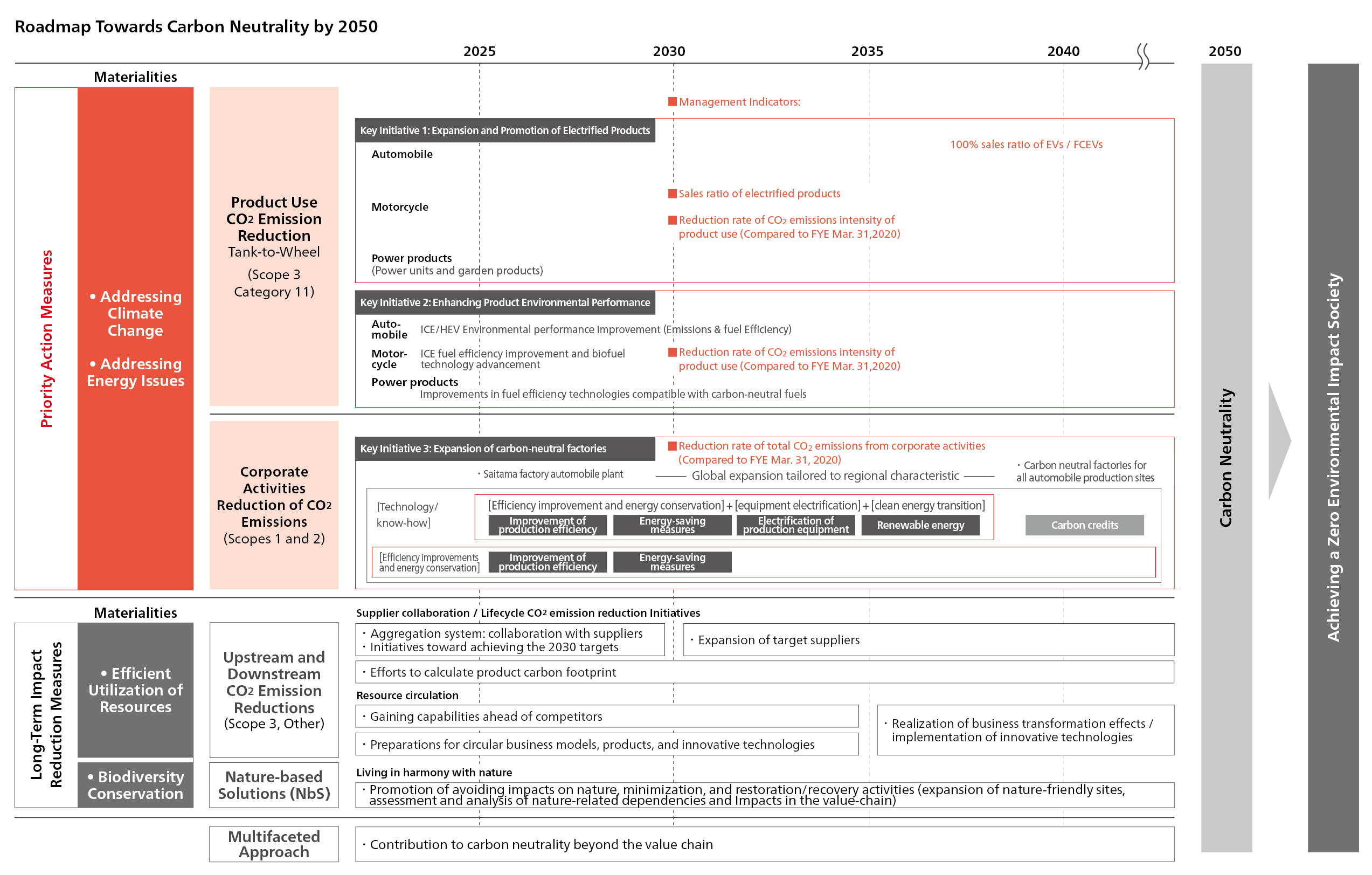
Among the four materialities, Honda is prioritizing and working on “addressing climate change” and “addressing energy issues” in pursuit of carbon neutrality.
As priority measures, we have set the reduction of CO₂ emissions from product use (Scope 3*2, Category 11*3) and from corporate activities (Scopes 1*4 and 2*5) as key initiatives, and subdivide them into more specific measures.zw Specifically, CO₂ emissions from individual product groups in each business area, as well as from each product plant and manufacturing equipment are aggregated to quantify the reduction of CO₂ emissions by product and by plant.
With respect to long-term measures for reducing environmental impact associated with the materiality of “efficient utilization of resources,” some require new initiatives beyond the existing frameworks. We are in the preparatory stage for the future reduction of CO₂ emissions throughout the product lifecycle from resource extraction (upstream) to disposal (downstream) processes. We also recognize the importance of advancing these initiatives while considering impacts on nature, including the materiality of “biodiversity conservation.” Honda will continue initiatives not only toward “carbon neutrality by 2050” but also toward the future with a long-term perspective for the “realizing a zero environmental impact society.”
Furthermore, to realize carbon neutrality across society as a whole, we are taking on challenges through a multifaceted approach in addition to the electrification of mobility.
- In the Paris Agreement, the approach of reducing CO₂ emissions is set forth with the aim of achieving the goal of limiting the rise in the Earth’s average temperature to 1.5°C compared to pre-industrial levels.
- Scope 3: Other indirect GHG emissions not included in Scope 1 and Scope 2, as defined by the GHG Protocol.
- Category 11: Use of motorcycles, automobiles, power products, and aircraft sold by Honda
- Scope 1: Direct GHG emissions from corporate activities, as defined by the GHG Protocol (e.g., combustion of fuel oil at a manufacturing plant, emissions from work vehicles and company cars). In Japan, Honda uses the emission factor based on the Act on Promotion of Global Warming Countermeasures and in each region except Japan, emission factors from the 2006 IPCC Guidelines for National GHG Inventories. Global Warming Potential (GWP) is based on the IPCC’s Fifth Assessment Report.
- Scope 2: Indirect GHG emissions from the use of energy in corporate activities , as defined by the GHG Protocol (e.g., electrical energy used by a manufacturing plant or office). Honda adopts the GHG Protocol’s standard market-based method. In Japan, Honda uses adjusted emission factors by electric utility based on the Act on Promotion of Global Warming Countermeasures. In each region except Japan, Honda uses emission factors by electricity utility or the latest regional emission factors, and if these are unavailable, national emission factors from the IEA’s CO2 Emissions from Fuel Combustion.