Development of All-Solid-State Batteries for Next-Generation Vehicles
To achieve carbon neutrality and expand the possibilities of electrified mobility, Honda took on the challenge of developing all-solid-state batteries for automotive applications that combine high energy density with low cost.
While building a pilot production line designed for mass production, Honda also developed battery cell specifications and established its own all-solid-state cell design compatible with a low-cost manufacturing process.
To safely harness the extremely challenging lithium-metal anode, the team established the required “electrochemical reaction,” “cell structure,” and “manufacturing process” technologies, achieving a high level of balance across capacity, mass producibility, durability, and safety.
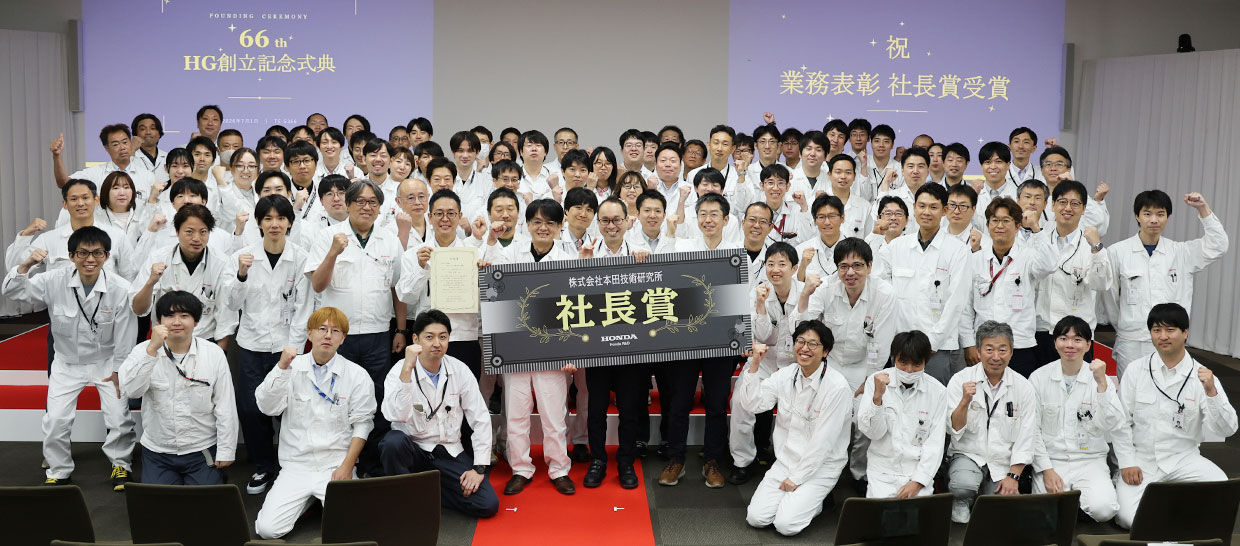
These achievements, which can extend EV driving range, create more cabin space, and reduce vehicle weight, earned the President’s Award as a key technology expected to strengthen product competitiveness in the electrification era.
- BACKSTORY
- Interview
From No Blueprint to a Battery We Can Manufacture.
─ Honda’s All-Solid-State Lithium-Metal Battery: Taking More Than a Decade of Research Toward Mass Production ─
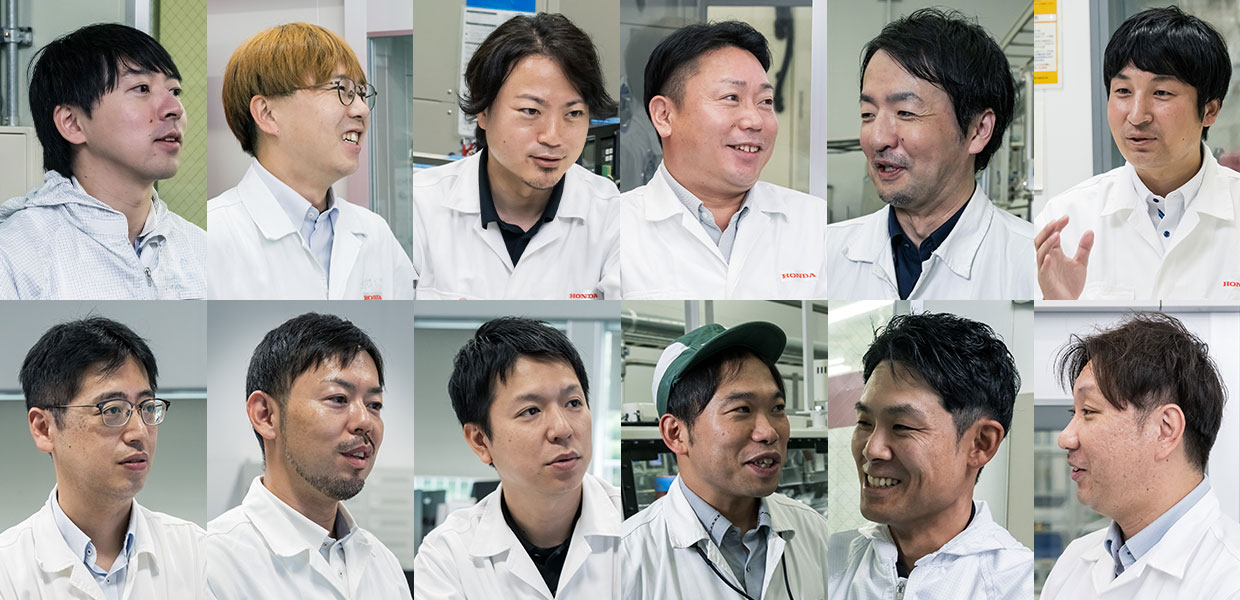
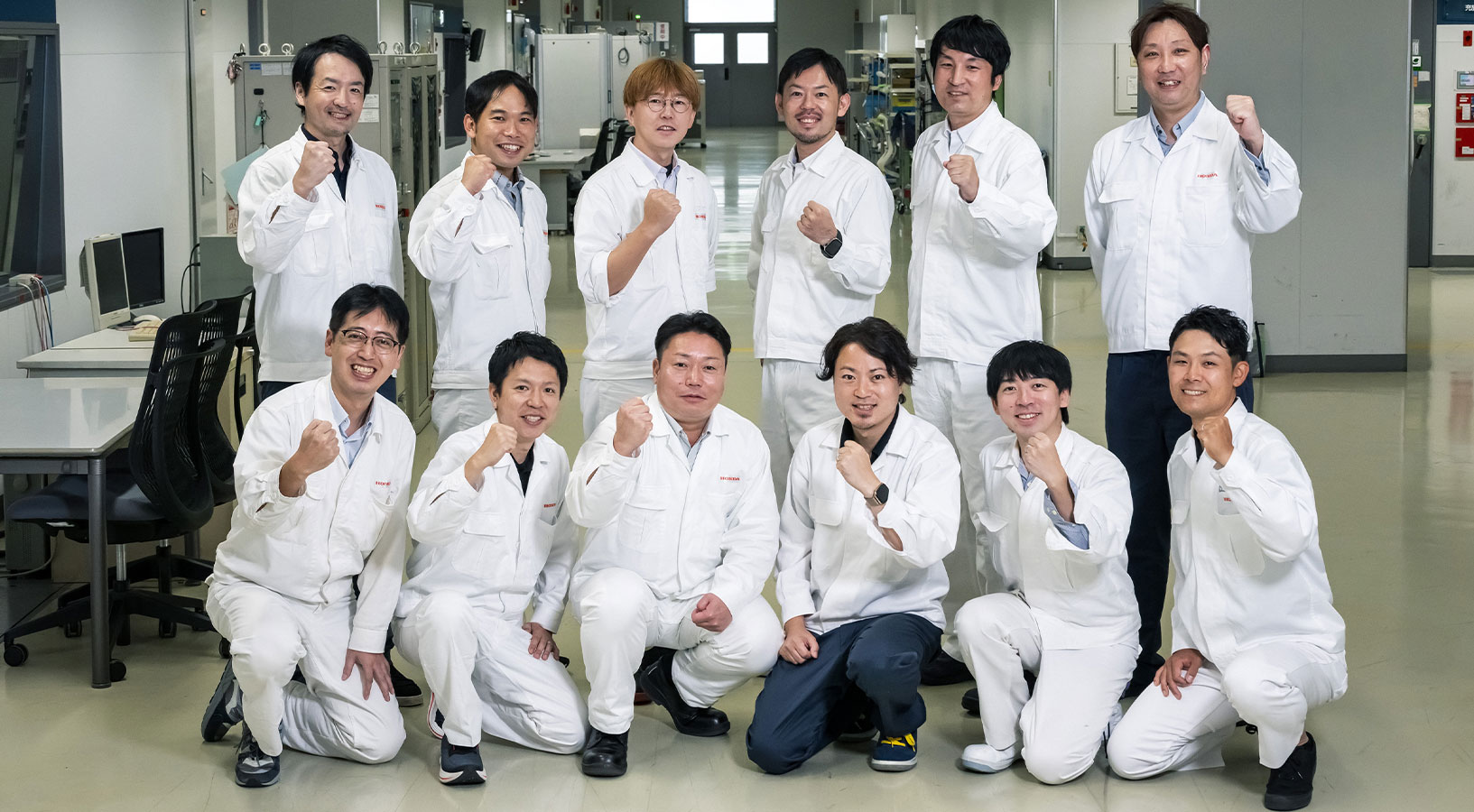
Interview participants: Maeyama, Kamaya, Usui, Kagei, Noji, Taniuchi, Toyoshima, Sasano, Watanabe, Taguchi, Nakajima, Tanaka
Extend driving range. Create more cabin space. Make the vehicle lighter.
An all-solid-state lithium-metal battery could dramatically change the value of BEVs. Honda has continued R&D to harness a high-energy-density lithium-metal anode and make it viable for future vehicles.
No one, however, had a blueprint for how to get there.
Good materials alone do not make a battery. Nor can a single working small cell be installed in a vehicle. Dozens of electrodes of consistent quality must be stacked, produced quickly and reliably, proven safe, and ultimately turned into a technology that can be mass-produced as an industrial product.
Some members had spent years researching all-solid-state batteries at Honda. Others joined from entirely different fields, including engines, chassis, and machining. Engineers with diverse expertise—materials, design, prototyping, production engineering, evaluation—came together around one ambitious goal.
The development of this all-solid-state lithium-metal battery earned the President’s Award. Tracing the path behind it reveals a team that kept creating its own answers precisely because no one else had them.
More Than a Decade of Knowledge, Turned into Development Speed.
─ All-Solid-State Battery Research That Began with Only a Handful of People
Around 2013, the Honda research effort that would evolve into today’s all-solid-state battery program was still a small team of just a few people.
Maeyama and Kamaya, who had been involved since those early days, started by setting up the experimental environment itself.
How should the battery be made? How should the materials be evaluated? How should the results be analyzed?
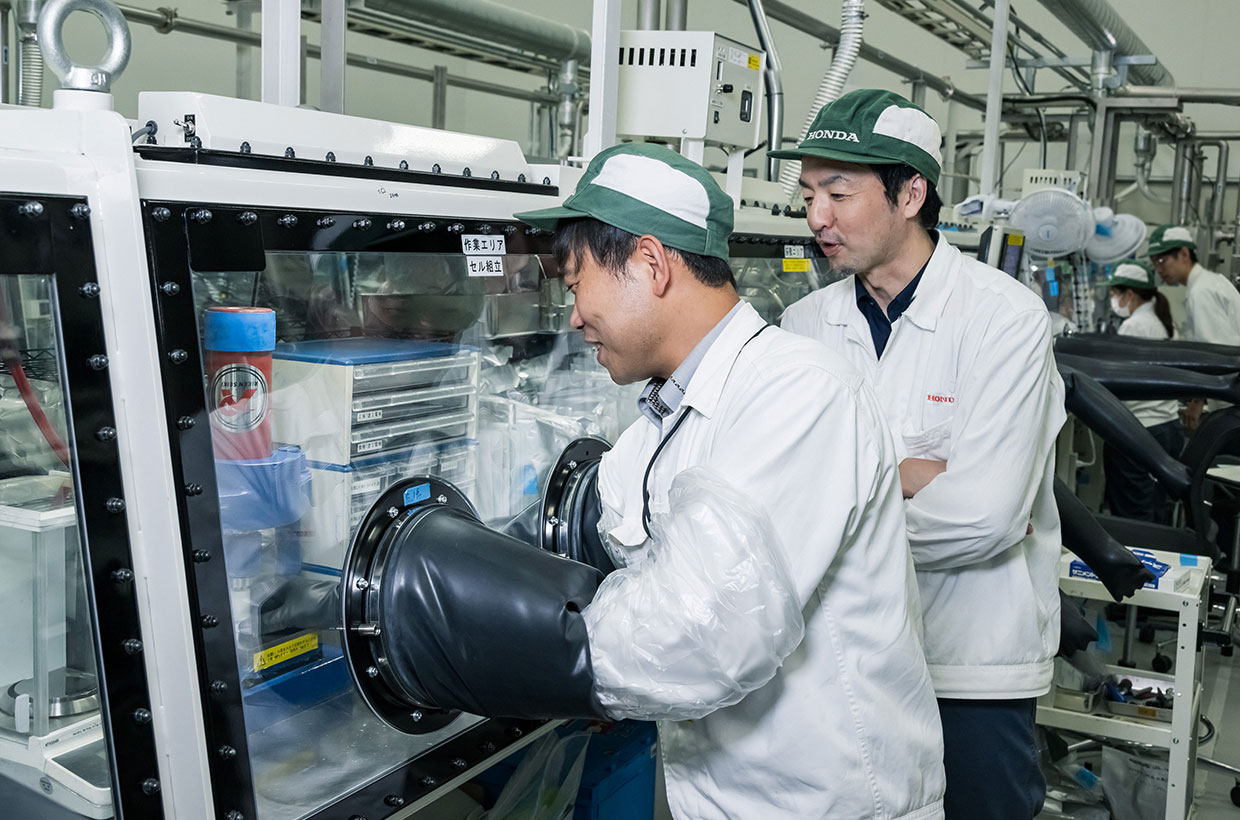
With little experimental equipment, they hand-built tiny prototypes resembling coin cells and tested methods one by one.
“Whether the result was good or bad, we didn’t know why. That’s where we started.”
Maeyama recalls those days.
Today, all-solid-state batteries are widely known as a next-generation battery technology. Back then, however, their value wasn't widely understood, even within the company.
Kamaya remembers explaining battery data and still being asked, “Why are we working on solid-state batteries?”
Still, they kept going.
What kept Maeyama going was the sense that, little by little, they were unquestionably moving forward.
“Results were hard to come by, but we knew more about something no one else in the world understood than anyone else did at that moment. Looking back six months or a year, there were always more things we could do. I think that’s what kept us going.”
For Kamaya, the colleagues pursuing the same research mattered just as much.
To turn the all-solid-state battery into something real.
Because colleagues were working toward the same goal, they could keep at the research for years.
That time would later prove enormously valuable.
When someone proposed, “Let’s try this approach” to a new problem, a long-serving member could immediately respond, “We tried that before. Here’s what happened.”
Instead of repeating the same tests, they could move directly to the next approach no one had tried.
The knowledge accumulated over more than a decade was more than a research history.
It had become a technology in itself—one that accelerated today’s development.
Turning a Difficult Material into Value for the Vehicle.
─ Mastering Lithium Metal
One defining feature of Honda’s all-solid-state battery is the use of lithium metal for the negative electrode.
The aim was straightforward.
Store more energy in a smaller battery.
With the same packaging space, extend driving range. With the same driving range, make the battery smaller, freeing up cabin space and reducing vehicle weight. This is the customer value Honda expects from its all-solid-state lithium-metal battery.
But lithium metal is difficult to handle.
As the battery charges and discharges, its shape changes as it expands and contracts. Lithium does not always deposit in the intended way.
Kamaya likens the difference from a graphite anode to having “assigned seats.”
In graphite, lithium ions can settle at defined sites. Lithium metal has no assigned seats. It can deposit freely, changing shape and potentially affecting durability and safety.
That is why controlling lithium metal is such a major challenge.
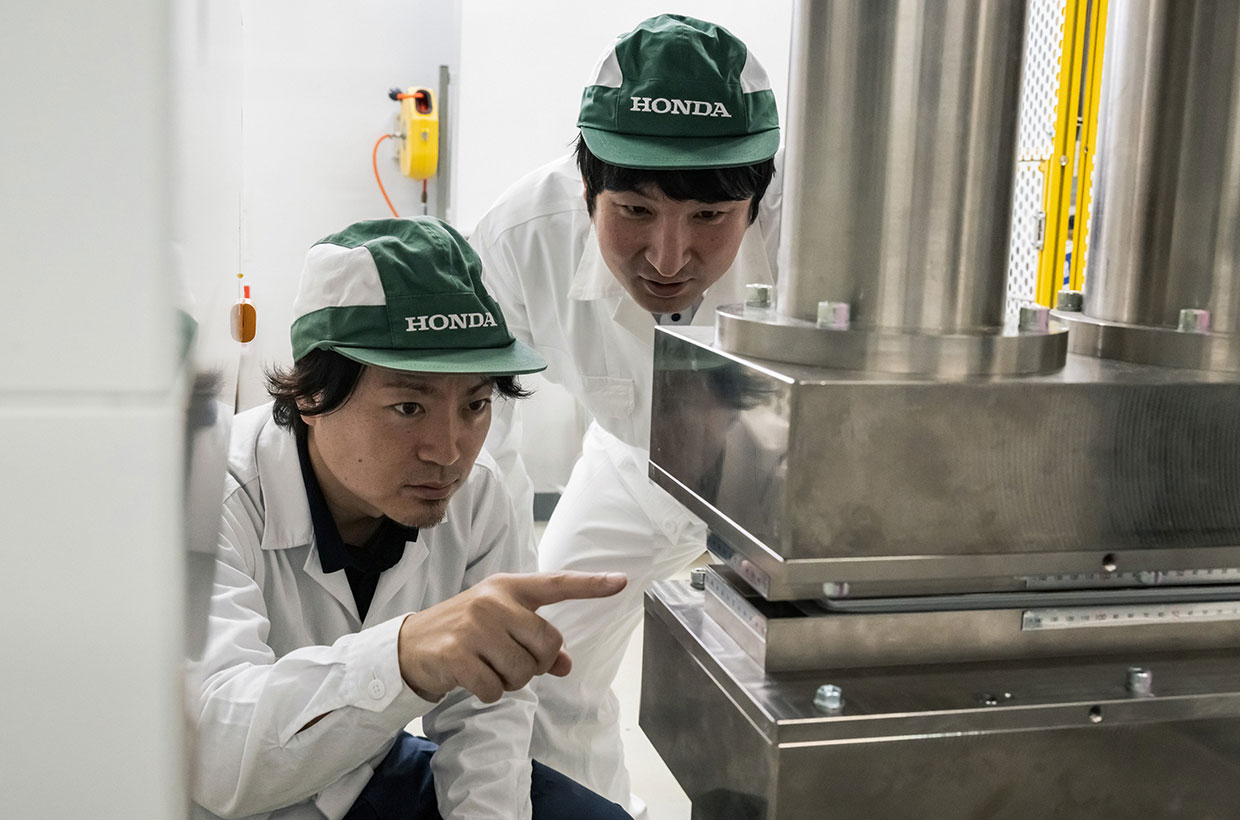
One technology that helps turn this “wild horse” into something viable for a vehicle is the restraint and cushioning technology developed by Usui.
Even as the battery expands, it needs to remain under the right pressure. But in a vehicle, that pressure-control mechanism cannot take up much space.
Usui describes the challenge this way.
“It’s like continuously supporting something that expands and contracts as if it were breathing, all within a confined space.”
No single existing material could do the job. The team had to combine multiple materials and structures to create a mechanism that was thin and light yet could maintain the required force.
This technology wasn't central to the program from the beginning.
“At first, people told me it was impossible. But we kept working on it little by little, and now it has become an essential technology for making this battery possible. I’m glad we didn’t stop.”
One more thing the team refused to change was its target for energy density.
Lowering the target would have made development easier.
But doing so would have undermined the very reason for developing an all-solid-state lithium-metal battery.
“I remember thinking many times, ‘Could they lower it just a little?’ But the target never changed.”
Materials researchers, structure designers, manufacturing engineers, evaluators—everyone was aiming at the same number.
Kagei explains:
“What matters to customers isn’t whether the battery is solid-state or liquid. It’s what value the battery creates in the vehicle. If it only delivers the same performance as today’s batteries, there is no point in doing all-solid-state.”
The goal was not simply to realize a difficult technology, but to create new vehicle value beyond that difficulty.
That standard was never lowered.
From One Successful Electrode to Repeatability at Scale.
─ Countless Prototypes and Tests, Toward a Battery That Can Be Manufactured
A fundamental difference exists between making one high-performance cell in the lab and manufacturing a battery as a product.
Noji drew a clear line between the two.
“In the lab, there are ways to make a cell with good performance. But that alone doesn’t make it a battery we can deliver to customers.”
Automotive batteries must be produced in large volumes, quickly, consistently, and with the same quality.
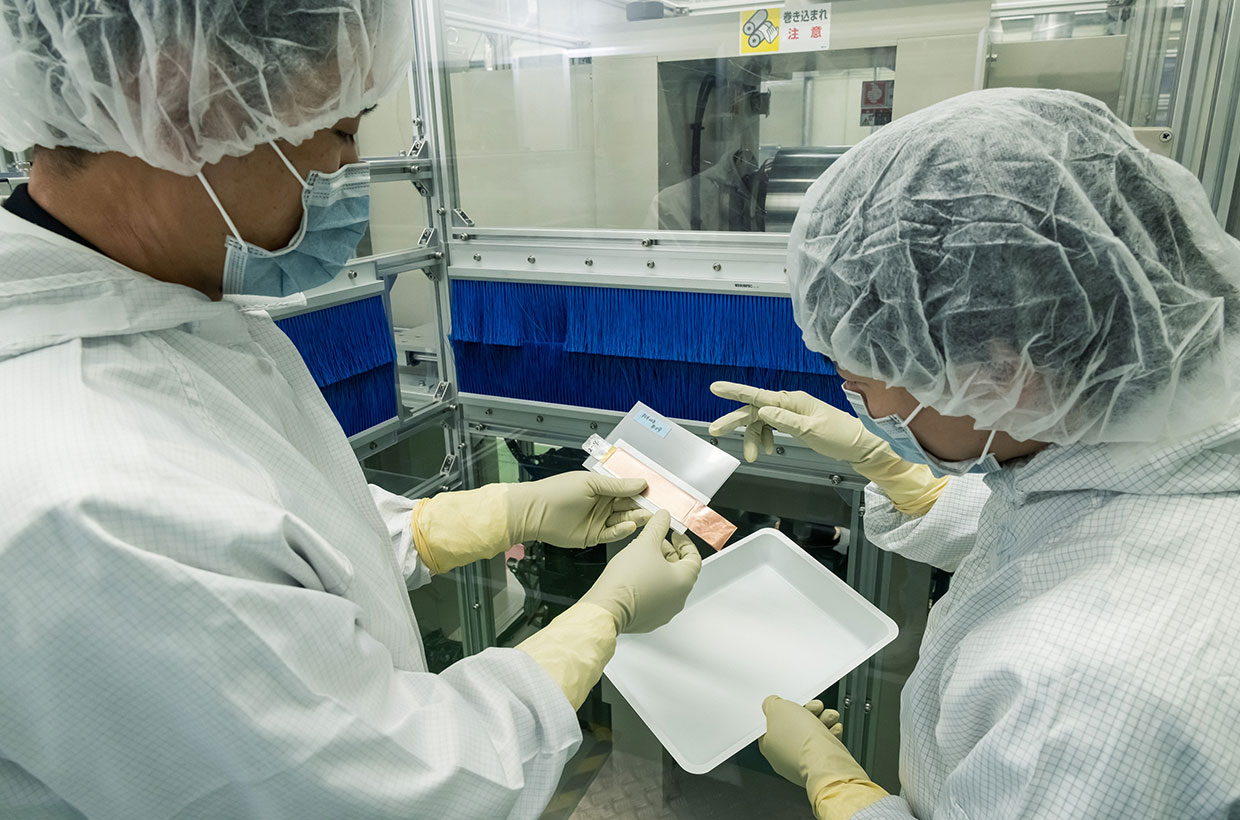
Honda therefore took on roll pressing.
Applying pressure while moving material continuously at high speed can improve productivity.
But in an all-solid-state battery, sufficient energy must be applied to create stable interfaces between solids.
Applying pressure slowly makes it easier to achieve the desired interface. But that makes it difficult to increase production speed.
Make it fast, while still achieving the intended performance.
Both had to be accomplished.
A battery isn't complete with a single electrode sheet.
Dozens of electrodes of the same quality must be stacked into one cell. Tiny variations from sheet to sheet can add up to performance differences across the whole battery.
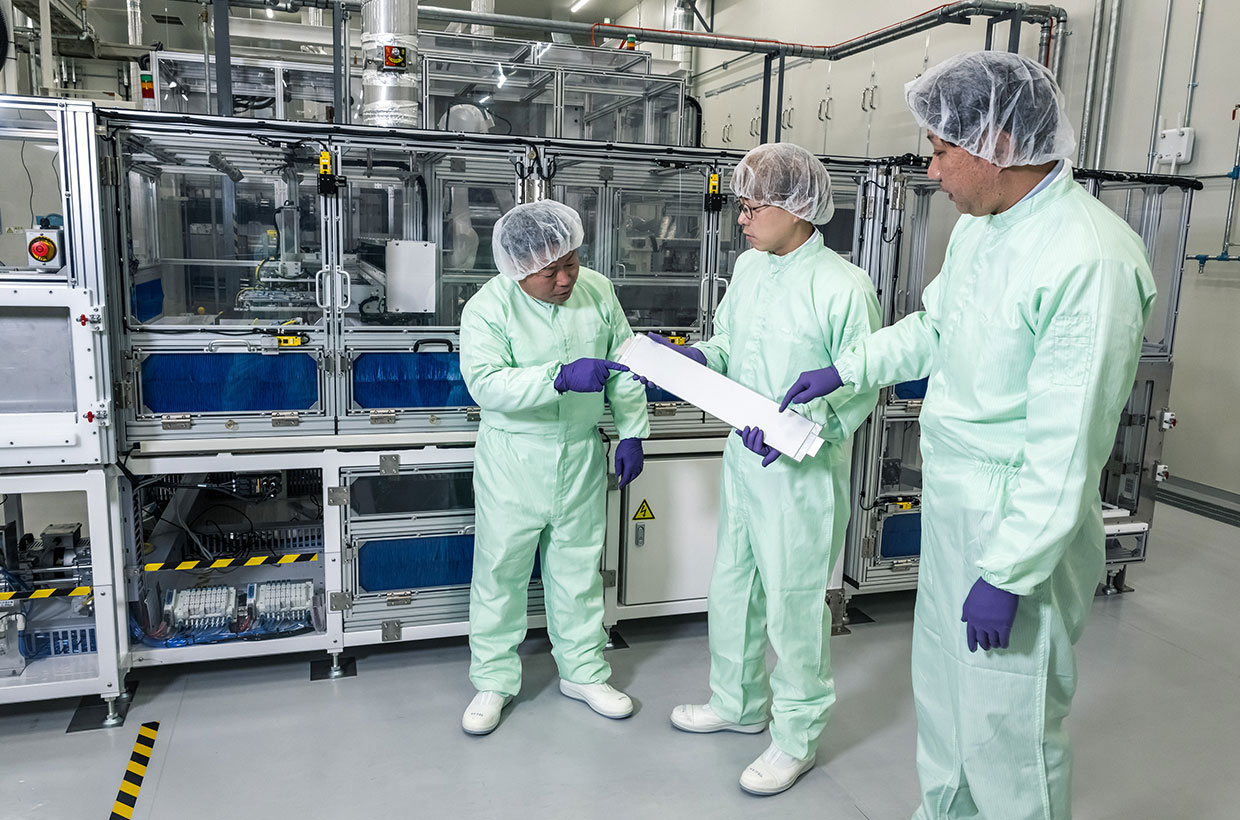
“Just because you can make one sheet doesn’t mean you’ve made a cell.”
Taniuchi says.
Tanaka also explains the challenge of stacking electrodes.
“Research often focuses on optimizing a single electrode. But an actual cell is made by stacking dozens of those electrodes together. Our focus has been on how to build a stable cell even when dozens of electrodes are stacked, while accounting for variations in each individual electrode.”
The challenge is to make something work not just as a single electrode, but with dozens stacked together. And it has to be reproduced at the same level of quality again and again—not just achieved once.
At the time, there was very little knowledge of how to produce and stack multiple all-solid-state battery electrodes with consistent quality.
The papers offered no answer either.
So they had no choice but to find out for themselves.
To develop just the stacking technology, the team evaluated roughly 150 specifications and built around 750 cells. About 600 of them did not perform as intended. Including other specification studies, the total number of cell prototypes ran into the thousands—and tens of thousands.
“Never before had I failed this many times.”
Toyoshima recalls.
They built something, and it didn’t work. They thought it worked, then couldn’t reproduce it the next time. Batteries are often compared to cooking.
Even with the same ingredients, the outcome changes depending on how you prepare them. The real challenge isn't making something taste good once, but reproducing the same result again and again.
Supporting that, Sasano and the prototype fabrication team relied on trial and error.
Their role was not simply to make whatever the researchers requested.
To make evaluation results comparable, they produced prototypes under the same conditions and to the same quality every time.
Sasano describes the R&D engineers as “our customers in prototyping.”
“I wanted us to be a kind of hub for R&D—getting test pieces into their hands as quickly as possible so they could move on to the next stage of development.”
That role was indispensable to the researchers, too.
An idea cannot be evaluated until it is made real.
And without evaluation, there is no way to reach the next answer.
Meanwhile, preparations for the pilot production line were moving ahead in parallel. Even while the team was still searching for answers in small cells, it also had to think about equipment and manufacturing methods for mass production.
They did not wait for research to finish before considering production.
R&D and manufacturing moved forward together.
Those constraints transformed the technology from something that could work once into something that could be made repeatedly.
Different Expertise, One Battery.
─ The Finish Line Is Delivery to the Customer
Today’s all-solid-state battery program brings together engineers from a wide range of backgrounds.
Taguchi came from chassis design.
Watanabe and Nakajima came from engine design.
Sasano came from machining.
Toyoshima brought experience in aluminum, die casting, and mass-production ramp-up.
Alongside them are engineers such as Maeyama and Kamaya, who have spent many years researching all-solid-state batteries. The team also includes people who came to Honda with battery experience from outside the company.
“Even when we share the same goal, our approaches are completely different.”
Watanabe says.
Materials specialists may believe, “This will give us the best performance.”
From the manufacturing side, the response may be, “We can’t make it consistently that way.”
Design engineers face constraints imposed by vehicle installation.
Even when everyone is aiming at the same goal, the right answer looks different from each field.
Those different answers must come together in a single battery.
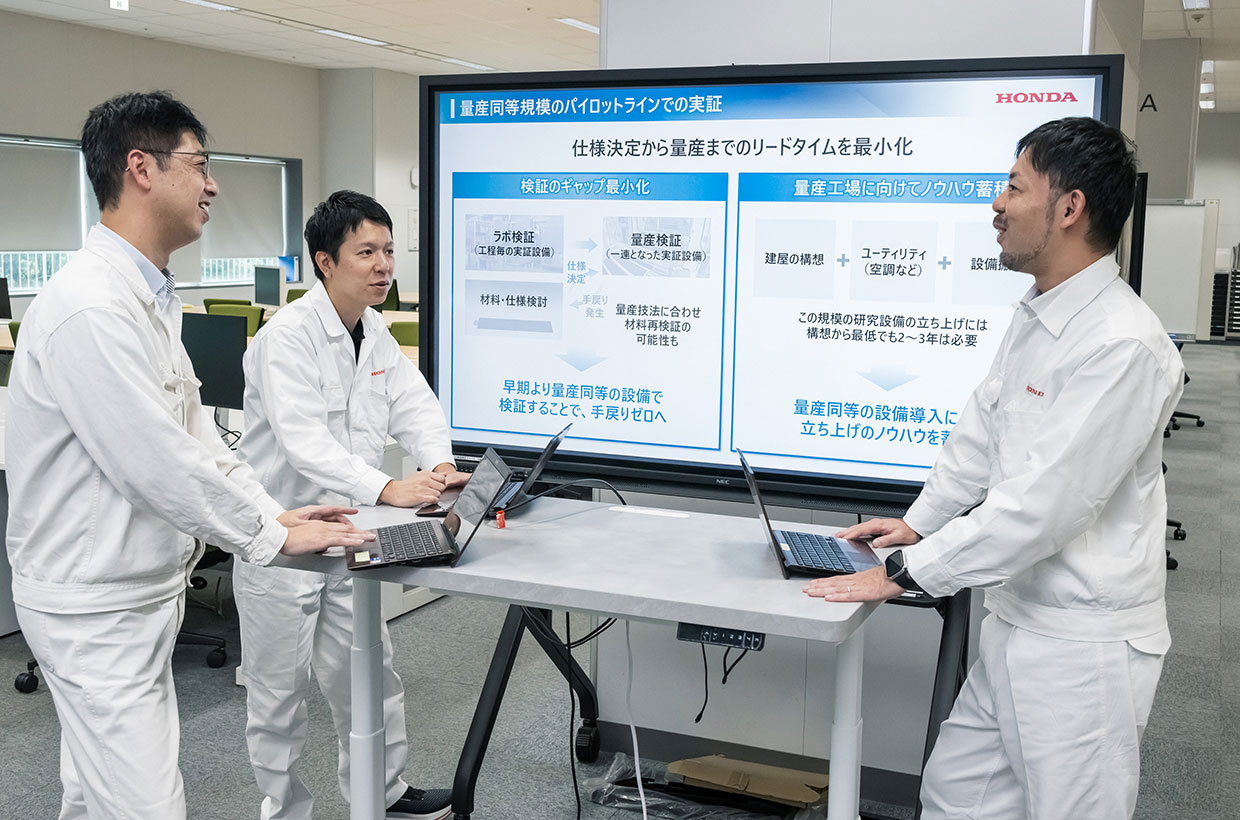
Nakajima and others created a “leader meeting” separate from the regular project meetings, where a small group of representatives from each area could talk frankly about technology.
They temporarily set aside organizational boundaries and spoke as equals.
Sometimes a meeting ended with nothing more than sharing frustrations.
But precisely because it was that kind of space, people would say things like, “I’ve dealt with something like this before,” or “What if we tried this?”
The required performance could not be reached by simply extending existing approaches.
At times, ideas from members who joined the project later opened up entirely new directions.
Taguchi recalls that “we came up with an enormous number of ideas.”
If one did not work, they thought of another.
But they did not change direction on impulse.
Why would the current approach fail? Why might the next one work?
Only after thinking that through did they move forward.
“We’re always asking whether we have the best reason for believing this is the right approach—and whether there might be an even better one. That’s why, even when we hit a dead end, another idea emerges.”
Watanabe describes the team’s approach that way.
Having the pilot production line already in place sometimes narrowed the team’s technical freedom. On the other hand, those very constraints forced them to imagine mass production and make technology choices with it in mind from the earliest stages.
“The product takes shape with manufacturing constraints reflected in it from the start. That means we are less likely to face major rework later.”
Watanabe sees that as an advantage.
Rather than progressing from research to production one after the other, the two move forward on the same timeline.
It is difficult. But it also shortens the distance to mass production.
On battery cell specification development, the team has cleared one major peak.
There is now clear confidence in the performance they set out to achieve.
The next step is to turn those results into batteries that can actually reach customers.
Next comes scaling up the pilot production line: producing large volumes of cells with consistent quality, making them work as modules, and solving the issues that only appear once they are installed in an actual vehicle.
Building on the cell-specification work, the team will tackle the remaining challenges of mass production and vehicle integration.
The goal is stable quality in continuous production—and a cost customers can realistically afford.
A gap remains between making a battery work in a laboratory and manufacturing the same battery at industrial scale.
The President’s Award marks a milestone, recognizing the team’s achievements in cell specification development and leading directly into the next challenge: delivering the battery to customers.
The words Honda included in the award materials capture the team’s mindset:
“Its difficulty is what makes it valuable. And that is exactly why we will see it through until we can deliver it.”
The research began with tiny cells built by hand.
Over time, experts in materials, design, prototyping, production engineering, evaluation, and more joined the effort.
Their experience and ways of thinking were different.
What they shared was a refusal to lower the goal simply because it was difficult, and a willingness to bring their expertise together to give form to answers that did not yet exist.
If no one knows the answer, create it ourselves.
If one discipline cannot solve it, bring different disciplines together.
If research alone is not enough, keep going until the technology can actually be manufactured.
So that Honda’s all-solid-state lithium-metal battery can truly reach customers.
Having cleared one major peak in battery cell specification development, the President’s Award-winning team is continuing its climb toward the next challenge: delivering the battery to customers.