Japanese Grand PrixRace Preview
Circuit Overview
Suzuka Circuit, located in the Ino district of Suzuka City in Mie Prefecture, was completed in autumn 1962. Officially named Suzuka International Racing Course in FIA documentation, it has hosted the Formula One Japanese Grand Prix almost every year since its debut in 1987, marking the circuit’s 25th anniversary. Since then, Suzuka has been the stage for many memorable races.
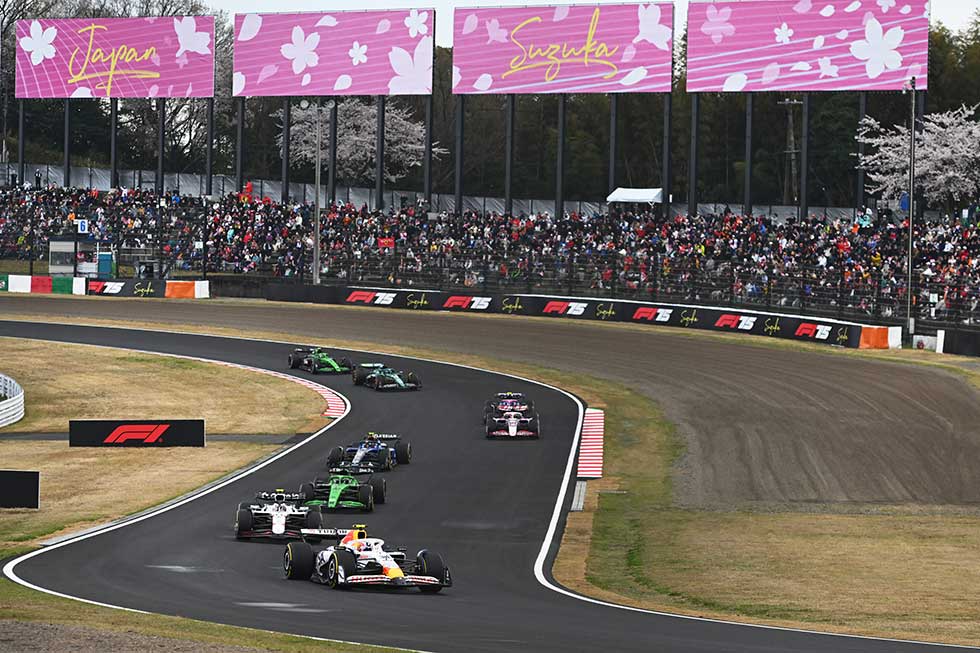
One of Suzuka’s defining features is its figure-eight layout, incorporating a crossover section. The first half of the lap (east course), run clockwise, features technical sequences such as the flowing S Curves and the challenging Degner Curves. After passing under the crossover, the second half (west course) runs counterclockwise and includes the hairpin followed by a series of high-speed turns. After the back straight over the crossover comes 130R, one of the most demanding turns on the circuit, where drivers must maintain very high speed through a fast left-hand turn.
The circuit also features significant elevation changes throughout the lap, adding to the challenge. With a total of 18 turns, Suzuka requires a smooth and consistent rhythm across both technical and high-speed sections. The differing characteristics of the first and second halves of the lap make it one of the most demanding circuits for drivers.
Many Formula One drivers who have raced at Suzuka cite it as one of their favorite circuits, often alongside Spa-Francorchamps (Belgium). Until the 1970s, the Nürburgring Nordschleife (Germany) was also a regular venue for Formula One Grands Prix. However, due to safety concerns, it was removed from the calendar, and today Suzuka and Spa remain among the few classic road courses that make full use of natural terrain.
The original lap length in 1987 was 5.859 km, but modifications were made over time for safety reasons, including updates to 130R and the chicane in 2003, resulting in the current layout. The lap length has remained 5.807 km since 2003, with the start line offset approximately 300 m toward Turn 1 from the control line. Each corner offers its own challenge, and Suzuka remains one of the most popular circuits among Formula One fans, widely regarded as a venue many would like to visit at least once.
Another distinctive feature of Suzuka Circuit is its integrated facilities, including an amusement park and hotel. At the time of its opening in 1962, a circuit with these facilities was rare on a global scale. Additional features such as a traffic education center and resort facilities have since been developed, further enhancing the venue.
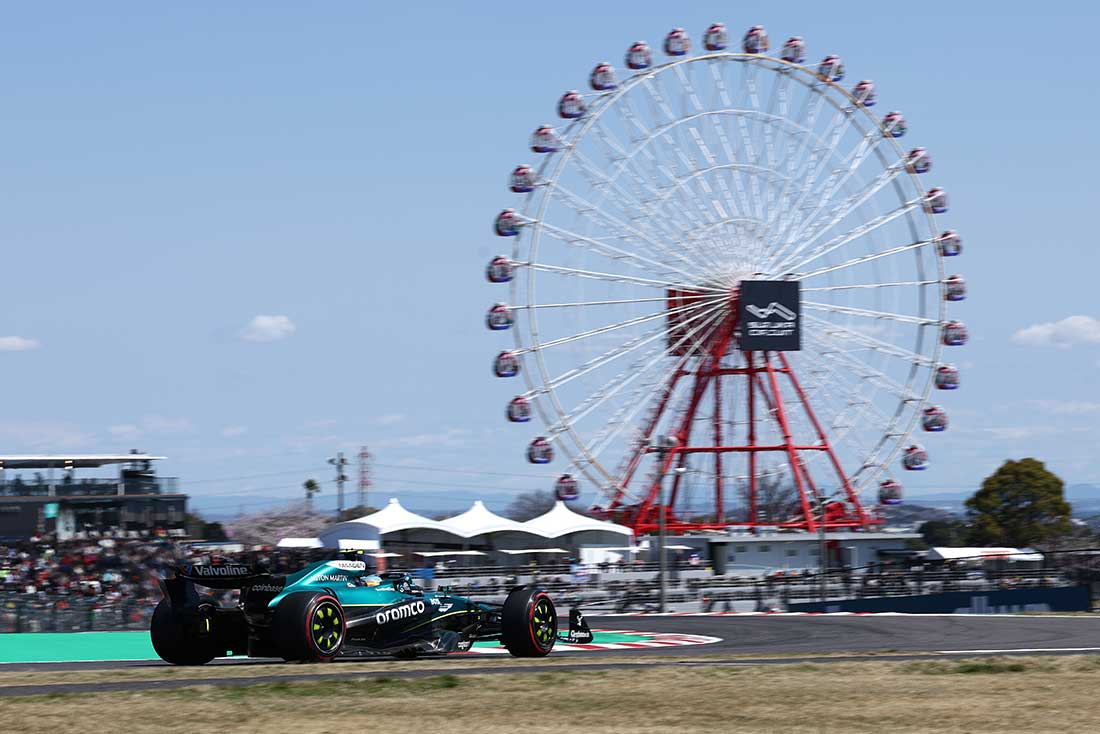
The large Ferris wheel located outside the final corner has become a symbol of Suzuka and is widely recognized through media coverage around the world.
History
Suzuka Circuit opened on September 20, 1962, as Japan’s first permanent racing circuit. Since hosting its first Formula One Japanese Grand Prix in 1987, the name SUZUKA has become widely recognized around the world.
In 1959, Honda founder Soichiro Honda purchased approximately 694,000 m² of land in Suzuka as a production site for the hit product, the Super Cub. Welfare facilities for employees were also planned, but the concept changed following his wish to build a racing circuit in Japan.
Initially, flat land within the site was considered, but he instead decided that farmland should be preserved and that the circuit should be developed on undeveloped woodland. As a result, a circuit was constructed by shaping the surrounding hills. By refining multiple layout proposals while making use of the natural terrain, the foundation of the current approximately 6 km course is said to have taken shape.
Five different layout proposals were developed before the circuit was completed. The initial design in August 1960 is said to have included as many as three crossover sections. A small team, including project leader Sadao Shiozaki, visited several circuits in Europe for reference. Dutch circuit designer John Hugenholtz of Zandvoort was then invited to Japan, and the final layout—measuring 6.00415 km—was established.
The opening event at Suzuka was an international motorcycle race held in November 1962. Six months later, in May 1963, the first Japanese Grand Prix for automobiles was staged at the circuit. Although it was not a Formula One race, it featured mainly domestic passenger cars and helped drive the rapid growth of four-wheel motorsport in Japan.
However, due to various circumstances, the Japanese Grand Prix moved to the newly built Fuji Speedway from 1966. Suzuka then focused on endurance racing and formula car events. In 1978, the Suzuka 8 Hours motorcycle endurance race was introduced, quickly gaining popularity and, at its peak, attracting around 150,000 spectators in a single day.
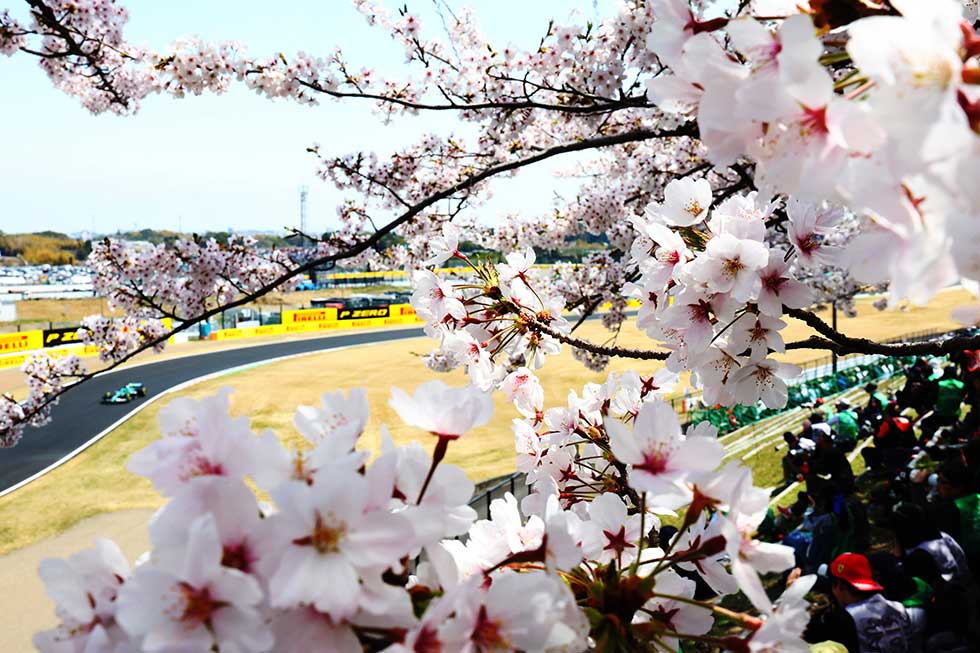
The first Formula One Japanese Grand Prix at Suzuka was held in 1987, marking the beginning of the F1 boom in Japan. That year saw the success of Honda-powered V6 turbo cars, the debut of Satoru Nakajima as Japan’s first full-time Formula One driver, and the start of full-season terrestrial television coverage in Japan. From 1987 to 2019, the Japanese Grand Prix was typically held late in the season and often served as the stage where the championship was decided, contributing to Suzuka’s reputation for dramatic races. Since 2024, the event has been held in spring, with cherry blossoms becoming a distinctive feature of the race.
Japanese drivers have also delivered notable performances at their home Grand Prix. In the inaugural 1987 race, Satoru Nakajima (Lotus Honda) finished sixth. In 1990, Aguri Suzuki (Lola Lamborghini) achieved Japan’s first Formula One podium with a third-place finish. In 2012, Kamui Kobayashi (Sauber Ferrari) finished third, returning a Japanese driver to the podium at Suzuka.
The most successful driver at Suzuka is Michael Schumacher, with six victories (1995, 1997, 2000, 2001, 2002, 2004). He is followed by Sebastian Vettel (2009, 2010, 2012, 2013), Lewis Hamilton (2014, 2015, 2017, 2018), and Max Verstappen (2022–2025), each with four wins.
Among constructors, Red Bull leads with eight victories (2009, 2010, 2012, 2013, 2022–2025). Ferrari (1987, 1997, 2000–2004) and McLaren (1988, 1991, 1993, 1998, 1999, 2005, 2011) follow with seven wins each, while Mercedes (2014–2019) has six.
What to watch
The Japanese Grand Prix marks the third round of the season under the new regulations. While teams are still working to understand the behavior of the new cars, Suzuka—known as a circuit that tests overall car performance—will provide a clear indication of each package’s potential.
Attention will focus on how the new cars perform across Suzuka’s mix of technical and high-speed sections, as well as how drivers adapt to the demands of the circuit. Comparisons with previous qualifying and lap times will also provide useful reference points in evaluating the performance of the new regulations.
This year marks the 36th Formula One Japanese Grand Prix at Suzuka. Round 3 of the season at Suzuka is expected to provide an early indication of the competitive order. With Rounds 4 and 5 in Bahrain and Saudi Arabia canceled, there will be a one-month gap in April, making this race an important point at which teams may take different strategic approaches.
Suzuka’s challenging layout, combined with strong support from Japanese fans, makes it a race many drivers look forward to. The heightened motivation often leads to a different dynamic compared to other Grands Prix. As in recent years, the event coincides with the cherry blossom season, adding to the atmosphere.
With the new regulations continuing to influence both car performance and race execution, the 2026 season remains difficult to predict. At a circuit with a long history such as Suzuka, fans around the world will be watching closely to compare performances and see how the competition evolves.
Course Data
【Japanese Grand Prix – Suzuka (Suzuka Circuit)】
Lap length: 5.807 km
[Lap Record]
1 min 30.965s — 229.815 km/h
Kimi Antonelli (Mercedes), 2025
[Lap Record with Honda engine/PU]
1 min 31.041s — 229.624 km/h
Max Verstappen (Red Bull Honda RBPT), 2025
[Fastest Qualifying Lap Record]
1 min 26.983s — 240.336 km/h
Max Verstappen (Red Bull Honda RBPT), 2025
(qualifying not classified as official lap record)