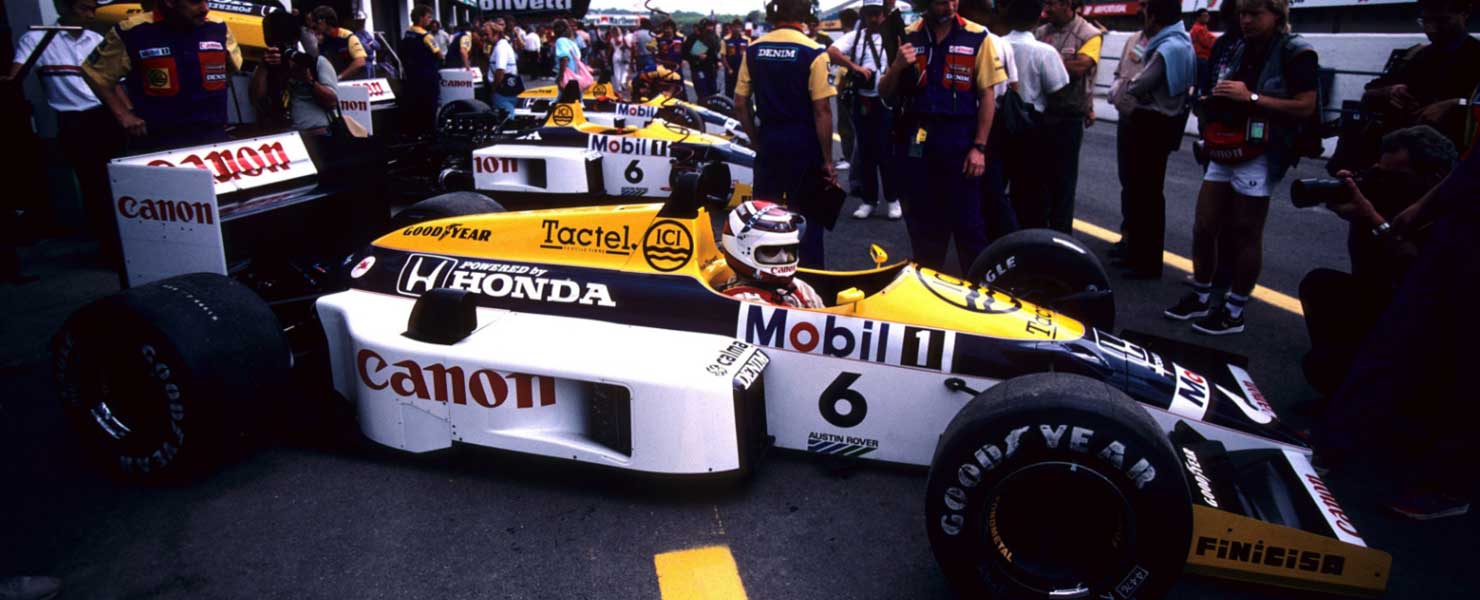
By 1986, Honda’s second F1™ era had entered its fourth season,
and the company had overcome the reliability issues that marked its early years to produce
what many regarded as the strongest engine on the grid.
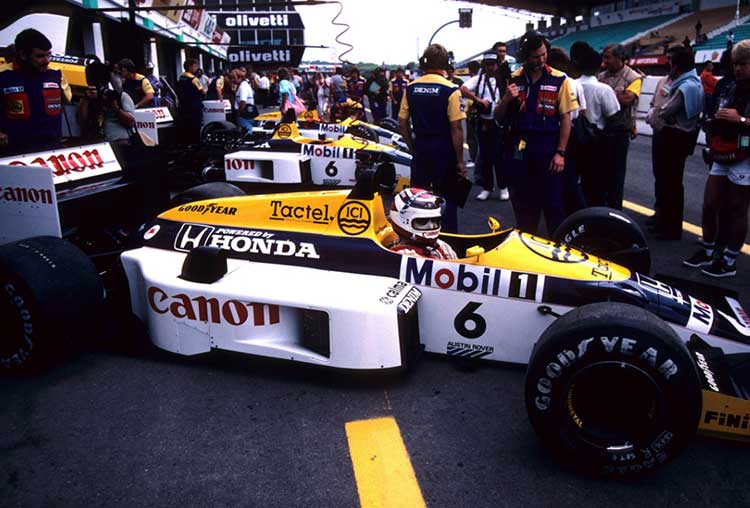
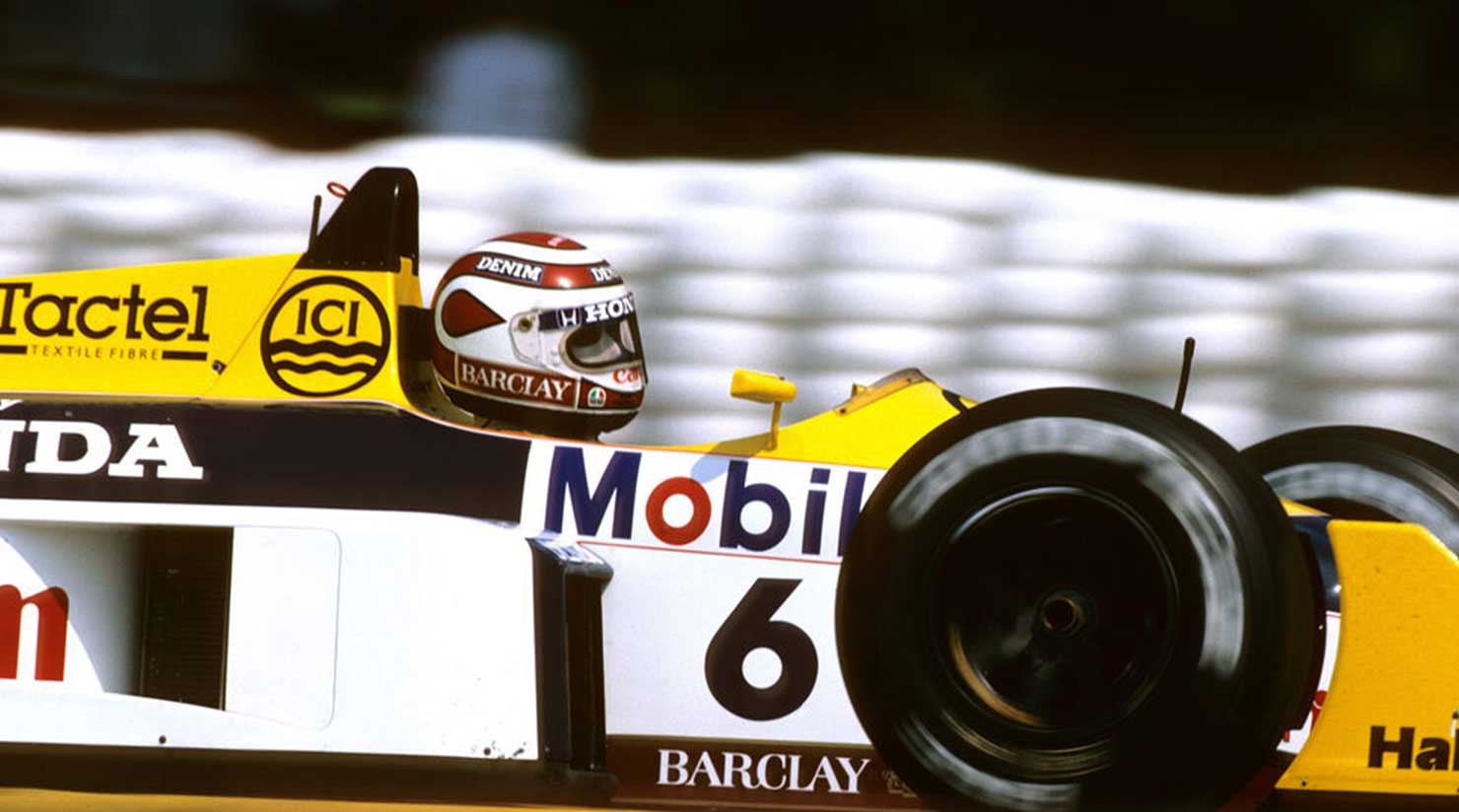
That year, former World Champion Piquet joined Williams,
where he partnered the increasingly rapid Nigel Mansell.
Together they helped Honda secure its first Constructors’ Championship.
However, with victories divided between the two drivers, neither was able to claim the Drivers’ title.
The long-awaited championship double arrived in 1987.
While Williams successfully defended the Constructors’ Championship,
Piquet captured his third World Championship through a characteristically consistent campaign
that included three victories and seven second-place finishes.
Having already won titles with Brabham in 1981 and 1983,
Piquet’s approach differed from that of many of his rivals. Rather than pursuing victory at all costs,
he favored a calculated and intelligent style, carefully managing races and consistently accumulating points.
He was also highly regarded for his technical feedback and ability to develop a car. Prioritizing stability and reliability,
Piquet built his success on consistency
and an exceptional ability to deliver results when it mattered most.
His third championship, achieved alongside Honda, perfectly reflected that philosophy.
Despite teammate Mansell winning six races,
Piquet’s consistency ultimately prevailed as he secured the title.
Profile
- Name
- Nelson Piquet Souto Maior
- Team
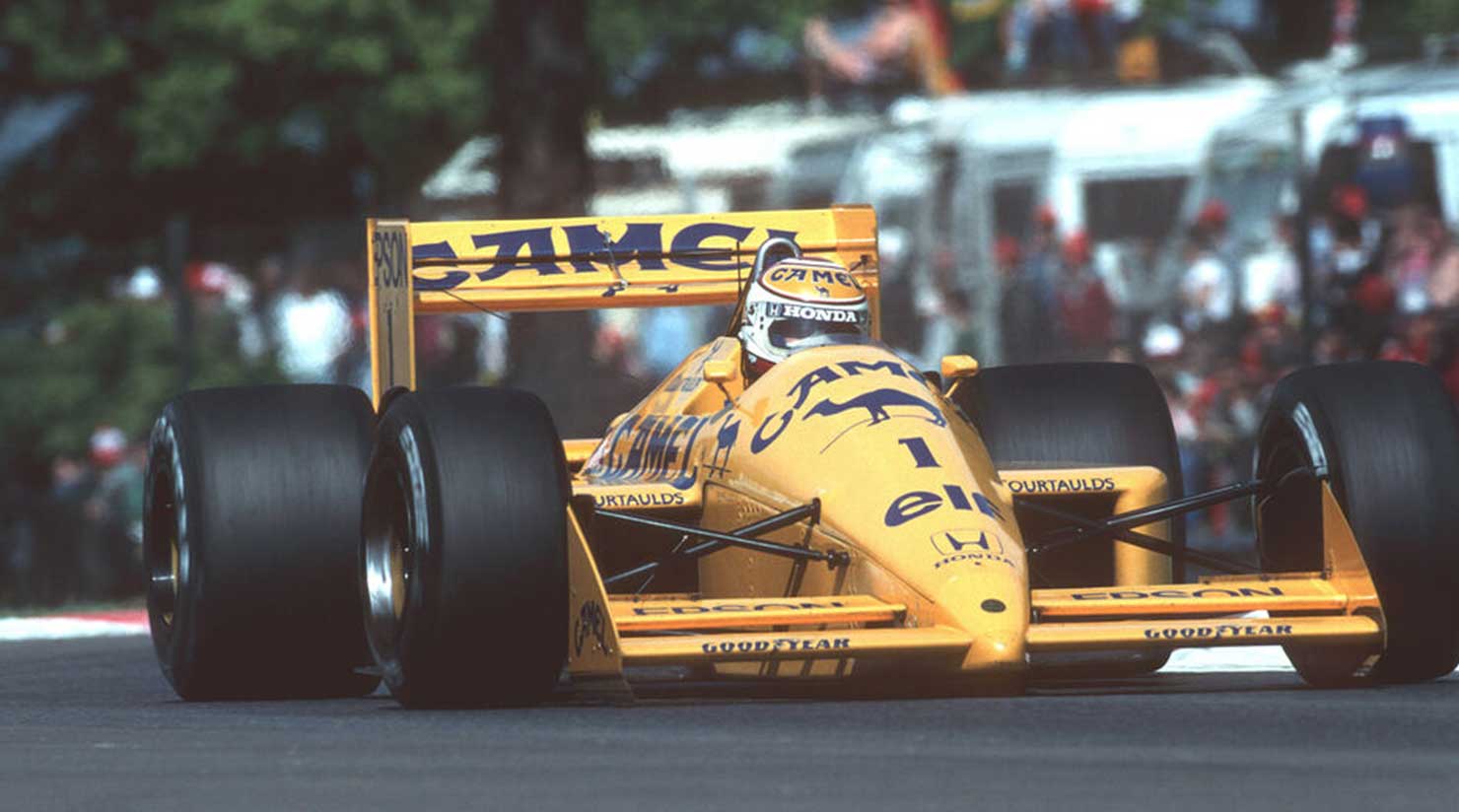
- Canon Williams Honda Team(1986-1987)
Camel Team Lotus Honda(1988)
- Nationality
- Brazil
- Birth date
- August 17, 1952
Career highlights
- 1977
- 3rd, European Formula 3 Championship
- 1978
- NC, FIA Formula One World Championship (Ensign-Ford, McLaren-Ford, Brabham-Alfa Romeo)
- 1979
- 15th, FIA Formula One World Championship (Brabham-Alfa Romeo, Brabham-Ford)
- 1980
- Runner-up, FIA Formula One World Championship (Brabham-Ford)
- 1981
- FIA Formula One World Champion (Brabham-Ford)
- 1982
- 11th, FIA Formula One World Championship (Brabham-Ford, Brabham-BMW)
- 1983
- FIA Formula One World Champion (Brabham-BMW)
- 1984
- 5th, FIA Formula One World Championship (Brabham-BMW)
- 1985
- 8th, FIA Formula One World Championship (Brabham-BMW)
- 1986
- 3rd, FIA Formula One World Championship (Williams-Honda)
- 1987
- FIA Formula One World Champion (Williams-Honda)
- 1988
- 6th, FIA Formula One World Championship (Lotus-Honda)
- 1989
- 8th, FIA Formula One World Championship (Lotus-Judd)
- 1990
- 3rd, FIA Formula One World Championship (Benetton-Ford)
- 1991
- 6th, FIA Formula One World Championship (Benetton-Ford)
Career
Born in Rio de Janeiro, Brazil, in 1952, Nelson Piquet began karting at the age of 14. He won the Brazilian Kart Championship in 1971 and successfully defended the title the following year.
In 1976, he captured the Brazilian Formula Vee championship before moving to Europe in 1977 to compete in the European Formula Three Championship. The move was reportedly supported by fellow Brazilian World Champion Emerson Fittipaldi. Although Piquet did not contest the full season, he won two races and finished third in the championship standings.
Piquet made his F1 debut at the 1978 German Grand Prix with Ensign. Although he retired from the race, his performance impressed Brabham team owner Bernie Ecclestone, who gave him an opportunity to drive for Brabham at the season-ending Canadian Grand Prix. That appearance secured him a full-time seat for 1979.
Despite being a rookie at Brabham, Piquet immediately demonstrated his speed. He qualified third at both the Belgian and British Grands Prix and quickly established himself as one of the sport’s most promising young talents. His first points came with a fourth-place finish at the Dutch Grand Prix.
In 1980, Piquet inherited the role of team leader following Niki Lauda’s surprise retirement during the previous season. Brabham switched to the highly competitive Cosworth DFV engine, and Piquet’s talent flourished. He became a championship contender, claiming his first F1 victory at the United States West Grand Prix in dominant fashion from pole position. Consistent results throughout the season kept him firmly in title contention. Although a costly retirement late in the year left him second in the championship, he scored points in 10 of the 14 races and reached the podium six times, including three victories.
Piquet entered 1981 determined to secure the championship that had narrowly escaped him. Combining race wins with consistent points finishes, he remained in contention throughout the season and ultimately overturned a one-point deficit at the final race in Las Vegas to become World Champion for the first time.
Brabham adopted BMW turbo power in 1982 as F1 entered the turbo era, but the transition proved difficult. The team improved significantly in 1983, and despite appearing to lose ground to rivals during much of the season, Piquet mounted a late charge with consecutive victories to secure his second World Championship.
Piquet remained with Brabham for the following seasons, but the team’s competitiveness gradually declined relative to its rivals. Although he achieved a personal-best nine pole positions in 1984, he converted only two into victories. In 1985 he managed just two podium finishes and decided it was time for a change.
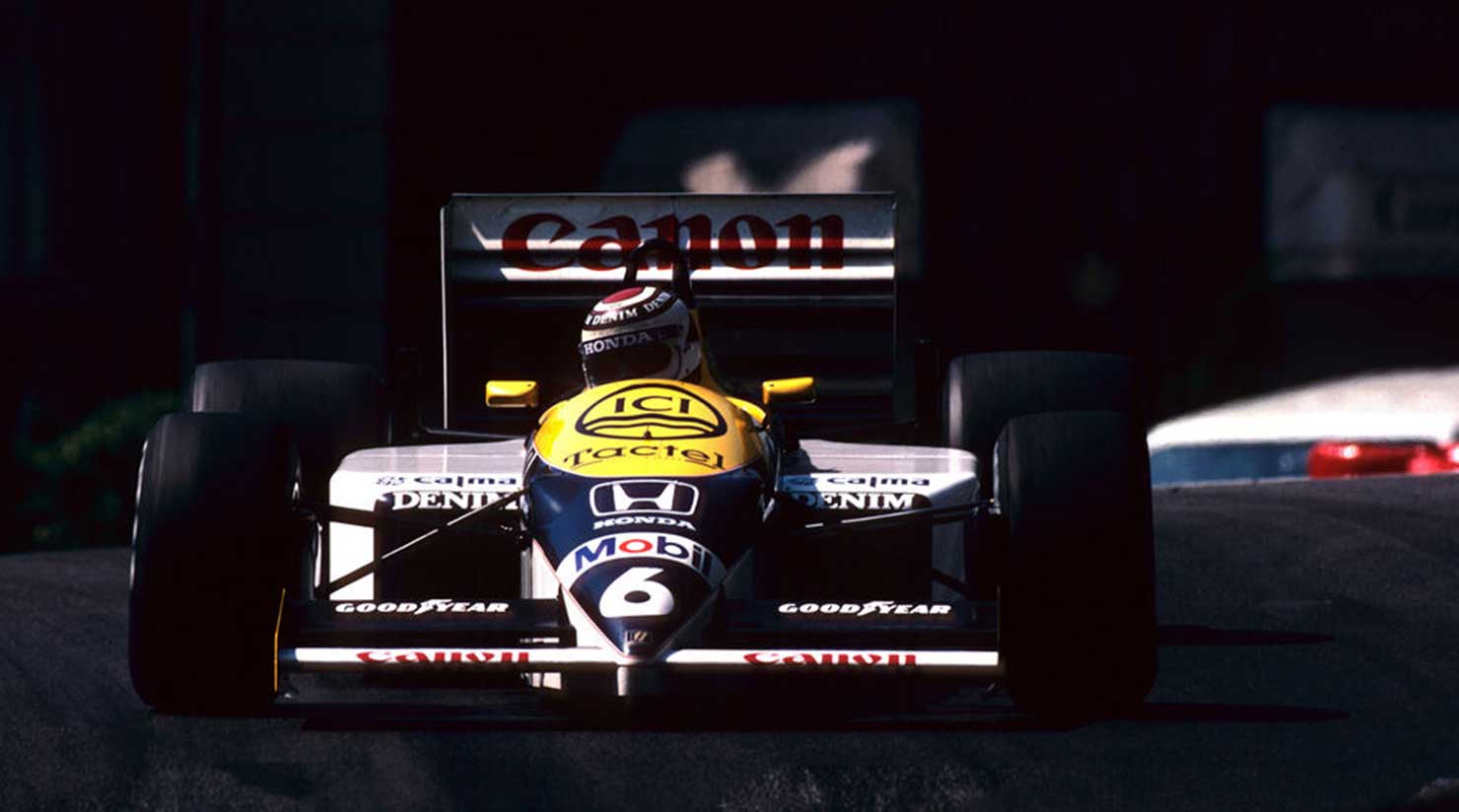
In 1986, Piquet joined Williams, which was powered by Honda’s increasingly dominant turbo engine. Honda strongly supported the signing of the experienced World Champion as it pursued its first championship titles. However, the season was overshadowed by a serious road accident involving team founder Frank Williams shortly before the opening race, creating significant changes within the organization. Tensions emerged between Mansell, Britain’s rising star and recent race winner, and Piquet, the established World Champion backed by Honda. The FW11 was exceptionally competitive, and Williams won nine of the season’s 16 races. Yet with Piquet claiming four victories and Mansell five, the two drivers effectively took points from one another, allowing the Drivers’ Championship to slip away despite securing the Constructors’ title.
The following year, Williams Honda became the benchmark of F1. Piquet demonstrated the consistency that had defined his career. While Mansell won six races, he also suffered several costly retirements. Piquet, by contrast, won only three races but scored points 12 times, including 11 podium finishes. His relentless consistency earned him a third World Championship. Honda secured both the Constructors’ and Drivers’ titles for the first time, proving the superiority of its engine package.
During the 1987 Italian Grand Prix weekend, Honda announced that it would switch its engine supply from Williams to McLaren for 1988. As a result, Piquet moved to Lotus, which would continue to receive Honda engines. Although Honda power remained dominant, Lotus could not match the performance of McLaren. Piquet began the season with a series of podium finishes but was rarely in a position to challenge for victories. He finished sixth in the championship after scoring points seven times, a result that fell short of his expectations.
Piquet remained with Lotus in 1989 despite the team’s loss of Honda power. Competitiveness dropped dramatically, and after scoring points on only four occasions and failing to reach the podium, he finished eighth in the championship and chose to move to Benetton.
In 1990, Piquet signed an unusual performance-based contract with Benetton. He contributed significantly to the development of the team’s increasingly competitive cars and continued to produce strong results. His trademark consistency remained intact, and he finished third in the championship after winning two races and scoring points in 12 of the season’s 16 rounds.
Piquet stayed with Benetton in 1991 and added another victory at the Canadian Grand Prix. However, changes within the team prompted him to seek opportunities elsewhere. When negotiations with potential teams failed to produce a satisfactory agreement, he decided to retire from F1 at the end of the season.
Although he stepped away from F1™, Piquet announced plans to compete in the Indianapolis 500 in 1992. During practice before qualifying, he suffered a major accident that left him with multiple fractures in both legs. Undeterred, he underwent extensive rehabilitation and made a remarkable recovery, eventually returning to competition. He continued racing until 1998, including appearances in the South American Formula Three Championship, before retiring from driving altogether.
In 2000, Piquet’s achievements were formally recognized with his induction into the International Motorsports Hall of Fame.
Records
Profile
- Name
- Nelson Piquet Souto Maior
- Birth date
- August 17, 1952
- Birthplace
- Rio de Janeiro, Brazil
Race Wins

-
Total
0
-
Honda
0
Pole Positions

-
Total
0
-
Honda
0
Races ※1

-
Total
0
-
Honda
0
Podiums

-
Total
0
-
Honda
0
Retirements ※2

-
Total
0
-
Honda
0
Laps Raced ※3

-
Total
0
-
Honda
0
Laps Led ※3

-
Total
0
-
Honda
0
- *1 Races: includes disqualifications
- *2 Retired: does not include classified finishes and disqualifications *Laps completed in disqualified races are excluded.
Formula 1.com and other sources