


Ayrton Senna remains one of the most legendary drivers in Formula 1® history.
Recognized as a prodigious talent from a young age,
Senna demonstrated extraordinary speed from the moment he entered F1 and quickly fulfilled the promise of his remarkable ability.
Constantly pushing himself and his machinery to the limit in pursuit of speed and victory,
he captivated fans around the world with his uncompromising dedication.
Senna’s qualifying performances redefined what was considered possible.
Driving as though he and the car were a single entity, he ventured into realms few others could reach.
His record of 65 pole positions stood for many years as the ultimate benchmark of outright speed.
However, Senna’s greatness was not defined by speed alone.
He viewed racing as an expression of life itself and competed according to deeply held personal beliefs.
Seeking meaning within the extremes of motorsport, he continually challenged and refined himself.
Honda identified strongly with that spirit and held him in the highest regard.
Senna, in turn, valued his relationship with Honda, and together they forged one of the most successful partnerships in F1 history.
Honda played a vital role in supporting Senna’s three World Championship victories.
On May 1, 1994, Senna lost his life in a racing accident at the age of 34.
Yet rather than marking the end of his story,
it became the beginning of the legend that continues to inspire generations.
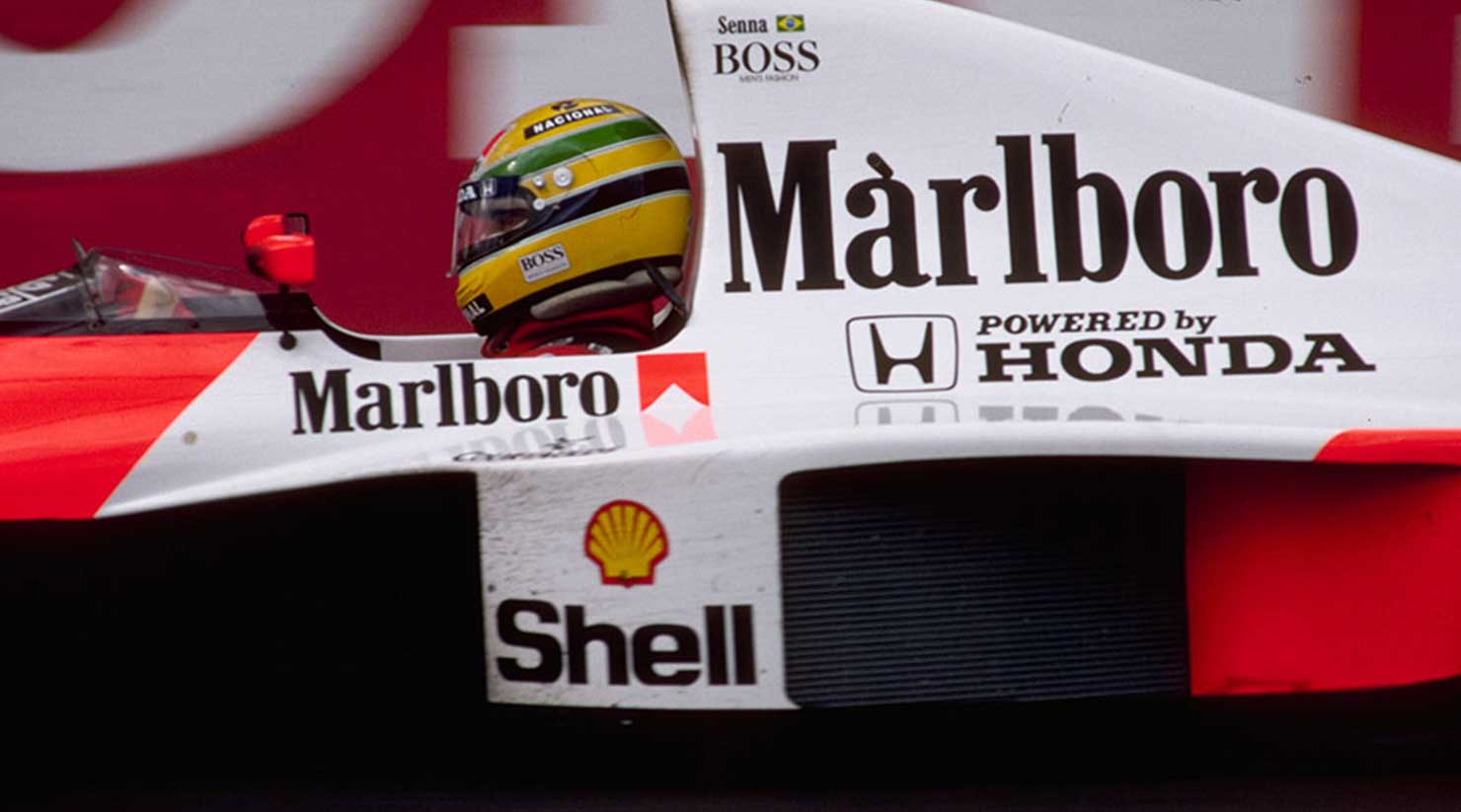
Profile
- Name
- Ayrton Senna
- Team
- Camel Team Lotus Honda(1987)
Honda Marlboro McLaren(1988-1992)
- Nationality
- Brazil
- Birth date
- March 21, 1960
Career
Born in São Paulo, Brazil, in 1960, Ayrton Senna da Silva was the eldest son of businessman and entrepreneur Milton Guirado da Silva and Neide Joanna Senna da Silva.
Senna developed an interest in motorsport at the age of four and began driving a go-kart built by his father. In July 1973, he entered his first official race and won while setting a new track record. After winning the South American Kart Championship in 1977, he competed in the World Karting Championship between 1978 and 1982, finishing runner-up in both 1979 and 1980. Although he never won the world title, his speed was exceptional, and many already regarded him as a future F1 champion.
In 1981, Senna moved to the United Kingdom to pursue a career in formula racing. He won both Formula Ford 1600 championships he entered that year, but surprisingly announced his retirement from Formula Ford and returned to Brazil. Despite pressure to join the family business, his passion for racing remained undiminished, and he returned to Britain in 1982.
That year, Senna captured both the British and European Formula Ford 2000 championships, firmly establishing himself as one of the sport’s brightest prospects.
In 1983, he stepped up to the British Formula 3 Championship, then regarded as a major pathway to F1. Senna won the title and also claimed victory at the Macau Grand Prix, winning both heats of the prestigious event.
Senna made his F1 debut with Toleman in 1984. Although several top teams had invited him to test and recognized his exceptional talent, sponsorship and contractual circumstances prevented a deal. He ultimately signed with Toleman after a vacancy became available.
Even in an uncompetitive car, Senna immediately attracted attention. At the rain-soaked Monaco Grand Prix, he charged from 13th on the grid to finish second before the race was stopped early, earning both his first podium and first fastest lap. Further podium finishes at the British and Portuguese Grands Prix helped him secure ninth place in the championship.
During the season, Senna announced a move to Lotus for 1985. However, a contractual dispute emerged because he still had two years remaining on his Toleman agreement. The matter was eventually resolved through compensation payments, although Senna was forced to miss one race.
Joining the prestigious Lotus team in 1985, Senna immediately made an impact. After securing his first pole position at the Portuguese Grand Prix, he delivered a dominant performance in torrential rain to claim his maiden F1 victory, finishing more than a minute ahead of second place.
Although results were inconsistent during the first half of the season, Senna’s speed was undeniable. He finished the year with seven pole positions and five consecutive podium finishes from the Austrian Grand Prix onward. At the Belgian Grand Prix, he seized the lead at the start and dominated the race to secure his second F1 victory. Despite frequent reliability problems, he finished fourth in the championship and outscored established teammate Elio de Angelis.
In 1986, now Lotus’s lead driver, Senna scored points in six of the opening eight races and won twice. However, recurring mechanical problems in the second half of the season undermined his title challenge. As Williams-Honda emerged as the dominant force, Senna openly expressed his desire for Lotus to secure Honda power.
That ambition became reality in 1987. Following extensive negotiations by team principal Peter Warr, Honda began supplying engines to Lotus. The team also welcomed Satoru Nakajima, Japan’s first full-time F1 driver, creating significant interest around the partnership.
Although Lotus struggled with the development of its active suspension system, Senna still delivered memorable performances. He won consecutive races at Monaco and Detroit and finished third in the British Grand Prix, although being lapped by the leading Williams Honda cars left him frustrated. Consistency helped him finish third in the championship.
During the Italian Grand Prix weekend, it was announced that Honda would supply engines to McLaren in 1988 and that Senna would join the team.
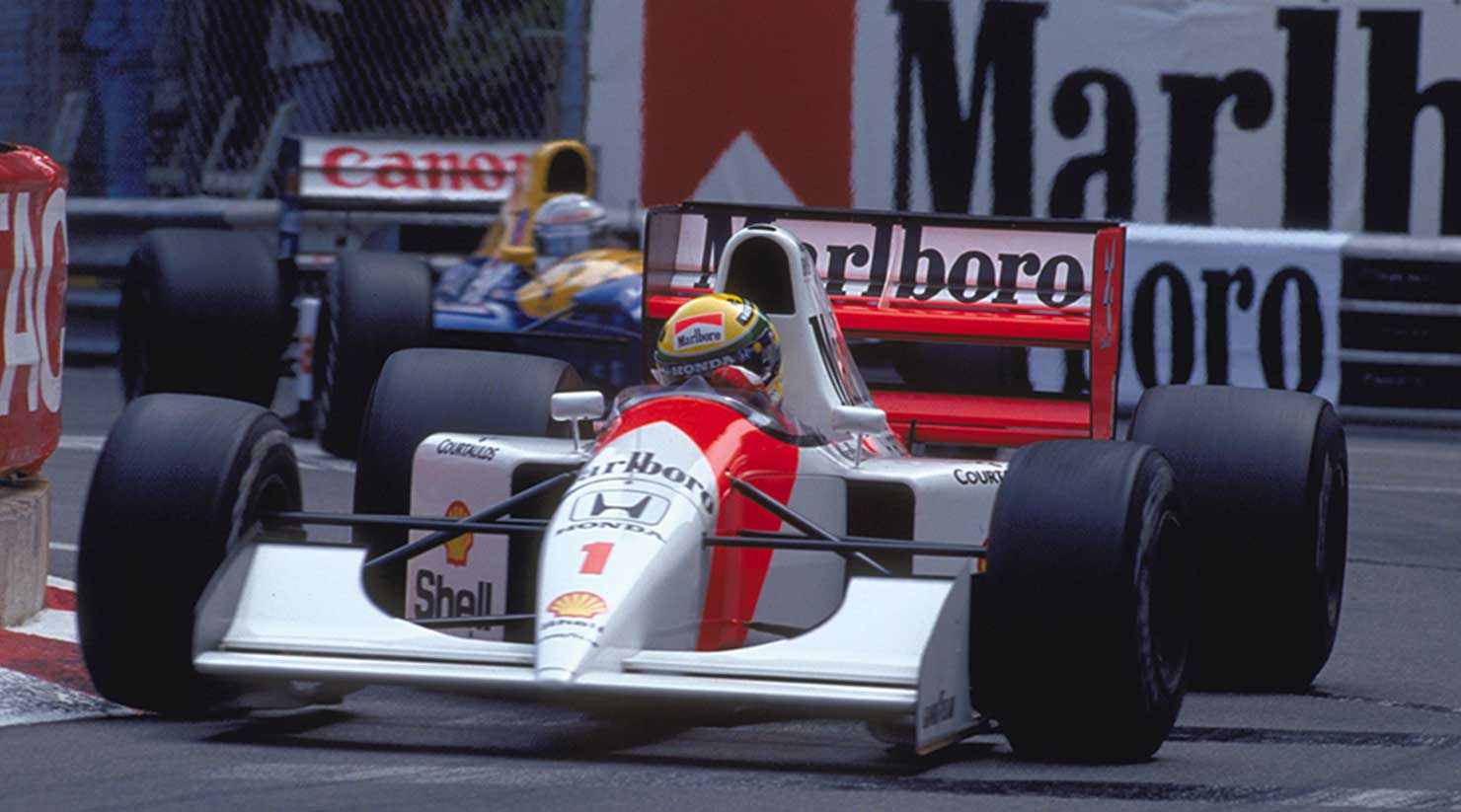
The Honda-powered McLaren MP4/4 proved dominant in 1988. Partnered with two-time World Champion Alain Prost, Senna helped McLaren Honda produce one of the greatest seasons in F1 history.
The championship quickly became a battle between the two teammates. Senna won eight races and secured his first World Championship. Prost won seven races and actually scored more points over the season, but the championship’s drop-score system awarded the title to Senna. While McLaren Honda achieved an extraordinary 15 wins from 16 races and 10 one-two finishes, the rivalry between Senna and Prost intensified and began to create deep divisions within the team.
In 1989, McLaren Honda remained the benchmark, but tensions between the two drivers escalated further. The controversy began publicly at the San Marino Grand Prix, where Prost accused Senna of breaking a pre-race agreement regarding the run to Tosa Corner.
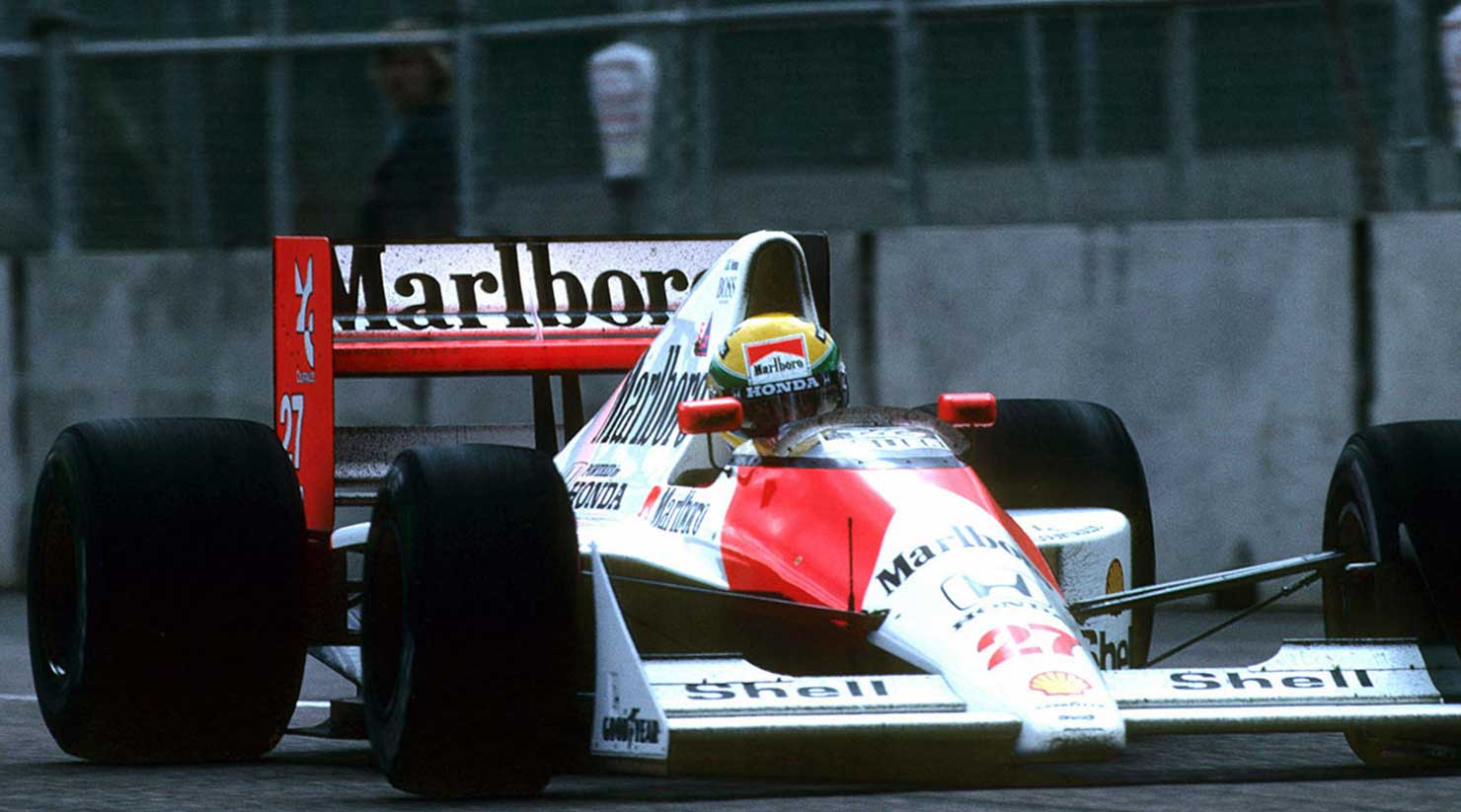
The title battle reached its climax at the Japanese Grand Prix when the pair collided at the chicane. Prost retired immediately, while Senna continued and crossed the finish line first. However, Senna was later disqualified, leading to one of the most controversial episodes in F1 history. Despite winning six races to Prost’s four, Senna lost the championship to the Frenchman, whose consistency proved decisive.
The fallout continued into 1990. Even Senna’s FIA Super Licence became the subject of controversy before being renewed in February. Prost had moved to Ferrari, while Gerhard Berger joined McLaren as Senna’s teammate.
Senna converted his exceptional qualifying pace into six victories and carried a championship advantage into the Japanese Grand Prix. Once again, the title was decided at Suzuka. This time, Senna collided with Prost at the first corner immediately after the start. Both retired, and Senna secured his second World Championship.
In 1991, Senna opened the season with a record four consecutive victories. At the Brazilian Grand Prix, he overcame severe gearbox problems to claim his first home victory in dramatic fashion.
As the season progressed, Williams became increasingly competitive. Senna ended a six-race winless streak at the Hungarian Grand Prix, shortly after the death of Honda founder Soichiro Honda. Wearing a black armband in tribute, Senna achieved a pole-to-flag victory.
A win in Belgium followed, but Williams responded with three consecutive victories. Once again, the championship was settled at Suzuka. Nigel Mansell retired early, handing Senna his third World Championship. Leading comfortably on the final lap, Senna slowed and allowed teammate Berger to take the victory while he finished second. With seven wins and 14 points-scoring finishes, Senna successfully defended his title.
F1 entered a new technological era in 1992 as Williams dominated with advanced electronic systems. Senna fought hard and ended Mansell’s five-race winning streak at Monaco, securing his fourth consecutive Monaco victory. Nevertheless, Williams’ superiority was overwhelming, and Senna finished fourth in the championship with three wins.
At the Italian Grand Prix, Honda announced that it would withdraw from F1 at the end of the season. Disappointed by the decision, Senna explored alternative opportunities but ultimately remained with McLaren.
In 1993, McLaren’s competitiveness declined with its customer Ford engine, but Senna continued to produce remarkable performances. He won in Brazil, delivered his legendary wet-weather victory at the European Grand Prix at Donington Park, and claimed a fifth consecutive Monaco victory—his sixth overall at the circuit, a record that still stands today.
Although his title hopes ended with retirement at the Italian Grand Prix, Senna finished the season strongly with victories in Japan and Australia. He ended the year second in the championship and brought his six-year McLaren career to a close.
In 1994, Senna moved to Williams. Although Williams had dominated F1 in the preceding seasons, new regulations banning technologies such as active suspension and traction control left the team facing an uncertain start to the year, while development of its new car was delayed.
Senna secured pole position for both the opening round in Brazil and the second round, the Pacific Grand Prix at Aida. However, he retired from both races, leaving him without a single point after the first two rounds of the season—the first time this had happened since his F1 debut.
At the San Marino Grand Prix, Senna started from pole position and led the race until a safety car period caused by an accident further back in the field.
On Lap 7, shortly after the restart, Senna left the circuit at the high-speed Tamburello corner and struck the concrete wall. He suffered catastrophic head injuries and was pronounced dead approximately four hours later.
The loss of Ayrton Senna sent shockwaves throughout the world. Honda mourned the passing of its former champion and established a memorial at its Aoyama headquarters. Thousands of Japanese fans came to pay their respects, forming long lines outside the building. The scenes remain one of the most enduring memories of the deep connection between Senna, Honda, and motorsport fans around the world.
Records
Profile
- Name
- Ayrton Senna da Silva
- Birth date
- March 21, 1960
- Birthplace
- Sao Paulo, Brazil
- Weight
- 70kg
- Height
- 174cm
Race Wins

-
Total
0
-
Honda
0
Pole Positions

-
Total
0
-
Honda
0
Races

-
Total
0
-
Honda
0
Podiums

-
Total
0
-
Honda
0
Retirements

-
Total
0
-
Honda
0
Laps Raced ※

-
Total
0
-
Honda
0
Laps Led ※

-
Total
0
-
Honda
0
* Laps for disqualified races not counted. 1988 Brazilian Grand Prix results are counted as Senna officially retired from the race (according to Formula 1.com)