Circuit info
- Circuit Length
- 5.543 km
- First Grand Prix
- 1999
Location
- Address
- Jalan Pekeliling, 64000 Sepang, Selangor, Malaysia
- Google Maps
History of the Circuit
In the 1990s, the Sepang International Circuit was built to host Formula One as part of the modernization program strongly promoted by Malaysian Prime Minister Mahathir bin Mohamad. Located close to Kuala Lumpur International Airport, which was also newly built on a large scale as part of the modernization project, the circuit offers convenient access from the capital, Kuala Lumpur.
The circuit was designed by Hermann Tilke, who would go on to become renowned as a designer of modern racing circuits in the 2000s. The Sepang International Circuit was the project that established his reputation and marked the beginning of the Tilke era.
Construction began in November 1997 and progressed rapidly, with the circuit officially opening in March 1999. The first F1 Malaysian GP was held there in October of the same year. A pioneer of modern racing circuits, the Sepang International Circuit has a capacity of 130,000 spectators. It features grandstands overlooking the long main straight and a “natural stadium” layout that makes use of the surrounding terrain, as well as extensive pit and hospitality facilities. The circuit has been highly regarded for its convenience and comfort for both spectators and participants. At the same time, it is also known for the challenging tropical climate, with high temperatures, high humidity and frequent heavy showers.
The F1 Malaysian GP was held every year from 1999 to 2017, but the event was discontinued due to factors including rising hosting fees and declining attendance. In 2026, the Bahrain GP, which had been postponed due to social conditions, is scheduled to be held at the Sepang International Circuit in October, attracting attention as a new approach to hosting an F1 race.
Circuit characteristics
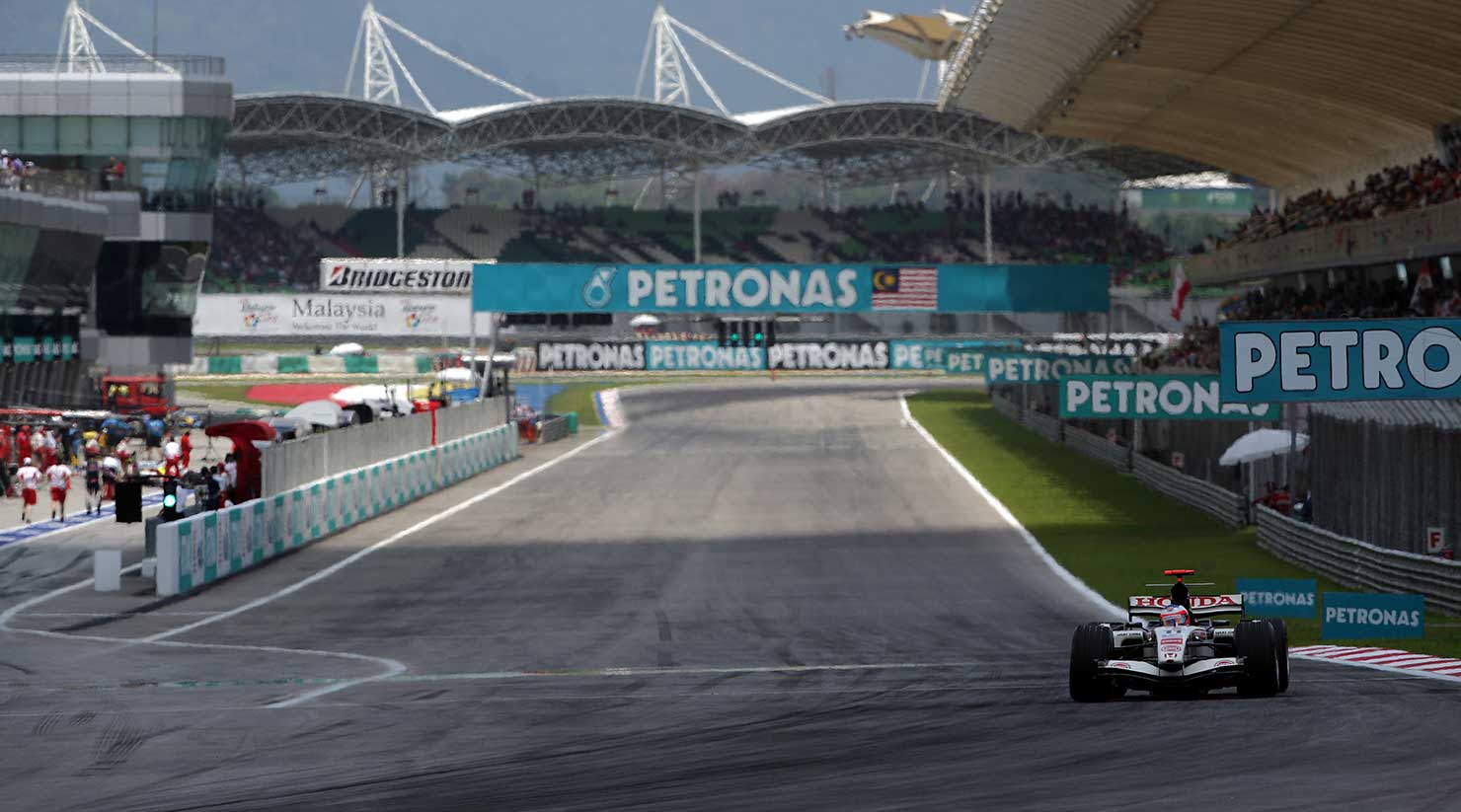
The Sepang International Circuit is a well-balanced course featuring two long straights and a wide variety of corners. Its layout combines high-speed corners, medium-speed S-bends and hairpins, and it is highly regarded as a circuit suited to evaluating the overall performance of a car. It is also known as the venue for the annual winter tests conducted by Japan’s SUPER GT series.
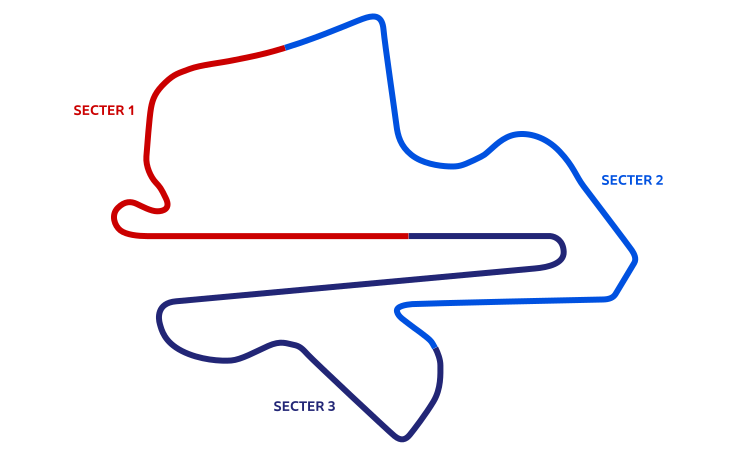
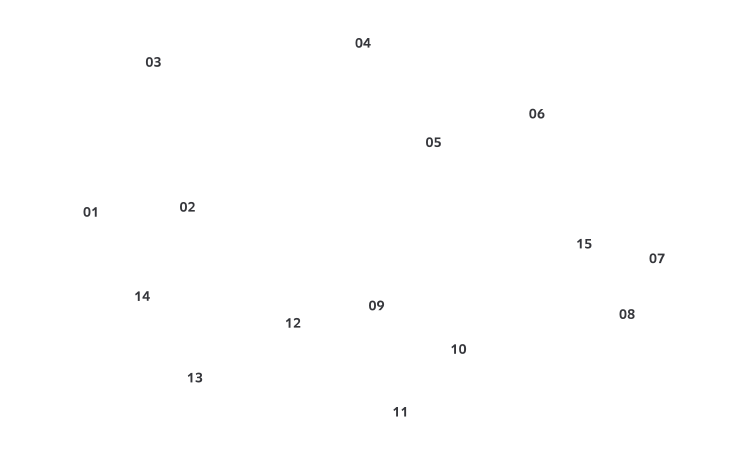
The main straight is approximately 900 m long, with 680 m from the starting line, making the battle for position after the start one of the highlights. Turns 1 and 2 form a tight S-shaped complex that is one of Sepang’s defining features, with the entry into Turn 1 providing the circuit’s main overtaking opportunity. Turn 3 is a high-speed right-hander taken almost flat out, while Turn 4, known as Langkawi, is an almost right-angled right-hander that requires heavy deceleration. Strong acceleration out of the corner is also important for carrying speed into the high-speed section that follows.
Turns 5 and 6 form a high-speed S-section, while Turns 7 and 8 form a right-hand complex. This section involves high-speed cornering and tests the car’s balance and aerodynamic performance. Turn 9 is an uphill hairpin where braking performance and acceleration from low speed are important.
Turns 10 through 13 form a medium-speed complex that requires rhythmic driving, while the nearly flat-out Turns 12 and 13 demand well-balanced aerodynamic performance. At Turn 14, minimizing time loss and achieving strong acceleration on exit are important for maximizing speed along the back straight. The same applies to the tight Turn 15 connecting the back straight with the main straight. Like Turn 1, Turn 15 is an overtaking opportunity, but with the main straight immediately following, there is also a high possibility of being passed back. The battles along these two straights are one of the circuit’s major highlights.

Memorable battles
Honda returned to F1 competition in 2000 and initially faced a difficult period together with BAR. By 2004, however, advances in technology and further development of the car had produced strong performance from the testing stage, raising expectations for good results.
At the 2004 Malaysian GP, Round 2, held at the Sepang International Circuit in March, Jenson Button produced a strong race from sixth on the grid to finish third. It was BAR Honda’s first podium in three years and Button’s first podium finish in his 68th F1 race.
Takuma Sato, who became a regular BAR Honda driver that year, ran off the track early in the race and dropped to 18th. From there, however, he made an impressive recovery through clever tire strategy and aggressive driving. By the closing stages, he had climbed to eighth and appeared certain to finish in the points, underlining the team’s strong performance, but an engine problem forced him to stop and narrowly miss out on points. Nevertheless, Sato’s impressive charge through the field, together with Button’s achievement, made it a memorable race.
Beginning with the strong result at the Malaysian GP, BAR Honda maintained its competitive form throughout the season. Although the team did not score a victory, it made significant progress to finish second in the Constructors’ Championship.
- Fastest pole position lap
- 1 min 30.076s
Lewis Hamilton (Mercedes), 2017
- Fastest Honda qualifying lap
- 1 min 31.582s
Stoffel Vandoorne (McLaren), 2017
- Fastest race lap
- 1 min 34.080s
Sebastian Vettel (Ferrari), 2017
- Fastest Honda race lap
- 1 min 34.967s
Jenson Button (BAR), 2004
*Data based on the 5.543 km circuit layout.
Honda Records
Explore Honda’s history of challenges and achievements across iconic circuits,
backed by race performance data.